Key Takeaways
If you don't hustle, you don't eat: grinding is non-negotiable
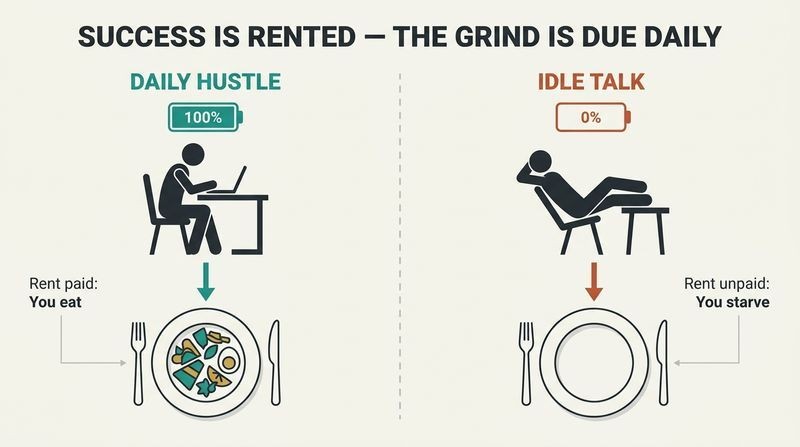
Hustle is the engine, not an accessory. Jimmy Phan's central argument is blunt: you can dream for free and borrow hope, but only relentless effort (gained "off the muscle") turns vision into a paycheck. He frames success as rented, never owned, with rent due every single day. There are no handouts.
Stop counting wins and losses. One of his sharpest reframes: if you have time to whine or pat yourself on the back, you have too much idle time. Save the celebration for when you're sitting at the top. Until then, the work continues. The book is essentially 48 short maxims orbiting this one demand: outwork everyone, every day, without an exit clause, because effort is the one variable fully within your control.
What's striking is how Phan strips motivation down to a single survival metaphor borrowed from street economics. The framing echoes Cal Newport's "deep work" and Angela Duckworth's research on grit, where sustained effort predicts achievement more than raw talent. Yet the "rent is due daily" model has a shadow side: hustle culture correlates with burnout, and modern productivity research suggests rest and recovery often drive performance more than relentless grinding. Phan's strength is urgency and clarity; the missing nuance is that effort without strategy or recovery can become a treadmill. The maxim works best as a corrective for the chronically passive, less so for the already-overextended.
Your starting line never determines your finish line
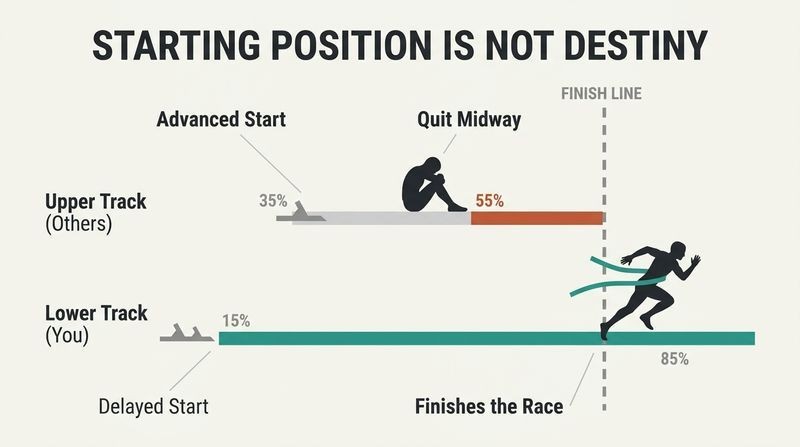
Where you begin is irrelevant. Phan opens the book insisting your origin story has no claim on your future. A slow start is not a verdict. He urges readers to delete the word "quit" from their vocabulary and to stop staring backward at circumstances that don't belong in what comes next. Everyone's clock starts at a different time, so comparison is wasted energy.
Not everyone who starts will finish. He pairs this with a warning about "day ones," the people who took the first step alongside you. Some are not conditioned to go the distance, and expecting them all to cross the finish line sets you up for disappointment. Life is a marathon, not a sprint. Focus inward, run your own race, and let the timeline take care of itself.
This insight aligns with psychologist Carol Dweck's growth mindset: outcomes are shaped by effort and adaptation, not fixed starting conditions. Phan's "nothing behind you belongs in your future" is a folk version of narrative therapy, which helps people rewrite limiting origin stories. The caution about "day ones" drifting away is emotionally honest and underdiscussed in success literature. One tension worth naming: structural reality matters. Starting capital, networks, and circumstance genuinely affect odds, and pretending otherwise can shade into toxic positivity. The most useful reading treats this as a psychological stance (don't let your start paralyze you) rather than a literal claim that circumstances are irrelevant.
No risk, no reward: major success demands major sacrifice
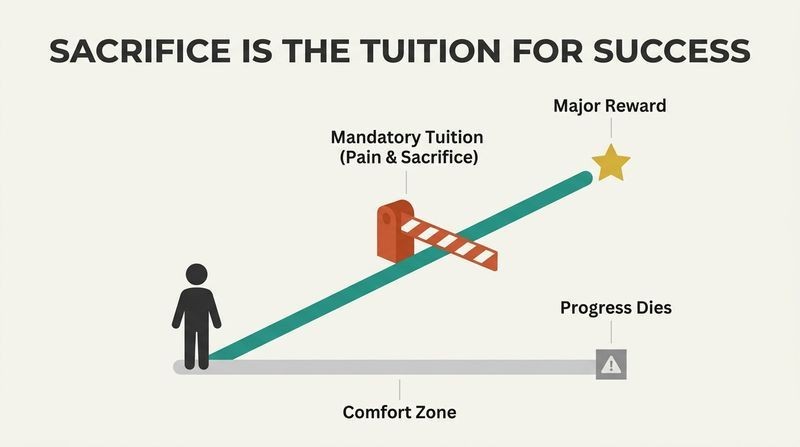
Pain is the tuition for growth. Phan's "no pain, no gain" is literal here: hardship builds the character that makes you distinct, and you cannot appreciate winning if you've never tasted loss. He argues discomfort should propel you rather than derail you.
Calculate the risk, then accept the possible loss. If there's no risk, there's no reward. Wanting big outcomes means being willing to lose in pursuit of the win. He extends this into a cost principle: you must pay for the lifestyle you want, because nothing worth having comes cheap or free. The framing positions sacrifice not as misfortune but as the entry fee. Comfort, in his view, is where progress dies, so he tells readers to run toward challenges instead of away from them and never to settle into a plateau.
The risk-reward logic mirrors finance's fundamental principle that higher expected returns require accepting higher variance. Phan's emphasis on "calculated" risk is important and easy to miss: this is not reckless gambling but informed exposure, closer to Nassim Taleb's idea of intelligent risk-taking where you cap your downside. The "no pain, no gain" claim finds support in post-traumatic growth research, which shows adversity can strengthen resilience. The counterweight: not all pain is productive, and survivorship bias inflates these maxims because we rarely hear from those whose calculated risks simply failed. Sacrifice is necessary but not sufficient for success.
Failure is a moment in time, never a life sentence
Losing is data, not destiny. Phan reframes failure as temporary, almost as if it isn't real. You may lose more battles than you win in a given year, but quitting is the only true ending. As long as you're not moving backward, you're learning something that betters you.
Getting knocked down isn't your fault; staying down is. This is his sharpest distinction. He grants that life will floor you through no fault of your own, but choosing to remain on the ground is entirely on you. He couples this with a refusal to complain: grumbling pays no bills, and everyone takes losses, so the productive response is to make more rather than mourn. Losses, in his framing, are the raw material that teaches you how to win.
This separation of the knockdown (often outside your control) from the choice to rise (always within it) is psychologically precise and maps onto Stoic philosophy's dichotomy of control, articulated by Epictetus. The "failure isn't final" stance also reflects what resilience researchers call explanatory style: people who frame setbacks as temporary and specific rather than permanent and pervasive recover faster, per Martin Seligman's work on learned optimism. The "don't complain, make more" line is brutally pragmatic but worth tempering. Sometimes complaint is signal, identifying systems that need fixing. Silencing all grievance can mean ignoring legitimate problems that effort alone won't solve.
If you can't picture it, you can't build it
Success is engineered in the mind first. Phan insists every achievement begins as a vision in your brain. You must know precisely what you want from life, and if you can't visualize it, it won't materialize. He notes that history's most successful people were often dismissed as crazy because no one else could see what they saw.
Belief precedes the move. His blunt corollary: you miss every shot you don't take. Fear of moving guarantees you make no money, no change, and no difference. Only you can stop yourself, so self-belief is the prerequisite for action. He tells readers to keep their vision in front of them at all times and act on conviction rather than waiting for external validation, because the crowd rarely endorses an idea before it has proof.
Phan intuitively combines two well-studied mechanisms: visualization and self-efficacy. Sports psychology confirms mental rehearsal activates many of the same neural pathways as physical practice, improving performance. Albert Bandura's research on self-efficacy shows belief in one's capability is a strong predictor of whether people attempt and persist at difficult tasks. The "miss every shot you don't take" framing is a behavioral nudge against loss aversion, our tendency to overweight potential losses and stay frozen. One refinement worth adding: visualization works best when paired with "process" imagery (seeing yourself doing the steps) rather than pure "outcome" fantasy, which research suggests can actually sap motivation.
Be the next you, not the next someone else
Authenticity is your only moat. Phan urges readers to reject the urge to become "the next" anyone and instead create from their own heart. Following the crowd cheats the world of your unique contribution, and ideas don't expire but people do, so act on yours now.
People buy you, not just your product. His business reframe: don't shrink to fit in. Sell yourself without selling your soul. When you operate from genuine gifts, competition becomes irrelevant, because no one can replicate you. He even reframes "competition" as a backhanded compliment to a rival; the only real opponent is a negative mindset. He also rejects copycat thinking: there's more than one blueprint to success, so study existing models, then improve on them and forge your own road rather than blindly imitating.
This echoes a now-dominant theme in personal branding and creator economics: differentiation through authenticity. Marketing scholars note that in attention-saturated markets, parasocial trust (audiences feeling they know the person) often outweighs product features, which validates "people buy you." Phan's "no competition when you're real" resembles the Blue Ocean Strategy concept of escaping competition by creating uncontested market space through uniqueness. The honest caveat: authenticity alone doesn't guarantee demand. The market must actually want what your genuine self offers. "Be you" works when your distinctive gift meets a real need, which connects directly to his separate insistence that you understand what the world needs from you.
Let your haters' noise become your applause and fuel
Criticism is disguised admiration. Phan reframes hostility as a backhanded form of fandom: the loudest critics are often the most envious, secretly studying you. Rather than losing sleep over hate, he advises getting rest so you can wake up and give detractors fresh reasons to seethe through your continued success.
Convert every negative into a positive. He plays on the math: two negatives don't make a positive, except in the hustle, where they do. Negative people toughen you, negative situations make you wiser, and the whole game tilts in your favor once you shift your mindset to treat obstacles as inputs. The reframe is a discipline, not a feeling: you decide to extract advantage from adversity, ignoring people who drain you and enduring circumstances that teach you.
This is cognitive reappraisal, one of the most evidence-backed emotion-regulation strategies in psychology, where reinterpreting a stressor changes its emotional impact. Phan's "haters are fans" framing also has a kernel of social truth: attention, even hostile attention, often signals relevance, and indifference is the real threat to anyone building something. The risk in this maxim is overuse. Treating all criticism as envy can become a defense mechanism that filters out legitimate, useful feedback. The wisest application distinguishes between envy (ignore) and critique (extract the signal), but Phan's blanket reframe is most valuable for those paralyzed by others' opinions.
Vet your circle ruthlessly: trust is earned, weak links break chains
Build a power circle of irreplaceable people. Phan's relationship doctrine is defensive and selective. Real friends are few, so expect nothing and appreciate everything. Trust must be earned through testing, never granted freely, or you'll be burned. He advises assembling a circle where everyone brings strength and can lift others in hard times, because weak links break chains.
Loyalty outranks blood. Several laws hammer this:
1. Read energy; people reveal who they are without words.
2. Cut "liabilities," the dishonest, by loving them from a distance.
3. Blood relation doesn't guarantee family; respect and loyalty define it.
4. A leader earns a team by being willing to get their own hands dirty.
He's clear that not everyone deserves a seat, and protecting your inner circle is a survival skill, not coldness.
Phan's social model resembles what sociologists call "strong ties" management, curating a small, high-trust network rather than maximizing connections. The "weak links break chains" principle aligns with research showing peer groups powerfully shape behavior and outcomes; Jim Rohn's famous claim that we become the average of our five closest associates captures the same idea. "Loyalty above blood" is a striking departure from kinship-based obligation and resonates with chosen-family concepts in psychology. The shadow risk is hypervigilance: treating every newcomer as a test subject can breed isolation and corrode the very trust that makes collaboration generative. Healthy networks balance discernment with openness to new, unproven relationships.
Discipline, determination, and dedication are one inseparable engine
Three D's that compound. Phan names his governing trio: discipline gets you to do the work, determination carries you through hard times, and dedication sustains success once you have it. None works alone; together they're the reason people win and keep winning.
Mastery is a moving target. He extends this into craft: study the game and improve every day because someone is always aiming for your spot. Perfection isn't attainable, but the pursuit is worth it. He insists you're never "there," because what got you to this level won't get you to the next, so daily learning is mandatory. Wisdom, in his framing, is a form of strength, and a brain not fed knowledge daily is effectively "dead." The hustle and the studying are the same act repeated relentlessly.
The alliterative trio is memorable but the substance maps onto serious research. Duckworth's grit construct explicitly combines passion (dedication) with perseverance (determination), while discipline connects to the self-regulation studies that predict long-term achievement better than IQ. Phan's "what got you here won't get you there" echoes Marshall Goldsmith's book of that title, a staple of executive coaching about why past strengths become future ceilings. The "never there" stance reflects the deliberate-practice literature from Anders Ericsson: expertise requires continuous, effortful refinement at the edge of ability, not mere repetition. The framing's value is in fusing character traits with a learning loop rather than treating motivation as a one-time spark.
One income stream is a trap: become an irreplaceable asset
Diversify your money, delay your shine. Phan rejects single-stream income, urging readers to tap multiple wells of wealth and build something that outlasts them across generations. He pairs this with a reinvestment rule: you can't get rich without reinvesting, so sacrifice flashy spending now (don't go broke trying to impress people who aren't even rooting for you) and play the long game until you hit your goal.
Be an asset, not just an appetite. His wordplay "Ass-SET" lands a real point: if you bring irreplaceable value to the table, your seat is secure, but if you only show up to eat, you'll lose your spot. He also stresses quality over quantity, because no one questions your prices when they can't question your product. Value creation, not consumption, earns longevity.
The multiple-income-streams advice has become financial orthodoxy, often attributed to studies suggesting wealthy individuals cultivate several revenue sources, and it aligns with portfolio theory's logic of reducing dependence on any single point of failure. The reinvestment discipline echoes the delayed-gratification findings from the marshmallow experiment, where the capacity to defer reward predicts long-term outcomes. "Be an asset" is essentially a call to build rare, valuable skills, which mirrors Cal Newport's "career capital" thesis that mastery, not passion, creates leverage. One practical caveat Phan understates: spreading across too many streams prematurely can fragment focus. Early on, depth in one domain often beats shallow diversification.
Keep your code: a good name outvalues gold, and money isn't your master
Integrity is the long-term asset. Phan warns that cheating people only boomerangs back on you. Honesty builds the trust that keeps a name worth more than gold. He frames an internal "code," the unwritten laws already in your heart, and insists that violating it gets you exposed, while honoring it lets success find you.
Money is a tool, not a god. In one of his most counterintuitive laws for a hustle book, he argues that if all you have is money, you're broke. Money rules nations but shouldn't rule you. Chase the things money can't buy, and live by your code rather than your gold. "Win from within" by letting your morals guide you, because integrity separates the real from the fake, and coming from a good place is what lets you finish the race.
It's notable that a book obsessed with grinding for money repeatedly subordinates money to character. This tension resolves into a coherent philosophy: reputation is the compounding asset that makes future deals possible, an idea game theory captures through repeated games, where cooperation and honesty pay off precisely because interactions recur. "A good name is worth more than gold" finds empirical backing in trust economics, where reputational capital lowers transaction costs and unlocks opportunity. Phan's "if all you have is money, you're broke" echoes Viktor Frankl's argument that meaning, not material success, sustains人 well-being. The maxim guards against the hollow achievement that plagues many who reach financial goals without an internal compass.
Give back from the heart, or you didn't really give
The world rewards givers. Phan closes his framework on generosity. Focus on being a blessing rather than begging for blessings, because what you send out returns with interest. Giving, in his view, is "the true meaning of living," reframing generosity not as charity but as a wealth-building loop.
Pay forward what you received. He reminds readers that at some point, someone helped each of us; no one "jumped off the porch with a torch" entirely alone, and every boss was once an employee. The obligation is to help the next person in line, because you never know how your contribution might change their trajectory. His one condition: give genuinely, from the heart, because a grudging gift isn't given, it's taken from you. Generosity must be voluntary and sincere to count.
The "give before you take" ethic aligns squarely with Adam Grant's research in Givers and Takers, which found that strategic givers often rise to the top of success distributions precisely because they build goodwill and dense networks of reciprocity. The neuroscience of generosity backs the "true meaning of living" claim: giving activates reward circuitry, and prosocial spending reliably increases well-being more than spending on oneself. Phan's condition that giving must be heartfelt anticipates the burnout that selfless givers risk, which Grant identifies as the failure mode of "otherish" generosity gone wrong. Ending a hustle manifesto on contribution reframes the entire project: the grind isn't the destination, it's what equips you to lift others.
Analysis
48 Laws of Hustle is best understood as a pocket-sized motivational catechism rather than a developed argument. Jimmy Phan (writing as Jimmy Boi) compresses a worldview into 48 aphorisms, each a paragraph or less, drawn from street wisdom, faith, and entrepreneurial striving. The title nods to Robert Greene's 48 Laws of Power, but the resemblance is mostly structural; where Greene catalogs Machiavellian manipulation, Phan offers earnest self-motivation rooted in personal grit and moral code. The book's genre is pure inspirational self-help, and its intellectual ancestry runs through Napoleon Hill, Eric Thomas, and hip-hop's bootstrap mythology.
The difficulty in summarizing the work is its deliberate simplicity and repetition. Many laws restate the same handful of ideas (persist, sacrifice, stay true, protect your circle) in slightly different metaphors. Distillation actually improves the material by clustering these into coherent themes the author never explicitly organizes. The real value sits in roughly a dozen durable principles around persistence, mindset, authentic differentiation, reciprocal generosity, and the surprising subordination of money to character.
What distinguishes Phan's contribution is tonal authenticity and an unusual moral throughline for a hustle book. He repeatedly pulls the reader back from greed toward integrity, loyalty, and giving, insisting that a good name and an internal code matter more than gold. That tension (relentless grind paired with moral restraint) is the book's most interesting feature and its saving grace against the genre's tendency toward hollow striving.
The weaknesses are equally clear: zero empirical support, heavy survivorship bias, and an individualist framing that underplays structural constraints. The advice is also occasionally contradictory (run your own race, but vet everyone ruthlessly). Still, as a motivational defibrillator for someone stuck in passivity, the book's clarity and urgency have genuine utility. It works as a daily reminder, not a strategy manual, and Phan never pretends otherwise.
Review Summary
The reviews for 48 Laws of Hustle are overwhelmingly positive, with readers praising its inspirational and motivational content. Many find it a quick, insightful read that covers various aspects of life beyond just money-making. Readers appreciate its precision and straightforward approach, with some incorporating it into their daily routines. The book's concise nature is seen as a strength, allowing for easy application of its principles. Overall, reviewers find the book's laws accurate and relevant to everyday life, making it a valuable resource for personal growth and motivation.
People Also Read

Glossary
Hustle
Relentless daily effort to succeedPhan's core concept: the non-optional, muscle-powered work that turns dreams and hope into income and results. He treats hustle as a daily obligation, framing success as "rented" rather than owned, with the rent due every day. It is distinct from passive wishing; only sustained action qualifies.
Power Circle
Small group of strong alliesA deliberately curated inner team in which every member contributes real strength and can lift others during hard times. Built on the principle that weak links break chains, it requires earned trust, vetting newcomers, and a leader willing to get their hands dirty rather than passively assembling acquaintances.
Day Ones
People present from your startThe individuals who took the first steps of your journey alongside you. Phan warns that not all of them are "conditioned to win," so some will not last until the end. The term reminds readers to accept that early companions may drift away as ambitions grow.
Ass-SET
Be irreplaceable, not just consumingPhan's wordplay distinguishing an asset from a freeloader. If you bring irreplaceable value to the table, your seat is secure ("if you're an asset, you're set"); if you only show up to consume ("come to eat"), you lose your spot. A call to create value rather than just take it.
No Lie-abilities
Cut dishonest people loosePhan's pun on liabilities, instructing readers to remove dishonest people from their lives. Once you recognize someone's lies, you should "love from a distance" rather than keep trusting them. Ignoring the warning signs, he argues, leads to a price you cannot afford to pay.
The Code
Internal unwritten moral lawThe set of unwritten principles Phan says already live in your heart, governing honor, loyalty, and integrity. Violating the code leads to exposure and consequence ("if you violate, life will demonstrate"), while sticking to it allows success to find you. It functions as an internal moral compass for the hustler.
Download PDF
Download EPUB
.epub digital book format is ideal for reading ebooks on phones, tablets, and e-readers.








































