

Key Takeaways
Your focused attention is a superpower that magnetizes your reality
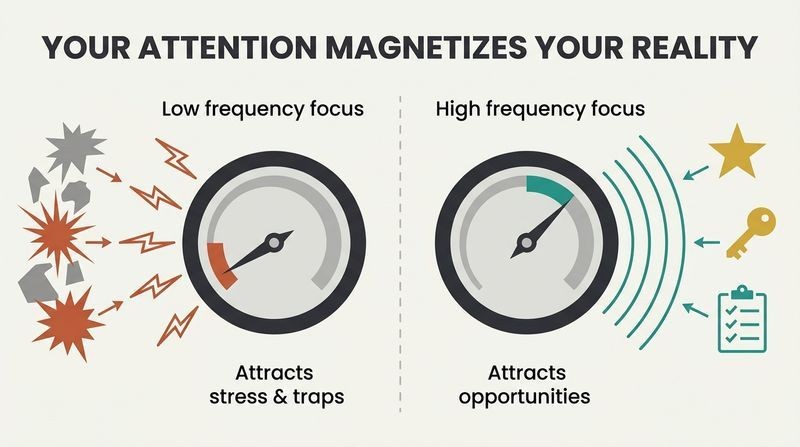
Attention is the engine of manifestation. Campbell's central claim is that whatever you concentrate your attention on grows and gets pulled toward you. He frames the world as vibrating energy, and you as a radio receiver that tunes to a frequency. Set your dial to a frequency, and the Universe delivers matching people, circumstances, and things.
Attention is broader than thought. It includes what you think about, the actions you take, and the environment you place yourself in. Your current life, he argues, is precise evidence of where your attention has been flowing. The uncomfortable corollary: if you feel trapped, your own attention built that trap. The empowering flip side is that the same power can retune you toward what he calls your heart's desire.
This is the law of attraction rebranded with an energy-frequency metaphor. The scientific framing (frequencies, vibration) is metaphorical rather than physical, and readers should hold it as such. Yet the psychological core has real support: selective attention, confirmation bias, and the reticular activating system genuinely shape what we notice and pursue. Cognitive behavioral therapy rests on a milder version of this claim, that where you direct attention reshapes emotional reality. The danger lies in the strong version, which can slide into blaming victims for circumstances beyond their control. The useful version treats attention as a lever you can deliberately pull, not a mystical vending machine.
Treat your deepest desires as assignments, not selfish fantasies
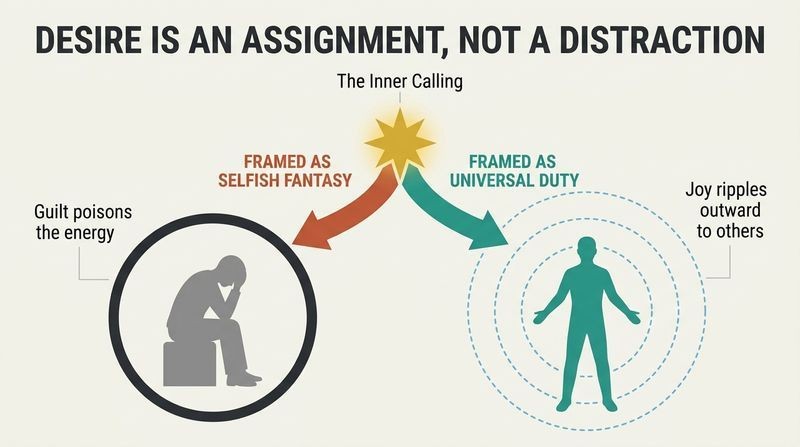
Desire is a message, not a distraction. Campbell insists you would not feel a genuine longing unless you had the capacity to make it real. Dreams, in his framing, are instructions from the Universe about what you incarnated to create. This reframes ambition from something to feel guilty about into something close to a duty.
Guilt poisons the pursuit. He argues that helping others from obligation only multiplies guilty energy in your life. Chasing your dream with joy, by contrast, radiates that joy outward. So he asks a single diagnostic question: what makes you come alive? Whatever that is deserves your full attention regardless of whether it looks practical. Even a seemingly selfish dream, he claims, produces positive ripples you cannot yet see.
The anti-guilt stance echoes Abraham Maslow's self-actualization and the aphorism about securing your own oxygen mask first. Positive psychology backs part of this: intrinsic goals (growth, connection, contribution) predict wellbeing better than extrinsic ones (money, status, image). But Campbell collapses an important distinction by treating every strong desire as divinely sanctioned. Addictions, revenge, and consuming envy are also strong desires, and few would call them assignments from the cosmos. A sharper version would test desires against whether they enlarge life or shrink it. Still, for chronically self-sacrificing readers who defer their own aspirations indefinitely, this permission slip has genuine therapeutic value.
Turn and face fear with curiosity; running is what harms you
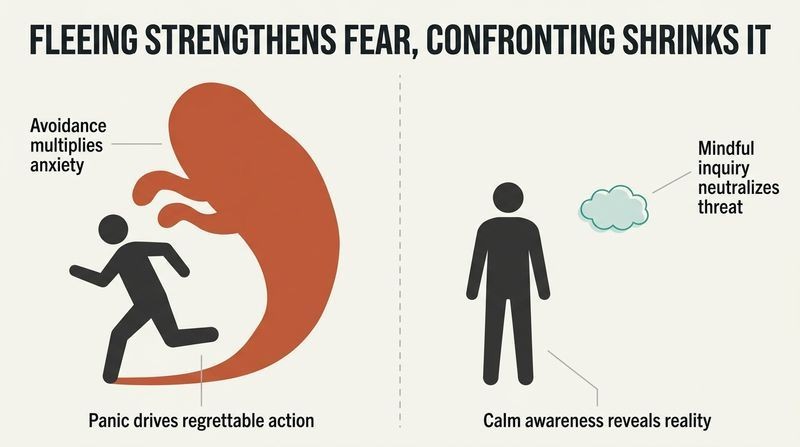
Fear is harmless when confronted. Campbell's counterintuitive claim is that fear itself never injures anyone. Injury comes from fleeing it, when panic drives regrettable action. Treat fear like a monster that shrinks the moment you look it in the eye. His practical method is bodily inquiry: notice where the fear sits, how you know it is there, whether it lingers or passes.
Fear is a recurring messenger. Whatever keeps reappearing in your life (a thought, a person, a circumstance) is knocking for your attention because something wants healing. Suppressed fear grows louder until you stop ignoring it. He reframes fear as the necessary contrast that motivates you to leave the life you were born into and pursue something greater. Without it, you would simply settle.
The turn-toward-fear practice aligns closely with evidence-based therapy. Exposure therapy works precisely because avoidance strengthens fear while approach extinguishes it. Acceptance and Commitment Therapy similarly teaches making room for anxiety rather than fighting it. Campbell's somatic focus (locate the fear in the body) parallels Peter Levine's trauma work and Eugene Gendlin's Focusing. Where the book overreaches is the blanket claim that fear cannot harm you. Fear responses evolved to prevent genuine harm, and some fears are accurate signals warranting action, not merely curiosity. The wisdom is in discernment: befriend the fear that guards a growth edge, but heed the fear that flags a real cliff.
Balance present gratitude with future excitement, or manifestation stalls
Two extremes both sabotage you. Campbell describes a tightrope. Focus only on your glorious future while resenting your present, and you reinforce present-moment unhappiness. Focus only on the present, and you attract more of exactly what you have (fine if you love it, limiting if you do not). The target state is a single point stretched to infinity: delighted now, excited for what comes next.
Gratitude must be genuine. Forced thankfulness fools people but not the Universe, which responds to authentic energy. If you are angry, be angry; do not paper over it. Instead find something small and real to appreciate, like sunlight on your face or a warm shower. Energy makes no distinction between small and large sources, so minor gratitude ignites the same frequency as major joy.
The insistence on authentic rather than performative gratitude is the book's most psychologically sound move. Research on gratitude interventions (Emmons and McCullough) shows real wellbeing gains, but studies on toxic positivity and forced affect suggest suppression backfires, raising physiological stress. Campbell's small-source insight anticipates savoring research, which finds that attending to minor pleasures reliably lifts mood. The present-and-future balance also resembles the tension in goal-setting theory between contentment and aspiration. One nuance worth adding: gratitude and ambition can coexist because they operate on different objects. You can be grateful for your health while striving for a career change, without the internal contradiction the book sometimes implies.
Manifest from being, not doing; the state precedes the action
Being comes before doing. Campbell's core method rejects grind culture. He argues you cannot manifest a dream life through discipline and sacrifice, because stressed, striving energy attracts more of the same. If you have to work hard to get something, you will work hard to keep it. Instead, occupy the frequency of your desire first, and inspired action follows naturally.
Surrender the how. He tells readers to hand the mechanics over to the Universe and trust intuitive impulses in each moment. Busy calendars are fine, he concedes, as long as the doing flows from the right state rather than reinforcing an anxious one. The practical instruction: pause when heavy emotions arise, breathe into your heart, and let your frequency rise before you act.
This inverts the conventional productivity gospel and lands close to Taoist wu wei (effortless action) and the flow state described by Mihaly Csikszentmihalyi, where absorption replaces strain. There is also an echo of the being-doing-having reversal common in coaching. The obvious critique: most tangible achievement demands sustained, sometimes uncomfortable effort, and pure being rarely ships a product or builds a skill. Yet the psychological kernel is defensible. Emotional state shapes decision quality, and acting from panic or resentment often produces worse outcomes than acting from calm. Read charitably, this is about regulating your internal state first, not abandoning effort altogether.
Feel every emotion fully; suppression is what makes them dangerous
Emotions only turn destructive when caged. Campbell argues the heart makes no distinction between positive and negative feelings; anger, fear, disgust, and sadness are all part of being alive. Emotions become a frightening, unpredictable force only when suppressed, because they need to breathe. Expressing an emotion the moment it arises feels satisfying at a deep level, no matter what the emotion is.
Each feeling carries a functional gift. He assigns purposes:
1. Anger fuels leaving environments that stunt you.
2. Fear surfaces beliefs ready to be released.
3. Disgust sharpens focus on what you actually want.
4. Sadness pushes you toward deeper connection.
Repressing any emotion, he says, denies a part of yourself that wants love. Underneath all of it lies a steady, undisturbed happiness that surfaces once you stop fighting your feelings.
This maps neatly onto emotion research. The functional view of emotions (each has adaptive information value) is mainstream affective science, echoing work by Paul Ekman and by Susan David's Emotional Agility. The suppression claim is well supported: expressive suppression correlates with worse health and relationships, while labeling and expressing emotions (affect labeling) measurably calms the amygdala. The book's weak spot is the leap that expressing an emotion the instant it arises is always satisfying and safe. Unregulated venting of anger can rehearse and amplify it, as aggression research shows. The mature synthesis is feeling and acknowledging emotions fully while choosing expression wisely, not reflexively.
Act as if you already live the dream, on a feeling level
Time is treated as an illusion. Campbell's practical technique is to occupy the emotional reality of your dream life now, rather than deferring the feeling until conditions change. Like changing a radio station, you can switch the channel of energy you receive in this moment. The being must come first; the physical world then rearranges to reflect it.
Act as if, but on feelings not finances. He draws a sharp boundary: this is emotional rehearsal, not reckless behavior. Do not spend money you lack pretending to be wealthy. Instead ask what it would feel like to already have what you want, and inhabit that. Then surrender your fixed beliefs about how the world works, returning to a child's assumption-free openness so unexpected opportunities can enter.
Acting as if has a respectable pedigree. William James argued that acting a certain way can generate the corresponding feeling, and modern research on embodied cognition and behavioral activation supports the direction. Visualization is used by elite athletes, though the evidence favors process visualization (rehearsing the effort) over pure outcome visualization (imagining the trophy), which can actually reduce motivation per Gabriele Oettingen's studies on positive fantasy. Campbell's feeling-level rather than fantasy-level framing partly threads this needle. The child's-mind instruction resembles beginner's mind in Zen. The financial caveat is a welcome guardrail that keeps the technique from becoming a recipe for magical-thinking self-sabotage.
You can only receive as much love as you give yourself
Self-love is the receiving valve. Campbell claims the Universe holds infinite blessings, but you absorb them only in proportion to how much you love yourself. Deciding you are unworthy is the single thing that throttles the flow. He uses a supermarket metaphor: feeling unloved is like starving while standing in an aisle overflowing with food, with money in your pocket.
Adopt the observer-mother stance. His concrete practice: watch your own thoughts and emotions the way a nurturing mother watches her child, through unconditional love. A good mother does not tell an angry child to stop being angry; she witnesses the anger with acceptance. So self-love is not eliminating self-doubt or hard feelings, but choosing to view everything that arises within you through that accepting lens.
The observer-mother device is essentially self-compassion, which Kristin Neff has operationalized and validated: treating yourself with the kindness you would offer a friend. The research is robust, linking self-compassion to lower anxiety, greater resilience, and healthier motivation, and notably distinguishing it from self-esteem, which depends on comparison and success. Campbell's insistence that self-love is not the denial of difficult feelings but the acceptance of them tracks Neff's work precisely. Attachment theory adds depth: people who lacked secure caregiving can develop earned security through reparenting practices like this one. The claim that self-worth alone unlocks external abundance is the more speculative leap, but the internal mechanism is sound.
Curate your inputs; every article and show tunes your frequency
Consumption is attention in disguise. Campbell's integration advice is ruthless about media diet. Reading fear-based news, watching anxiety-inducing programs, and marinating in complaint-filled conversations all direct your superpower toward what you do not want. You might feel inspired reading a book like his, then spend the rest of the day undoing it. A dream life cannot grow if the vast majority of your attention feeds a frequency you are trying to leave.
Let awareness replace discipline. He does not demand an abrupt media detox. Instead, notice how each activity feels in your body. Once you genuinely register that fear-based scrolling pulls you away from what you want, avoiding it stops requiring willpower and starts feeling like the obvious choice. Your body becomes the reliable instrument reporting alignment or misalignment.
This is the book's most immediately actionable prescription and its most empirically grounded. Media psychology confirms that heavy news consumption, especially of threat-focused content, raises anxiety and distorts risk perception (mean world syndrome). The recommendation to let awareness replace discipline anticipates habit research: sustainable change comes less from willpower than from redesigning cues and making the desired choice feel intrinsically better. Using bodily sensation as a decision signal echoes interoception research and Antonio Damasio's somatic marker hypothesis, which holds that gut-level physical signals guide sound decisions. The practical upshot stands independent of any metaphysics: audit what you consume, because attention is finite and formative.
Retreat into nature alone to receive clarity you cannot force
Nature is the reset button. When confusion and anxiety grip you tightly, Campbell prescribes solitary time outdoors. Attuning to nature's frequency, he says, dissolves fear and delivers the messages you cannot hear amid noise. The solitude is essential; company, even good company, blocks the specific guidance trying to reach you. He frames Earth as a nurturing mother offering the unconditional love some readers never received in childhood.
Honor both Soul and human. His closing balance warns against overcorrecting into pure spirituality. Overweight the Soul and you feel unsafe and ungrounded, struggling to manifest anything material. Overweight the human and you fear death and find life pleasurable but hollow. Enjoy earthly pleasures without judgment, cultivate the body, and hold both halves of yourself in respect to feel genuinely at home.
The nature prescription is arguably the book's most evidence-backed claim. Research on shinrin-yoku (forest bathing) documents measurable drops in cortisol, blood pressure, and rumination, and attention restoration theory explains why natural settings replenish depleted focus. Solitude research similarly links chosen alone time to creativity and emotional regulation. The Soul-and-human balance is a thoughtful corrective to spiritual bypassing, the tendency to use spirituality to avoid embodied life and unresolved psychological wounds, a term coined by psychologist John Welwood. Campbell's refusal to moralize about ordinary human pleasures and his warning against neglecting the body distinguish this from more ascetic traditions and give the framework a grounded, humane finish.
Analysis
Eric John Campbell's slim manual (roughly 14,000 words) is a distilled, unapologetic entry in the law-of-attraction genre, delivered in the second person with the cadence of channeled scripture. Structurally it is thesis-driven: one idea (focused attention as a reality-shaping superpower) elaborated across eight chapters covering desire, fear, gratitude, emotion, time, the Universe, love, and integration. The intended audience is spiritually inclined readers, many arriving via his TikTok following, who want permission and a method rather than argument or evidence.
What distinguishes the book within a crowded field is less its metaphysics (standard vibration-and-frequency fare) than its psychological instincts. Campbell repeatedly lands on positions that mainstream clinical science independently validates: turning toward fear rather than fleeing it (exposure therapy), refusing forced gratitude in favor of genuine appreciation (anti-toxic-positivity research), expressing rather than suppressing emotion (affect labeling), self-compassion via the observer-mother stance (Neff), auditing media inputs, and retreating into nature (attention restoration, forest bathing). Stripped of cosmology, much of the book reads as accessible cognitive and somatic self-help.
The weaknesses are the genre's familiar ones. The strong manifestation claim (that attention literally attracts matching external circumstances) is unfalsifiable and can curdle into victim-blaming, implying the ill, poor, or grieving simply tuned to the wrong frequency. The book preempts this with talk of Higher Selves choosing their incarnation, which comforts believers but dodges the ethical problem. Its epistemology is explicitly anti-rational (surrender the mind, feel it in the body), which insulates claims from scrutiny.
Read pragmatically, though, the manual functions as a permission structure and a state-regulation toolkit. Its most defensible thesis is that internal state precedes effective action, and that you have more agency over that state than you assume. Whether one accepts the Universe as literal collaborator or useful fiction, the behavioral prescriptions (curate inputs, feel emotions, befriend fear, love yourself, walk in nature) are sound. The metaphysics is optional; the practices largely survive without it.
Review Summary
A Manual For Manifesting Your Dream Life receives mostly positive reviews, with readers praising its concise yet impactful content. Many find it motivational, inspiring, and life-changing, appreciating its focus on positivity and self-improvement. Readers highlight the book's ability to shift perspectives and encourage gratitude. Some criticize its repetitiveness and lack of depth, while others view the repetition as reinforcing key concepts. Overall, reviewers recommend it as a quick, uplifting read for those interested in manifestation and personal growth.
People Also Read





Glossary
Focused attention
Your reality-shaping superpowerCampbell's term for the human capacity that supposedly determines what you attract and experience. It encompasses not only thoughts but also actions and environment. Whatever you concentrate this attention on grows and is drawn toward you, so the book frames deliberate direction of attention as the master skill for changing your life.
Frequency of your heart's desire
Vibrational state of your dream lifeThe specific energetic state that corresponds to the life you most deeply want. Campbell argues you must occupy this frequency internally (through feeling and being) before the matching people, circumstances, and things can appear externally. It contrasts with the default frequency you were born into or currently rest at.
Being before doing
State precedes actionCampbell's principle that manifestation flows from occupying the right internal state first, after which inspired action follows naturally. He argues that acting from a stressed or striving state only reproduces that state, so you should regulate your emotional frequency before taking action rather than grinding your way toward goals through discipline.
Act as if
Emotionally inhabit the dream nowA technique of feeling, in the present moment, what it would be like to already live your dream life. Campbell stresses it operates on the feeling level, not the physical one, so it means generating the emotional reality of your desire rather than reckless behavior like spending money you do not have.
Observer-mother lens
Witness yourself with unconditional loveA self-love practice in which you observe your own thoughts and emotions the way a nurturing mother watches her child, with acceptance rather than judgment. Like a good mother who does not forbid a child's anger, you witness self-doubt and difficult feelings without denying them, choosing to view everything arising within you through unconditional love.
Download PDF
Download EPUB
.epub digital book format is ideal for reading ebooks on phones, tablets, and e-readers.








































