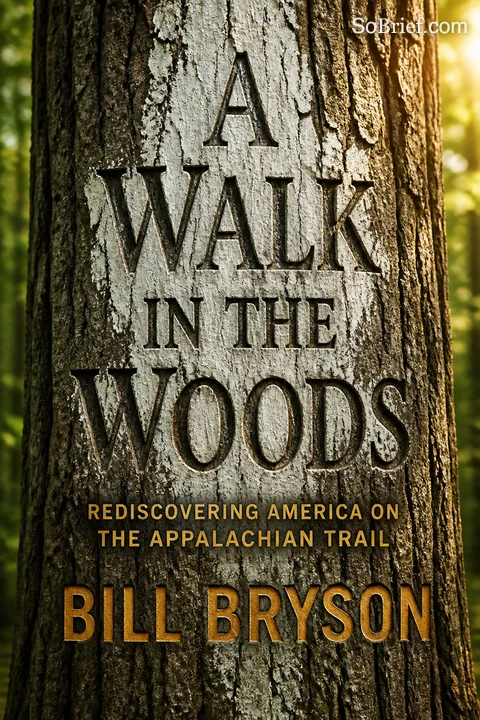
Key Takeaways
1. The Appalachian Trail: A Grand, Grueling Endeavor
Running more than 2,100 miles along America’s eastern seaboard, through the serene and beckoning Appalachian Mountains, the AT is the granddaddy of long hikes.
Initial allure. Bill Bryson, after years abroad, felt a sudden urge to hike the Appalachian Trail (AT) upon discovering it near his New Hampshire home. He envisioned it as a way to get fit, reconnect with his native land's beauty, and gain a sense of wilderness self-reliance, shedding his "cupcake" image. This romanticized view, however, quickly collided with the daunting reality of the trail's immense scale and physical demands.
Overwhelming preparation. The sheer logistics of a 2,000-mile hike became apparent during equipment shopping. Bryson learned that carrying everything needed for months of outdoor living meant lugging 40+ pounds, a stark contrast to casual English rambles. The cost and complexity of gear, from specialized tents to water purifiers, highlighted the expedition-level commitment required, far beyond his initial expectations.
Immediate struggle. The first days on the trail in Georgia were brutal, a "hell" of endless, steep climbs. Bryson, hopelessly out of shape, found every step a struggle, the pack an unbearable weight. The constant, dispiriting discovery of "more hill" and the physical toll quickly shattered any lingering illusions of an easy stroll, revealing the true, relentless nature of the AT.
2. Wilderness Perils: More Than Just Bears
My particular dread—the vivid possibility that left me staring at tree shadows on the bedroom ceiling night after night—was having to lie in a small tent, alone in an inky wilderness, listening to a foraging bear outside and wondering what its intentions were.
Constant anxieties. Bryson's pre-hike reading, particularly "Bear Attacks: Their Causes and Avoidance," filled him with vivid fears of encounters with black bears, rattlesnakes, wild boar, and even "loony hillbillies." Despite statistics showing low attack rates, the psychological impact of imagining these dangers, especially alone in a tent, was profound, leading to sleepless nights and a heightened sense of vulnerability.
Hidden threats. Beyond large predators, the wilderness presented a host of less obvious but equally terrifying threats. Bryson worried about:
- Rabies-crazed animals (skunks, raccoons)
- Venomous insects (fire ants, blackfly)
- Poisonous plants (ivy, sumac, oak)
- Parasitic worms affecting moose
- Diseases like Lyme disease and hantavirus, which could lead to severe impairment or death.
The sheer unpredictability of these dangers made the woods feel like a minefield.
Isolation's risks. The thought of being alone in the vast wilderness brought fears of injury or illness without help. A twisted ankle, a fall, or a sudden medical emergency like appendicitis could be fatal. This profound sense of isolation underscored the need for a companion, making Stephen Katz's unexpected offer to join the hike a massive relief, despite his questionable fitness and past.
3. The Human Element: Companionship and Annoyances
We started off on each other’s nerves. We ended up despising each other. But that was a long time ago.
Unlikely partnership. Stephen Katz, an old school friend with a history of substance abuse and recent car repossession, unexpectedly joined Bryson. Despite their past "despising each other" and Katz's current unfitness and eccentricities (like packing Snickers for seizures), Bryson was immensely relieved not to hike alone, highlighting the desperate need for companionship in the face of the trail's challenges.
Trail dynamics. Their hiking rhythm quickly diverged, with Bryson often waiting for the slow, panting Katz. Despite the physical disparity, a bond of mutual care developed, with Bryson checking on Katz and Katz sometimes carrying Bryson's stick. This quiet understanding formed the backbone of their journey, punctuated by shared discomforts and small acts of kindness.
The Mary Ellen factor. Their brief encounter with Mary Ellen, a relentlessly talkative, inexperienced, and critical hiker, provided both comic relief and immense frustration. Her constant bluster, unsolicited advice, and oblivious consumption of their last Hostess cupcake tested their patience. Their eventual, deliberate "ditching" of her, though initially guilt-inducing, underscored the intense desire for peace and quiet on the trail.
4. Nature's Resilience and Human Impact
Most of that forest is now gone, but what survives is more impressive than you might expect.
Lost grandeur. The eastern American woods, once an immense, unbroken canopy stretching from Alabama to Canada, have been largely decimated by human activity like logging. Bryson reflects on the historical transformation, noting that the forests he and Katz traversed were often "strapping adolescents" compared to the ancient, towering trees of centuries past.
Misguided management. Bryson critiques the U.S. Forest Service, which, despite its name, primarily builds roads for logging, often losing money in the process. He highlights the "scientific forestry" (clear-cutting) that devastates landscapes and ecologies. Similarly, the National Park Service is criticized for:
- Neglect due to underfunding
- Past blunders like poisoning Abrams Creek to introduce non-native trout
- Allowing unique features like grassy balds to vanish due to a "no interference" policy.
These actions reveal a complex, often contradictory, relationship between humans and nature.
Endangered beauty. The book touches on the tragic loss of iconic species like the American chestnut, wiped out by an introduced fungus, and the decline of songbirds due to habitat loss. Even the beloved loons are disappearing due to acid rain. These examples serve as poignant reminders of nature's fragility and the lasting consequences of human actions, even as the remaining wilderness still offers moments of profound beauty.
5. The Paradox of Modern "Wilderness"
It is an intoxicating experience to taste Coca-Cola as if for the first time and to be conveyed to the very brink of orgasm by white bread.
Re-entry shock. Leaving the trail for towns like Gatlinburg or Waynesboro provided a jarring contrast. The simple comforts of civilization—showers, clean clothes, and especially processed food like Coca-Cola and white bread—became sources of "low-level ecstasy" after days of deprivation. This highlights how the trail re-calibrates one's appreciation for the mundane.
America's car culture. Bryson observes the pervasive car-dependency in American towns, where walking is often impractical or even dangerous due to a lack of sidewalks and pedestrian infrastructure. His frustrating attempt to walk to Kmart in Waynesboro, navigating six-lane roads and hostile traffic, starkly contrasts with the pedestrian-friendly nature of European towns, emphasizing America's unique relationship with mobility.
Commercial encroachment. Towns like Gatlinburg, specializing in "slurpy food, motels, gift shops," exemplify the commercialization that often springs up at the edges of natural parks. This rapid, often ugly, development contrasts sharply with the AT's venerable, unchanging nature, making the trail a "miracle" for its resistance to constant reinvention and commercialism.
6. The Unexpected Joys of Deprivation
All that is required of you is a willingness to trudge.
Simplicity of purpose. On the trail, life takes on a "neat simplicity." Time loses meaning, dictated only by light and dark. The absence of engagements, commitments, and complex wants reduces existence to the fundamental act of "trudging." This mental state, a "mobile Zen mode," allows the brain to detach, making walking an automatic, almost meditative, act.
Heightened senses. Deprivation on the trail sharpens the senses and deepens appreciation. The taste of a simple Snickers bar becomes a luxury, and the sight of a distant town's lights is "beautiful." This forced simplicity reveals how much modern life overstimulates and desensitizes, making ordinary comforts extraordinary.
Solitude's embrace. Despite occasional encounters with other hikers, the AT offers profound periods of "perfect aloneness." This solitude, though initially unsettling, fosters a unique connection with the forest, where every rustle and groan becomes distinct. It's a space for introspection, where the "endless murmurings and stirrings" of nature become a nightly symphony.
7. The Unpredictable Nature of the Journey
One thing was obvious. We were never going to walk to Maine.
Plans unravel. The initial ambition to thru-hike quickly dissolved upon seeing the full scale of the AT map in Gatlinburg. Realizing their progress amounted to mere inches on a four-foot map, Bryson and Katz accepted they wouldn't complete the entire trail. This "liberating" realization freed them from obligation, allowing them to enjoy the experience without the pressure of a rigid goal.
Weather's tyranny. The White Mountains of New Hampshire, known for their extreme and sudden weather changes, proved this unpredictability firsthand. Bryson's near-hypothermia experience on Mount Lafayette, where a sunny morning quickly turned into a freezing, disorienting fog, highlighted the constant danger and the importance of preparedness, even in summer.
Lost and found. Katz's repeated tendency to get lost, including a 37-mile detour and walking days in the wrong direction, underscored the trail's capacity to disorient even the most seasoned (or in his case, unseasoned) hikers. Bryson's frantic search for Katz in the Hundred Mile Wilderness, fearing he was lost without water, brought home the very real consequences of missteps in remote terrain.
8. The Enduring Spirit of the Appalachian Trail
It is the most clearly defined, well-blazed footpath imaginable. Usually it is the only thing in the woods that isn’t woods.
A volunteer marvel. The AT, formally completed in 1937, is a testament to volunteerism, with thousands maintaining its 2,100+ miles. Despite its lack of historical basis or scenic optimization, its existence is a "miracle" in America's fast-changing landscape, remaining free of commercialism and true to its founding principles.
Resilience and adaptation. The trail has constantly adapted, rerouted to avoid development or logging, and protected by the National Trails System Act of 1968. This ongoing effort ensures its survival as a wilderness corridor, a stark contrast to the fleeting nature of most American enterprises and attractions.
Unique trail culture. The AT fosters a unique community, from the "Trail Magic" of unexpected kindness to the camaraderie among hikers sharing shelters. Despite occasional overcrowding, the trail remains largely uncrowded, offering solitude and a shared experience that binds diverse individuals in their common pursuit of reaching Maine, or at least trying.
9. Personal Growth and Redefining Success
We didn’t walk 2,200 miles, it’s true, but here’s the thing: we tried.
Beyond the miles. Bryson and Katz ultimately hiked 870 miles, less than half the AT, but Bryson argues this was still a significant achievement. The journey taught him patience, fortitude, and a profound respect for wilderness. It was less about conquering the trail and more about the personal transformation and the experience itself.
Redefining "completion." Katz, despite their incomplete journey, proudly declared, "I hiked the Appalachian Trail." This redefinition of success, focusing on the effort and experience rather than strict completion, reflects a deeper understanding gained from the challenge. It's a powerful statement about personal accomplishment.
Lasting impact. The hike left Bryson with a new perspective: a "profound respect for wilderness and nature," an understanding of the "colossal scale of the world," and a newfound confidence when viewing mountains. The journey, though arduous and often frustrating, ultimately enriched his life, proving that the value of an adventure isn't always measured in miles.
Review Summary
A Walk in the Woods receives mixed reviews, with many praising Bryson's humor and storytelling. Readers appreciate his witty observations, historical insights, and the entertaining dynamic with his hiking companion, Katz. The book offers a blend of travelogue, nature writing, and social commentary. Some criticize Bryson's occasional snarkiness and digressions into historical and scientific information. While not universally loved, most find it an enjoyable and informative read that captures the challenges and joys of hiking the Appalachian Trail.
People Also Read










FAQ
What is A Walk in the Woods by Bill Bryson about?
- Hiking the Appalachian Trail: The book follows Bill Bryson’s attempt to hike the 2,100–2,200-mile Appalachian Trail, stretching from Georgia to Maine, capturing his adventures, challenges, and the beauty of the American wilderness.
- Blend of Humor and Reflection: Bryson’s narrative mixes humor, satire, and personal reflection, making the journey both entertaining and insightful.
- Exploration of Nature and History: The story delves into the history, ecology, and environmental issues of the Appalachian region, offering readers a deeper understanding of the trail and its significance.
- Themes of Friendship and Perseverance: The relationship between Bryson and his companion Katz, along with their personal struggles, adds emotional depth and relatability to the adventure.
Why should I read A Walk in the Woods by Bill Bryson?
- Engaging and Humorous Writing: Bryson’s witty, accessible style and comic storytelling make the book enjoyable for a wide audience, even those unfamiliar with hiking.
- Insight into American Wilderness: The book provides vivid descriptions of the Appalachian Trail, blending natural history, environmental issues, and cultural observations.
- Relatable Human Experience: Bryson’s candid portrayal of his fears, struggles, and friendship with Katz makes the journey accessible and emotionally resonant.
- Educational and Thought-Provoking: Readers gain knowledge about conservation, American history, and the challenges of preserving wild spaces.
What are the key takeaways and reflections from A Walk in the Woods by Bill Bryson?
- Respect for Nature: Bryson develops a deep appreciation for the scale, complexity, and fragility of the American wilderness.
- Limits and Acceptance: The narrative acknowledges the physical and mental limits of the hikers, emphasizing that value lies in the journey, not just completion.
- Balance of Adventure and Comfort: The book contrasts the hardships of the trail with the comforts of civilization, highlighting the mixed emotions of leaving the wilderness.
- Personal Growth and Connection: Bryson’s experience leads to greater patience, humility, and a renewed sense of connection to the land.
Who is Katz in A Walk in the Woods by Bill Bryson, and what role does he play?
- Old Friend and Companion: Katz is Bryson’s friend from Iowa who joins the hike after years apart, providing companionship and comic relief.
- Source of Humor and Contrast: Katz’s lack of preparation, physical struggles, and impulsive behavior create many of the book’s funniest and most memorable moments.
- Symbol of Friendship and Resilience: Despite his flaws, Katz’s perseverance and evolving relationship with Bryson highlight themes of loyalty and human vulnerability.
- Emotional Depth: Katz’s battle with sobriety and his impact on the journey add emotional complexity to the story.
What are the main challenges faced by Bill Bryson and Katz on the Appalachian Trail in A Walk in the Woods?
- Physical and Environmental Hardships: The duo faces rugged terrain, unpredictable weather, insects, and the sheer length of the trail, testing their endurance.
- Equipment and Logistical Issues: They struggle with heavy packs, lost gear, water scarcity, and the need to adapt their supplies and strategies.
- Wildlife and Health Risks: Encounters with bears, snakes, and diseases like Lyme disease and hantavirus add to the dangers.
- Psychological and Interpersonal Struggles: The isolation, monotony, and Katz’s personal challenges, including alcoholism, strain their friendship and resolve.
How does Bill Bryson describe the Appalachian Trail and its environment in A Walk in the Woods?
- Vast and Varied Wilderness: The trail traverses diverse landscapes, from southern mountains to New England forests, with changing seasons and ancient geology.
- Enclosing and Spooky Woods: Bryson describes the woods as “cubic,” pressing in from all sides, creating a sense of vulnerability and awe.
- Wildlife and Natural History: The book features encounters with animals like moose and bears, and reflections on lost species and ecological changes.
- Human Impact and Conservation: Bryson discusses the balance between preserving wilderness and allowing human access, critiquing environmental management and highlighting conservation efforts.
What is the history and significance of the Appalachian Trail as described in A Walk in the Woods by Bill Bryson?
- Visionaries Behind the Trail: The trail was conceived by Benton MacKaye in 1921 as a retreat for urban workers, and built under Myron Avery’s leadership with volunteer labor.
- Trail’s Construction and Evolution: Completed in 1937, the trail has been rerouted and maintained by volunteers, making it a symbol of grassroots conservation.
- Cultural and Historical Context: Bryson connects the trail to broader American history, including Civil War sites and the evolution of hiking culture.
- Enduring Spirit: The Appalachian Trail represents resilience, adventure, and the ongoing challenge of preserving wild spaces in America.
What dangers and wildlife encounters does Bill Bryson describe in A Walk in the Woods?
- Bear Attacks and Animal Hazards: Bryson recounts stories of bear attacks, differences between black bears and grizzlies, and the unpredictability of wildlife.
- Other Wildlife and Insects: Encounters with snakes, bobcats, coyotes, wild boar, and disease-carrying insects like ticks are detailed.
- Environmental and Human Risks: The book addresses dangers from weather, accidents, illness, and rare but real threats from other people on the trail.
- Preparation and Caution: Bryson emphasizes the importance of knowledge, proper equipment, and respect for the wilderness to mitigate risks.
What environmental and conservation issues does A Walk in the Woods by Bill Bryson address?
- Threats to Forests: The decline of tree species due to disease, pests, and climate change is a recurring concern, with warnings about the future of the Appalachian ecosystem.
- Critique of Forest Management: Bryson criticizes the U.S. Forest Service for prioritizing logging and road building over conservation, leading to habitat loss and inefficiency.
- National Park Service Challenges: Underfunding, neglect, and mismanagement in national parks are discussed, alongside the dedication of rangers and volunteers.
- Balance of Preservation and Access: The book explores the tension between protecting wilderness and allowing public enjoyment, highlighting ongoing conservation debates.
What historical and cultural insights does A Walk in the Woods by Bill Bryson provide about the Appalachian region?
- Civil War and Industrial Heritage: Bryson recounts the history of Harpers Ferry, John Brown’s raid, and the impact of coal mining and environmental disasters like the Centralia mine fire.
- Development of Wilderness and Tourism: The rise and fall of grand hotels, the evolution of hiking culture, and contrasts with European attitudes toward nature are explored.
- Trail Towns and Local Culture: The book features small towns along the trail, revealing diverse attitudes toward hikers and wilderness.
- Connection to American Identity: The trail is situated within the broader context of American land use, history, and recreation.
How does friendship and companionship shape the journey in A Walk in the Woods by Bill Bryson?
- Central Relationship: The friendship between Bryson and Katz is the emotional core, providing support, humor, and conflict throughout the hike.
- Support and Conflict: Katz’s struggles with sobriety and fitness challenge their partnership, but shared hardships deepen their bond.
- Reflection on Companionship: Bryson reflects on the importance of having a companion in the wilderness, highlighting both vulnerability and strength.
- Human Connection: The journey is as much about human relationships as it is about the physical adventure.
What are some memorable anecdotes and quotes from A Walk in the Woods by Bill Bryson, and what do they mean?
- Comic Incidents: Stories like losing a walking stick, Katz’s shoelace antics, and the “Breakfast of Champions” on Mount Washington add humor and humanity.
- Notable Quotes: “It takes about five months, and five million steps, to walk the trail from end to end,” emphasizes the trail’s vastness and challenge.
- On the Woods’ Atmosphere: “Woods are not like other spaces. To begin with, they are cubic…” captures the unique, enclosing nature of the forest.
- On the Trail’s Spirit: “We hiked the Appalachian Trail,” reflects the sense of accomplishment and the value of the journey, regardless of completion.
About the Author
Other books by Bill Bryson









Download PDF
Download EPUB
.epub digital book format is ideal for reading ebooks on phones, tablets, and e-readers.








































