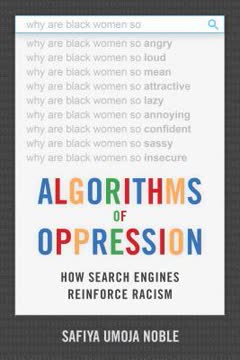
Key Takeaways
1. Algorithms are Not Neutral: They Encode Human Bias
While we often think of terms such as “big data” and “algorithms” as being benign, neutral, or objective, they are anything but.
Human-made decisions. Algorithms, the mathematical formulations driving automated decisions, are created by human beings who hold diverse values, including those that promote racism, sexism, and false notions of meritocracy. This inherent human bias is then embedded into the computer code and artificial intelligence technologies we increasingly rely on. The author terms this phenomenon "technological redlining," where discrimination is coded into digital systems.
Silicon Valley's culture. The tech industry's culture often openly promotes sexist and racist attitudes, as evidenced by incidents like Google's "antidiversity" manifesto, which argued for women's psychological inferiority in software engineering. Such attitudes among developers directly influence the "neutral" or "objective" decision-making tools they create for the public. This disconnect between stated neutrality and internal biases is a critical issue.
Consequences of bias. The values prioritized in automated systems often reinforce oppressive social relationships and enact new modes of racial profiling. Understanding this challenge requires recognizing that these systems are not occasional "glitches" but rather fundamental to the operating system of the web, masking and deepening social inequality. Artificial intelligence is poised to become a major human rights issue in the twenty-first century.
2. Commercial Search Engines Reinforce Racism and Sexism
This process reflects a corporate logic of either willful neglect or a profit imperative that makes money from racism and sexism.
Pornification of identity. The author's personal experience of searching "black girls" and consistently retrieving pornographic results highlights how commercial search engines can dehumanize and sexualize marginalized identities. This phenomenon is not limited to Black women but extends to other women of color, such as Latinas and Asians, who are also often pornified in search results. The UN's campaign, using Google searches like "Women cannot: drive" or "Women should: stay at home," further underscores how search results reflect and amplify societal sexism.
Advertising's influence. Google Search is fundamentally an advertising company, not a reliable information company. Its algorithms prioritize web search results based on commercial interests, promoting its own business interests or those of profitable advertising clients. This means that representations of women and people of color are ranked in ways that underscore their historical lack of status, directly mapping old media traditions into new media architecture.
Corporate responsibility. The persistent surfacing of racist and sexist content as top results reflects a corporate logic that either willfully neglects the social impact or actively profits from racism and sexism. This inquiry forms the basis of understanding how privately managed, black-boxed information-sorting tools become essential to data-driven decisions, often at the expense of marginalized communities.
3. Google's "Glitches" Reveal Systemic Algorithmic Oppression
These human and machine errors are not without consequence, and there are several cases that demonstrate how racism and sexism are part of the architecture and language of technology, an issue that needs attention and remediation.
Racist auto-tagging. Google's algorithms have repeatedly produced deeply offensive results, which the company often dismisses as "glitches." For instance, in 2015, Google's photo application automatically tagged African Americans as "apes" and "animals." Similarly, searches for "N*gger" on Google Maps led to the White House during Obama's presidency, and images of Michelle Obama were associated with "apes" in autosuggestions.
Stereotypes in image search. Beyond explicit racism, Google Images has reinforced harmful stereotypes. A search for "three black teenagers" yielded mug shots, while "three white teenagers" showed wholesome, all-American images. Similarly, "unprofessional hairstyles for work" predominantly featured Black women, contrasting with "professional hairstyles" showing White women. These examples demonstrate how algorithms perpetuate existing societal biases.
Denial and superficial fixes. Google's typical response to these incidents is to deny responsibility, claiming its algorithm is neutral, followed by a "quick fix" or "tweak" to suppress the most egregious results. This pattern highlights that these are not isolated errors but rather symptoms of systemic issues embedded in the technology's design and the lack of diverse perspectives in its development.
4. The Profit Motive Drives Algorithmic Bias and Misrepresentation
At the core of my argument is the way in which Google biases search to its own economic interests—for its profitability and to bolster its market dominance at any expense.
Advertising-driven model. Google's primary revenue comes from advertising, making it an advertising company first and foremost. Its PageRank algorithm, while initially conceived to measure relevance based on popularity (hyperlinks), is heavily influenced by commercial processes like AdWords and search engine optimization (SEO). These mechanisms allow advertisers to pay for prominent placement, effectively prioritizing profitable content over credible or unbiased information.
Pornography's sophisticated SEO. The pornography industry, a highly capitalized sector, is adept at using sophisticated SEO strategies to manipulate search rankings. By closely monitoring top search terms and creating "long tail keywords" (e.g., "filipino grandma sex"), they link every possible combination of words and identities to pornographic content. This ensures their material rises to the top, even for seemingly innocuous searches, because it is profitable.
Gaming the system. Brin and Page, Google's founders, foresaw the potential for commercial interests to "game" the system. SEO companies actively work to push their clients' sites up in PageRank, often in a "gray market" that Google attempts to police. This constant battle for visibility means that what appears on the first page of search results is often a reflection of financial investment and strategic manipulation, not just organic popularity or objective truth.
5. Search Results Shape Reality and Can Fuel Extremism
The power of search engines to lead people to a breadth and depth of information cannot be more powerfully illustrated than by looking at Dylann Roof’s own alleged words about using Google to find information about the Trayvon Martin murder, which led to his racial identity development.
Radicalization through search. The case of Dylann Roof, the Charleston church shooter, starkly illustrates how search results can shape an individual's worldview and fuel extremism. Roof allegedly used Google to search for "black on white crime" after the Trayvon Martin case, which led him to white nationalist websites like the Council of Conservative Citizens (CCC). These "cloaked websites" masquerade as legitimate news sources but are fronts for hate groups.
Absence of credible information. Google's algorithm failed to direct Roof to credible sources like FBI crime statistics, which would have shown that most violence is intraracial. Instead, it prioritized propaganda designed to foment racial hatred. This demonstrates how commercial search engines, driven by profit and popularity, can inadvertently legitimize false narratives and deny users access to essential, contextualized knowledge.
Impact on public discourse. Research shows that manipulating search rankings can significantly shift voters' preferences without their awareness, posing a serious threat to democracy. When search engines prioritize biased or false information, especially on sensitive topics like race relations, they compromise the public's ability to engage deeply with complex ideas and make informed decisions, with potentially devastating real-life consequences.
6. The Internet Never Forgets: The Need for Digital Protections
What does it mean that one’s past is always determining one’s future because the Internet never forgets?
Permanent digital records. The internet's pervasive data collection means that human activities are recorded and stored indefinitely, creating a "permanent record" that can haunt individuals. Cases abound of people losing jobs, reputations, or educational opportunities due to past online content, such as pornography or revenge porn, even if those actions occurred years ago or were shared without consent. This digital permanence undermines the concept of a "fresh start."
"Right to be forgotten." In response to these harms, the European Union has enacted "right to be forgotten" laws, allowing individuals to request the delisting of links to information about them from search engines if it causes personal harm. However, such legal protections are largely absent in the United States, where privacy invasions thrive, and vulnerable communities have little recourse against damaging online information.
Profiting from public records. New platforms like Mugshots.com profit by publishing arrest photos, often disproportionately impacting people of color who are over-arrested. Services then charge exorbitant fees to remove these images from search results. This commercial exploitation of public records, coupled with Google's own data retention practices and sharing with third parties, highlights the urgent need for robust privacy legislation and the right to control one's digital identity.
7. Information Institutions Must Challenge Biased Classification
The field of library science has been implicated in the organization of people and critiqued for practices that perpetuate power by privileging some sectors of society at the expense of others.
Historical bias in classification. Traditional library and information science (LIS) systems, such as the Library of Congress Subject Headings (LCSH) and the Dewey Decimal Classification (DDC), have a long history of reflecting Western, Eurocentric, and patriarchal biases. Examples include terms like "Jewish question," "Yellow Peril," or categorizing women as an "aberration" to assumed male subjects. These systems privilege dominant groups while diminishing or subduing others.
Student activism for change. Student protests, like those at Dartmouth College, have successfully pushed for changes to these biased systems, such as replacing "illegal aliens" with "noncitizens" and "unauthorized immigrants" in LCSH. This demonstrates that classification is a sociopolitical act, and challenging these systems is crucial for achieving transformative justice and accurate representation.
LIS's role in perpetuating bias. The LIS field, often invested in "colorblind" ideology, struggles to critically examine its own role in perpetuating racial and gender bias. Without integrating critical race theory and social justice training, information professionals risk replicating historical misrepresentations in new digital contexts, as seen in problematic metadata in library image databases like ArtStor.
8. Tech Monopolies Threaten Democracy and Public Good
This monopoly in the information sector is a threat to democracy, as is currently coming to the fore as we make sense of information flows through digital media such as Google and Facebook in the wake of the 2016 United States presidential election.
Consolidated power. Google's parent company, Alphabet, holds unprecedented power, extending beyond search into drone technology, robotics, fiber networks, and behavioral surveillance. This near-monopoly status in the information sector, coupled with its influence over information flows, poses a significant threat to democracy, as evidenced by the circulation of "fake news" during the 2016 U.S. presidential election.
Erosion of public resources. The shift of information resources from public institutions like libraries and schools to private corporations, exemplified by projects like Google Books, places previously public assets under corporate control for private exploitation. This "enclosure of the public domain" erodes the public information commons, a basic tenet of U.S. democracy, and allows corporations to dictate terms of access based on shareholder interests.
Unregulated influence. Despite its immense power, Google operates in a largely unregulated marketplace, especially in the U.S. The focus on "net neutrality" often overlooks the content prioritization within search engines. This lack of oversight allows Google to bias information towards its own properties and commercial partners, compromising the quality of information available to the public and undermining journalistic standards.
9. "Colorblind" Ideology Masks Systemic Inequality in Tech
This makes calls for “prosumer” participation, as a way of conceptualizing how Black people can move beyond being simple consumers of digital technologies to producers of technological output, a far more complex discussion.
Flawed "pipeline" narratives. The tech industry often frames its lack of diversity as a "pipeline issue," suggesting a shortage of qualified Black and Latino talent. This narrative ignores the systemic racism and sexism that actively exclude people of color from Silicon Valley, despite increasing numbers of graduates in computer science. It places the onus for change on marginalized individuals rather than on the industry's discriminatory employment practices and product design.
"Colorblindness" as a liability. Silicon Valley executives often embrace "colorblindness," believing it fosters meritocracy. However, research shows that colorblind attitudes are linked to less empathy and a greater tolerance for derogatory racial images. This ideology masks the "possessive investment in Whiteness," preventing recognition of how white hegemonic ideas about race and privilege perpetuate social problems and influence technological output.
Commodification of users. The concept of "prosumer" participation, where users are both producers and consumers of digital content, is often presented as empowering. However, in reality, it often translates to "labortainment" or "audience as commodity," where users' unpaid labor and personal data are exploited for corporate profit. This dynamic, coupled with digital redlining in applications like Zillow, reinforces existing social and economic inequalities.
10. Beyond Apps: Systemic Solutions for Algorithmic Justice
There is no algorithm that can replace human dignity.
Algorithmic control over livelihoods. The story of Kandis, a Black hair salon owner, powerfully illustrates how algorithms on platforms like Yelp can exert control over small businesses and racial recognition. Yelp's "pay to play" model, filtering of reviews, and promotion of competitors demonstrate how algorithmic design, often implemented with a "colorblind" approach, can invisibilize businesses crucial to communities of color, directly impacting livelihoods.
Need for transparency and regulation. The current system allows algorithms to simulate value and redefine who is "valuable" based on commercial interests, not human dignity or community needs. This necessitates greater transparency in algorithmic design and robust public policy to regulate unregulated and unethical artificial intelligence. We must slow down the automation of our worst impulses and hold tech companies accountable for the social impact of their products.
Imagining alternatives. Instead of accepting current commercial search as inevitable, we must imagine and build public, noncommercial alternatives. These could include interfaces that visually categorize information (e.g., color-coded for pornographic, commercial, academic) to provide greater transparency and user control. Decoupling advertising from information access is crucial for fostering a climate where information can be trusted and found reliable, serving a multiracial democracy.
Review Summary
Reviews for Algorithms of Oppression are mixed, averaging 3.89/5. Praise centers on the book's important subject matter—how Google's search algorithms reinforce systemic racism and sexism, particularly against Black women. Many appreciate Noble's grounding in Black feminist thought and her challenge to the myth of algorithmic neutrality. However, common criticisms include excessive repetition, overly academic writing, weak methodology, vague solutions, and a lack of technical depth explaining why algorithms produce biased results. Several reviewers suggest the content would have been more effective as a shorter article.
People Also Read