

Key Takeaways
UFO belief is a religion being born in real time
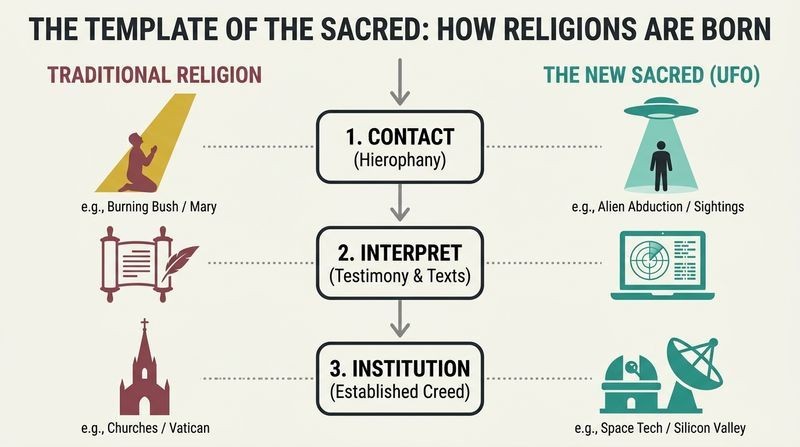
The saucer is the new sacred. D.W. Pasulka, a religious studies scholar, argues that belief in UFOs functions as a genuine emerging religion, not a fringe curiosity. She watched it forming firsthand, echoing Carl Jung's remark that we have a rare chance to witness a legend take shape. The parallels are structural, not superficial.
Religions follow a pattern. A perceived contact with a nonhuman intelligence descending from the sky (a hierophany, or manifestation of the sacred) generates interpretations, which harden into communities, which spawn institutions. Moses and the burning bush, Mary at Lourdes, and modern abductees all fit the template. Polls back the scale: a 2008 Scripps survey found over half of Americans believe in extraterrestrial life, and 74% of 18-to-24-year-olds are believers.
What's striking is Pasulka's methodological discipline: as a scholar she brackets whether UFOs are objectively real and studies only the incontestably real social effects. This mirrors Emile Durkheim's sociology of religion, which treated the sacred as a social fact regardless of metaphysical truth. The framing also recalls historian of religions Mircea Eliade, whose concept of hierophany she borrows directly. One tension worth noting: calling something a religion can flatten crucial differences. UFO belief lacks unified doctrine, clergy, or shared ritual calendar, which may make it closer to what sociologists call a diffuse or invisible religion than an organized faith.
Serious scientists secretly believe, then hide their findings from ridicule
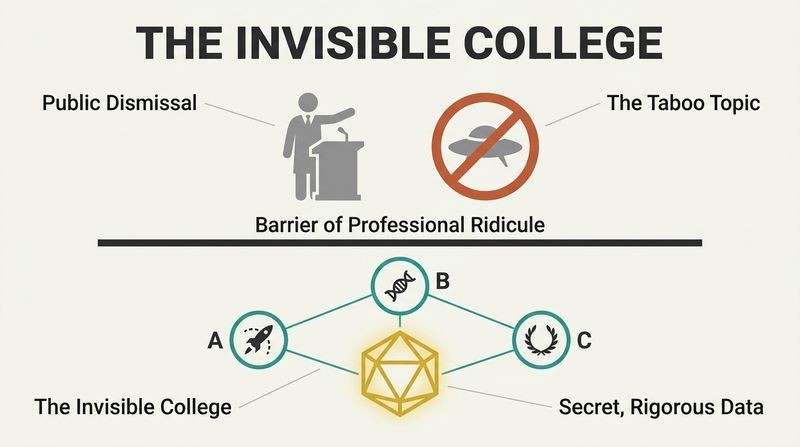
The believers are not cranks. Stephen Hawking dismissed UFO reports as coming from weirdos. Pasulka found the opposite: billionaires like aerospace magnate Robert Bigelow, Nobel laureates, and endowed-chair professors quietly study the phenomenon. Physicist Eric Davis claims corroborated forensic data exists but scientists refuse to publicize it, fearing not the subject but the backlash from colleagues.
A parallel research tradition exists. Astronomer J. Allen Hynek called it the Invisible College, a network of researchers who never make their work public. Pasulka embedded with two anonymous figures she calls Tyler (a space-program engineer with 40+ patents) and James (a molecular biologist with an endowed chair). Both interact with what they believe is nonhuman intelligence, yet neither will conclude what it is. To them the phenomenon is too sacred for dogma and too sacred for media.
The dynamic Pasulka documents is a textbook case of what sociologists call pluralistic ignorance and reputation cascades: individuals privately hold a belief but assume they are alone, so silence perpetuates itself. The stigma functions exactly like the taboos surrounding heterodox ideas in Thomas Kuhn's account of science, where anomalies get ignored until a paradigm shifts. A fair challenge: anonymity makes verification impossible, and the reader must take extraordinary claims on the author's testimony. Pasulka is candid about this bind, noting she occupies the uncomfortable position of a religion scholar almost confirming a myth rather than analyzing it from a safe distance.
Media invents the UFO, and the fake becomes the real one
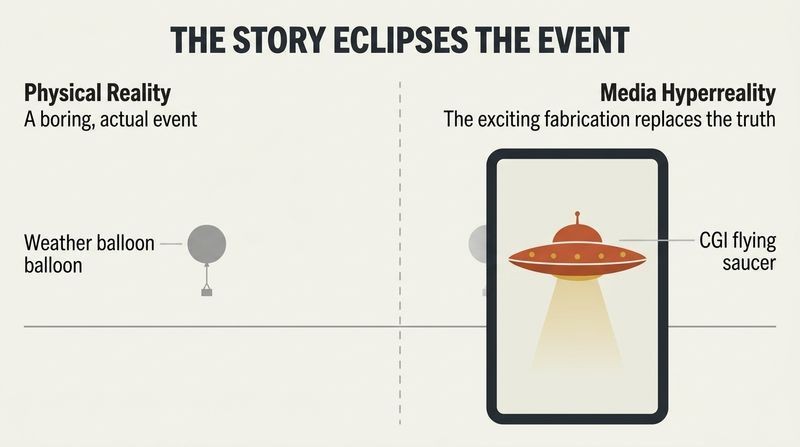
The story eclipses the event. Pasulka's second shock was that what scientists actually find barely resembles what reaches the public. When she stood at a supposed New Mexico crash site, her host noted the scene had been recreated for an X-Files episode. Her belief in its literal truth stopped mattering: it was already true for millions through screens.
Fabrication now outcompetes reality. Debunker Scott Browne runs an online group of videographers who expose hoaxed UFO photos. He showed that viral images were just oddly shaped balloons, yet believers concluded the UFOs had disguised themselves as balloons. His own instructional fake UFO photos reappeared for years, presented everywhere as authentic. Browne's despair is that new technology makes real and fake indistinguishable, so the fabricated UFO effectively becomes the real UFO.
This is Jean Baudrillard's simulacrum made literal: the copy without an original that becomes more real than reality. Pasulka's balloon example is a perfect illustration of what psychologists call belief perseverance and the backfire effect, where disconfirming evidence gets absorbed into the belief rather than dislodging it. Leon Festinger documented the same in his classic study of a doomsday cult whose faith intensified after prophecy failed. The deeper point extends beyond UFOs to our entire information ecology: deepfakes, viral misinformation, and algorithmic amplification mean the epistemic problem Browne faces on the fringe is now everyone's mainstream problem.
Media memories overwrite real ones, so screens manufacture belief
The brain files fiction as fact. Pasulka calls this the Total Recall Effect: movies about religious or historical events implant themselves as genuine memories, and the vivid image beats the historical record. Neuroscientist Jeffrey Zacks argues we build cognitive models of events and cannot cleanly separate ones from films versus real life. Stanford's Virtual Human Interaction Lab found the brain often fails to distinguish virtual experiences from real ones.
Techniques engineer this confusion. Working as a consultant on the horror film The Conjuring, Pasulka watched filmmakers use realist montage (splicing real photos beside actors) and based-on-true-events framing. The Great Martian War spliced digital aliens into World War I footage and called itself a documentary. If Star Wars Was Real inserts stormtroopers into JFK-assassination photos. These blend fact and fiction until UFO belief becomes near-universal.
Pasulka's synthesis of media studies with cognitive science is genuinely valuable and aligns with Elizabeth Loftus's landmark memory research, which she cites: memory is reconstructive, more like a Wikipedia page anyone can edit than a video recording. Alison Landsberg's concept of prosthetic memory extends this. The unsettling implication reaches a 2016 Stanford study finding students routinely could not distinguish sponsored content from news. One caveat: the strong claim that screens can wholesale manufacture belief risks underselling human skepticism and the many viewers who compartmentalize fiction perfectly well. The effect is real but probabilistic, not deterministic.
Study what people do with belief, not whether it is true
Bracket the metaphysics. Pasulka's core method, borrowed from ufologist Jacques Vallee, is that belief in space visitors is independent of the physical reality of UFOs. A sighting is not automatically a UFO event, and a UFO event is not automatically religious; each becomes so through an interpretive process shaped by culture and sometimes by deliberate institutional intervention.
Interpretation is everything. In the biblical Book of Samuel, the boy hears his name called and assumes his teacher called him; only after the third time does the priest Eli interpret it as God. The experience becomes religious through interpretation, not on impact. Vallee advised the same for UFOs: refuse to conclude, break events into constituent patterns, and analyze the social consequences. If people define situations as real, they are real in their consequences.
This phenomenological suspension of judgment is the disciplined heart of the book and echoes the sociologist W.I. Thomas's famous theorem, which Pasulka quotes. It protects the analysis from the trap of debating existence, which no one can settle. Yet it also creates a slippery position: by refusing to adjudicate truth while vividly reporting scientists' conviction and anomalous artifacts, the book can read as tacit endorsement. Pasulka acknowledges falling into Nietzsche's abyss, unable to stay neutral once embedded. The method is intellectually honest but demands a reader sophisticated enough to hold description and endorsement apart, which the immersive storytelling makes surprisingly hard.
Technology has become our new sacred, a religiouslike relationship
Infrastructure shapes faith. Just as the printing press mass-produced Bibles and enabled the Protestant doctrine of Scripture Alone, today's digital infrastructure spreads UFO belief virally and reshapes religiosity. Pasulka's deeper claim, drawn from philosopher Martin Heidegger, is that we misunderstand technology as mere instrument. Heidegger saw it as a saving power that could birth a new epoch, much as a Greek temple housed the gods.
The UFO is a technological angel. Carl Jung's phrase captures the fusion. Believers treat technology as a portal to other minds and places, a frequency shift like the nineteenth-century Spiritualists. Meanwhile some theologians call the internet the Beast. Tyler builds cancer-healing bone implants he believes are seeded by off-planet intelligence. Technology here is not secular but saturated with theological meaning, both sacred medium and sacred object.
Pasulka joins a rich lineage arguing technology and religion are entangled rather than opposed, including David Noble's The Religion of Technology and Erik Davis's TechGnosis. Arthur C. Clarke's law that sufficiently advanced technology is indistinguishable from magic hovers over the whole argument, though Pasulka inverts it: the space founders she profiles fused magic and technology deliberately. The Heidegger framing is provocative but leans on a notoriously opaque essay, and skeptics will note that describing Silicon Valley reverence as religious can be metaphor-stretching. Still, the observation that engineers speak of wizards, daemons, and machines that read your mind is hard to dismiss.
Elite creators experience their best ideas as arriving from outside
Genius feels received, not produced. Both Tyler and James describe innovation as a download from somewhere else. James lays out his most difficult problem before sleep, hands it to subconscious processes he jokingly calls elves, and wakes with the answer. Tyler tunes his body (sleep, sunlight, hydration, no coffee) to receive signals he attributes to off-planet intelligence. Nobel laureate Kary Mullis and mathematician Srinivasa Ramanujan (who credited a Hindu goddess) reported similar external-seeming inspiration.
Neuroscience offers a materialist read. Neuroscientist Heather Berlin notes that during creative flow the dorsolateral prefrontal cortex, tied to self-awareness, quiets down, so novel ideas feel like they come from outside the self. This resembles dreaming, meditation, and hypnosis. Whether the source is nonlocal intelligence or suppressed self-monitoring, the subjective experience of externality is consistent.
This is the book's most testable and cross-disciplinary thread. The founders of both the American and Russian space programs, Jack Parsons and Konstantin Tsiolkovsky, believed nonhuman intelligences seeded ideas into receptive geniuses, a striking historical pattern. The neuroscience Pasulka cites (transient hypofrontality) genuinely predicts the felt externality of insight and dovetails with research on flow by Mihaly Csikszentmihalyi. The honest fork she leaves open is whether these anomalous downloads require an external agent or whether the brain simply misattributes its own subconscious work. The physical artifacts complicate the tidy materialist story, which is precisely why she refuses to resolve it.
Absurdity is the camouflage that lets new beliefs spread undetected
Ridicule keeps the phenomenon hidden. Vallee argued the UFO event carries a constant factor of absurdity that makes elites reject the story while its symbols sink into the unconscious. Early Christianity worked the same way: too absurd for a reader of Plato to take seriously (Christians were called cannibals for eating their god), it spread among slaves and the disenfranchised until it erupted into Rome's state religion. Time favors the camouflaged.
The absurd may function like a Zen koan. A koan such as the sound of one hand clapping has no answer; it fatigues the rational mind toward a different state of awareness. Vallee wondered whether the UFO is a mass koan working on millions. George Hansen links paranormal absurdity to the trickster, tied to disorder, transition, and the blurring of boundaries, which surges during cultural upheaval.
The logic-of-camouflage thesis is one of the book's most original contributions and has real explanatory power: it predicts why credible witnesses stay silent and why the topic resists institutional study. It resonates with anthropologist Mary Douglas on how cultures police boundary-violating categories, and with Hansen's trickster framework drawing on Victor Turner's liminality. The historical analogy to Christianity is elegant but should be handled carefully, since survivorship bias means countless absurd fringe beliefs simply died without erupting into anything. Absurdity may be necessary for stealth spread, but it is nowhere near sufficient, so it explains the survivors without predicting which fringe belief wins.
Institutions weaponize UFO myth to hide real secrets and sell content
Confusion is a cover story. Tyler's view of Roswell: the best place to hide truth is in a mess of confusion. Journalist Annie Jacobsen documents genuine top-secret military programs around Area 51; the carnival of alien lore conveniently makes reasonable people scoff at anything from that location. Declassified files confirm deliberate perception management. The 1953 Robertson Panel recommended a mass-media education and debunking campaign using outlets like Walt Disney to shape public knowledge of UFOs.
The data gets monetized and distorted. Rey Hernandez reported a positive, healing family encounter to the Mutual UFO Network. The History Channel's Hangar 1 turned it into an episode titled UFO Home Invasion, inverting its meaning entirely, using his own handwriting on screen. Honest reports become raw material for entertainment products that then feed public belief.
Pasulka threads a careful needle here between documented fact and conspiracy. Perception management is real and declassified, which lends the chapter credibility, but the leap from acknowledged disinformation to nonhuman craft remains unbridged, and she wisely leaves it so. The Hangar 1 case is the sharpest illustration of a structural problem in the attention economy: crowdsourced sincere testimony becomes proprietary IP, stripped of context and reshaped for narrative punch. This is the same dynamic media scholars critique in true-crime and reality television. The winner is whoever controls the interpretation, which returns to her central thesis that institutions have always managed the contact event.
Meaningful coincidences are the fuel of belief, so treat them warily
Synchronicity converts skeptics. Jung defined synchronicity as meaningful coincidences with no causal link. Researchers report that once you notice the phenomenon, it seems to notice you, and confirming coincidences pile up. Rey Hernandez, an atheist lawyer, was pulled into founding a research organization by cascading synchronicities after a sighting. These experiences are, as Nietzsche noted, the engines of religious belief.
The disciplined response is restraint. Veteran researcher David Stinnett experiences synchronicities constantly but refuses to conclude they mean anything, warning they can lead a researcher off the right track. Pasulka herself opened Nietzsche's book to three aphorisms about New Year's Eve on New Year's Eve, one warning against ascribing deep meaning to exactly such moments. Vallee reframes it: in an information universe, coincidences are just the search engine working, not miracles.
This is a rare piece of practical epistemic hygiene in a book full of destabilizing claims. Stinnett's stance, being steeped in synchronicity yet declining to drink the Kool-Aid, models the calibration cognitive scientists prescribe against apophenia, the human tendency to perceive meaningful patterns in noise. Vallee's information-universe reframing is prescient given how recommendation algorithms now manufacture synthetic synchronicities: the Michelin ad appearing right after a Michelin conversation felt fated to one subject who fully understood the ad-targeting behind it. The lesson generalizes far beyond UFOs to anyone navigating an engineered-coincidence environment, where the feeling of destiny is increasingly a designed product.
The same cast midwifes every religion, now with new job titles
Scribes became screenwriters. At the birth of every major tradition there are contact events, interpreters, and institutions that manage meaning. In the first century they were scribes and redactors; today they are television producers, screenwriters, government agents, and authors. Pasulka realized she and everyone around her were part of, and possibly pawns in, the machinery forming a global belief system in real time.
Old patterns, new infrastructure. Just as thousands of Christian interpretive communities fought over the meaning of Jesus until Rome enforced one version four centuries later, UFO belief is contested, spun, and marketed. The difference is speed and reach: the printing press took generations, but digital media spreads and mutates belief virally, and bots and algorithms now interpret alongside humans. The mechanisms of belief formation are ancient; the amplification is unprecedented.
Positioning herself and her subjects as unwitting participants in myth-genesis is Pasulka's boldest reflexive move, and it distinguishes the book from ordinary UFO journalism. It echoes how scholars now understand scripture formation as a social process rather than a single revelation, work associated with figures like Bart Ehrman on textual transmission. The genuinely new variable is machine agency: when Facebook bots invent their own language or algorithms curate what feels like fate, non-human, non-conscious actors join the ancient interpretive guild. That raises a question the book gestures at but leaves open: what happens to religion when some of its scribes are neither human nor alive?
Analysis
American Cosmic is best understood as a work of method disguised as a work of wonder. Pasulka, chair of a religious studies department, is not asking whether aliens exist; she is asking how a technologically mediated society manufactures the sacred. Her signal contribution is importing two toolkits rarely joined: the phenomenology of religion (Eliade's hierophany, Durkheim's social fact, W.I. Thomas's theorem) and the cognitive science of media (Zacks on event models, Loftus on reconstructive memory, Landsberg's prosthetic memory). The synthesis yields a genuinely fresh thesis: belief no longer requires evidence because screens install experience directly, bypassing the conscious evaluator.
The book's structure mirrors its argument. It alternates between immersive narrative (blindfolded desert trips, Vatican conversions) and analytic distance, enacting the very oscillation between participation and observation that anthropologists call the insider-outsider problem. This is both its charm and its vulnerability. By vividly rendering credible scientists' conviction and unanalyzable artifacts while formally bracketing truth, Pasulka produces a text that skeptics can read as credulous and believers can read as validation. She admits this, invoking Nietzsche's abyss. The anonymity of Tyler and James makes independent verification impossible, so the empirical spine rests on trust. What elevates the work above ufology is its diagnosis of a general epistemic crisis. The balloon-UFO that believers reinterpret as a disguised craft, the Hangar 1 inversion of Rey's testimony, the students who cannot spot sponsored content, all point to a world where Baudrillard's simulacrum is operational infrastructure. The camouflage-through-absurdity thesis, borrowed from Vallee and Hansen, is the most original analytic offering, explaining institutional silence better than conspiracy does.
Ultimately the book is less about the cosmos than about us: how meaning propagates when technology becomes both medium and object of faith, and how the ancient machinery of religion runs on new, partly non-human, hardware.
Review Summary
American Cosmic explores UFO beliefs through a religious studies lens. Readers are divided - some praise its unique perspective on UFOs as a modern belief system, while others criticize its reliance on anonymous sources and perceived lack of skepticism. The book examines how technology and media shape UFO narratives, drawing parallels to religious experiences. Some found it thought-provoking, while others felt it lacked cohesion or critical analysis. The author's approach as a religious scholar studying UFO phenomena intrigued many, but left others questioning its scientific rigor.
People Also Read


Glossary
Hierophany
Manifestation of the sacredA term borrowed from historian Mircea Eliade meaning a manifestation of the sacred, typically when a nonhuman intelligent being descends from the sky or reveals itself to humans. Pasulka treats sites like Roswell and Lourdes as modern hierophanies, sacred places where believers hold that contact with the divine or nonhuman touched down on Earth.
Meta-experiencer
Scientist who studies experiencersPasulka's coined term for scientists (also called scientist-believers) who study the people who claim UFO contact, and who often harvest that data for their own technological work. Unlike experiencers, meta-experiencers are usually reticent to admit belief in UFOs publicly. Tyler and James are her central examples.
The Invisibles
Researchers erased from public recordPeople whose work requires them to remain completely removed from the internet and social media, their names scrubbed and accomplishments never publicly credited, often because of classified government affiliations. Related to J. Allen Hynek's Invisible College, a network of scientists and academics who study the phenomenon anonymously and never publish their findings.
Total Recall Effect
Media memories overwrite real onesPasulka's term (named after the Philip K. Dick-inspired film) for how movies and media about religious or historical events implant themselves as genuine memories, so the vivid screen image trumps the historical record. It goes beyond confabulation, describing memory manufactured and nurtured by modern immersive technology.
Logic of camouflage
Absurdity hides spreading beliefVallee's and Pasulka's idea that the UFO phenomenon carries built-in absurdity that causes elites to reject it while its symbols embed in the unconscious. This keeps the belief hidden from official study yet allows it to spread underground, just as early Christianity seemed too absurd for Roman elites before erupting into a state religion.
Realist montage
Splicing fact beside fictionA media technique Pasulka identifies in which fictional scenes or images are placed side by side with real footage or photographs to create a realistic effect and forge a false cognitive connection. Used in The Conjuring's closing credits and in fake documentaries that insert digital aliens into real historical events.
Contact modalities
Ways nonhuman intelligence reaches humansRey Hernandez's term for the various anomalous ways people report interacting with nonhuman intelligence, including UFO sightings, near-death experiences, out-of-body experiences, and telepathic downloads. His organization FREE studies these as interconnected spokes of a single wheel, explained through the quantum hologram theory of consciousness.
The download
Ideas received from elsewhereA term used in UFO research communities for the experience of receiving creative ideas or information that feel as though they originate from an external, nonlocal, or nonhuman source rather than from one's own mind. Both Tyler and James describe their innovations arriving this way, echoing accounts from Kary Mullis and Ramanujan.
FAQ
What is American Cosmic: UFOs, Religion, Technology by D.W. Pasulka about?
- Intersection of UFOs, Religion, and Technology: The book explores how belief in UFOs has evolved into a new form of religiosity, blending scientific, spiritual, and technological elements in contemporary culture.
- Ethnographic Approach: Pasulka uses interviews and fieldwork with scientists, engineers, and experiencers to reveal how UFO phenomena shape worldviews and spiritual lives.
- Media and Memory: The narrative examines how media and technology influence the formation of belief, blurring the lines between reality and fiction.
- Historical and Religious Context: UFO beliefs are situated within broader religious traditions, drawing parallels to historical miracles and sacred artifacts.
Why should I read American Cosmic by D.W. Pasulka?
- Unique Academic Perspective: Pasulka, a scholar of religion, rigorously investigates UFO phenomena as a modern religious movement, bridging science, spirituality, and technology.
- Insight into Hidden Worlds: The book uncovers the secretive community of scientists and experiencers who study UFOs seriously, challenging the stereotype that UFO belief is purely fringe or irrational.
- Understanding New Religiosity: Readers gain a deeper understanding of how technology and media foster new forms of belief and sacred experience in the digital age.
- Critical Media Analysis: The book offers tools to critically assess how media and misinformation shape public perceptions of UFOs and the sacred.
What are the key takeaways from American Cosmic: UFOs, Religion, Technology by D.W. Pasulka?
- UFOs as Modern Sacred: UFO phenomena function as contemporary hierophanies—manifestations of the sacred—impacting culture, belief, and spirituality.
- Technology as Sacred Medium: Advanced technology, including digital media, acts as both the object and medium of new religious beliefs centered on UFOs.
- Invisible College: A hidden network of scientists and researchers studies UFOs confidentially, influencing public narratives from behind the scenes.
- Memory and Media: Media representations and cognitive science explain how belief in UFOs is shaped, reinforced, and sometimes fabricated through cultural narratives.
Who are Tyler D. and James in American Cosmic, and why are they significant?
- Tyler D.: A charismatic aerospace engineer and biomedical entrepreneur who claims to interface with off-planet intelligence, inspiring his technological innovations.
- James: A molecular biologist and experiencer who studies the biological and genetic basis of anomalous cognition, believing in the physical reality of UFO artifacts.
- Invisible Researchers: Both represent the "Invisible College"—scientists who study UFOs seriously but remain largely anonymous due to stigma and secrecy.
- Challenging Conventional Science: Their research and experiences push the boundaries of accepted scientific inquiry, informing the book’s core arguments.
What is the "Invisible College" in UFO research, as described in American Cosmic?
- Definition: The "Invisible College" is a secretive group of scientists, academics, and researchers who study UFO phenomena confidentially, often under government or military auspices.
- Purpose and Secrecy: Their work involves classified programs and national security concerns, requiring strict codes of silence and anonymity.
- Scientific Rigor: They investigate anomalous aerial phenomena with seriousness and scientific methodology, contrasting with popular media portrayals.
- Influence on Public Narratives: This parallel tradition shapes public understanding of UFOs indirectly, often remaining hidden from mainstream discourse.
How does American Cosmic by D.W. Pasulka explain the relationship between UFOs and religion?
- UFOs as Hierophanies: Pasulka frames UFO events as modern manifestations of the sacred, akin to religious visions or miracles throughout history.
- Formation of Belief Communities: Contact events with UFOs lead to the creation of interpretive communities and institutions, similar to traditional religions.
- Technology as Sacred: UFOs and related technologies are seen as portals or frequencies connecting humans to other intelligences, blending technological and religious significance.
- Historical Parallels: The book draws analogies between UFO phenomena and religious apparitions, emphasizing their shared transformative power.
What role do media and technology play in shaping UFO beliefs, according to American Cosmic?
- Media as Reality Shaper: Films, TV, and digital content use techniques like "realist montage" to blur fact and fiction, deeply influencing public belief and memory.
- Digital Technology and Cognition: Technologies extend human cognition, making media an integral part of how people experience and interpret UFO phenomena.
- Misinformation Challenges: The proliferation of hoaxes, CGI, and disinformation complicates discerning real phenomena, necessitating critical scrutiny and expert vetting.
- Viral Belief Formation: The internet and social media facilitate the rapid spread and reinforcement of UFO-related beliefs.
What is the "Total Recall Effect" in American Cosmic, and how does it relate to UFO belief?
- Definition: The Total Recall Effect describes how media about religious or supernatural events can create real physiological effects and even false memories in viewers.
- Mechanism: Immersive storytelling and realistic portrayals in media can implant memories or beliefs that feel authentic, blurring the line between actual experience and fiction.
- Impact on UFO Belief: This effect explains how popular culture and media representations of UFOs contribute to widespread belief, even when objective evidence is lacking.
- Cognitive Science Basis: Research shows the brain processes media events similarly to real-life events, reinforcing the power of media in shaping belief.
How does American Cosmic address the tension between real and imaginary in UFO phenomena?
- Dual Nature of UFO Reality: Pasulka suggests UFOs are both real and imaginary; their physical reality is ambiguous, but their social and religious effects are undeniable.
- Media Ecology Perspective: The digital age dissolves traditional distinctions between real and unreal, as virtual experiences have tangible cognitive and physiological impacts.
- Skepticism and Openness: Scientists in the book avoid dogmatic conclusions, embracing the mystery and complexity of the phenomenon.
- Cultural Impact: The blending of reality and imagination creates new frameworks for understanding belief and experience.
What are some key concepts introduced in American Cosmic by D.W. Pasulka?
- Hierophany: A sacred manifestation, used to describe UFO contact events as modern sacred encounters.
- Amplificatory Interpretation: Carl Jung’s concept explaining how unknown phenomena are interpreted and given meaning through cultural narratives.
- Download: A term for receiving information or inspiration from nonhuman intelligences, often linked to creativity and anomalous cognition.
- Technogenesis: The coevolution of humans and technology, blurring boundaries between biological and technological.
- Invisible College: The secretive community of scientists studying UFOs confidentially, shaping the field from behind the scenes.
How does American Cosmic conceptualize UFOs as a form of technology?
- Technological Phenomena: UFOs are seen as advanced technologies, with secrecy and camouflage integral to their function.
- Human-Technology Coevolution: The book discusses "technogenesis," where humans and technologies evolve together, influencing consciousness and culture.
- Materiality of Information: Information is viewed as material, stored and transmitted through biological systems like DNA, suggesting humans act as receivers and transmitters.
- Quantum and Consciousness Theories: The book explores links between UFO phenomena, consciousness, and quantum physics, proposing a holographic model of reality.
What is the significance of the artifact studied in American Cosmic by D.W. Pasulka?
- Anomalous Object: The artifact is described as incomprehensible and possibly not of this universe, challenging conventional scientific understanding.
- Religious and Cultural Power: Like sacred relics, the artifact inspires devotion, mythologizing, and reverence among those who encounter it.
- Symbiotic Relationship: The artifact and those near it share a symbiotic relationship, with the object generating information and influencing human consciousness.
- Potential for Paradigm Shift: The anomaly encourages scientists to reconsider established hypotheses and may herald a revolution in understanding reality and consciousness.
What are the best quotes from American Cosmic by D.W. Pasulka, and what do they mean?
- “Almost two thousand years, and no new god!” — Friedrich Nietzsche: Highlights humanity’s longing for new forms of transcendence, positioning UFOs as modern sacred symbols.
- “The Internet is an alien life form.” — David Bowie: Suggests technology is transformative and otherworldly, echoing the book’s theme of technology as a sacred medium.
- “When you gaze long into the abyss, the abyss gazes also into you.” — Friedrich Nietzsche: Reflects the epistemological shock of confronting the unknown in UFO studies.
- “Trust no one. Do not even trust what you see.” — Jacques Vallee: Warns of the deceptive and elusive nature of UFO phenomena, emphasizing critical scrutiny.
- “I don’t give a damn. It’s not going to make a difference. It’s not going to change the reality of what I know.” — Robert Bigelow: Emphasizes that belief in UFOs is grounded in personal conviction, transcending public opinion or stigma.
Download PDF
Download EPUB
.epub digital book format is ideal for reading ebooks on phones, tablets, and e-readers.








































