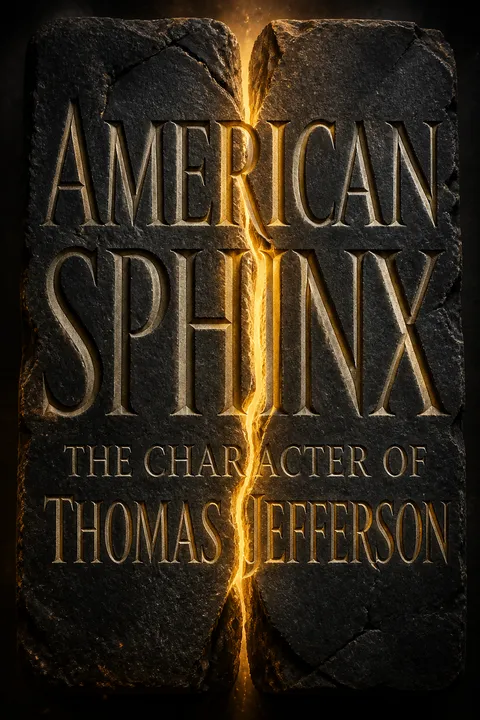
Key Takeaways
1. Jefferson's character is defined by a deep-seated, protective capacity for self-deception and psychological agility.
His psychological agility, his capacity to play hide-and-seek within himself, was a protective device he developed to prevent his truly radical and highly romantic personal vision from colliding with reality.
The inner sphinx. Jefferson possessed a unique psychological architecture that allowed him to hold contradictory beliefs without experiencing internal conflict. This internal diplomacy shielded his highly idealized visions of human nature from the messy, compromising realities of political and personal life.
Compartmentalized thinking. By keeping different aspects of his life in separate mental compartments, he could advocate for universal freedom while remaining a lifelong slaveowner. This was not conscious hypocrisy, but rather a sincere form of self-deception that preserved his moral purity.
Avoidance of conflict. He detested personal confrontation and went to great lengths to maintain a placid, harmonious facade.
- He used written correspondence to modulate his message for different audiences.
- He relied on trusted intermediaries to handle the dirty work of partisan politics.
- He retreated to his mountaintop whenever public life became too contentious.
2. The Declaration of Independence was a brilliant distillation of shared revolutionary sentiments rather than an original philosophical treatise.
Neither aiming at originality of principle or sentiment, nor yet copied from any particular and previous writing, he drew his ideas from the harmonizing sentiments of the day...
Distilling the American mind. Jefferson did not set out to invent new political philosophies when drafting the Declaration of Independence in June 1776. Instead, his genius lay in his ability to draft a document that perfectly captured the collective spirit and shared assumptions of the American colonists.
Recycling previous drafts. Under immense pressure in a hot Philadelphia room, Jefferson relied heavily on his own earlier writings and contemporary drafts. He synthesized these familiar ideas into a powerful, poetic statement of natural rights that transcended the immediate political crisis.
The power of rhetoric. The lasting impact of the Declaration lies in its ability to elevate political arguments into universal moral truths.
- He substituted the "pursuit of happiness" for the traditional Lockean right to "property."
- He framed the colonial struggle as a simple, black-and-white moral dichotomy.
- He presented the colonists as innocent victims of a systematic British conspiracy.
3. Jefferson's political vision was deeply rooted in a romanticized, mythological view of the Saxon past.
The 'once upon a time' character of Jefferson's interpretation, which has also come to be known as the Whig interpretation of history, deserves studied attention as a crucial clue to Jefferson's deepest intellectual instincts.
The Saxon myth. Jefferson was deeply influenced by Whig historians who argued that pre-Norman England was a pristine paradise of individual liberty. He believed that the Anglo-Saxon settlers had lived in perfect harmony without the coercive institutions of kings, priests, or feudal lords.
The doctrine of expatriation. This romanticized history led Jefferson to argue that the American colonists had completely severed their ties with England when they migrated. In his view, the American Revolution was not a radical innovation, but a conservative restoration of ancient Saxon liberties.
Utopian expectations. This historical fable perfectly matched Jefferson's instinctive preference for a world without explicit government authority.
- He viewed all government power as an artificial, corrupting intrusion on natural rights.
- He believed that individuals, once liberated from feudal structures, would naturally self-regulate.
- He sought to recreate this pristine, voluntary society on the western frontier.
4. His time in Paris refined his cosmopolitan tastes while paradoxically deepening his hatred of European institutions.
The roughness of the human mind are so thoroughly rubbed off with them that it seems as one might glide thro' a whole life among them without a justle.
The Parisian paradox. Jefferson's five years in Paris as America's minister to France were a period of intense personal and cultural refinement. He fell in love with French art, architecture, wine, and salon society, finding in them a level of civility that smoothed his own rough edges.
Old World corruption. Despite his genuine affection for the French people, his exposure to European court politics deepened his conviction that European institutions were fundamentally corrupt. He viewed the monarchies, aristocracies, and established churches of the Old World as predatory systems designed to exploit the common people.
A lesson in contrast. His European experience served to reinforce his belief in the moral superiority of the young American republic.
- He contrasted the "wolves" of European governments with the "sheep" of American society.
- He warned young Americans traveling abroad to avoid the moral contamination of European cities.
- He became a more ardent and uncompromising nationalist as a result of his diplomatic frustrations.
5. The famous "Dialogue between the Head and the Heart" reveals his preference for experiencing intimacy in the safety of his imagination.
Had they ever felt the solid pleasure of one generous spasm of the heart, they would exchange for it all the frigid speculations of their lives...
A romantic infatuation. In the summer of 1786, the widowed Jefferson fell deeply in love with the beautiful, married Anglo-Italian artist Maria Cosway. Their brief, intense romance in Paris released a torrent of emotional energy that temporarily shattered his carefully maintained self-control.
The head versus heart. Following their separation, Jefferson wrote a famous twelve-page letter to Cosway cast as a debate between his rational intellect and his romantic emotions. While the heart argued eloquently for the value of passion, the very act of writing the dialogue allowed his head to regain control.
Safe, imaginary love. Jefferson ultimately preferred to experience intimacy in the safe, controlled environment of his own mind rather than the messy physical world.
- He gradually cooled the relationship as it became more demanding and less manageable.
- He translated his real feelings for Cosway into an idealized, nostalgic memory.
- He consistently chose the safety of emotional distance over the vulnerability of real-world passion.
6. Jefferson's stance on slavery was a profound paradox of moral condemnation and practical procrastination.
The generous and enlightened Mr. Jefferson cannot but demonstrate a desire to see these negroes emancipated. But he sees so many difficulties in their emancipation... that it is thus reduced to the impossible.
The moral chasm. Jefferson was one of the first American statesmen to argue that slavery was a moral travesty that violated the natural rights of man. Yet, he remained a lifelong owner of over two hundred slaves, whose labor supported his lavish lifestyle and funded his architectural projects at Monticello.
The fear of mixture. His inability to act on his antislavery principles was rooted in his deep-seated belief that blacks and whites could never live together as equals. He argued that emancipation must be accompanied by immediate deportation, a logistical and financial impossibility that effectively blocked any practical reform.
Paternalistic self-image. To resolve this painful contradiction, Jefferson adopted a paternalistic posture that allowed him to view himself as a benevolent guardian.
- He treated his household slaves, particularly the Hemings family, with special privileges.
- He kept the harsh realities of field labor at a distance, leaving daily management to overseers.
- He passed the responsibility for ending slavery along to the next generation of American leaders.
7. As President, Jefferson successfully implemented a "textual presidency" designed to minimize the visibility of federal power.
We are all republicans—we are all federalists.
Republican simplicity. Jefferson's inauguration in 1801 was a carefully orchestrated statement of republican simplicity designed to contrast with the monarchical pomp of his predecessors. He walked to the Capitol, wore plain clothing, and refused to deliver his annual messages to Congress in person, preferring to send them in writing.
Governing by the pen. This "textual presidency" allowed Jefferson to exercise immense executive influence while maintaining the appearance of passivity and deference to the legislature. By conducting the business of the executive branch almost entirely in writing, he could govern from the quiet sanctuary of his study.
Dismantling the state. His primary goal as president was to shrink the size and scope of the federal government to its absolute minimum.
- He worked closely with Albert Gallatin to systematically retire the national debt.
- He abolished all internal taxes, making the federal government virtually invisible to ordinary citizens.
- He drastically reduced the size of the army and navy, arguing that a strong military was a threat to liberty.
8. The Louisiana Purchase forced Jefferson to compromise his strict constitutional principles for a grander vision of western expansion.
To lose our country by a scrupulous adherence to written laws, would be to lose the law itself...
The western empire. When Napoleon unexpectedly offered to sell the entire Louisiana Territory in 1803, Jefferson recognized it as a providential opportunity to secure the future of the American republic. The acquisition doubled the size of the nation overnight, providing an "empire for liberty" that would last for generations.
Constitutional gymnastics. The purchase presented Jefferson with a profound constitutional dilemma, as the Constitution made no provision for acquiring foreign territory. Although he initially argued that a constitutional amendment was necessary, he ultimately chose to act in silence to avoid putting the deal at risk.
Imperial executive power. To secure and govern this vast new territory, Jefferson exercised a level of unilateral executive authority that violated his own republican principles.
- He authorized a secret reconnaissance mission (Lewis and Clark) into foreign territory.
- He bypassed Congress to finalize the purchase treaty before Napoleon could change his mind.
- He established a provisional territorial government in Louisiana that denied residents the right to self-government.
9. In his final years, Jefferson sought to secure his legacy by framing his life's work as a perpetual battle against consolidation.
The great object of my fear is the federal judiciary. That body, like gravity, ever acting, with noiseless foot, and unalarming advance, gaining ground step by step... is engulphing insidiously the special governments into the jaws of that which feeds them.
The battle for history. During his final decade at Monticello, Jefferson became increasingly obsessed with how posterity would judge his life and the meaning of the American Revolution. He feared that the Federalists, led by Chief Justice John Marshall, were successfully rewriting history to justify a consolidated federal government.
The threat of consolidation. Jefferson viewed the growing power of the federal courts and proposals for federal internal improvements as a coordinated conspiracy to undermine state sovereignty. He responded by retreating into a militant, states' rights posture that aligned his legacy with the most reactionary elements of southern politics.
The final testament. Despite his growing pessimism about the future of the Union, he worked tirelessly to secure his version of the revolutionary story.
- He compiled his "Anas" to expose the alleged monarchical conspiracies of the 1790s.
- He renewed his correspondence with John Adams to engage in a grand, retrospective dialogue on the Revolution.
- He founded the University of Virginia as a safe haven to protect southern youth from northern "consolidationist" ideas.
Review Summary
People Also Read


Download PDF
Download EPUB
.epub digital book format is ideal for reading ebooks on phones, tablets, and e-readers.








































