

Key Takeaways
Every animal carries "medicine," a mirror of powers sleeping inside you
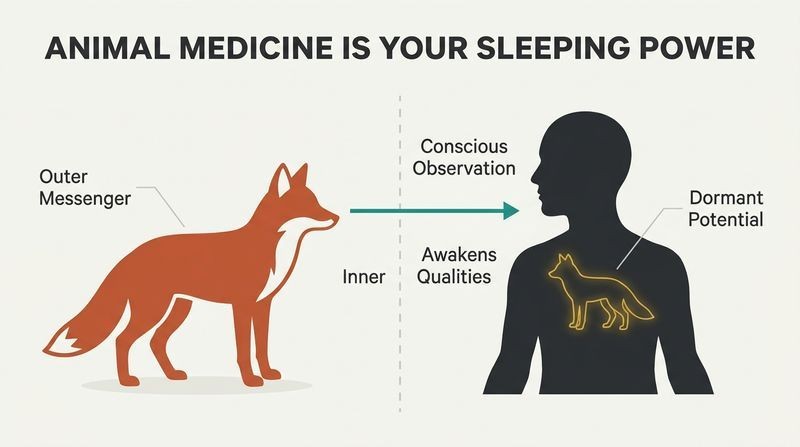
Nature is a language, not decoration. Ted Andrews argues that animals appearing in your life through dreams, repeated sightings, or sudden fascination are speaking to you. Each species has a "medicine," meaning its characteristic talents, behaviors, and survival strategies, which reflect qualities you can awaken in yourself. A fox teaches camouflage and invisibility. A hummingbird teaches finding joy and the nectar of life.
The animal is a gateway to self-knowledge. Andrews insists what you think about an animal reveals how you think about yourself. By studying a creature's habits, diet, hunting style, and rhythms, then drawing parallels to your own circumstances, you learn to read your life more clearly. The promise is reconnection: seeing nature anew makes you see yourself anew.
What's compelling here is the psychological mechanism beneath the mysticism. Whether or not animals carry literal spirit messages, treating a recurring animal as a prompt for reflection works like a Rorschach inkblot or Jungian active imagination. Carl Jung used animal symbols in dreams as expressions of the unconscious, and ethologists note humans are cognitively primed to find meaning in animal behavior. Andrews essentially builds a structured attention practice: notice what you notice in nature, then ask why. The risk is confirmation bias, projecting meaning onto coincidence. But as a tool for self-examination rather than prediction, the framework has genuine value.
The animal chooses you; ego grabs the eagle, but mouse medicine may save you
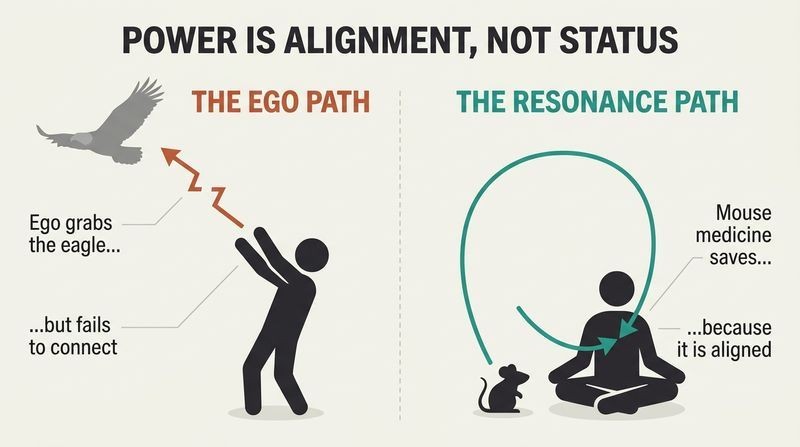
You do not shop for a totem. Andrews warns that beginners pick the most glamorous, powerful-seeming animal, then wonder why nothing happens. The relationship works in reverse: the animal that genuinely resonates, frightens, or recurs is the one with something to teach. As he puts it, being powerful in mouse medicine beats being clumsy and ineffectual in eagle medicine.
No animal outranks another. A chipmunk can be as instructive as a grizzly; a prairie dog's gift for community matters as much as a hawk's vision. Andrews adds that totems shift over time. You may have one lifelong power animal plus temporary ones for a rough period, a creative project, or a single day. The key is connecting fully with at least one, which opens the bridge to others.
This is a quietly subversive idea in a self-help culture obsessed with apex predators and "alpha" branding. Andrews inverts status: the humble totem is often the more useful one. The insight echoes positive psychology research on signature strengths, where flourishing comes from developing your actual talents rather than chasing prestigious but ill-fitting ones. It also resembles the therapeutic principle that what we resist or fear (the frightening animal becoming a "shadow totem") holds our growth. The honest move is letting the unglamorous truth choose you, which requires the ego-restraint most people lack.
Find your totem by tracking fascination, fear, dreams, and what once bit you
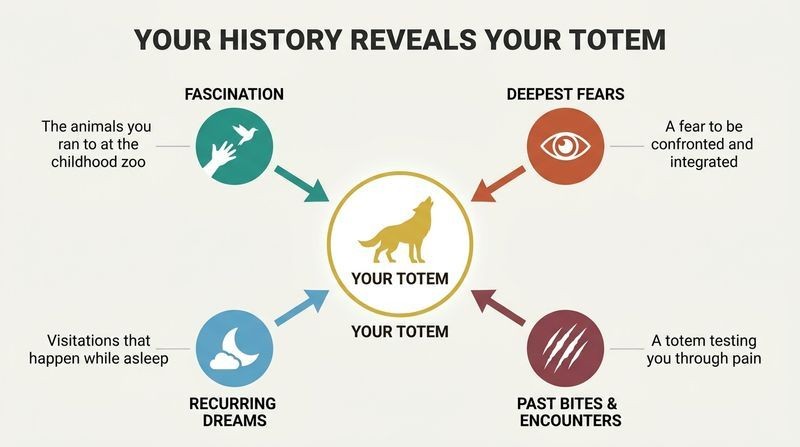
Your history already names your totems. Andrews offers a diagnostic questionnaire rather than a mystical lottery. Which animal has always captivated you? Which did you rush to at the zoo as a child? Which frightens you most? Have you ever been bitten or attacked? Do certain animals recur in dreams, especially childhood ones?
Fear and attack are clues, not warnings. That which frightens you most is often something you must come to terms with, becoming a power once confronted. Historically, shamans who survived an animal attack believed that creature was their totem testing them. Andrews shares his own recurring childhood visitations from a spirit wolf and an owl that returned around his father's death. The method is observation plus imagination, not special powers: notice the patterns, then verify through study.
The questionnaire is shrewd because it externalizes introspection. Asking "what frightens you?" is a backdoor into the psyche that bypasses self-flattery. This mirrors how trauma and depth psychology treat phobias and recurring dreams as compressed information about unresolved material. The childhood-zoo question is especially smart: early, unguarded preferences often reveal temperament before socialization edits it. One caution worth flagging is the survivorship logic in the "attack means totem" belief, a classic case where only the survivors tell the story. Still, as a self-inventory exercise, this beats generic personality quizzes by anchoring to vivid, emotionally charged memories.
A true omen rests on knowledge; superstition rests on fear
The difference is a knowledge base. Andrews draws a sharp line. Reading omens means noticing genuine changes in nature against a backdrop of what is normal, then interpreting from understanding. Superstition is irrational fear with no foundation. His example: when meadow mice (voles) suddenly erupt in population, short-eared owls appear overnight in hordes. The superstitious person, primed to see owls as evil, reads a coming plague. The knowledgeable person knows this is nature restoring balance, an abundance, the opposite of doom.
Learn the usual to recognize the unusual. Andrews urges studying your local wildlife so that genuine anomalies stand out. Nature speaks like a person raising their voice: when behavior breaks its normal pattern, pay attention. Watch direction, color, number, and activity, but never force correspondences your fears invent.
This is the book's most intellectually honest passage, and it functions as a built-in skeptic's safeguard. Andrews essentially demands a baseline before inference, which is the foundation of all signal-detection science: you cannot spot an anomaly without knowing the norm. The vole-and-owl example is genuinely ecological, reflecting real boom-bust predator-prey cycles studied since Lotka and Volterra. The deeper lesson transcends totems: most human dread comes from pattern-matching on incomplete data. Birdwatchers, trackers, and field naturalists develop exactly this discernment. The tension Andrews never fully resolves is where disciplined observation ends and motivated interpretation begins, but his insistence on knowledge-first is the right guardrail.
Predator and prey teach four lessons mapped to the elements
Hunting is a curriculum, not just cruelty. Andrews reframes the predator-prey relationship as four linked lessons, each tied to an element and direction:
1. Life, Death, and Rebirth (Fire, South): use endings as openings; the vulture cleans death so life continues.
2. Adaptation (Water, West): shift like water to fit your environment; the coyote thrives everywhere by eating anything.
3. Using Your Potential (Earth, North): be authentically yourself; a hawk that misses doesn't try to become a weasel, it hunts harder as a hawk.
4. Responsible Relationships (Air, East): every action ripples through the web of life.
Study the prey too. Andrews suggests pairing a predator totem with its prey (owl with skunk, hawk with snake) to grasp the full cycle of giving and taking.
The framework's strength is converting a squeamish subject into ethics and ecology. The fourth lesson, the interconnected food web where energy is lost at each trophic level so predators are forever outnumbered, is sound biology and dovetails with the Iroquois "seventh generation" principle Andrews cites: weigh consequences far downstream. The third lesson resonates with modern authenticity research and even with biologist's niche theory, where overspecialization (the snail kite eating only one snail) breeds fragility while flexibility breeds resilience. The elemental mapping is more poetic scaffolding than empirical claim, but it gives the four lessons a memorable mnemonic structure that aids recall.
Study the literal animal before you chase its symbolism
Biology grounds the mysticism. Andrews, who volunteered at a nature center cleaning cages, repeatedly insists you start with facts: color, size, shape, diet, habitat, sounds, breeding season, and behavior. Only then move to myth and metaphor. A red-tailed hawk's red tail links symbolically to the kundalini base-of-spine life force, but you grasp that only after knowing the bird is a permanent resident, a soaring buteo, a fierce protector of its nest.
Details carry the meaning. The number of points on a deer's antlers, the direction a fox crosses your path, the color of a bird you keep seeing, all refine the reading. Andrews offers "keynote" and "cycle of power" for each species as starting points, not gospel, urging readers to build their own personal dictionary through observation.
This is the book's methodological backbone and what separates it from lazier New Age fare. Andrews treats natural history as prerequisite, citing real authors and field guides in his bibliography. The principle generalizes powerfully: meaning earned through close observation is richer and less arbitrary than meaning assigned by lookup table. It echoes the naturalist tradition of Aldo Leopold and the close-reading discipline of any serious craft. The honest tension is that once you know an animal deeply, almost any trait can be spun symbolically, which makes the system unfalsifiable. But as a practice that drives people toward genuine ecological literacy, the insistence on facts-first is admirable.
Honor your totem relentlessly, and guard its power with silence
Attention is the currency. Andrews says a totem's medicine strengthens in proportion to how much significance you give it. Concrete ways to honor it: read everything about it, draw it (badly is fine), buy or gift figurines, donate time or money to wildlife groups, and dance its movements. He recommends children's books for frightening totems because they present scary animals appealingly.
But do not boast. Andrews is firm that speaking carelessly about your totem dissipates its energy before it can work. Others' disbelief, expressed or silent, creates barriers. Tell people you simply admire the animal if asked. This discretion, he notes, is usually your first test in the relationship. Honor, study, and quiet practice build the bond; bragging breaks it.
Strip the metaphysics and a robust behavioral principle remains. The "honoring" practices are really repeated cues and rituals that keep an intention salient, exactly how habit and identity formation work: surround yourself with reminders and the idea shapes behavior. The injunction to stay silent has empirical support. Psychologist Peter Gollwitzer's research found that announcing identity-goals to others can produce a premature "sense of completeness" that reduces follow-through. Andrews intuited this decades earlier in mystical language. The donation-and-volunteering element also grounds the practice in real-world reciprocity, preventing the totem from becoming pure self-indulgent fantasy and tying it to conservation.
Shapeshifting is daily energy-adjustment, not turning into a beast
You already shapeshift constantly. Andrews demystifies the most fantastical-sounding concept in the book. Shapeshifting means controlling and shifting your own energy to meet what a situation demands. You learned as a child when to smile, when to be serious, when to be vulnerable. Anyone who can turn a foul mood pleasant or adapt across different social settings is shapeshifting.
The skill is deliberate adaptation. He gives a vivid example: inner-city students he taught lit up with childlike wonder at the zoo, then on the bus home visibly shifted back into hardened street personas to survive their environment. That instinctive change is shapeshifting. Through imitation of an animal's posture and movement (even practicing invisibility by blending into a wall or party), Andrews claims you can borrow its qualities and consciously adjust your own presence.
This reframing is the book's most psychologically modern moment. What Andrews calls shapeshifting, social scientists call self-monitoring, code-switching, and situational self-presentation, all well-documented. The zoo-bus anecdote is a poignant illustration of contextual identity under social pressure, anticipating sociologist Erving Goffman's dramaturgical theory that we perform different selves across stages. There is also a thread of embodied cognition here: research by Amy Cuddy and others suggests posture and physical bearing can shift internal states, lending partial support to "imitate the animal's stance to access its energy." The invisibility-at-a-party exercise is essentially an attention-and-body-language experiment dressed in mystical clothing, and surprisingly testable.
Birds open the "Initiation of Air"; master breath and feathers are tools
Flight symbolizes rising consciousness. Andrews positions birds as the bridge between earth and heaven, the symbols of transcendence and higher intuition. Working with bird totems triggers what he calls the Initiation of Air, a period of opening to higher wisdom and learning to control the mind. Because birds live on breath, he urges practical breathwork: birds breathe opposite to us, expelling air through muscular effort while fresh air enters on relaxation, and a hummingbird burns food fifty times faster than a human.
Feathers are fetishes. Any feather connects you to any bird's energy. Andrews teaches preening, breathing on feathers to activate them, breathing through them to direct healing into the body, and sweeping the aura clean with them. Prayer sticks and feather pots store and focus this energy.
The breath emphasis is where Andrews touches universal contemplative tradition. Pranayama in yoga, qigong in Taoism, and Buddhist breath meditation all treat respiration as the lever for shifting consciousness, and modern physiology confirms slow breathing activates the parasympathetic nervous system, lowering stress. So the bird-as-breath-teacher metaphor lands on real ground. The feather practices are harder to defend empirically and edge into ritual magic, but anthropologically they fit a near-universal human pattern: investing objects with meaning to focus intention, from rosaries to worry stones. The value for a modern reader is less the literal aura-cleansing and more the disciplined, embodied attention these rituals scaffold.
Reverence over sacrifice: honor roadkill, refuse the knife, learn to receive
Andrews flatly rejects animal sacrifice. Against shamanic purists who slaughter chickens or hunt for ritual hides, he argues humans have evolved past needing blood to amplify spiritual energy, and that such acts only contaminate the practitioner's energy field. Ancient peoples killed for survival with poor hygiene and short lives; romanticizing that is misguided.
Honor what nature already offers. He praises people who collect roadkill to ritually honor it or move it off the road so scavengers aren't struck too. He carries gloves and bags for exactly this. He recounts a semi-truck driver carefully weaving around hundreds of turtles crossing a flooded Missouri highway. Andrews also stresses receiving: most people deflect compliments and help, blocking abundance. Accept the small gifts and the larger ones flow, just as a predator seizes the prey the Earth presents.
This ethical stance gives the book moral seriousness often missing in totem literature. Andrews's anti-sacrifice argument doubles as an environmental ethic: reverence without exploitation, honoring death without causing it. The roadkill practice is genuinely countercultural and aligns with contemporary movements honoring salvaged animals. The "learn to receive" insight is the sleeper here, connecting to research on reciprocity and even to clinical observations that chronic self-denial and inability to accept help correlate with burnout and depression. Framing receptivity as a discipline (not selfishness) inverts the martyrdom many absorb from culture and religion. It is practical psychology wrapped in the predator-prey metaphor of seizing what the Earth provides.
Analysis
"Animal Speak" (1993) is a hybrid: half philosophical manifesto on reconnecting with nature, half encyclopedic reference cataloging the symbolic "medicine" of birds, mammals, insects, and reptiles. Ted Andrews, a metaphysical teacher and nature-center volunteer, writes squarely within the New Age and neo-shamanic revival of the late twentieth century, drawing on Native American traditions, Hermeticism, the Qabala, and Jungian archetypes. The book's enduring popularity (printed twenty-seven times by 2004) rests on its accessibility and its dictionary format, which functions like a horoscope for the animal kingdom.
The summarizing challenge is that roughly eighty percent of the text is reference entries; the transferable wisdom lives in the conceptual chapters. The intellectual core is surprisingly disciplined for the genre. Andrews repeatedly subordinates mysticism to natural history, distinguishes evidence-based omen-reading from fear-based superstition, and reframes the most fantastical ideas (shapeshifting, totems) as recognizable psychological processes: self-monitoring, active imagination, attention management, and identity formation.
Viewed through a modern lens, much of Andrews's framework prefigures or parallels legitimate research. His breathwork emphasis aligns with documented parasympathetic effects of slow respiration. His silence-protects-power principle matches Gollwitzer's findings on premature goal-announcement. His shapeshifting echoes Goffman's dramaturgy and embodied-cognition studies. His insistence on a knowledge base before interpretation is sound signal-detection logic.
The weaknesses are the genre's familiar ones: the symbolic system is unfalsifiable, correspondences can be spun to fit any outcome, and confirmation bias is a constant hazard. Yet Andrews builds in unusual safeguards, demanding ecological literacy and warning against ego-driven projection. His ethical stance, rejecting sacrifice and championing reverence, conservation, and roadkill-honoring, lends genuine moral weight. The most durable takeaway transcends totems entirely: structured, humble attention to the natural world deepens attention to oneself, and that reciprocal noticing is its own reward.
Review Summary
Animal-Speak serves as a comprehensive reference guide to animal symbolism and totems in shamanic spirituality. Reviews praise its extensive dictionary covering birds, mammals, insects, and reptiles, making it valuable for interpreting animal encounters in dreams and daily life. Critics note disproportionate focus on birds, concerns about cultural appropriation of Native American practices, quality issues in the ebook version, and dry encyclopedia-style writing. Most readers recommend it as essential for beginners exploring animal spirituality and totemism.
People Also Read


Download PDF
Download EPUB
.epub digital book format is ideal for reading ebooks on phones, tablets, and e-readers.








































