
Key Takeaways
Five percent run the other ninety-five by reading human nature
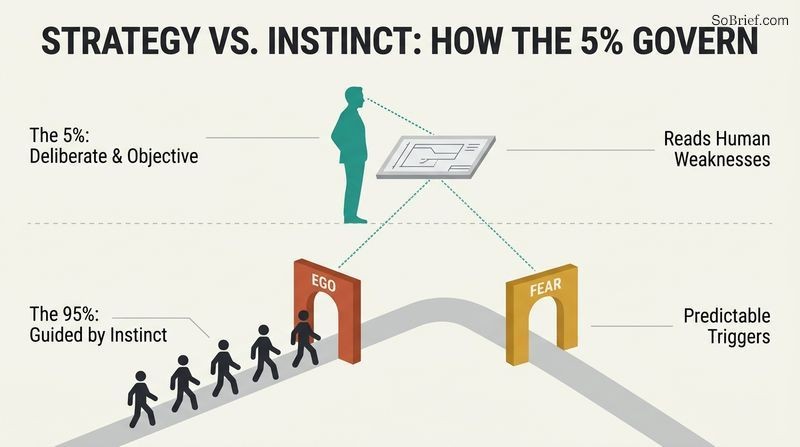
Manipulation is a learnable craft. Sparkman's premise is that a small minority consistently gets what it wants from people, while most plod along following gut instinct and lose. The difference is not charisma or luck but a working knowledge of human nature's predictable weaknesses, then exploiting them. He claims to have learned this not from his master's degree in advertising but by sharing a Houston apartment with five con artists during the 1973 oil boom, chief among them a brilliant drunk named Hardy who could sell anything and bed anyone.
Instinct is a fool's compass. The tactics feel unnatural because they run against impulse. You must shut up when you want to scream, feign indifference when you feel desperate. The sole test of any tactic, he insists, is whether it works.
What's striking is how cleanly this anticipates Robert Cialdini's later, more rigorous Influence (1984), which formalized the same street intuitions into reciprocity, scarcity, and social proof. Sparkman's "jungle epistemology" (trust only what survives real stakes) echoes Nassim Taleb's later "skin in the game." The weakness is obvious: anecdotes from five con men are not data, and survivorship bias looms large. Still, the framing that influence is a teachable skill rather than an innate gift is empowering and broadly supported by negotiation research. The honest admission that these tools are amoral, usable for civil rights or for fraud alike, gives the book an unsettling intellectual honesty.
Unpredictable rewards enslave people faster than constant kindness
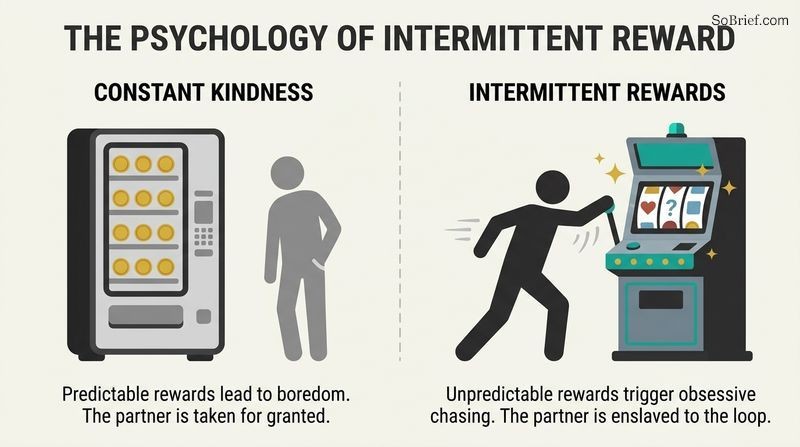
The pigeon that pecked like crazy. A caged pigeon rewarded with food every single peck pecks moderately. Rewarded never, it quits. But rewarded sometimes, unpredictably, it pecks frantically and incessantly. This intermittent reinforcement is the strongest motivator. Sparkman maps it onto a beautiful blonde he dated at eighteen who was hopelessly hooked on a man named Bill who alternated five-minute kisses with black eyes. She could never take Bill for granted, so she chased him.
Treat someone well always and you are taken for granted. The two-step method: first reinforce (charm, money, attention) seventy to ninety percent of the time, then withdraw the reward the moment they grow complacent. The person scrambles to restore it. You become the thing they cannot have.
This is genuine behavioral science, drawn from B.F. Skinner's operant conditioning, and the variable-ratio reinforcement schedule is precisely why slot machines, social media notifications, and infinite-scroll feeds are so addictive. Sparkman intuited in 1978 what attention economists now monetize at scale. The ethical problem is glaring: his central illustration is an abusive relationship, which he half-disowns while still using it as the template. Modern attachment research reframes the "hooked" partner not as a manipulation triumph but as trauma bonding, a pathology rather than a goal. The mechanism is real and powerful; presenting deliberate cruelty as a relationship strategy is the book at its most corrosive.
Radiate "I don't need you" and watch resistance collapse
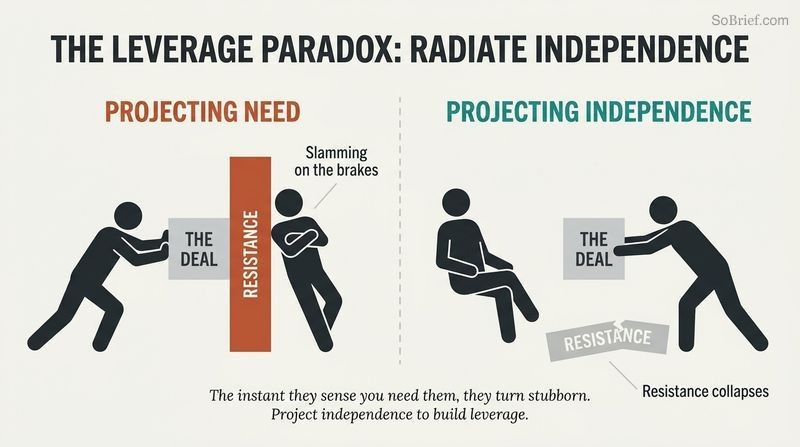
Need is the tell that kills your leverage. Sparkman calls this the essence of manipulation. The person who can walk away from a deal, or merely appear to, holds the power. The instant someone senses you need them, human nature slams on the brakes and they turn stubborn. Convince them instead that they need you, and their instincts make them receptive.
Hardy's Acapulco chart. Broke and wiring his mother for food money, Hardy sold worthless West Texas land by posting a fake sales contest chart already marked "I won my trip to Acapulco!" No customer guessed he desperately needed the commission. He told them flatly he didn't need to sell, they needed to buy. He outsold every other salesman combined. Silence, refusing to fill a pause, also broadcasts independence.
This maps directly onto modern negotiation theory. Jim Camp's Start with No and the concept of BATNA (your best alternative to a negotiated agreement) both rest on the same insight: perceived walk-away power dictates outcomes. Scarcity and playing hard to get are well-documented attraction drivers in social psychology. The nuance Sparkman flags himself is sharp: roughly five to ten percent of people give favors precisely to those who seem to need help, so the tactic backfires on rescuers and caretakers. The deeper limitation is that manufactured indifference can curdle relationships built for the long term, where genuine interdependence, not feigned detachment, sustains trust.
Keep your monthly overhead small so you can always walk away
Your "nut" is your bargaining cage. In business slang the nut is the fixed overhead that must be paid every month: rent, car notes, insurance. Sparkman argues your personal nut secretly determines your success in any negotiation. Drown yourself in payments and you cannot afford to quit a job or reject a bad deal, so you negotiate with your back to the wall and your desperation leaks out.
A small nut funds your nerve. With low fixed costs you can endure a stretch of little income, which lets you genuinely project the take-it-or-leave-it confidence that the "I don't need you" tactic requires. A large nut all but enslaves you to your boss or clients. Financial slack is not just comfort; it is negotiating ammunition.
This is one of the book's most durable and least cynical insights, and it predates the modern FIRE (financial independence) movement by decades. The mechanism connects to behavioral economics: scarcity, as Mullainathan and Shafir document in Scarcity, narrows cognitive bandwidth and pushes people toward short-term, fear-driven choices. A bloated lifestyle does not just cost money; it taxes judgment. Entrepreneurs call the same idea "runway." The advice generalizes well beyond manipulation into life design: optionality is power. The only caveat is that under-investing or hoarding can itself become a trap, but as a corrective to lifestyle inflation, the principle is genuinely valuable.
Whoever holds the money holds the power; never pay in advance
Advance payment is the hook in nearly every con. The moment you hand over cash before receiving goods, the other party can do nothing for you and you have no recourse. Suing is futile because con artists are usually broke and lawyers eat any winnings; wrecking their credit is pointless because it is already ruined; violence risks your life over a few hundred dollars. Sparkman lost eight hundred dollars to a roommate; a friend lost twenty-eight thousand to a contractor who cashed the advance check and vanished.
Practical defenses. Pay only for completed work, buy materials yourself, demand collateral on any prepayment, lend money only as a gift you can write off, hoard your keys, and pick up checks rather than trusting the mail. The same con scales identically from hundreds to hundreds of thousands.
This is the book's most practically protective chapter and remains accurate. Escrow services, milestone-based contracts, and credit-card chargebacks all exist precisely because advance payment concentrates risk on the buyer. The old Chinese proverb he cites, that lending money to a friend makes an enemy, is echoed in Shakespeare's Polonius and validated by relationship research showing financial entanglement is a leading cause of friendship and family rupture. His psychology of why loans sour is acute: the borrower consumes the benefit, then resents the lingering debt while gratitude evaporates. The collateral-between-friends advice feels cold but is arguably the kindest way to preserve a relationship through a loan.
Play dumb and eat crow; retaliation only breeds more retaliation
The meek manipulate the earth. A know-it-all posture works against you both ways: fail and you are mocked, succeed and you are resented. Worse, looking clever signals that you might be manipulating someone right now, and the hook should never be visible. Playing ignorant disarms suspicion and makes people want to help you. The genuinely successful, Sparkman observed, rarely brag; a millionaire boss and a thirty-three-year master mechanic both told him they were still learning.
Eat crow to dodge costly enemies. Discord is expensive in money and emotion; an enemy at work sabotages you for years. When someone fires a cutting remark, answering "You're probably right" deflates them, because eating crow begets eating crow just as retaliation begets retaliation. The Hollywood fantasy of the witty knockout putdown only escalates real conflicts.
Two robust ideas converge here. First, strategic incompetence and the "Columbo effect" (the detective who disarms suspects by seeming bumbling) are documented influence tactics; underestimation is an asset. Second, the retaliation point aligns with conflict-spiral research and Dale Carnegie's century-old insistence that you cannot win an argument. Modern de-escalation training teaches near-identical verbal aikido: validate, do not counterattack. The cost-of-enemies calculus also resembles game theory's repeated-game logic, where defection invites defection. The tension worth naming is that chronic crow-eating can shade into doormat passivity; the skill lies in conceding ego battles while quietly protecting the substantive interests that actually matter.
Only try to persuade people who already like you
It's all in who says it. Sparkman's first rule of thumb: manipulate only friends. People are influenced exclusively by those they like and respect. He recalls praising a movie to lukewarm girls who dismissed it, then watching them gush over the identical film moments later when their charming heartthrob endorsed it. The message did not change; the messenger did.
Sell yourself before your ideas. When he stopped giving car sales pitches and simply befriended customers, chatting about their jobs and kids, his sales exploded. All the logic of Socrates fails on someone who dislikes you, while a friend forgives your blunders and comes around anyway. So the first question before any persuasion is not "What should I say?" but "Does this person like me?" Arguing with someone who dislikes you is wasted breath.
This is one of the most empirically vindicated claims in the book. Cialdini's "liking" principle and decades of source-credibility research confirm that the communicator's likability often swamps argument quality, especially under low scrutiny (the peripheral route in Petty and Cacioppo's Elaboration Likelihood Model). Salespeople intuit it; the data confirm it. The practical reframe is powerful: stop trying to win debates and start building rapport. The limitation is scope. In high-stakes, high-scrutiny decisions (hiring a surgeon, evaluating evidence) substance can and should override likability, and the liking heuristic is precisely how charming frauds succeed. Knowing the bias protects you as much as it equips you.
Win arguments by agreeing with feelings, never with logic
The Unargue Technique. Sparkman's signature six-step method flips an argument's outcome. An argument produces an angrier enemy; Unargue produces an ex-adversary acting like a friend who lets you have your way. The steps: become friends, listen fully (then probe "Is there any other reason in addition to that?"), agree with their feelings while massaging the ego, stress shared values, state your case, and save face for them throughout.
Agree with the feeling, not the position. Instead of "Yes, but," which provokes, say "I don't blame you for feeling that way; I've felt that way myself," then share a matching experience. When stating your case, use "Nine out of ten times you'd be right, but this is unusual," and end with the disclaimer of need: "It's totally up to you." Concede a minor point so they can yield the major one and still save face.
The architecture is remarkably modern. Hostage negotiators and the Chris Voss school (Never Split the Difference) teach near-identical moves: tactical empathy, labeling emotions, and letting the counterpart feel in control. Distinguishing the validation of feeling from agreement with content is exactly what therapists and mediators do. The "nine out of ten times you'd be right" line is a textbook face-saving concession that lowers ego defenses. Where Sparkman's framing grates is intent: the same toolkit used for collaborative problem-solving is here aimed at extraction, illustrated by a man maneuvering a reluctant woman toward a motel. The technique is sound; the spirit determines whether it heals or exploits.
Smile during and after your words, and flatter judgment, not looks
Favoritism runs the world, so harness it. When executives were surveyed on what drove their success, the top answer was getting in good with the boss, not hard work. Fighting favoritism is jousting windmills; the manipulator exploits it. The cheapest tool is a precisely timed smile. Sparkman tested smiling styles on strangers and found that smiling constantly read as goofy, smiling afterward read as sarcastic, but smiling during and after a remark proved "resistance-shattering."
Flatter the ego invisibly. Blatant flattery backfires, but subtle flattery of someone's judgment lands. Three potent moves:
1. Tell them their advice actually helped you solve a problem.
2. Adopt their recommendations and report back that they were great.
3. Ask how they got into their career, then listen. A long-haired record-store owner signed a year contract simply because Sparkman asked about his struggle.
The career-origin question is gold and well grounded. People disclose autobiographical stories with measurable pleasure; neuroscience shows self-disclosure activates the brain's reward circuitry much like food or money (Tamir and Mitchell, Harvard, 2012). Letting others talk about themselves is among the most reliable rapport builders known. The smile-timing observation, while anecdotal, aligns with research distinguishing genuine Duchenne smiles from forced ones; congruent, well-timed warmth signals authenticity. The flattery-of-judgment insight is subtler than flattery of appearance because it cannot easily be faked and feels like recognition rather than seduction. The risk is that any scripted warmth, once detected, reads as exactly the manipulation it is.
Spot the manipulator: he protests too much and lost a fortune
The tells that you are about to be taken. Sparkman catalogs warning signs learned by being conned. Every con man who bilked him first insisted loudly that he could be trusted, repeating how much money he would make for him. Good terms speak for themselves; the more someone harps on your benefit, the more they gain at your expense. As Hardy put it, he pats your back to find the soft spot for the knife.
Other red flags:
1. The riches-to-rags story ("I was once a millionaire") that signals a charlatan setting you up.
2. Telling the same story differently each time, which exposes a habitual liar.
3. Lying to others in front of you, since friend status is never permanent.
4. Obsessing over trivial details (the boss who enforced a dress code while his salesmen lost all respect) marks an incompetent.
This defensive chapter is the book's gift to honest readers. The "protest too much" tell tracks deception research: liars often over-justify and over-assure, a pattern sometimes called verbal overcompensation, though detection studies caution that no single cue is reliable. The story-consistency test is essentially what investigators use, since fabrications are harder to reproduce than memories. The riches-to-rags warning anticipates the affinity-fraud playbook, where con artists manufacture credibility through claimed past success. The misplaced-priorities-as-incompetence point connects to management research on the urgent-versus-important distinction. Read defensively, these heuristics inoculate against exactly the tactics the rest of the book teaches, which may be the author's quiet redemption.
Ingratitude grows with the favor; collect repayment before you give
The Formula of Ingratitude. Sparkman's grim law: the resentment you receive is directly proportional to the size of the debt someone owes you. The benefit of your favor gets consumed and forgotten, but the heavy obligation lingers, breeds dread, and curdles into an "I'm not paying him back" attitude. He learned this by helping a friend launch a carpet business from his apartment, only to be evicted at midnight and stiffed for eight hundred dollars.
Defuse it with reinforcement and prepayment. Doing only tiny favors avoids ingratitude but makes you selfish, so pair generosity with intermittent reinforcement: make the recipient contribute, so they cannot take you for granted. Best of all, collect repayment in advance, have the friend repaint your place before you drive her cross-country, so no resentment-breeding debt remains. On loans, that means collateral up front.
The core claim resonates with La Rochefoucauld, whom Sparkman quotes, and with later research on the "beneficiary's burden," where receiving aid can threaten self-esteem and provoke resentment rather than warmth (the self-threat model of help). Reciprocity, as Marcel Mauss showed in The Gift, creates obligation that can feel oppressive. The prepayment fix is clever applied behavioral design: convert an open-ended debt into a closed transaction, removing the lingering imbalance. The cynicism is real but so is the kernel of truth, that unilateral generosity can damage relationships. The healthier reframe many would prefer is to give freely with zero expectation, which sidesteps the debt ledger entirely.
Using people ruthlessly buys you a funeral no one attends
You reap what you sow. After teaching an arsenal of exploitation, Sparkman closes with a warning rooted in observation, not morality. Every con man he lived among, charming and hilarious as they were, ended up friendless. Each had been divorced; women fled within weeks; men tired of being used. He predicts each will be the only mourner at his own funeral. Hardy, he notes, did not drink because he enjoyed it.
Selective selfishness is impossible. People imagine they will exploit strangers but stay loyal to friends. It does not work, because behavior changes little from one relationship to the next. Mistreat your enemies and you will eventually stab your friends too, like an eagle that grips a fish frozen in ice and gets dragged over the waterfall. The self-interested move, he concludes, is the golden rule.
This ending reframes the entire book as a cautionary tale wearing a how-to costume. The behavioral-consistency claim has real support: character traits show meaningful cross-situational stability, and habits, as habit researchers note, generalize across contexts. The loneliness warning anticipates findings that social connection is among the strongest predictors of wellbeing and longevity, while chronic manipulation erodes the trust those bonds require. The eagle metaphor captures path dependence neatly: small ethical compromises become identity. The argument is shrewdly pitched to the selfish reader on their own terms, that exploitation does not even pay. Whether a book teaching these tactics can credibly end here is the genuine paradox the reader is left holding.
Analysis
The Art of Manipulation is a 1978 artifact of pop psychology dressed as gonzo memoir. Its method is its hook: Sparkman claims to have apprenticed himself to five Houston con artists during an oil boom, paying tuition in stolen dollars. This "jungle epistemology," trust only what survives in conditions where deception is punished by starvation, gives the book an anti-academic swagger and a single ruthless criterion: does it work?
What makes the book hard to summarize is the gap between its mechanisms and its packaging. Strip away the lurid anecdotes (an abused girlfriend, motel seductions, fake sales charts) and what remains is a surprisingly accurate folk version of behavioral science. Intermittent reinforcement is straight Skinner. "I don't need you" is the psychology of perceived alternatives that negotiation scholars later codified as walk-away power. "Only persuade people who like you" prefigures Cialdini's liking principle and the peripheral route to persuasion. The Unargue Technique is, structurally, the tactical-empathy playbook that hostage negotiators now teach. Sparkman intuited in barrooms what universities formalized in journals.
The book's most valuable material is defensive. Its catalog of con-artist tells, the trustworthiness protests, riches-to-rags stories, inconsistent retellings, and the iron rule that whoever holds the money holds the power, is genuinely protective consumer education. A reader who absorbs only the warnings comes out ahead.
The deep tension is ethical and structural. Sparkman insists the tactics are amoral tools, like karate, then spends a closing chapter arguing that ruthless use guarantees a lonely death, because behavior generalizes and exploitation poisons the exploiter. This makes the book quietly self-subverting: a manual that concludes the manual's heaviest users all lose. Read charitably, it is a Trojan horse for the golden rule, justified on self-interest rather than virtue. Read cynically, it is exploitation with a disclaimer. Either way, the underlying observations about human nature have aged better than the seedy 1970s frame.
Review Summary
The Art of Manipulation receives mostly positive reviews, with readers praising its practical advice on understanding and avoiding manipulation. Many find the book's insights valuable for personal and professional situations. Reviewers appreciate the concise writing style and real-world examples. Some readers note the dated feel of certain concepts but still find them relevant. The book is seen as both a guide to manipulating others and a tool for recognizing manipulative behavior. Critics warn about the potential misuse of the techniques presented.
People Also Read


Glossary
Intermittent reinforcement
Unpredictable rewards create compulsive pursuitA reward pattern where someone is treated well only sometimes, unpredictably, rather than always or never. Drawn from a Skinner-style pigeon experiment, it produces the most frantic, addictive pursuit because the target can never take the reward for granted. Sparkman recommends reinforcing a person seventy to ninety percent of the time, then withdrawing the reward the instant they grow complacent, to gain puppet-like control.
The "I don't need you" tactic
Project independence to gain leverageThe core stance of Sparkman's system: subtly conveying that you do not need the other person while they need you. Because human nature turns stubborn when it senses someone's need, appearing willing to walk away tilts any negotiation, romantic or financial, in your favor. Silence and the ability to genuinely walk (a small financial "nut") reinforce it.
Nut
Your fixed monthly overheadBusiness slang for the overhead an operation must pay monthly to survive; applied personally, it means rent, car payments, insurance, and other fixed obligations. Sparkman argues a large nut destroys bargaining power by making you unable to walk away, while a small nut funds the confidence and independence that effective manipulation requires.
Unargue Technique
Six-step persuasion that avoids arguingSparkman's signature method for changing someone's mind without a fight: (1) become friends, (2) listen fully and probe for the real objection, (3) agree with their feelings while soothing the ego, (4) stress shared values, (5) state your case using the "nine out of ten times you'd be right" framing plus a disclaimer of need, and (6) save face for them throughout.
Formula of Ingratitude
Resentment scales with favor sizeSparkman's claim that the ingratitude you receive is directly proportional to the size of the debt a person owes you. The favor's benefit is consumed and forgotten while the obligation lingers and breeds resentment. He recommends defusing it with intermittent reinforcement or by collecting repayment in advance, including taking collateral on loans.
Guernsey versus the Brahma
Persistence beats positive attitudeA metaphor contrasting an orphaned Guernsey calf that gives up and starves with a Brahma calf that stubbornly keeps nursing until it succeeds. Sparkman uses it to argue that Brahma-like persistence, not a chanted "positive attitude," drives success, because positive attitude collapses under hard times while persistence is a decision you can sustain through failure.
The three-second tactic
Read true feelings in eyesHardy's method for uncovering hidden feelings: surprise someone with a direct question while watching the area around their eyes. For roughly three seconds before they regain composure, their face reveals their genuine reaction, exposing lies or true intentions. Sparkman notes psychological studies have observed a similar brief window of unguarded emotional leakage.
FAQ
What's "Art of Manipulation" about?
- Overview: "Art of Manipulation" by R.B. Sparkman is a guide on how to influence and control people in various aspects of life, including business, personal, and romantic relationships.
- Focus on Techniques: The book details specific tactics used by manipulators to get what they want, emphasizing practical, street-smart methods over theoretical approaches.
- Human Nature: It explores the quirks of human nature that make people susceptible to manipulation, such as the desire for things they can't have.
- Real-Life Examples: Sparkman uses anecdotes from his experiences with con artists to illustrate how these manipulation techniques work in real-world scenarios.
Why should I read "Art of Manipulation"?
- Practical Insights: The book offers practical insights into human behavior and how to leverage it for personal gain.
- Self-Defense: Understanding these tactics can help you recognize when others are trying to manipulate you, allowing you to protect yourself.
- Improved Relationships: By learning these techniques, you can improve your ability to influence others positively and ethically.
- Unique Perspective: The book provides a unique perspective by drawing on the author's experiences with con artists, offering a gritty, real-world view of manipulation.
What are the key takeaways of "Art of Manipulation"?
- Intermittent Reinforcement: This is a powerful tool for manipulation, exploiting the human desire for things they can't have by alternating between positive and negative reinforcement.
- Favoritism and Friendship: Building relationships and leveraging favoritism can significantly enhance your ability to influence others.
- "I Don't Need You" Tactic: Conveying independence and making others feel they need you more than you need them is crucial for successful manipulation.
- Listening and Agreement: Listening to objections and agreeing with feelings, not necessarily viewpoints, can disarm resistance and open people up to your influence.
How does "Art of Manipulation" define manipulation?
- Influence and Control: Manipulation is defined as the ability to influence and control others to achieve your desired outcomes.
- Exploiting Human Nature: It involves exploiting human tendencies, instincts, and weaknesses to persuade others against their will.
- Practical Application: The book emphasizes that manipulation is not about morality but about what works in real-life situations.
- Street Wisdom: The techniques are based on street wisdom and practical experience rather than academic theories.
What is the "Intermittent Reinforcement" technique in "Art of Manipulation"?
- Concept: Intermittent reinforcement involves giving rewards sporadically rather than consistently, making the recipient crave the reward more.
- Human Nature: It exploits the human tendency to want what they can't have, making them more eager to please the manipulator.
- Application: This technique can be used in personal relationships to keep someone interested and in business to maintain leverage.
- Effectiveness: It is considered one of the most potent motivators for getting desired behavior from others.
How can "Art of Manipulation" help in business settings?
- Favoritism: The book explains how to use favoritism to your advantage by building relationships with key decision-makers.
- Negotiation Tactics: It provides strategies for negotiating deals by making the other party feel they need you more than you need them.
- Understanding Motives: By understanding the real motives and feelings of others, you can tailor your approach to influence them effectively.
- Avoiding Financial Cons: The book offers advice on how to avoid being taken advantage of in financial dealings by watching where the money is.
What are some specific tactics from "Art of Manipulation"?
- "I Don't Need You" Tactic: This involves making others feel that you are independent and they need you more, giving you leverage.
- Listening and Agreement: Listening to objections and agreeing with feelings can disarm resistance and make others more open to your influence.
- Playing Dumb: Acting as if you know less than you do can make others underestimate you, giving you an advantage.
- Unargue Technique: A method for manipulating someone against their will by making them feel like they are not being argued with.
What are the best quotes from "Art of Manipulation" and what do they mean?
- "People want what they cannot have." This quote highlights a fundamental aspect of human nature that manipulators exploit through intermittent reinforcement.
- "The person with the upper hand in any situation is the one who can afford to walk away." This emphasizes the power of independence in negotiations and relationships.
- "If you take advantage of some people, you'll take advantage of anyone." This warns against the slippery slope of using people, suggesting that behavior is consistent across relationships.
- "Manipulation is not about morality; it's about what works." This underscores the book's focus on practical, effective techniques rather than ethical considerations.
How does "Art of Manipulation" suggest handling ingratitude?
- Intermittent Reinforcement: By withdrawing reinforcement occasionally, you prevent others from taking your generosity for granted.
- Predicting Ingratitude: The book suggests that the greater the favor, the more likely you are to encounter ingratitude, allowing you to prepare accordingly.
- Collecting Repayment in Advance: To avoid ingratitude, collect repayment for favors before performing them, ensuring no debt remains.
- Understanding Human Nature: Recognizing that ingratitude stems from the dread of repayment can help you manage your expectations and interactions.
How can "Art of Manipulation" improve personal relationships?
- Intermittent Reinforcement: Use this technique to keep partners interested by alternating between positive and negative reinforcement.
- Building Favoritism: Cultivate relationships by leveraging favoritism, making others more inclined to do things your way.
- Listening and Agreement: Disarm resistance by listening to objections and agreeing with feelings, not necessarily viewpoints.
- Avoiding Arguments: The book advises letting sleeping dogs lie if they don't affect your vital interests, reducing unnecessary conflict.
What are the risks of using manipulation as described in "Art of Manipulation"?
- Loneliness: The book warns that using people can lead to loneliness, as others will eventually catch on and distance themselves.
- Consistent Behavior: It suggests that behavior changes very little, meaning if you use some people, you'll likely use everyone, including friends.
- Moral Considerations: While the book focuses on what works, it acknowledges that manipulation can be used for selfish ends, which may not align with ethical standards.
- Potential Backfire: Manipulation can backfire if others recognize your tactics, leading to mistrust and damaged relationships.
How does "Art of Manipulation" suggest dealing with financial dealings?
- Watch the Money: The book advises keeping control of the money to maintain power in financial transactions.
- Avoid Advance Payments: It warns against making advance payments, as this shifts control to the other party.
- Collateral for Loans: Insist on collateral when lending money to friends to avoid resentment and ensure repayment.
- Recognizing Cons: By understanding common cons, you can protect yourself from being taken advantage of financially.
Download PDF
Download EPUB
.epub digital book format is ideal for reading ebooks on phones, tablets, and e-readers.








































