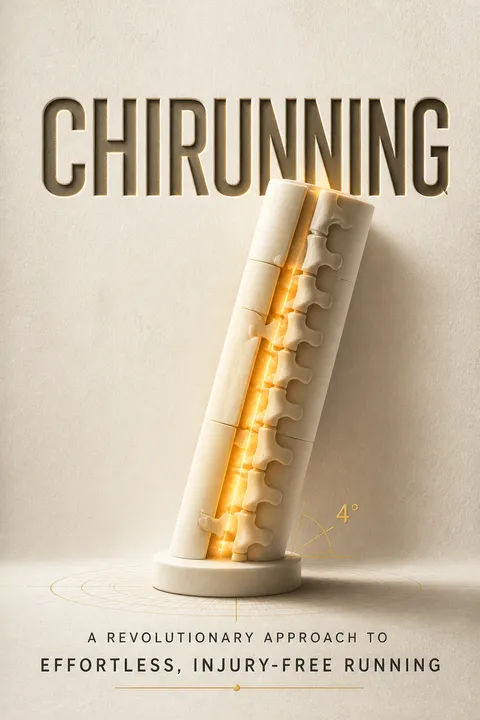
Key Takeaways
1. Running doesn't injure bodies; poor running form does
The conclusion I’ve come to after teaching countless runners is that running does not hurt your body. Let me repeat that—and you can read my lips—running does not hurt your body. It’s the way you run that does the damage and causes pain.
The injury epidemic. Western running culture is dominated by "power running," a muscle-bound approach that relies on brute leg strength and results in a staggering 65% annual injury rate. This "no pain, no gain" paradigm forces runners to push off with their toes and strike heavily on their heels, turning every step into a high-impact collision.
Form over force. ChiRunning shifts the focus from building bigger leg muscles to refining biomechanical efficiency and structural alignment. By correcting poor running form, runners can eliminate the root causes of common ailments like shin splints, runner's knee, and plantar fasciitis.
A natural movement. Children run with perfect, effortless form because they are relaxed, playful, and structurally aligned. To reclaim this childhood joy, adults must systematically unlearn years of accumulated physical tension and stress.
- Power running relies on muscle strength, leading to fatigue and high impact.
- ChiRunning emphasizes relaxation, structural alignment, and energy efficiency.
- Over 60% of running injuries are caused by overtraining and poor biomechanics.
- Reclaiming natural form requires conscious reeducation of the mind and body.
2. Cooperate with gravity and the road instead of fighting them
In T’ai Chi one of the first things we are taught is that the best way to deal with a force is to cooperate with it, not oppose it.
Allies in motion. Every runner must constantly negotiate two powerful external forces: the downward pull of gravity and the oncoming force of the road. Power runners fight gravity by staying vertical and fight the road by landing with a braking heel strike in front of their bodies.
Gravity-driven propulsion. By tilting your entire body forward from the ankles, you transform your posture into a forward-falling column. Gravity naturally pulls your center of mass forward, meaning your legs no longer have to push, but simply catch your fall.
Neutralizing road impact. Landing with a midfoot strike directly under your center of mass allows the road to slide harmlessly behind you. This eliminates the braking effect of heel striking, turning the road's rearward force into a mechanism that swings your legs back.
- Vertical running forces the legs to act as both the gas pedal and the brakes.
- Leaning forward enlists gravity as a free source of forward propulsion.
- Midfoot striking under the hips eliminates the high-impact braking force.
- Cooperating with natural forces reduces muscle fatigue and joint wear.
3. Master the "Needle in Cotton" by aligning your core and relaxing your limbs
The phrase “needle in cotton” describes the feeling that a T’ai Chi practitioner should have while doing the form. You align your body and concentrate chi energy to your center, while your arms and legs are as soft as cotton, holding no tension.
The central axis. The "needle" represents your straight, strong, and aligned spine, which acts as the central axis of rotation. By gathering your physical and mental energy to this centerline, your skeletal structure supports your weight instead of your muscles.
Cotton-soft limbs. With your structural column securely aligned, your arms and legs can relax completely and become as soft as cotton. This relaxation allows your limbs to swing freely without creating internal resistance or wasting precious energy.
Core-driven movement. In ChiRunning, all movement originates from your center (the dan tien) and radiates outward to the periphery. When your center rotates, your relaxed limbs are simply pulled along for the ride, mimicking the natural efficiency of a spinning wheel.
- The "needle" is the aligned spine that structurally supports body weight.
- "Cotton" represents relaxed, tension-free limbs that offer no resistance.
- Movement originates in the core (dan tien) rather than the legs.
- Aligning the spine allows life-force energy (chi) to flow unhindered.
4. Use Body Sensing as your high-speed internal feedback loop
Body Sensing is the skill of having your mind and your body working together as a team.
High-speed communication. Body Sensing is the essential skill of listening to the subtle physical feedback your body provides during movement. It replaces mental static and judgmental thoughts with objective, real-time data collection about your alignment and tension levels.
The three-step loop. To master any physical adjustment, you must follow a systematic three-step process: listen carefully to your body's sensations, assess the information objectively, and adjust your form incrementally. This loop prevents you from overcorrecting or forcing unnatural movements.
The mirror of truth. Many runners have a discrepancy between what they think their body is doing and what it is actually doing. Regular body scans and tools like video analysis or mirror exercises help align your physical perception with reality.
- Body Sensing establishes a clear, non-judgmental mind-body communication link.
- The three steps are: 1. Listen carefully, 2. Assess objectively, 3. Adjust incrementally.
- Regular body scans from head to toe identify and release hidden tension.
- Video feedback helps bridge the gap between physical perception and reality.
5. Level your pelvis and engage your core to stabilize your Column
Keeping your pelvis level does two things: it strengthens your core muscles (lower abdominals), allowing you to hold your Column straight when running, and it brings your focus to your center, where your true power lies, allowing you to 'contain' your chi.
The level bowl. Think of your pelvis as a bowl filled with water; if it tilts forward or backward, the water spills, and your structural integrity collapses. Leveling your pelvis requires a subtle "vertical crunch" that engages your lower abdominals and flattens your lower back.
Structural column alignment. When your pelvis is level, your shoulders, hips, and ankles align to form a solid, vertical Column. This structural alignment allows your bones to bear the load of running, instantly relieving your quads and lower back from chronic strain.
Preventing lateral sway. A disengaged core causes the pelvis to sway side-to-side, which is the primary driver of hip bursitis and iliotibial band syndrome. Stabilizing your pelvis through core engagement ensures that your hips rotate cleanly around your spine's vertical axis.
- Leveling the pelvis requires engaging the lower abs via a "vertical crunch."
- An aligned Column allows the skeletal structure to support body weight.
- A tilted pelvis spills energy (chi) and compresses the lower back.
- Core stability prevents the lateral hip sway that causes IT band syndrome.
6. Let gravity be your gas pedal through a controlled forward lean
Your lean is your 'gas pedal.' If you want to go faster, you lean slightly more, in very small increments, and if you want to run slowly, you lean less.
Ankle-hinged falling. Leaning in ChiRunning is not bending at the waist; it is a straight-line tilt of your entire Column from your ankles. Your ankles act as hinges, allowing your center of mass to fall forward in front of your feet.
Effortless acceleration. To increase your speed, you simply increase your forward lean by tiny, one-inch increments, allowing gravity to pull you faster. This shift removes the need to push off with your legs, preserving your muscle glycogen for longer distances.
The window of balance. Finding the "sweet spot" of your lean requires balancing yourself so your lower legs remain completely relaxed. If you lean too far, your calves and shins will clench to prevent you from falling; if you lean too little, your legs must push.
- Leaning must occur from the ankles, keeping the Column perfectly straight.
- Bending at the waist overworks the lower back and disengages the core.
- Speed is controlled by the angle of the lean, not by leg muscular push.
- The "window of lean" is reached when the calves and shins are fully relaxed.
7. Keep your lower legs passive by peeling your feet and landing midfoot
In ChiRunning, you won’t be pushing yourself forward with each stride. In fact, all you have to do is pick up your feet to keep up with your forward fall.
The passive lower leg. Pushing off with your toes and calves is a highly inefficient habit that causes vertical bouncing and severe muscle fatigue. ChiRunning advocates for a "passive lower leg," where your lower extremities are used strictly for support, not propulsion.
Peeling the foot. Instead of pushing off, focus on peeling your foot off the ground, heel first, as if removing a stamp from a roll. This action uses your powerful core psoas muscles to lift your ankles, leaving your calves, shins, and toes completely limp.
The midfoot strike. By combining a relaxed lower leg with a forward lean, your foot naturally lands in a soft, balanced midfoot strike. This landing distributes impact evenly across the entire foot, eliminating the destructive shock waves of heel striking.
- Pushing off with the toes causes vertical bouncing and overworks the calves.
- Peeling the foot heel-first engages the core psoas muscles for lifting.
- A midfoot strike distributes impact evenly and prevents braking.
- Keeping the ankles and toes limp eliminates shin splints and plantar fasciitis.
8. Unlock pelvic rotation at the T12/L1 pivot point to lengthen your stride
Allowing your pelvis to rotate allows the road to move right on by, without sending any of that force into your body.
The spinal pivot. Pelvic rotation is the ultimate key to a smooth, injury-free, and long stride. The rotation occurs at the T12/L1 joint of your spine—the Pivot Point—where your lower body effectively begins and swings like a chandelier.
Passive stride length. When your pelvis rotates, your leg is allowed to swing fully to the rear, naturally lengthening your stride behind your body. This rearward stride length is achieved without reaching forward with your legs, which would cause a braking heel strike.
Shock absorption. A rotating pelvis acts as a natural shock absorber, cooperating with the oncoming force of the road. If your pelvis remains rigid, your knees, hips, and lower back must absorb the full impact of every step.
- The Pivot Point at T12/L1 allows the lower body to rotate independently.
- Pelvic rotation naturally extends the stride behind the body.
- Reaching forward with the legs causes high-impact heel striking.
- A rotating pelvis neutralizes road impact and protects the joints.
9. Maintain a constant cadence and shift gears using stride length
In ChiRunning there’s one thing that never changes: your cadence. That’s the rate at which your feet strike the ground, measured in strides per minute.
The constant rhythm. Unlike power running, where cadence increases with speed, ChiRunning maintains a steady, rhythmic cadence of 85 to 90 strides per minute. This constant turnover keeps your feet on the ground for the shortest possible time, minimizing weight-bearing stress.
Shifting gears. To change your speed, you shift gears by adjusting your stride length, which is controlled entirely by your angle of lean. A greater lean opens up your stride behind you, while a vertical posture shortens it for slower speeds or uphills.
The metronome advantage. Training with a metronome is the most effective way to lock in a steady cadence and teach your body to adjust its stride length. Matching your footfalls to a consistent beat forces your legs to move in highly efficient, circular patterns.
- Optimal cadence is a constant 85 to 90 strides per minute.
- Stride length (gears 1-4) is adjusted by changing the angle of the lean.
- A fast, steady cadence minimizes the time spent supporting body weight.
- Metronomes are invaluable tools for training a consistent, rhythmic stride.
10. Run as you live by transforming running into a mindful practice
Making an activity a practice is a process of self-mastery. You are no longer simply practicing that activity; you use it to learn about, understand, and master yourself as well as the activity.
A moving meditation. ChiRunning elevates running from a purely physical sport to a mindful, lifelong practice of self-mastery. By focusing on internal sensations rather than external results, your runs become a moving meditation that cultivates presence and mental clarity.
The lesson of non-identification. Non-identification teaches you to observe your body's challenges, fatigue, or discomfort without judgment or ego. This mindful approach allows you to make objective, body-friendly adjustments instead of forcing your way through pain.
Spilling over into life. The physical and mental skills developed on the road—alignment, relaxation, breathing, and focus—naturally spill over into your daily life. By learning to run from your center, you learn to live from your center, meeting life's challenges with grace.
- Transforming running into a practice shifts the focus from goals to the process.
- Non-identification helps you listen to your body instead of your ego.
- The four Chi-Skills (Focusing, Sensing, Breathing, Relaxing) apply to daily life.
- Running from your center teaches you to live from a place of centered calm.
People Also Read








Download PDF
Download EPUB
.epub digital book format is ideal for reading ebooks on phones, tablets, and e-readers.








































