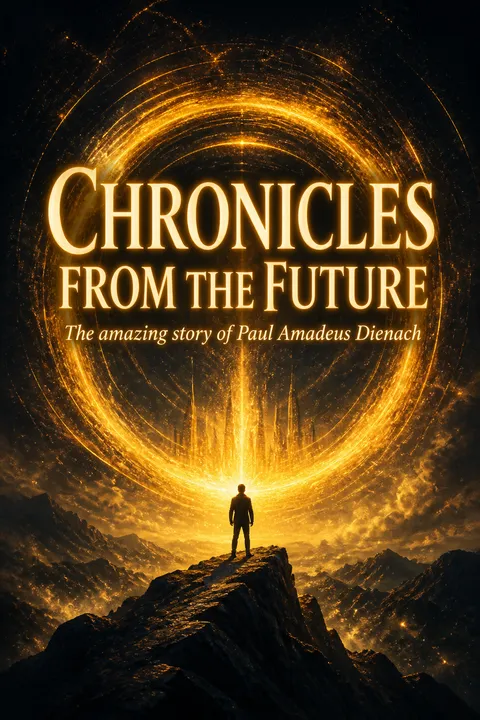


Key Takeaways
A dying teacher claimed he lived a year in the year 3906
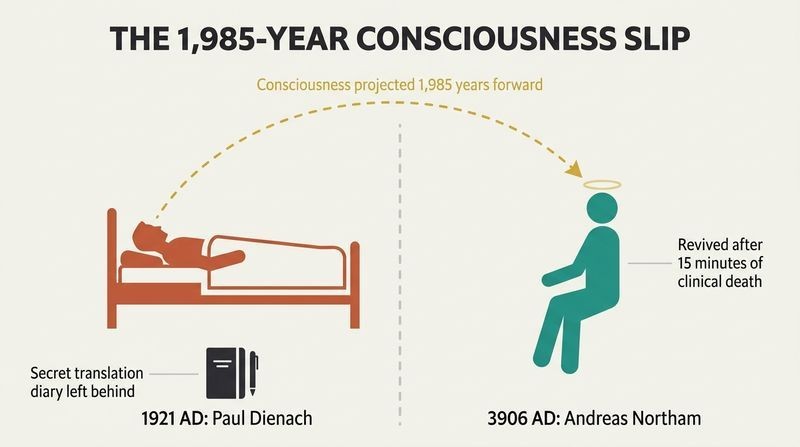
The premise is audacious. Paul Amadeus Dienach, a frail Swiss-Austrian teacher, fell into a year-long coma around 1921 from encephalitis lethargica. He claimed his consciousness slid forward nearly two thousand years, inhabiting the body of Andreas Northam, a man revived after fifteen minutes of clinical death in 3906 AD. Fearing ridicule, Dienach told no one, but secretly wrote everything down before dying of tuberculosis around 1924.
He entrusted his diary to a young Greek student, George Papachatzis, ostensibly as German translation practice. Papachatzis slowly realized the notes described the future. The book presents itself not as fiction but as parapsychological testimony, a chronicle smuggled backward through time by a sick, lonely, unremarkable man who insisted every impossible thing he described was seen with his own eyes.
What's striking is how the framing device mirrors classic utopian literature from Thomas More to Edward Bellamy's Looking Backward, where a sleeper awakens in a transformed society. The book demands readers suspend disbelief about consciousness traveling through time, a claim modern neuroscience would attribute to elaborate confabulation during febrile delirium. Yet the value does not hinge on literal truth. Whether prophecy or projection, the text functions as a thought experiment: what would humanity look like if moral evolution outpaced technological progress? The choice of an ordinary, self-described mediocre narrator is rhetorically shrewd, since a genius could have invented it, but a simple man supposedly could not.
Humanity's future crisis is overpopulation, not war or scarcity
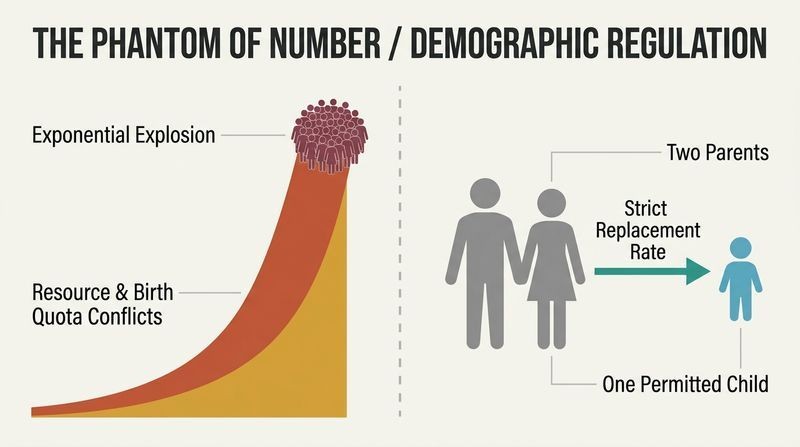
Dienach reports that the centuries after ours are dominated by what the future calls the phantom of number. As population explodes, the old fights over trade, energy, and territory give way to brutal conflicts over birth rates and replacement quotas. Famines ravage Asia and Africa; even industrial Europe faces malnutrition. A medium-scale nuclear war around 2309 AD devastates the continent.
The eventual solution is radical demographic regulation. In 3906, each couple may have one child and must apply to the Office Partners for permission, waiting roughly a year for their turn. The goal is a stable replacement rate so no generation outgrows the last. What was once unthinkable coercion becomes, over centuries, quiet consensus, because people are educated to see it as a matter of survival and human dignity.
Written by a man of the early twentieth century, this fixation on overpopulation echoes the Malthusian anxieties that peaked decades later with Paul Ehrlich's The Population Bomb (1968) and the Club of Rome. History complicated the prophecy: fertility rates across developed nations have collapsed below replacement without coercion, driven by female education, urbanization, and contraception. The book's grimmest predictions about racial demographic conflict read as disturbing artifacts of interwar European thinking. Yet the underlying insight, that carrying capacity and resource distribution shape political order more than ideology, remains a serious theme in ecological economics and debates over planetary boundaries.
Two years of work at seventeen earns a lifetime of freedom
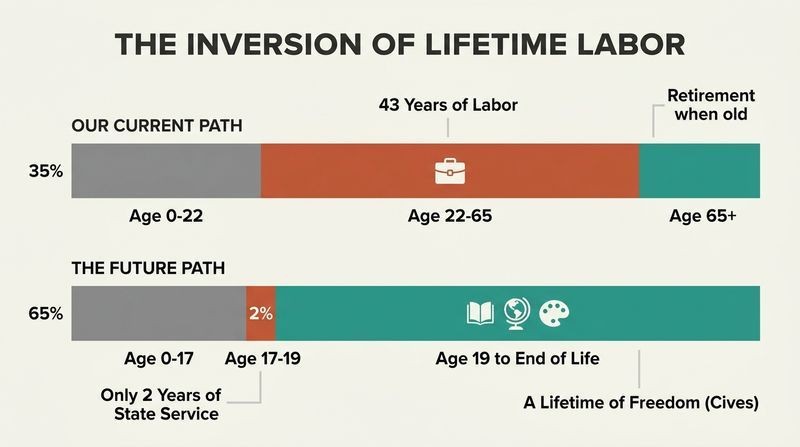
The future's economic backbone is a universal service system. Between ages seventeen and nineteen, every person, regardless of future status, works in the glothners (vast state-owned industrial cities), producing everything from combs to construction. After these two years, they become Cives (full citizens) and never need to work for money again. Goods are distributed based on need, not contribution, in such abundance that theft and hoarding have vanished.
Stefan, Dienach's guide, once made combs and speaks of it with pride. Freed from labor, most people spend life traveling, loving, studying, and appreciating art. This inverts our arrangement, where retirement arrives when one is too old to enjoy it. The society deliberately keeps service short, reasoning that excess wealth would only enslave people to ambition and rob them of inner cultivation.
The design resembles a national service model fused with post-scarcity economics, anticipating later speculation by Keynes on the fifteen-hour work week and contemporary universal basic income experiments. Automation supplies the abundance that makes distribution-by-need feasible, a premise echoed in Aaron Bastani's Fully Automated Luxury Communism. The sharpest observation is psychological rather than economic: front-loading unpleasant labor into youth, when energy is high and the sacrifice is shared, then releasing people into decades of freedom. It challenges our assumption that meaning requires lifelong career striving. The obvious tension, that a society of non-workers might drift into aimlessness, is one the narrator himself repeatedly notices among his cheerful, childlike hosts.
Rank people by inner cultivation, not wealth or power
In 3906, social hierarchy is purely spiritual and cultural. At the top sit the Lorffes, Ilectors, and great artists and thinkers, honored with love, respect, and symbolic palaces but granted no material advantage or coercive power over others. A humble nurse or physician outranks a comfortable idle citizen. The only currency of status is contribution to knowledge, art, and human understanding.
Strikingly, this ruling intelligentsia descends from what were once industrial workers. Around 2600 AD, scientists and technicians replaced politicians as global governors, and over centuries all forms of penalty, enforcement, and bureaucracy withered away. The Troende (the new human being) simply cannot do wrong, not from law but from deeply implanted respect for every person as a whole inner world. The defeated beast of bureaucracy is remembered as a monster slain.
This vision of authority as moral prestige rather than command power resonates with Michael Young's satirical coinage of meritocracy (1958) and with sociologist Max Weber's distinction between charismatic and legal-rational authority. The claim that penalties become obsolete because citizens are educated into virtue optimistically sidesteps the darker lesson of twentieth-century social engineering, where attempts to manufacture a new human often required immense coercion. Still, the emphasis on cultivating internal restraint rather than external enforcement aligns with virtue ethics from Aristotle to Confucius, and with modern findings that societies high in interpersonal trust need fewer formal controls. The blind spot is how such uniform virtue emerges without suppressing dissent.
All civilization springs from one hidden thirst: the Samith
The book's metaphysical core is the Samith, a coined term for the whole of objective reality, its true essence forever inaccessible to human minds. Dienach argues that every religion, artwork, act of love, and scientific pursuit throughout history flows from a single unconscious source: the soul's nostalgia and thirst for the Samith, the pain of being separated from it. This metaphysical ache, not economics (Marx), sexual repression (Freud), or power (Adler), is the deepest origin of all culture.
A great symphony, a martyr's sacrifice, a lover's devotion: each is a reflection of the Samith, a desperate attempt to touch something the human mind cannot grasp. Civilizations rise and fall, but the thirst behind them never changes. This is why the greatest artists always feel unsatisfied; they sense the infinite they can never reach.
This is essentially a monist metaphysics dressed in invented vocabulary, closely tracking Kant's das Ding an sich (the thing-in-itself we cannot know), Schopenhauer's Will, and Platonic longing for the Forms. The idea that art and religion express an inexpressible transcendent reality also echoes Rudolf Otto's numinous and Aldous Huxley's perennial philosophy. The bold move is reducing all human striving to a single metaphysical hunger, an elegant but unfalsifiable synthesis. Critics would note it explains everything and therefore predicts nothing. Yet as a phenomenology of yearning, of why satisfaction always recedes, it captures something real that psychology labels the hedonic treadmill and existentialists called the restless heart.
A new mental organ, the Nibelvirch, ended metaphysical doubt forever
The pivotal event in future history is the Nibelvirch, a term coined by the Aidersen Institute for a new cognitive faculty beyond intellect and reason. In 3382 AD, a monk named Alexis Volky became the first to survive its overwhelming force and directly perceive the existence (though never the essence) of the Samith. This granted humanity a new antenna, the Oversyn, transforming Homo sapiens into Homo Occidentalis Novus, the enlightened human of the new era.
This was not knowledge taught from outside but light felt from within, ending millennia of doubt about God, afterlife, and purpose. The society divides history at this moment: the Eldere (old technological era) and the Nojere (new enlightened era). Crucially, it came not through technology but through five centuries of disciplined inner cultivation at the Valley of the Roses.
The Nibelvirch functions as a fictional evolutionary leap in consciousness, resonating with Teilhard de Chardin's Omega Point and Julian Jaynes's controversial theory that human cognition itself has transformed across history. The insistence that this breakthrough came from inner discipline rather than machines is the book's central polemic against technological utopianism. Notably, the text hedges carefully: humans perceive that the Samith exists but never what it is, preserving mystery and avoiding the trap of claiming complete knowledge. Skeptics will recognize this as the structure of mystical experience universalized and made permanent, raising the question of whether a society-wide unfalsifiable certainty is enlightenment or a sophisticated shared faith.
Guard joy fiercely; suppressing it silently kills the soul
Dienach's future dwellers retain childlike wonder into old age. They weep at a symphony, watch ants for hours, celebrate the change of seasons, and treat a full moon as an event. Their motto is a return to the early joys of childhood. Stefan condemns Dienach's twentieth century not mainly for poverty or war but for systematically strangling joy, letting souls age prematurely through relentless routine, anxiety, and the suppression of every fine feeling.
Joy, in this view, is food for the soul and a reflection of the Samith. The daily grinding down of enthusiasm was, Stefan argues, a greater and more unjust loss than we ever realized, because we could not even perceive what was being stolen from us. The future's happiness costs nothing; it lives in sunbeams, birdsong, and noble thought.
This anticipates positive psychology's findings on savoring and awe, notably Dacher Keltner's research showing awe experiences reduce self-focus and increase wellbeing and prosocial behavior. The claim that emotional suppression causes cumulative harm aligns with research on alexithymia and the health costs of chronic stress. The book frames modern efficiency culture as spiritually corrosive decades before burnout entered the lexicon. One useful challenge: the childlike wonder Dienach describes is only possible because material needs are fully met and death anxiety is dissolved by the Nibelvirch. Whether preserved wonder is achievable amid genuine hardship, or whether some struggle is necessary for depth, the book leaves productively unresolved.
Treat every person as a whole inner universe, never a number
The future's deepest moral principle is that each human being is an entire inner world of dreams, love, and sacred suffering, never to be reduced to living material or a statistic. This is why they revile history's tyrants, whom they call the beasts, and why teacher Lain condemns leaders like Napoleon for saying one night suffices to replace a lost army.
Remarkably, the future honors anonymous everyday heroes as much as famous ones: reformed convicts, self-sacrificing parents, unknown martyrs. The Temple of the Unsung Martyrs holds a great annual pilgrimage mourning our era's forgotten victims: children who starved while others wasted food, the homeless who froze, the sick who died without money. They pay tribute we never paid to the casualties of our own way of living.
This ethic of infinite individual worth echoes Kant's categorical imperative to treat persons as ends never merely as means, and the Talmudic principle that to destroy one life is to destroy a world. The commemoration of the anonymous forgotten inverts standard historiography, which tends to record kings and generals, aligning with the social history movement and Walter Benjamin's call to brush history against the grain by remembering the nameless defeated. The book's moral seriousness peaks here. Yet a tension surfaces: the same society enforces strict demographic limits and separates soldier-citizens from their families in childhood, showing that even a civilization worshipping individual worth still subordinates individuals to collective survival.
Technological progress without moral maturity breeds a barbaric race
Dienach's guides diagnose our era, which they call prehistory and the new Dark Ages, as suffering from one-sided development: dazzling technical achievement paired with spiritual emptiness. A civilization that cultivates only the intellect, they warn, becomes materially almighty but barbaric within, with no gentleness, no inner culture, and a vast void where the soul should be.
Tellingly, the future's own technology has declined from its ancient peak. Their ancestors colonized Mars around 2204 AD (the colony collapsed, killing twenty million), built artificial rivers and controlled climate. The people of 3906 could not replicate these feats and do not want to. Having satisfied material needs, they redirected energy toward moral and spiritual evolution. Their superiority over us is measured in centuries of inner culture, not gadgets.
This is the book's thesis and its most durable warning: that instrumental progress can outrun ethical wisdom, a fear voiced by thinkers from Oswald Spengler (whom the text explicitly invokes) to Lewis Mumford and contemporary critics of artificial intelligence. The deliberate abandonment of technological maximalism, choosing sufficiency over endless growth, prefigures degrowth economics and E.F. Schumacher's Small Is Beautiful. The Mars catastrophe serves as a parable against hubris. The framework's weakness is its sharp binary between technical and spiritual culture, since history suggests they often advance together, as in Renaissance Florence or the scientific revolution's entanglement with theology. Still, the caution against valuing capability over character lands with force.
Wait for love; abstinence and quality deepen it beyond passion
In 3906, love is redefined as the Lipvirch, a profound heart-connection considered a direct reflection of the Samith, distinct from mere physical attraction. Young people practice abstinence until nineteen, and even after, many wait years for the right partner rather than rushing. Relationships are free of legal contracts, jealousy, and deceit; partners tell each other the truth, and separation, when it comes, is handled with dignity and mutual care.
Dienach's own romance with Silvia embodies this. What makes love holy, they insist, is not intensity but quality of emotion. Stefan argues that seeing a partner clothed under moonlight preserves more genuine longing than nudity, and that suppressing easy gratification actually heightens spiritual depth. The old violent passions and dramatic tragedies of our era have, they claim, largely disappeared.
The elevation of restraint and delayed gratification as intensifiers of romantic depth inverts modern liberationist assumptions but finds support in research on how anticipation and scarcity amplify desire, and in older traditions of courtly love. The framing of honesty and equality as the foundation of partnership anticipates contemporary ideals of ethical non-monogamy and secure attachment. However, the narrator himself, an incurable romantic writing partly to continue a lost love with the dead Anna, is a suspect witness, and skeptics of the whole diary read Silvia as wish-fulfillment. The claim that heartbreak persists even in utopia (they suffer, but know why) is the honest, humanizing touch.
Use engineered fear of the past to inoculate the future
The future preserves its peace partly through a deliberate educational method: exposing children to horrifying recreations of our era's wars and atrocities via the Reigen-Swage (an immersive sound-and-image projection technology). Young students, watching cities consumed by firestorms, first assume it must be an alien invasion, then recoil in disbelief upon learning humans did this to themselves. They clench their fists and swear never to let it return.
Dienach finds this cultivation of anxiety cruel and questions whether it is fair or necessary. The educators believe it is essential to implant devotion to their institutions and rule out any future backsliding into barbarism. The society treats historical memory as a vaccine: a controlled dose of horror to build lasting immunity against the diseases of anarchy, war, and dehumanization.
This is one of the book's most ambivalent passages, and Dienach's discomfort makes it credible. The technique resembles how post-war Germany institutionalized Holocaust remembrance as moral pedagogy, and how museums like Hiroshima's Peace Memorial deploy visceral horror to sustain resolve. Psychology offers mixed verdicts: fear-based messaging can motivate but also traumatize or backfire through desensitization. The narrator's ethical unease, his sense that terrorizing children is intolerable even in service of peace, prevents the future from reading as flawless. It quietly asks whether any utopia can maintain itself without some form of ideological conditioning, a question that haunts every engineered society from Plato's Republic onward.
Nothing is ever lost; time may be an eternal present
The book's consoling metaphysical claim is that linear time (yesterday, today, tomorrow) is merely a limitation of human perception, not objective reality. The true nature of time may be an everlasting present in which nothing that has existed is ever destroyed. Dienach's guides insist the time-space continuum is no barrier to the spirit, and that consciousness persists and re-manifests across lives and worlds.
This frames Dienach's entire experience. When he asks whether his mother has truly ceased to exist, Jaeger gently questions the assumption. The diary closes with Dienach reuniting the memory of his dead love Anna with Silvia on the same flowered hill, weeping that their old dreams were real all along. The moment he finally feels sleepy, he awakens back in 1921, the consciousness slide reversed.
The eternalist view of time, that past, present, and future coexist, is not mere mysticism; it maps onto the block universe implied by Einstein's relativity, where simultaneity is observer-dependent and no privileged now exists. Physicists from Hermann Weyl to Brian Greene have taken this seriously, and Dienach's phrasing (an everlasting present) is remarkably close. The consolation that nothing is lost echoes Buddhist and Stoic acceptance of impermanence resolved into permanence. As narrative craft, ending on the reversal (falling asleep in the future means waking in the past) is elegant closure. Whether metaphysical truth or a dying man's comfort, the idea reframes grief as a failure of perception rather than a fact.
Analysis
Chronicles From The Future is best understood not as literal prophecy but as a hybrid genre: part utopian speculation, part spiritual manifesto, part disguised confession of grief. Structurally it nests three narrators: editor Sirigos, translator Papachatzis, and Dienach himself, a chain that lends pseudo-documentary weight while conveniently placing verification permanently out of reach. This framing recalls a long lineage from More's Utopia to Bellamy's Looking Backward and Bulwer-Lytton's The Coming Race, works that smuggle social critique inside travelogues to impossible places.
The book's enduring provocation is its inversion of the standard progress narrative. Where twentieth-century optimism located salvation in technology, Dienach's future has deliberately let its technology decay, having concluded that machines cannot manufacture wisdom. Salvation instead arrives through the Nibelvirch, an evolutionary leap in consciousness cultivated over five centuries. This is a fundamentally anti-materialist thesis, and it anticipates later countercultural and ecological critiques of industrial civilization, from Schumacher to degrowth theory.
Two weaknesses demand honesty. First, the demographic and racial content reflects interwar European anxieties in ways that range from dated to disturbing, particularly the narrative of white racial ascendancy after nuclear catastrophe. Second, the utopia is philosophically monist to the point of being unfalsifiable: everything reduces to the Samith, a move that explains all and predicts nothing.
Yet the psychological acuity is genuine. The diagnosis that modernity suppresses joy and ages the soul prematurely prefigures burnout research and positive psychology. The ethic of treating each person as an inexhaustible inner world is morally serious. And the recurring motif that nothing is ever lost gives the whole a poignant coherence, since the true engine of the text may simply be a lonely, dying man's need to believe he would see his lost Anna again. Read that way, the future is a mirror held up to our spiritual poverty.
Review Summary
Chronicles From The Future receives mixed reviews, with ratings ranging from 1 to 5 stars. Some readers find it fascinating and thought-provoking, praising its unique perspective on the future and spiritual concepts. Others criticize it as poorly written fiction or a hoax. Many are intrigued by the premise of a man experiencing life in 3906 AD while in a coma, but skepticism remains about its authenticity. The book's predictions and descriptions of future technology and society spark debate among readers, with some finding them eerily accurate and others implausible.
People Also Read





FAQ
What's Chronicles From The Future about?
- Diary of a Time Traveler: The book is based on the diary of Paul Amadeus Dienach, who claims to have lived in the year 3906 AD after experiencing a coma. It blends science fiction with philosophical reflections.
- Exploration of Humanity's Evolution: Dienach's writings explore the evolution of humanity, societal structures, and the spiritual journey of individuals in the future.
- Personal and Universal Themes: The narrative intertwines Dienach's personal struggles with broader themes of love, loss, and the quest for knowledge.
Why should I read Chronicles From The Future?
- Unique Perspective on Time: The book offers a fascinating perspective on time travel and the potential future of humanity, challenging conventional notions of reality.
- Philosophical Insights: Readers will encounter profound philosophical insights regarding the nature of love, suffering, and the human condition.
- Historical Context: It provides a historical context that connects past, present, and future, allowing readers to appreciate the evolution of human thought.
What are the key takeaways of Chronicles From The Future?
- Understanding the Samith: The Samith represents the ultimate reality that transcends human understanding, symbolizing interconnectedness and spiritual enlightenment.
- Humanity's Potential for Growth: The book emphasizes spiritual and intellectual evolution, suggesting true progress comes from inner cultivation.
- The Role of Love and Suffering: Love and suffering are depicted as integral to personal growth and understanding, leading to a deeper connection with the Samith.
What are the best quotes from Chronicles From The Future and what do they mean?
- “The past is not as past as it seems.”: This quote emphasizes the interconnectedness of time and the influence of past experiences on the present and future.
- “Life is a priceless, divine gift!”: It underscores the value of life and encourages appreciation of everyday experiences.
- “The lack of the Samith is the deepest source of all great works of intellect.”: This highlights that the absence of a higher spiritual reality drives humanity's quest for meaning.
Who is Paul Amadeus Dienach?
- Background and Identity: Paul Amadeus Dienach was a Swiss-Austrian teacher who believed he traveled to the future during a coma.
- Personal Struggles: His writings reveal deep emotional struggles, particularly regarding love and loss, providing a poignant backdrop to his exploration of future society.
- Legacy of His Diary: Dienach entrusted his diary to his student, who later published it, sparking interest in parapsychology and metaphysics.
What is the significance of the Samith in Chronicles From The Future?
- Ultimate Truth: The Samith represents the highest purpose of existence, guiding the moral and spiritual framework of the future society.
- Collective Consciousness: It embodies shared aspirations and values, emphasizing unity in pursuing a greater understanding of life.
- Spiritual Fulfillment: The pursuit of the Samith is essential for true happiness, intertwining individual and collective growth.
How does Chronicles From The Future address the theme of love?
- Love as a Central Motif: Love is depicted as a powerful force shaping human experiences and relationships, transcending time and space.
- Connection to the Samith: True love is a reflection of the Samith, connecting individuals to a higher reality.
- Emotional Growth: Love leads to personal growth and understanding, even amidst suffering, serving as a catalyst for deeper self-awareness.
What societal changes does Dienach observe in the future?
- Evolution of Social Structures: Significant changes include the absence of traditional hierarchies and the emergence of a more egalitarian community.
- Cultural and Spiritual Growth: A shift towards a spiritually aware society prioritizes inner cultivation and the pursuit of knowledge.
- Demographic Regulations: A system ensures a balanced population, reflecting a mature approach to societal needs.
How does Chronicles From The Future compare the past and future?
- Reflection on Human Nature: The book contrasts the struggles of humanity in Dienach's time with the enlightened perspectives of the future.
- Cultural Evolution: Future cultural achievements are built upon past foundations, emphasizing continuity and learning from history.
- Spiritual Awakening: A spiritual awakening in the future represents a departure from materialistic values.
What role does the Aidersen Institute play in the future society?
- Center of Knowledge: The Aidersen Institute fosters spiritual and intellectual growth, shaping the understanding of the Samith.
- Advancement of Human Evolution: It facilitates the evolution of humanity to Homo Occidentalis Novus, representing a new, enlightened version of humanity.
- Influence on Culture: The institute's teachings promote values of compassion, understanding, and the pursuit of knowledge.
How does the book portray the evolution of society?
- From Materialism to Spirituality: The narrative contrasts materialistic values with the spiritually rich culture of the future.
- Community and Cooperation: Emphasizes collective efforts in achieving societal goals, reflecting harmonious coexistence.
- Cultural Renaissance: The future society experiences a renaissance of art, philosophy, and spirituality, integrating past wisdom.
How does Chronicles From The Future reflect on the past and its impact on the future?
- Historical Reflection: Encourages consideration of lessons from past struggles, emphasizing history's role in shaping identity and values.
- Cultural Legacy: Highlights how past achievements and failures inform the present, urging appreciation for cultural heritage.
- Hope for Progress: Conveys optimism, suggesting humanity's potential to evolve towards a brighter future through collective effort and spiritual growth.
Download PDF
Download EPUB
.epub digital book format is ideal for reading ebooks on phones, tablets, and e-readers.








































