
Ideas clave
1. Agriculture is the foundation of civilization and survival
Todo lo que somos se lo debemos a la agricultura.
The origin of civilization. Thanks to the development of agriculture, humanity was able to abandon nomadism and the constant search for food. This allowed a portion of society to dedicate their time to other activities such as science, art, and technology.
The Engel's law effect. In wealthy countries, food is cheap and accessible, which makes us forget the historical effort required to secure the supply. In contrast, in poor countries, the majority of income is spent on basic food.
Evolution and survival. Our bodies still retain physiological strategies from times of scarcity, such as amenorrhea in malnourished women. Agriculture broke this cycle of hunger and abundance.
- It allowed population growth and urban development.
- It freed up time for technological and cultural advancement.
- It stabilized the food supply against climatic inclemencies.
2. Food is bound by the immutable laws of physics and chemistry
La comida, y lo que hace nuestro metabolismo con ella, sigue los mismos principios y leyes de la física y la química que toda la materia y la energía en el universo.
Laws of thermodynamics. Our body functions as a thermal machine that processes matter and energy. The first law of thermodynamics explains that energy is neither created nor destroyed, so excess calories are inevitably stored as fat.
The entropy of digestion. Digestion is an irreversible process that increases the entropy of the environment to maintain our internal order. We are not literally what we eat, as our genome determines how nutrients are reorganized.
Nutrients and supplements. A balanced diet provides all the necessary elements without the need to resort to expensive vitamin complexes. Excess vitamins provide no benefits and are often eliminated directly through urine.
- Catabolism: degradation of nutrients to obtain energy.
- Anabolism: use of that energy to build our own molecules.
- Supplements are only necessary in cases of diagnosed deficiencies.
3. The myth of "natural" food: everything we eat is artificial
Por lo tanto, por mucho que te lo digan, la comida natural es un mito.
The artificial selection. Practically nothing we eat today exists in nature in a wild state. Since the Neolithic, humans have genetically modified species through crossbreeding, selection, and forced mutations.
The common mutagenesis. Many of the fruit and vegetable varieties we buy in the supermarket were obtained by bombarding seeds with radiation or chemicals in the 1950s. This process, although artificial, is the basis of modern agriculture.
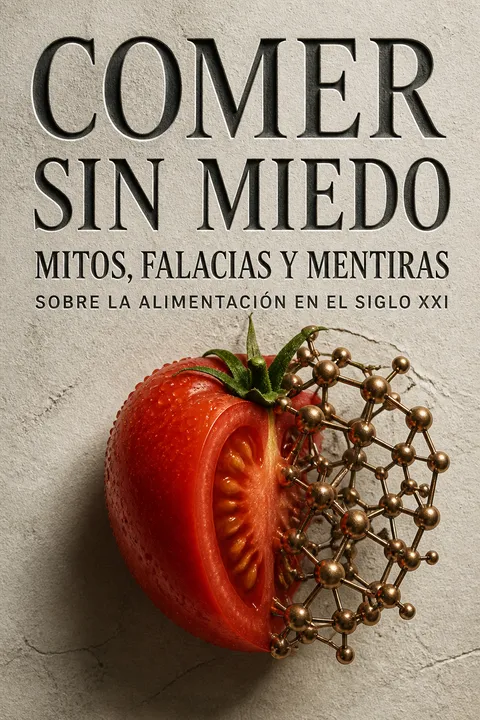
The paradox of taste. We often select food based on its aesthetic appearance rather than its nutritional value or flavor. The modern tomato is a clear example of how the search for a perfect red color ruined its original taste.
- Modern corn comes from teosinte, a wild plant that is almost inedible.
- Orange carrots were created in Holland to honor the royal House of Orange.
- The modern strawberry is an artificial hybrid from the 18th century.
4. "Ecological" is a commercial brand, not a health or environmental guarantee
En el fondo, el sello de producción ecológica no es más que un tranquilizaconciencias pagado a precio de oro.
A commercial brand. The "ecological" or "organic" label does not respond to scientific criteria of health or sustainability, but to compliance with an administrative regulation. This regulation is limited to requiring the use of inputs of natural origin, regardless of their toxicity.
Negative environmental impact. Due to its low productivity, organic farming requires almost twice the land area to produce the same amount of food. If all global production were organic, we would have to deforest a large part of the planet's forests.
Safety and nutrition. Scientific studies show that organic foods are not more nutritious or healthier than conventional ones. Furthermore, they present higher risks of biological contamination due to the use of organic fertilizers.
- It uses "natural" pesticides like copper, which is highly persistent and toxic to the soil.
- It is not synonymous with local trade; many products travel thousands of miles.
- It protects pseudosciences like biodynamic agriculture and its esoteric rituals.
5. Traditional cooking is pure chemistry in action
Cocinar un alimento no es más que aplicarle una serie de reacciones químicas para cambiar sus propiedades.
The culinary chemistry. Cooking is humanity's oldest laboratory, where we transform matter through heat and acidity. Cooking facilitated digestion and allowed the evolutionary development of our brain by saving metabolic energy.
Everyday chemical reactions. Processes like the Maillard reaction are responsible for the appetizing brown color of roasted meat and bread crust. Similarly, the emulsion of mayonnaise or the curdling of milk are pure fluid physics and protein biochemistry.
Fermentation and preservation. Traditional foods like cheese, wine, beer, and yogurt are the result of controlled fermentations by microorganisms. These techniques arose historically to preserve perishable foods before the existence of refrigeration.
- Denaturation of proteins when frying an egg.
- Gelatinization of starch when cooking rice or making bread.
- Lactic fermentation for the production of yogurt and cheese.
6. Food has never been safer, despite rampant chemophobia
Los números lo dicen alto y claro: nunca hemos tenido una seguridad alimentaria comparable a la que tenemos en la actualidad.
The irrational chemophobia. We live in the era with the highest life expectancy in history, yet the fear of "chemicals" in food is more widespread than ever. Society forgets that toxicity depends exclusively on the dose, not the origin of the molecule.
Pesticides under control. Pesticide residues in conventional foods are subjected to strict safety controls and are well below safety limits. European legislation is extremely conservative and prioritizes consumer health.
The anti-transgenic myth. Genetically modified crops (GMOs) have been on the global market for decades without causing a single health problem. This technology allows for a reduction in the use of insecticides and improves agricultural productivity.
- Life expectancy in Spain has gone from 35 years in 1900 to over 80 today.
- EFSA controls guarantee that supermarket food is safe.
- Transgenics reduce the environmental impact of intensive agriculture.
7. The real food risks are biological, not chemical
El principal problema de la alimentación europea son las micotoxinas, y a bastante distancia, la contaminación por metales pesados y la salmonela.
Real biological dangers. While public opinion is alarmed by synthetic additives, the real health risks come from bacteria, fungi, and natural toxins. The most serious food poisonings are usually caused by poor hygiene or preservation.
The dreaded mycotoxins. These compounds, secreted by fungi that grow on grains and nuts, are potent natural carcinogens. Paradoxically, organic farming often presents higher levels of mycotoxins due to the lack of effective fungicide treatments.
The importance of hygiene. Diseases like salmonellosis or listeriosis remain real threats if control measures in the distribution chain are relaxed. Pasteurization and refrigeration are the most effective tools to save lives.
- Mycotoxins in poorly preserved grains and nuts.
- Pathogenic bacteria such as Salmonella, Listeria, and E. coli.
- Anisakis in raw or poorly frozen fish.
8. Miracle diets are unscientific and potentially dangerous illusions
La mejor dieta es la del cucurucho: comer poco y correr mucho.
The weight loss business. The aesthetic obsession with thinness has created a lucrative market for miracle diets that lack scientific basis. Promising rapid weight loss without effort is a deception that often puts health at risk.
The fallacy of enzymes. Books like "The Enzyme Diet" are based on completely false biological premises, such as the existence of a "source enzyme." Enzymes in food are destroyed in the stomach during digestion, so they have no therapeutic effect.
Pure thermodynamics. There are no "fat-burning" foods or magic combinations that alter the laws of physics. To lose weight in a healthy way, the only effective formula is to generate a caloric deficit through a balanced diet and physical exercise.
- The alkaline diet is based on the absurd myth of modifying body pH through food.
- Extreme high-protein diets can overload the kidneys and alter metabolism.
- "Fat-burning" supplements only succeed in slimming the consumer's wallet.
9. Vegetarianism is an ethical choice, not a nutritional necessity
No hay ninguna objeción científica a un vegetarianismo ovolácteo, pero tenemos que hilar más fino cuando se trata de algunos grupos más radicales...
A respectable option. Vegetarianism is a perfectly valid ethical and philosophical stance, but it should not be sold as a superior nutritional necessity. A poorly planned vegetarian diet can lead to serious deficiencies in essential nutrients.
Deficiencies of veganism. Strict vegans must pay special attention to vitamin B12, which is only found naturally in foods of animal origin. They can also suffer from iron, zinc, and essential fatty acid deficiencies due to low bioavailability in plants.
The myth of lower impact. Although meat production consumes more resources, the intensive agriculture required to supply a vegetarian diet also destroys ecosystems and causes animal deaths through pesticide use and land clearing.
- Vitamin B12 (requires mandatory supplementation).
- Iron and zinc (blocked by phytates in plants).
- Essential amino acids (requires combining legumes and grains).
10. Preservatives save lives by preventing deadly pathogens
Mejor conservante en mano que salmonela volando.
Defense against pathogens. Food additives, far from being modern poisons, are essential tools to guarantee the safety of what we eat. Preservatives prevent the growth of microorganisms that could cause deadly diseases like botulism.
The "no additives" fallacy. Advertising that highlights the absence of preservatives and colorants appeals to the consumer's irrational fear. Food without preservatives has a much shorter shelf life and presents a significantly higher biological risk.
Rigorous scientific evaluation. All additives identified with an E number have passed strict safety controls before being authorized. Their presence in processed foods ensures that we can eat without fear of poisoning.
- Preservatives (E2XX): prevent the development of bacteria and molds.
- Antioxidants (E3XX): prevent the rancidity of fats.
- Stabilizers (E4XX): maintain the texture and homogeneity of the product.








































