

Key Takeaways
Manipulation's deadliest weapon is invisibility, not aggression
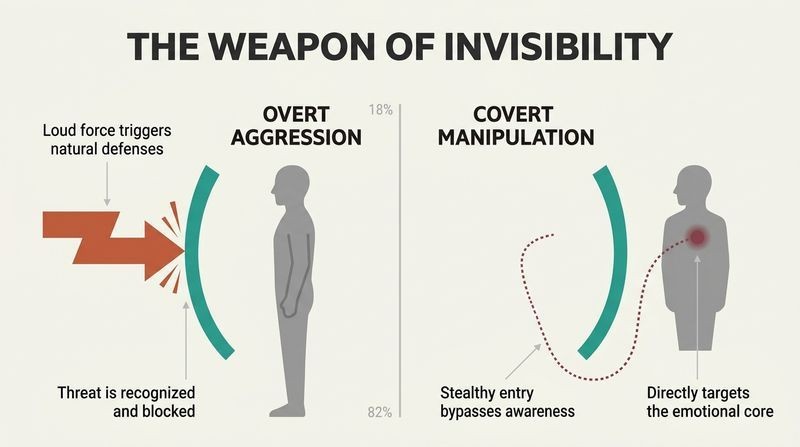
The stealth is the point. The book's foundational idea is Covert Emotional Manipulation (CEM): one person influencing another's feelings so quietly the target never detects it, never grasps how it happened, and cannot even guess the motive. The author compares it to a stealth bomber that slips past every defense before impact. Manipulation differs from influence by intention alone: an influencer thinks 'I want to help you decide well,' a manipulator thinks 'I want to secretly control you for my benefit.'
Emotions are the master key. The manipulator targets feelings rather than beliefs or behavior because emotions govern everything else. Control someone's emotional state, the argument goes, and you control the whole person. CEM shows up most in romance, family, friendship, and work, where existing trust lowers the guard.
The framing that harm disguised as kindness evades detection aligns with clinical research on coercive control, now criminalized in the UK and parts of Australia precisely because victims rarely recognize it as abuse. The author's key insight, that you cannot resist what you cannot see, echoes Robert Cialdini's finding that awareness of an influence tactic is the primary defense against it. One caution: the book's sweeping claim that emotion equals total control understates human variability. Attachment style, self-esteem, and social support all moderate susceptibility, which is why identical tactics devastate some targets and bounce off others entirely.
Love bombing then unpredictable reward manufactures addiction to the abuser
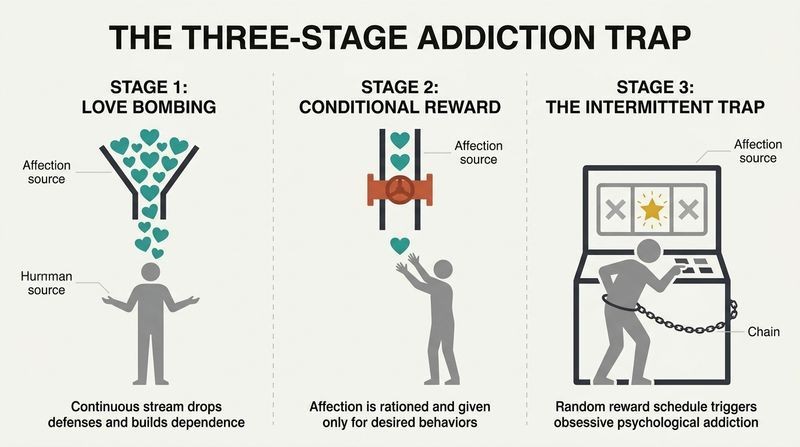
A three-stage emotional trap. The book maps a chillingly precise sequence. First comes love bombing: sudden, overwhelming affection that softens defenses and builds dependence. Next, positive reinforcement, where warmth is rationed and given only when the target behaves as desired. Finally, intermittent positive reinforcement (IPR), where the reward arrives only sometimes, even when the target complies perfectly.
Unpredictability is the hook. That randomness breeds a subconscious craving. The victim chases approval by any means, never understanding why. The author notes skilled manipulators calibrate dosage to the person: compliments work on some, gifts on others, and a lonely target gets bombed harder than a grounded one. Like a physician prescribing the right drug in the right dose, the experienced manipulator reads exactly how much affection a specific target will absorb.
The mechanism is straight behavioral psychology. B.F. Skinner demonstrated that variable-ratio reinforcement, the same schedule that powers slot machines, produces the most persistent, extinction-resistant behavior of any reward pattern. Applying it to human attachment explains the maddening loyalty seen in toxic relationships: the intermittent crumb of warmth is neurologically more compelling than steady affection. Dopamine spikes on anticipation, not reward. What the book adds is the deliberate staging, moving from abundance to scarcity to randomness. Worth noting: this pattern often emerges unconsciously in insecure relationships too, so its presence signals dysfunction without necessarily proving calculated malice.
Gaslighting erodes your sanity one small doubt at a time
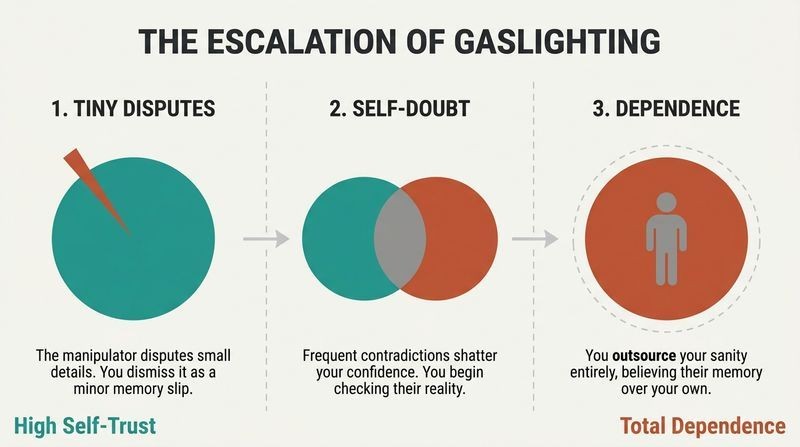
Graduality destroys trust in your own mind. The book calls it reality denial: a manipulator makes you question your memory and perception until you no longer trust your own faculties. It never starts big. It begins with tiny disputes over what was said or what happened, with the manipulator always offering the more credible-sounding version.
Doubt transfers into dependence. This does double duty. It shrinks your confidence in your own recall and simultaneously hands that trust to the manipulator, who now seems to have the better memory. At first you feel grateful to have someone reliable to lean on. Over time, the stakes of what you are made to doubt escalate, until you blame your own mind for the confusion the manipulator engineered. The cruelest part: the victim indicts herself rather than her tormentor.
The term derives from the 1938 play Gas Light, where a husband dims the gas lamps then insists his wife imagines it. Modern psychology treats it as a recognized form of emotional abuse, and the book's emphasis on incremental escalation matches how survivors describe it: never one dramatic lie, but a slow accumulation. There is a useful defensive principle buried here. Keeping external records, a journal, texts, a trusted confidant, breaks the tactic because it anchors reality outside the manipulator's control. The book underplays that chronic self-doubt also stems from anxiety disorders, so the tactic works partly by exploiting preexisting vulnerabilities rather than creating them from nothing.
No one jumps a canyon, so manipulators build a bridge plank by plank
The staircase of compliance. Graduality is the book's unifying mechanism across persuasion, brainwashing, and crime. Nobody agrees to something monstrous cold. Instead the manipulator secures one small, harmless-seeming step, then another slightly larger one, until the target is far down a path they never consciously chose. The author uses the image of a criminal recruiter: first ask someone to hide a weapon, then commit petty theft, and eventually the person feels 'in too deep' to refuse serious crimes.
Small deceptions test and condition. Each early step also serves as leverage, since the manipulator can hold prior misdeeds over the victim. Related is the door-in-the-face trick: ask for $1,000 you never expect, get refused, then request the $200 you actually wanted, which now feels too small to deny.
This is the foot-in-the-door effect, validated by Freedman and Fraser's 1966 study where homeowners who agreed to a tiny request later accepted an enormous one at far higher rates. Consistency bias drives it: once we act, we rationalize to keep our self-image intact. The book's fusion of gradual escalation with the sunk cost trap is astute, because commitment compounds. The most valuable practical defense, unstated here, is to evaluate each request against your values afresh rather than against the previous request. The relevant baseline is your original principles, not the incrementally shifted status quo the manipulator has engineered.
Manipulators hunt the wounded because unmet needs override judgment
A goal makes a mind suggestible. The book argues the first move of any mind controller is finding a target with a pressing need, whether physical hunger or a craving for love. A brain that wants something filters the world toward it and gratefully accepts suggestions about how to satisfy it. The author cites a subliminal study: viewers shown a hidden image of iced tea bought it in greater numbers, but only the thirsty ones.
Fresh wounds are prime targets. Someone recently through a breakup, bereavement, or job loss is craving stability, and the manipulator arrives disguised as the savior. Common exploited needs are money, belonging, and companionship. The predator offers certainty to a person whose world just lost its meaning, converting general vulnerability into specific dependence on him.
This maps onto cult recruitment research: sociologists find conversions cluster around life transitions, when social bonds are weak and identity is unsettled. The pattern also explains why scam victims skew toward the recently widowed or isolated. There is a defensive corollary worth naming: periods of acute need are precisely when you should slow down major decisions and consult your existing network, because your normal skepticism is chemically and emotionally depressed. The book's iced-tea anecdote references the discredited 1950s subliminal advertising claims, which failed replication, so the specific evidence is shaky even though the broader principle, that need heightens suggestibility, is well supported.
Three dark traits, Machiavellianism, psychopathy, narcissism, power every manipulator
The Dark Triad is the engine. The book presents these as psychology's three most destructive personality traits. The Machiavellian is a cold strategist obsessed with image, asking only 'how does this benefit me and how will I be perceived?' The psychopath combines superficial charm with impulsivity and a genuine incapacity for empathy or remorse, not unwilling but unable, like asking a deaf person to enjoy music. The narcissist believes they are superior, craves constant praise, and treats criticism as poison.
Sadism completes a tetrad. The author adds a fourth pillar: sadism, deriving pleasure from others' suffering for its own sake, not as a means to an end. What distinguishes sadism is cruelty as entertainment, the way ordinary people watch sports.
The Dark Triad is a legitimate construct introduced by Paulhus and Williams in 2002, and the sadism-as-fourth-pillar move reflects real academic debate about a Dark Tetrad. The book's provocative claim that psychopaths cluster at the top of business is partly supported: studies by Babiak and Hare found corporate psychopathy rates several times higher than the general population's roughly 1 percent. But the framing that these are cartoonishly evil supervillains oversimplifies. These traits exist on continuous spectrums, most people carry some, and moderate Machiavellianism can correlate with leadership effectiveness. Pathologizing ambition or strategic thinking as inherently dark risks paranoia rather than protection.
Deception means misleading, and silence lies louder than words
Four flavors of dishonesty. The book insists lying is only one form of deception, which really means anything that makes someone believe a falsehood. It maps four tactics:
1. Lying, often embedding a 10 percent falsehood inside a 90 percent true story
2. Implying, hinting at wealth or status without stating it, preserving deniability
3. Omission, simply never mentioning inconvenient truths
4. Fraud, backing lies with forged documents and evidence
Size does not equal darkness. A tiny deception can be more damaging than a huge one, because small lies condition a target to accept bigger ones and quietly undermine their faith in their own judgment. The author flags a favorite omission trick: building an 'emotional fence' around a topic by implying it is too painful to discuss, so the target avoids it out of guilt.
The taxonomy is sound and mirrors deception research distinguishing falsification, concealment, and equivocation. The implication tactic is especially insidious because it weaponizes the listener's own imagination: plant a seed and the target fills in a flattering picture the manipulator never actually promised, which grants plausible deniability if challenged. This connects to Gricean linguistics, where listeners infer meaning beyond literal words. The most practical takeaway is defensive: judge people by what they concretely commit to, not by impressions you assembled yourself. The book's claim that most men lie about height on dating profiles, cited to normalize ordinary deception, usefully reminds readers that not all misleading is predatory.
Real brainwashing feels voluntary and unfolds over months, not minutes
Forget the Hollywood version. The book stresses that genuine brainwashing is nothing like A Clockwork Orange. It is the slow, seemingly self-chosen replacement of a person's map of reality, and the victim feels in control the entire time. The recruiter appears calm, warm, and successful, builds rapport through faked shared experiences, and offers gifts to create indebtedness.
Milk before meat. Palatable ideas come first (God loves you), objectionable ones much later (God wants you to die for the cause). Three forces keep victims from leaving: genuine affection for the recruiter, the sunk cost of time and money already invested, and accumulated 'dirt' the recruiter can wield as gentle blackmail disguised as concern. The end product is an indoctrinated person who believes they arrived at these views entirely on their own.
This aligns with Robert Cialdini's commitment-and-consistency principle and with Festinger's cognitive dissonance theory: the more someone invests, the harder they rationalize to justify it. Real defector accounts from groups like Jonestown and modern extremist networks confirm the gradual, community-reinforced pattern over the sudden-snap myth. The book's insight that the victim feels autonomous is crucial and counterintuitive: coercion that preserves the illusion of choice is stickier than overt force, because the person defends the belief as their own identity. The reference to online radicalization is prescient for 2015, anticipating how the internet dissolved the physical isolation that once limited such recruitment to compounds.
The illusion of choice controls people better than commands
Restricting choice, keeping the mask of freedom. The book describes taking away real options while preserving the feeling of control. The everyday example: instead of asking 'Would you like to go out?' (which invites no), the manipulator charms the target, then confidently asks 'So, are we doing Thursday or Saturday?' Refusal was never on the menu. If caught, the manipulator has two escape hatches, denial ('you misremember') or reframe ('I can't believe you're overanalyzing me, that hurts').
Mind games manufacture instability. Related tactics include the 'eternal breakup,' where a partner constantly threatens or stages breakups they never complete, destroying the target's security and testing how much they will tolerate. And ultimatums (do this or else), which turn dark when they push a target to violate their own morals.
The false-choice close is a documented sales technique, and its power reflects how framing shapes decisions, the terrain Kahneman and Tversky mapped in prospect theory. Presenting two options within a bounded set anchors the mind inside that set, quietly deleting the third option of refusal. The eternal-breakup tactic connects to trauma-bonding research: intermittent threat plus relief produces the same attachment intensification as intermittent reward, keeping the nervous system on high alert. The defensive move is deceptively simple, always mentally restore the deleted option. When offered Thursday or Saturday, remember that 'neither' remains fully available, and reclaiming it breaks the frame.
Anchoring links a feeling to a trigger the manipulator can pull anytime
NLP borrows Pavlov. The book treats neurolinguistic programming as the hypnotist's advanced toolkit, powerful enough that it likens handing it to a manipulator to arming a psychopath with a nuke. Anchoring pairs an intense emotion with an external cue, a gesture, a tone, a place, so the manipulator can later summon that emotion by firing the cue alone. Skilled operators build an 'anchor stack,' triggering love, then terror, then love in quick succession to overload and destabilize the target.
Reframing edits perception. The manipulator relabels a loss as freedom while flattering the target's intelligence for agreeing. Future pacing walks a victim through a vivid multisensory imagined scenario to preload a desired future behavior. The author claims the best operators keep interactions 95 percent normal, hiding influence in the remaining 5 percent.
Anchoring is genuine classical conditioning, well established since Pavlov's dogs. NLP's broader therapeutic claims, however, have been repeatedly criticized as pseudoscience with weak empirical support, a fact the book glosses over while presenting NLP as near-magical. That said, the underlying components, conditioned emotional responses, reframing, and mental rehearsal, each have independent scientific backing. Mental rehearsal in particular is validated in sports psychology, where vividly imagined performance measurably improves real outcomes. The honest synthesis: the ingredients are real, the branded package is oversold, and the 95-percent-normal principle rightly captures that effective influence hides inside ordinary rapport rather than announcing itself with strange rituals.
Charm before harm: predators like Bundy weaponized likability itself
The case studies decode the theory. Ted Bundy, charged with dozens of murders, embodied psychopathic deception: witnesses found him charming and attractive, and he inspired comfort in victims moments before killing them. In his final interview with anti-pornography campaigner James Dobson, Bundy strategically blamed pornography for his crimes, feeding his audience exactly what it wanted, proof of a psychopath's skill at reading and exploiting others' biases.
Context shapes destiny. The book contrasts Bundy with Andy McNab, an SAS soldier and author with psychopathic traits who channeled them into elite performance. The lesson: the same trait, an ability to dial down fear, produces a serial killer in one life and a decorated soldier or hedge fund manager in another. Circumstance, not the trait alone, determines the outcome.
The Bundy-McNab contrast draws directly from Kevin Dutton's research on 'functional' psychopathy, which argues that traits like fearlessness, focus under pressure, and emotional detachment are advantageous in surgery, special forces, and finance. This challenges the pure-monster narrative and matches the finding that psychopathy is dimensional, not binary. The uncomfortable implication is that society both punishes and rewards the same wiring depending on where it is aimed. One caveat: the 'good psychopath' framing can romanticize a trait cluster that still correlates strongly with harm at the population level. The genuinely useful defensive lesson is that surface charm is data-free. Warmth proves nothing about intent.
Analysis
This is a popular self-help title dressed as forbidden knowledge, structured as a taxonomy of manipulation tactics followed by historical case studies. Its rhetorical stance is deliberately double-edged, marketed simultaneously as a shield for potential victims and a sword for aspiring manipulators, a positioning that generates commercial intrigue while sidestepping ethical accountability. The recurring 'with great power comes great responsibility' framing is less a moral safeguard than a marketing device.
Substantively, the book is stronger than its lurid packaging suggests. Its core mechanisms, intermittent reinforcement, gradual escalation, exploitation of unmet needs, the illusion of choice, and commitment traps, are each grounded in legitimate behavioral science (Skinner, Freedman and Fraser, Festinger, Cialdini), even though the author rarely cites sources and occasionally leans on debunked material like 1950s subliminal advertising. The Dark Triad and its sadistic extension are real, actively researched constructs. Where the book overreaches is in its treatment of NLP and hypnosis, presented with breathless certainty despite thin empirical support, and in its cartoonish villain framing that treats manipulators as a distinct species rather than acknowledging these traits and tactics exist on continua within ordinary people.
The deeper value lies in pattern recognition. By naming tactics, love bombing, gaslighting, the eternal breakup, milk-before-meat recruitment, the book equips readers to detect coercion that thrives precisely because it stays unnamed. This is its genuine contribution and echoes why coercive control legislation now criminalizes patterns rather than single acts.
The glaring omission is defense. For a book claiming protective value, it invests overwhelmingly in describing offense and offers almost no systematic countermeasures. The reader must infer defenses: keep external records, restore deleted options, evaluate requests against original values, slow decisions during vulnerable periods, and treat charm as evidence of nothing. Read critically, it functions best as a field guide to the architecture of influence, useful less for wielding these tools than for recognizing when they are being wielded on you.
Review Summary
Dark Psychology 101 receives mixed reviews, with an average rating of 3.28 out of 5. Negative reviews criticize the book for poor writing, lack of academic rigor, and misinformation. Some readers find it superficial and repetitive. Positive reviews praise it for providing insights into manipulation tactics and self-protection. Critics argue the author lacks qualifications in psychology. The book's content is described as broad but shallow, with some readers suggesting it offers little beyond what can be found through basic online research. Overall, opinions are polarized, with some finding it life-changing and others dismissing it as worthless.
People Also Read










FAQ
What's "Dark Psychology 101" about?
- Overview of Dark Psychology: "Dark Psychology 101" by Michael Pace explores the hidden world of psychological manipulation and influence. It delves into tactics like covert emotional manipulation, mind control, and deception.
- Comprehensive Guide: The book serves as a comprehensive guide to understanding the principles and tactics used by powerful influencers throughout history.
- Real-Life Applications: It includes real-life case studies to illustrate how these dark psychological principles have been applied in various contexts.
- Empowerment and Awareness: The book aims to empower readers by providing knowledge to protect themselves from psychological exploitation.
Why should I read "Dark Psychology 101"?
- Self-Defense: Understanding dark psychology can help you protect yourself and your loved ones from manipulation and exploitation.
- Personal and Professional Growth: The principles can be applied to gain an advantage in personal and professional settings, enhancing your influence and decision-making skills.
- Insight into Human Behavior: The book offers a deep dive into human psychology, providing insights into how people think and behave.
- Ethical Considerations: It emphasizes the responsibility that comes with understanding these powerful psychological tools.
What are the key takeaways of "Dark Psychology 101"?
- Knowledge is Power: Understanding human psychology is akin to having superpowers, enabling you to influence others effectively.
- Dark Psychology Tactics: The book covers various tactics like covert emotional manipulation, dark persuasion, and mind control.
- Real-Life Case Studies: It provides examples of how these tactics have been used throughout history, offering practical insights.
- Ethical Use of Power: With great power comes great responsibility; the book stresses the importance of using these insights ethically.
What is Covert Emotional Manipulation according to "Dark Psychology 101"?
- Definition: Covert Emotional Manipulation (CEM) is the attempt to influence someone's thoughts and feelings in an undetected manner.
- Key Characteristics: It involves hiding intentions, focusing on emotional states, and manipulating without the victim's awareness.
- Common Scenarios: CEM often occurs in professional, personal, romantic, and family settings, with romantic manipulation being the most common.
- Manipulative Tactics: Techniques like love bombing and intermittent positive reinforcement are used to control victims emotionally.
How does "Dark Psychology 101" define Dark Persuasion?
- Difference from Positive Persuasion: Dark persuasion is used to make people act against their self-interest, often for the persuader's benefit.
- Motivations: It can be driven by self-interest, malicious intent, or a desire for control.
- Outcomes: The persuader benefits while the victim is harmed, often without realizing the manipulation.
- Tactics: Techniques like the Long Con and graduality are used to subtly influence and control victims.
What is Undetected Mind Control in "Dark Psychology 101"?
- Concept: Undetected mind control involves influencing a person's thoughts and actions without their awareness.
- Tactics: It includes interpersonal interactions and media manipulation, using techniques like restricting choice and subliminal messaging.
- Vulnerable Targets: People with pressing needs or desires are more susceptible to undetected mind control.
- Media Influence: Modern technology allows for media-based mind control, using images and sounds to manipulate emotions.
What are Mind Games according to "Dark Psychology 101"?
- Definition: Mind games are psychological schemes intended to toy with a victim's sanity and willpower for the manipulator's amusement.
- Motivations: They can be used to influence behavior, test a victim's limits, or simply for entertainment.
- Common Tactics: Techniques like ultimatums and the eternal breakup are used to create instability and anxiety.
- Impact: Mind games can lead to severe trust issues and emotional instability in victims.
How does "Dark Psychology 101" explain Deception?
- Definition: Deception involves misleading someone to believe something other than the truth, using tactics like lying, omission, and fraud.
- Dark vs. Normal Deception: Dark deception is carried out with negative or indifferent intentions toward the victim.
- Deception Spectrum: It can occur on a large or small scale, with small deceptions often used to condition victims for larger lies.
- Common Topics: Deception often involves money, marital status, criminal background, and personal feelings.
What is Hypnotism in "Dark Psychology 101"?
- Real Hypnotism: Unlike the stereotypical image, real hypnotism involves making deep suggestions to influence a person's subconscious.
- Tactics: Techniques include verbal and nonverbal suggestions, using tone of voice, body language, and environmental cues.
- Vulnerable Victims: People who are emotionally vulnerable or in a suggestible state are more susceptible to hypnotism.
- NLP Techniques: Neurolinguistic programming (NLP) is used to anchor emotions to stimuli, allowing manipulators to control victims' responses.
How does "Dark Psychology 101" describe Brainwashing?
- Definition: Brainwashing is the gradual replacement of a person's beliefs with new ideas that serve the brainwasher's purpose.
- Contexts: It occurs in cults, ideologies, and personal relationships, often using isolation and gradual revelation.
- Process: Brainwashing involves identifying vulnerable victims, building rapport, and presenting a utopian solution to their problems.
- Impact: It can lead to a loss of identity, behavioral changes, and even PTSD in victims.
What is The Dark Triad in "Dark Psychology 101"?
- Definition: The Dark Triad consists of three destructive personality traits: Machiavellianism, psychopathy, and narcissism.
- Machiavellianism: Involves strategic self-interest, manipulation of public perception, and ruthless exercise of power.
- Psychopathy: Characterized by superficial charm, impulsivity, and a lack of empathy and remorse.
- Narcissism: Involves an inflated sense of self-worth, need for praise, and inability to accept criticism.
What are the best quotes from "Dark Psychology 101" and what do they mean?
- "Knowledge is power." This quote emphasizes the importance of understanding human psychology to gain influence and protect oneself.
- "With great power comes great responsibility." It highlights the ethical considerations of using psychological insights for manipulation.
- "Dark psychology is at work in the world." This statement underscores the pervasive nature of psychological manipulation in various aspects of life.
- "The world of 'dark psychology' is akin to psychological black magic." It illustrates the hidden and powerful nature of the tactics discussed in the book.
Download PDF
Download EPUB
.epub digital book format is ideal for reading ebooks on phones, tablets, and e-readers.








































