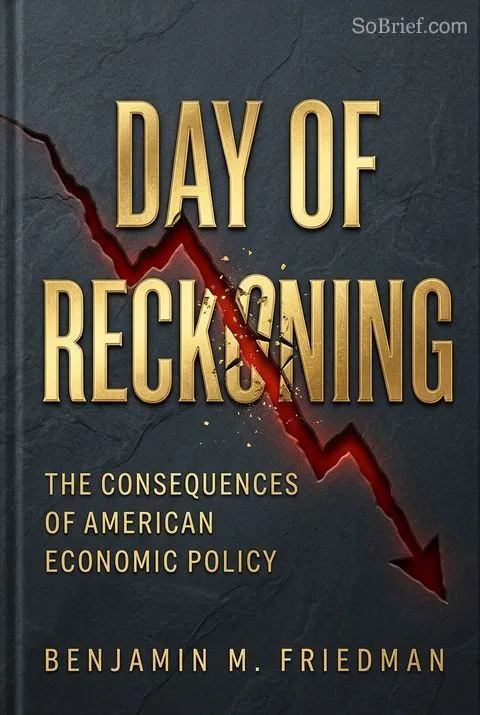
Key Takeaways
1. Reagan's Fiscal Policy: A "Broken Faith" with the Future
The thesis of this book is that the radical course upon which United States economic policy was launched in the 1980s violated the basic moral principle that had bound each generation of Americans to the next since the founding of the republic: that men and women should work and eat, earn and spend, both privately and collectively, so that their children and their children's children would inherit a better world.
Generational obligation. American history was built on the principle of each generation striving to leave a better world for the next. This forward-looking ethos, evident in frontier expansion and wartime sacrifices, fostered a sense of progress and collective responsibility. The economic policies of the 1980s, however, fundamentally broke this tradition.
Living for the present. The Reagan era shifted the nation's focus from long-term investment to immediate gratification. By systematically overconsuming and underinvesting, America began living beyond its means, accumulating debt and selling off assets. This short-sighted approach mortgaged the future for present comfort, creating a false prosperity.
Future costs. The consequences of this policy, though initially subtle, include a lower standard of living for future Americans and a diminished global standing. The author argues that this was not a matter of individual choice but of legislated public policy, making every citizen a borrower and every industry a liquidator of assets on behalf of future generations.
2. The Illusion of Prosperity: Debt-Fueled Consumption
In short, our prosperity was a false prosperity, built on borrowing from the future.
False sense of well-being. Many Americans felt economically secure in the 1980s, with plentiful jobs, lower inflation and interest rates, and cheap foreign goods. This sense of prosperity, however, was an illusion. It was fueled by an artificial boost in consumption at the expense of investment, dissipating national assets and accumulating debt.
Borrowing from the future. The government's tax and spending policies under Reagan led to unprecedented borrowing. Since January 1981, the government borrowed over $20,000 on behalf of each family of four. This meant that after-tax incomes rose not because of increased productivity, but because the government was not collecting enough taxes to cover the services it provided.
Selling off America. A significant portion of this new debt, nearly half, was owed to foreign lenders. The U.S. transformed from the world's leading creditor to its largest debtor, with foreigners increasingly acquiring American assets like office buildings, houses, farmland, and entire companies. This "selling off America" financed current consumption, but at the cost of future economic birthright.
3. America's Economic Decline: Underinvestment and Stagnant Productivity
With so little investment in the basic structure of a strong economy, our ability to produce the goods and services that people want has been disappointing in the 1980s despite a marked improvement in some of the other factors that affect business performance.
Underinvestment's impact. The core economic cost of the 1980s policy was a drastic reduction in investment. The federal deficit, averaging 4.2% of total income, absorbed nearly three-fourths of net private saving. This left little for:
- Business plant and equipment (investment rate fell to 2.3% from a prior 3.3%)
- Government infrastructure (roads, bridges, airports)
- Education
Stagnant productivity. This lack of investment directly led to disappointing productivity growth. Despite favorable factors like an older, more experienced workforce and increased R&D, there was no significant increase in capital per worker. Overall productivity growth averaged just 1.1% per annum since 1979, threatening the traditional rise in living standards.
Eroding progress. Sustained low investment risks the material basis for American progress. Historically, economic betterment underpinned social mobility, individual opportunity, and democratic institutions. Without a continually rising living standard, the nation risks rigidity, complacency, and increased social conflict over a non-growing national product.
4. From Creditor to Debtor: Selling Off America
By year-end 1986 America was a net debtor to other countries in the amount of $264 billion, or more than $1,000 for every citizen.
Dramatic reversal. The U.S. underwent a spectacular transformation from the world's leading creditor nation to its largest debtor. In 1980, Americans held a net international balance of $2,500 per family. By 1987, this had reversed to a net debt of over $7,000 per family, projected to reach $800-900 billion by the end of the decade.
Debt servicing burden. This massive foreign debt means America, like other debtor nations, must now focus on paying interest, not just reducing the principal. This will require a sustained trade surplus of 1-2% of total income, meaning:
- Fewer foreign-made goods for Americans (cars, cameras, VCRs)
- More American-made products exported, not for domestic use
- Increased reliance on foreign tourism
Borrowing to consume. Unlike historical periods (e.g., 19th century railroad expansion) where foreign borrowing financed productive investment, the 1980s debt was accumulated primarily to finance overconsumption. This means there are no new industries or increased earning power to service the debt, directly mortgaging future living standards.
5. Loss of Sovereignty: Foreign Dependence and Diminished Influence
Losing control over one's affairs is, after all, what being in debt is all about—no less for a nation than for an individual or a business.
Erosion of control. America's new status as a debtor nation implies a loss of control over its own economic policies. The era where other countries pegged their currencies to the dollar is giving way to one where the U.S. might sacrifice monetary policy independence to stabilize the dollar against the mark or yen. The 1987 stock market crash highlighted this tension between supporting the currency and propping up the economy.
Selling real assets. Foreign investors, increasingly wary of dollar-denominated debt, are buying up American businesses and real estate. This trend, already significant with foreigners owning substantial portions of commercial real estate in major cities, means surrendering ownership of productive assets not for foreign assets in return, but to finance domestic overconsumption. This jars with America's traditional self-perception as a nation of owners.
Diminished global role. Historically, world power and influence accrued to creditor countries. America's rise as a global power coincided with its transition to a creditor nation. Now, as a debtor, its future role is in question. The respect and deference earned as a world banker will shift to new creditor countries like Japan and Germany, circumscribing America's maneuverability in world affairs and potentially reducing its influence to that of a "mere policeman."
6. The Supply-Side "Fairy Tale": Failed Promises of Tax Cuts
The essence of the "supply-side" argument that Reagan advanced in 1980 (and to which he has resolutely clung ever since) is that the incentive effects of across-the-board cuts in personal tax rates would so stimulate individuals' work efforts and business initiatives that lower tax rates would deliver higher tax revenues.
Flawed premise. Reagan's supply-side economics promised that massive tax cuts, particularly the Kemp-Roth proposal, would stimulate work, saving, and investment to such an extent that tax revenues would actually increase, balancing the budget by 1983. This "fairy tale" allowed for lower taxes, increased military spending, and no cuts to popular social programs, seemingly offering benefits without costs.
Reality check. The experiment failed spectacularly. The largest tax cut in U.S. history did not lead to higher revenues. Instead, it drastically reduced federal revenues, contributing to massive deficits. For example, in 1986, individual income tax payments were $110 billion lower than they would have been under old rates, with only an estimated $16 billion attributable to increased work effort.
Disappointed assumptions. Several key supply-side assumptions proved wrong:
- Work effort: The belief that lower marginal tax rates would significantly increase work effort was contradicted by evidence, which showed only a small positive response, far from what was needed to offset revenue losses.
- Saving: The idea that higher after-tax returns would spur greater personal saving also failed. Despite record-high real interest rates and tax incentives like IRAs, the net private saving rate declined, suggesting saving is not highly sensitive to asset returns.
- Business investment: While tax breaks increased corporate cash flows, businesses used these funds for corporate reorganizations (e.g., stock repurchases, leveraged buy-outs) rather than new productive investment.
7. Deficits, High Interest Rates, and the Overvalued Dollar
When the government borrows to finance its deficit, therefore, companies that want to invest in new plants or new machines and families that want to buy new houses must compete among themselves all the harder for whatever saving is left.
Deficits absorb saving. The fundamental economic consequence of large government deficits is that they absorb a disproportionate share of national saving. In the 1980s, the federal deficit consumed over two-thirds of all net saving by businesses and individuals, leaving a mere 1.5% of income for net private investment.
Rising real interest rates. This scarcity of available saving intensified competition among private borrowers (businesses, homebuyers), driving up real interest rates. Short-term real interest rates, which averaged less than 1% from the 1950s to 1970s, surged to nearly 5% in the 1980s. This discouraged both business and residential investment, which fell to two-thirds of prior postwar averages.
The overvalued dollar. High American real interest rates, unmatched by those abroad, attracted foreign capital. Foreign investors bought dollars to invest in U.S. financial markets, driving up the dollar's value by 74% against major currencies between 1980 and 1985. This overvalued dollar made American exports uncompetitive and imports artificially cheap, leading to a massive trade deficit.
8. The Reagan Recovery: Consumption Over Investment
Even on the most favorable construction of the facts however, the party thrown by America's new fiscal policy in the 1980s has merely restored growth in per capita consumer spending to 2.2 percent per annum, the same average rate that prevailed before 1973.
Stimulus, not supply-side. The Reagan recovery, while impressive in duration, was primarily a demand-side phenomenon, not a supply-side miracle. The economy, starting from the deep 1981-82 recession, responded to a massive fiscal stimulus:
- Doubled defense spending (e.g., new aircraft carriers, MX missiles)
- Increased income support payments (unemployment, Social Security)
- Lower individual and corporate taxes (Kemp-Roth)
Consumption-led growth. This stimulus, combined with an easing of monetary policy in mid-1982, fueled a recovery led by consumer spending. Consumption's share of income rose steadily, reaching 66.1% by 1987, the highest since WWII. However, this growth merely restored per capita consumer spending to pre-1973 rates, and real earnings per worker stagnated or even declined.
Weak job quality. Despite job growth, the 1980s saw a shift towards lower-paying, often part-time positions, particularly outside manufacturing. This meant that even with more people working, the average worker's real pay did not recover to 1970s levels, challenging the traditional American belief in economic advancement through work.
9. The Hard Choices Ahead: Tax Increases and Spending Cuts
The question at issue is instead whether we actually want to implement these potential cuts.
Unavoidable fiscal correction. To escape the path of fiscal instability, America must reduce its federal debt-to-income ratio. This requires narrowing the deficit by over $100 billion annually, bringing it to an average of $60 billion per year (excluding Social Security surplus) from 1989-1996. This shift necessitates both spending cuts and tax increases.
Spending cut illusions. Despite a decade of rhetoric about cutting "waste, fraud, and abuse," genuine, politically acceptable spending cuts are extremely difficult to find. Most federal spending goes to widely supported programs:
- Defense (28% of budget in 1987)
- Social Security (20%)
- Medicare and Medicaid (10%)
- Interest on national debt (14%)
The remaining 27% covers all other federal activities, making deep cuts politically unfeasible without broad public consensus, which has not materialized.
The need for tax increases. Since Americans have shown they want the current level of government services, the only realistic solution is a substantial tax increase, not merely "revenue enhancement" or closing "loopholes." A phased increase in personal income tax rates (e.g., raising the 15% and 28% rates by three percentage points) could generate the necessary $75 billion annually, with a modest impact on individual families.
10. A Moral Imperative: Restoring Fiscal Responsibility
Adopting a different fiscal policy is not just an economic desideratum but a moral imperative.
Beyond economics. The consequences of the 1980s fiscal policy extend beyond mere economic statistics, affecting the fundamental character of American society and its global standing. Continued inaction risks:
- Loss of national vibrancy and dynamic progress
- Erosion of social mobility and individual opportunity
- Diminished influence in the world order
Subtle, corrosive damage. The danger lies in the gradual, often imperceptible nature of this decline. Unlike a sudden crisis, the damage from persistent fiscal imbalance accumulates subtly, making it harder for a crisis-activated political system to respond. This gradual decay preserves an illusion of prosperity today at the expense of future generations.
Clarity and fairness. Correcting course requires clear understanding of what is at stake and a commitment to fair sacrifices. The choice of how to cut spending or raise taxes is secondary to the decision to act, but fairness in distributing the burden is crucial for public support. The author concludes that if the U.S. fails to correct its fiscal course, future generations will rightly hold the current one responsible for their diminished circumstances.
Review Summary
The sole review of Day of Reckoning gives it 2 out of 5 stars. The reader recalls engaging with the book in the late 1980s, during which time they were convinced that the Reagan-era deficits would lead to financial catastrophe for the United States. With the benefit of hindsight, the reviewer reflects with some irony that this feared economic doom never materialized, implying the book's dire predictions did not come to pass as expected.
About the Author
Other books by Benjamin M. Friedman


Download PDF
Download EPUB
.epub digital book format is ideal for reading ebooks on phones, tablets, and e-readers.








































