Key Takeaways
1. Religious Roots of Economic Thought: Adam Smith's Revolution
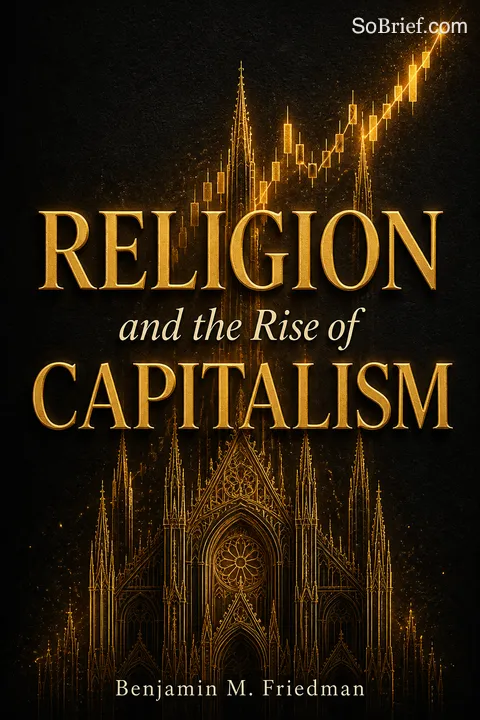
The central argument of this book is that our ideas about economics and economic policy have long-standing roots in religious thinking.
Unseen influences. Most people, especially in the Western world, take for granted that our economic sphere is organized around private initiative and markets. However, the foundational shift in economic thinking, rightly associated with Adam Smith in the eighteenth century, was profoundly shaped by new and vigorously debated religious ideas within the English-speaking Protestant world. This influence often goes unrecognized, yet it continues to impact how societies, particularly America, approach economic policy.
Integrated intellectual life. Smith and his contemporaries lived in a time when intellectual life was far more integrated than today. Theology was not a separate, peripheral discipline but an active part of ongoing discussions alongside sciences and humanities. Smith, a professor of moral philosophy, even taught natural theology, exposing him and his peers to fresh theological debates that fundamentally altered their understanding of human nature and everyday interaction.
Cultural soil. This deep connection means that the "preanalytic cognitive act" or "worldview" that shaped early economic thinkers was steeped in religious currents. The coincidence in timing between the rise of modern economics and significant shifts in religious thought was not accidental; the evolving religious landscape provided the "cultural soil" from which new economic ideas could emerge and flourish, establishing resonances that persist today.
2. From Vice to Public Benefit: The Intellectual Journey to Self-Interest
Although there is nothing so opposed to Charity, which relates all to God, as Self-love, which relates all to itself, yet there is nothing so resembling the effects of Charity as those of Self-love.
Challenging traditional views. Before Adam Smith, self-interested behavior was often seen as a vice, threatening social order and individual morality. Medieval scholastics focused on "just prices," and mercantilists advocated top-down economic control, both skeptical of individual initiative. The 17th-century saw intense debates, with Thomas Hobbes fearing a "war of all against all" driven by self-interest, while Shaftesbury posited an innate "moral sense" guiding virtue.
Jansenist paradox. A more optimistic view emerged from French Jansenist thinkers like Pierre Nicole, who argued that actions motivated by self-interest could produce consequences indistinguishable from those of charity. Nicole observed that self-love "knows so well how to trim it self up with the appearances of Charity," leading to social peace and the provision of material needs, not despite, but because of human corruption. This was God's providential design for fallen man.
Mandeville's provocative fable. Bernard Mandeville's 1705 Fable of the Bees famously declared "Private Vices, Publick Benefits." He satirically argued that individual self-interest—even "luxury" and "pride"—drove industry, employment, and ultimately, a higher standard of living for all. However, Mandeville offered no systematic mechanism for this outcome, merely a series of clever examples, leaving a crucial gap for later thinkers like Smith to fill.
3. Smith's Market Mechanism: Competition as the Engine of Unintended Public Good
It is not from the benevolence of the butcher, the brewer, or the baker, that we expect our dinner, but from their regard to their own interest.
The missing mechanism. Adam Smith, building on earlier ideas but seeking a Newtonian-like system, provided the crucial mechanism for how self-interest leads to public good: competitive markets. In The Wealth of Nations, he argued that the universal "desire of bettering our condition," combined with the human "propensity to truck, barter, and exchange," drives specialized production (division of labor) and voluntary trade.
Prices as coordinators. Smith meticulously explained the role of prices in coordinating economic activity. Prices, including wages, act as:
- Reflections of scarcity, guiding consumer choices.
- Incentives for production, motivating producers.
- Guides for allocation, steering resources to valued uses.
This system, driven by buyers and sellers pursuing their own interests, leads to an efficient allocation of resources and optimal outcomes for society.
The invisible hand revealed. Smith's famous "invisible hand" metaphor, though used sparingly, encapsulates this systematic, unintended coordination. It demonstrates that individuals, by pursuing their own gain, "frequently promote that of the society more effectually than when they really intend to promote it." This powerful insight resolved Mandeville's paradox, showing how market competition, not benevolence or central planning, harnesses self-interest for the common good.
4. Calvinist Foundations: Depravity, Predestination, and God's Glory
Our nature is not only destitute and empty of good, but so fertile and fruitful of every evil that it cannot be idle.
The Fall and human nature. The Reformation, particularly John Calvin's theology, profoundly shaped early Protestant views on human nature. Following Augustine, Calvin asserted "utter depravity"—that Adam's sin resulted in a hereditary corruption of all humanity, rendering individuals incapable of good on their own. This doctrine, enshrined in the Thirty-Nine Articles and the Westminster Confession, painted a pessimistic picture of human moral capacity.
Unconditional destiny. Central to Calvinism was the doctrine of predestination, meaning God's eternal, unchangeable decree to save some ("the elect") and damn others ("the reprobate"), irrespective of their actions or merits. This "double predestination" created profound anxiety for believers, as their ultimate spiritual fate was determined before birth, leaving no room for human agency in salvation.
God's ultimate purpose. For Calvin, the sole purpose of all creation, including humanity, was the glorification of God. Human happiness was secondary, achieved only through union with God, and even the Fall itself served to manifest God's glory. This worldview emphasized God's absolute sovereignty and man's utter dependence, setting a stark backdrop against which later theological and economic ideas would emerge.
5. The Arminian Challenge: Human Agency and Benevolence Reshape Religious and Secular Views
It is the greatest and justest discouragement in the world to all endeavors of repentance and reformation, to tell men that they can do nothing in it.
Rebellion against determinism. The rigid doctrines of Calvinism faced increasing challenges, notably from Jacob Arminius and his followers. Arminianism asserted that human agency does matter for salvation: God's grace is offered, not unconditionally imposed, and individuals can choose to accept or resist it, and even fall from it. This shift emphasized free will and individual responsibility.
Latitudinarian influence. In England, Latitudinarian clergy like Archbishop John Tillotson and philosopher John Locke championed reason and a more benevolent view of God. They rejected total depravity, arguing that humans possess innate reason and a "moral sense" (echoing Shaftesbury and Hutcheson) enabling them to discern good and evil. For them, God intended human happiness, and predestination contradicted divine goodness and discouraged moral effort.
Secularizing benevolence. These theological shifts had profound secular implications. If humans possessed inherent goodness and free will, they could reliably understand and pursue their self-interest, and act in ways beneficial to others. If God intended human happiness, then the world must be structured to facilitate it, implying that human institutions could channel behavior toward positive outcomes. This more optimistic worldview provided fertile ground for Smith's economic theories, which posited that natural human desires, when properly channeled, could lead to societal improvement.
6. Progress and Providence: Millennial Visions and the Four Stages of Societal Advance
Mankind…in striving to remove inconveniencies, or to gain…advantages, arrive at ends which even their imagination could not anticipate.
Biblical prophecies and earthly futures. Debates over biblical eschatology—the "end of days"—also influenced economic thought. While Augustine had favored an allegorical reading of Revelation, the Reformation saw a return to literal interpretations. This led to two main millennial views: premillennialism (Christ returns before a period of earthly peace, often pessimistic about human-led progress) and postmillennialism (human efforts lead to an earthly golden age, then Christ returns, optimistic about progress).
Postmillennial optimism. English theologians like Joseph Mede and Richard Baxter, and later American figures like Jonathan Edwards and Samuel Hopkins, embraced postmillennialism. They saw human history as an inevitable, staged advance toward a better world, driven by natural forces, human agency, and expanding knowledge. This view imbued human efforts to improve the world with religious significance, seeing them as hastening the Kingdom of God on Earth.
Smith's Four Stages of Progress. Adam Smith's Lectures on Jurisprudence presented a dynamic theory of societal progress through four economic stages: Hunters, Shepherds, Agriculture, and Commerce. This progression, driven by population pressure and expanding knowledge, was irreversible and led to improvements in governance and liberty. This theory, congruent with postmillennial thought, provided a self-contained explanation for societal advancement, where unintended human actions, guided by self-interest, cumulatively led to a better world.
7. American Exceptionalism and Economic Destiny: The New Republic's Unique Landscape
Equality of conditions not only ennobles the notion of labor, but raises the notion of labor as a source of profit.
A new economic frontier. The nascent United States presented a unique economic context, distinct from Europe. With vast lands, low population density, and a republican ethos, the nation faced different challenges: westward expansion, internal improvements, and the question of slavery. The absence of European-style monarchical corruption and military ambitions fostered a focus on domestic prosperity and individual opportunity.
Democratization of religion and economy. Alexis de Tocqueville observed a profound "equality of condition" in America, fostering an intense spirit of economic initiative. This democratic ethos, coupled with the Second Great Awakening, democratized religion, leading to a proliferation of denominations (Methodists, Baptists) that emphasized human agency over predestination. This religious shift aligned with the expanding economic opportunities, where individual effort visibly led to success.
Millennial mission. Americans increasingly saw their nation as having a special, divinely ordained mission. Figures like Thomas Paine, Andrew Jackson, and Herman Melville articulated a postmillennial vision of America as a "new world," an "Israel of our time," destined to lead global progress in liberty and civilization. This national predestination, however, did not extend to individual fates, reinforcing the belief in personal agency and the moral legitimacy of pursuing wealth through labor.
8. Clerical Economists and Divine Intent: Shaping Early American Economic Policy
To forbid trade among nations, is, therefore, a very unwise thing; but it is also a very wicked thing, for it is contrary to the will of God.
Economics as divine law. Early American political economists, many of whom were clergymen, explicitly grounded their economic theories in religious principles. John McVickar, an Episcopal priest and Columbia professor, viewed economics as a Newtonian science, revealing God's established laws. He argued that the pursuit of wealth fostered moral character and that international trade, facilitated by God's creation of diverse resources and oceans, promoted peace and mutual benefit.
Indefinite growth and divine blessings. Francis Wayland, a Baptist minister and Brown University president, authored the most widely used pre–Civil War economics textbook. He saw labor as a divine law and economic activity as a collaboration between human agency and God's creation. Crucially, Wayland was the first to articulate the possibility of indefinite economic growth driven by technological progress, attributing this to God's inexhaustible "blessings in reserve for man."
Protectionism and national design. Not all clerical economists advocated free trade. Francis Bowen, a Unitarian and Harvard professor, championed protectionism, arguing that God intended nations to remain distinct, each pursuing its own interests. He believed that tariffs preserved national economic independence and allowed domestic industry to flourish, aligning with God's "beneficent designs" by removing foreign competition as an "artificial check." These debates illustrate how religious interpretations directly shaped economic policy arguments.
9. Competing Gospels and Social Reform: Wealth vs. Social Justice in Industrial America
Men learned to make wealth much faster than they learned to distribute it justly. Their eye for profit was keener than their ear for the voice of God and humanity. That is the great sin of modern humanity, and unless we repent, we shall perish by that sin.
The rise of industrial challenges. Post–Civil War America experienced unprecedented economic growth, but also widening inequality, the rise of powerful industrial monopolies, and mass urban poverty. This era saw two competing religious responses: the Gospel of Wealth and the Social Gospel. The former, championed by figures like Henry Ward Beecher and Russell Conwell, celebrated wealth creation as a moral imperative, believing it civilized society and that individual success reflected divine favor.
The Social Gospel's critique. In contrast, Washington Gladden and Walter Rauschenbusch spearheaded the Social Gospel movement, arguing that the church must address societal structures, not just individual souls. They condemned extreme economic inequality as a collective sin and a threat to democracy, calling for government intervention to ensure a "Christian society" where human life was valued above property. Rauschenbusch believed that "unless the economic and intellectual factors are strongly reenforced by religious enthusiasm, the whole social movement may prove abortive."
Economics for social improvement. This religious debate directly influenced the professionalization of economics. John Bates Clark and Richard T. Ely, founders of the American Economic Association, were deeply influenced by the Social Gospel. They rejected laissez-faire as a form of determinism and advocated for economics to be an "ethical agency" actively identifying and solving social problems, particularly wealth distribution. Ely's institutional-comparative methodology sought to understand how different policies could lead to a more just society, aligning economic science with Christian ethics.
10. The Great Depression's Impact: Economic Crisis Reshapes Theory and Religious Confidence
We must be able to think our modern life clear through in Christian terms, and to do that we also must be able to think our Christian faith clear through in modern terms.
Unprecedented economic collapse. The Great Depression, beginning in 1929, brought unprecedented economic devastation to America and the world. Mass unemployment, widespread bankruptcies, and the collapse of financial systems shattered public confidence and challenged existing economic theories, which could not explain the prolonged crisis. This trauma also profoundly impacted religious attitudes.
Erosion of postmillennial optimism. The Depression, following the disillusionment of World War I, undermined the confident postmillennialism that had underpinned both the Gospel of Wealth and the Social Gospel. The idea of inevitable human progress toward an earthly millennium seemed increasingly fanciful in a world marked by visible decline and the rise of totalitarian regimes. Mainline Protestant churches, with their modernist, ecumenical, and activist stance, saw their appeal wane as people sought more concrete spiritual comfort.
Keynesian revolution. In response to the crisis, John Maynard Keynes introduced the concept of aggregate demand, fundamentally reshaping economic theory. This new "macroeconomics" recognized that market economies could fail to coordinate individual actions, leading to persistent unemployment. This conceptual departure, coupled with the Roosevelt administration's experimental New Deal policies, marked a new era of government intervention, often aligned with the Social Gospel's call for collective action.
11. Anticommunism Unites Conservatives: Religious and Economic Right Coalesce
Communism is not only an economic interpretation of life—Communism is a religion that is inspired, directed, and motivated by the Devil himself who has declared war against Almighty God.
The dual threat. The post-WWII rise of "godless communism," backed by Soviet atomic weapons, created an existential threat that uniquely united religious and economic conservatives in America. Communism opposed:
- Political democracy (dictatorship of the proletariat).
- Free market capitalism (socialized production, central planning).
- Western religion (Marx's "opium of the people," state atheism).
This dual opposition galvanized a powerful anticommunist crusade, mobilizing both businessmen and conservative clergy.
Buckley and Graham's leadership. William F. Buckley Jr., through National Review, blended free market economics, libertarian politics, and traditional religion, framing communism as "satanic utopianism" against which "coexistence" was impossible. Billy Graham, a leading evangelical revivalist, similarly denounced communism as a "religion inspired by the Devil," linking economic freedom to Christianity and warning of impending Armageddon.
A lasting alliance. This alliance, forged in the Cold War, transformed American conservatism. It shifted the focus of religious conservatives from internal theological disputes to external political and economic threats, and it deployed religious arguments to advocate for laissez-faire policies. This melding of religious and economic conservatism, initially a response to communism, created an enduring force in American public life, shaping attitudes long after the Cold War ended.
12. Enduring Influence on Public Opinion: Religious Beliefs Shape American Economic Policy Views
A society that responds voluntarily to its needs is superior to one in which the welfare of humanity becomes the sole responsibility of government.
Persistence of influence. Despite the demise of communism, the alliance between religious and economic conservatism persists, particularly in America. This mirrors Max Weber's observation that attitudes (like industriousness and thrift) can outlive the specific religious beliefs that spawned them. In the modern era, this influence primarily shapes public opinion on economic policy, rather than the technical theorizing of professional economists.
American religiosity and policy paradoxes. The United States stands out among high-income countries for its high levels of religiosity. This deep religious commitment influences public attitudes, leading to "puzzling" voting patterns where many lower- and middle-income Americans vote against their apparent economic self-interest. For example, a significant portion of the population opposes higher taxes on the wealthy or favors abolishing the estate tax, despite having little personal financial stake in these issues.
Three key drivers:
- Non-predestinarianism: The historical shift away from predestination fostered a belief in individual agency and the idea that economic success is a result of hard work, not fate. This underpins support for policies that reward individual initiative.
- Protestant voluntarism: A strong tradition of religious institutions addressing social needs, rather than government, leads many, especially evangelicals, to oppose government welfare programs and regulation. They believe voluntary charity is superior.
- Premillennialism: The widespread belief among evangelicals that the world will end before an earthly millennium often fosters skepticism about human-led social progress and government reform efforts, shifting focus to individual salvation.
These deeply rooted religious beliefs continue to shape how Americans perceive economic opportunity, the role of government, and the moral dimensions of wealth and poverty, profoundly influencing the nation's public discourse and policy choices.
Review Summary
Reviews of Religion and the Rise of Capitalism are mixed, averaging 3.89/5. Praise centers on its sweeping historical analysis linking Protestant theology—particularly debates over predestination and millennialism—to the development of economic thought, with Adam Smith's treatment frequently highlighted. Many found it genuinely illuminating about why religious beliefs shape economic policy attitudes today. Criticisms include structural looseness, feeling like multiple books combined, insufficient argument-building beyond parallel histories, and a rushed final section. Several reviewers noted the Anglo-American focus limits its broader claims.
People Also Read










About the Author
Other books by Benjamin M. Friedman
Download PDF
Download EPUB
.epub digital book format is ideal for reading ebooks on phones, tablets, and e-readers.








































