
Plot Summary
Storm, Sewers, and Salvation
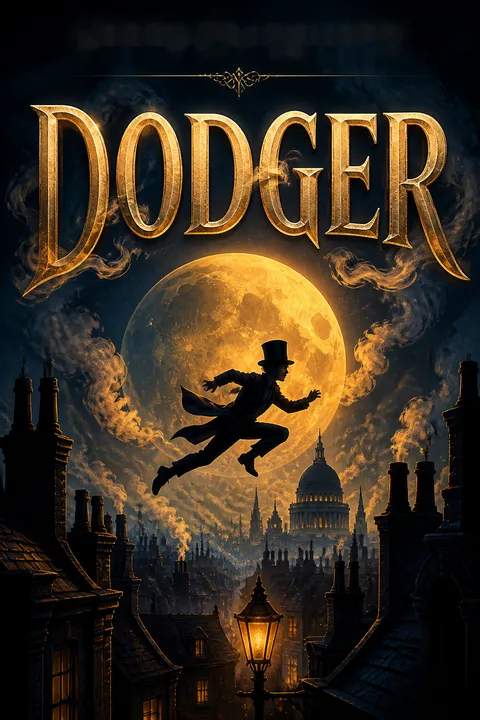
On a night when London's filth is churned by relentless rain, Dodger, a streetwise tosher, emerges from the sewers just in time to rescue a mysterious, battered girl from two violent men. His impulsive act of heroism draws the attention of Henry Mayhew and "Charlie" Dickens, two gentlemen who see more in Dodger than just a street urchin. The girl's plight and Dodger's intervention set off a chain of events that will upend his life, thrusting him into a world of intrigue, danger, and unexpected opportunity. The city's grime and cruelty are palpable, but so is the possibility of transformation, as Dodger's fate becomes entwined with that of the golden-haired stranger.
The Girl with Golden Hair
Dodger's rescue of the girl, later called Simplicity, reveals her to be more than a typical victim of London's streets. She is foreign, terrified, and refuses to reveal her name, clutching a ring with a noble crest. As she recovers in the Mayhew household, Dodger is drawn to her vulnerability and beauty, vowing to protect her. The city's underbelly is unforgiving, and Dodger's act of kindness marks him as a target for those who want the girl silenced. Simplicity's fear of being returned to her husband hints at a deeper, more dangerous story, and Dodger's loyalty is tested as he navigates the perilous line between survival and heroism.
Solomon's Wisdom and Grief
After the storm, Dodger seeks solace with Solomon Cohen, his wise Jewish landlord and mentor. The death of Grandad, the king of the toshers, in the sewers leaves Dodger grieving and reflective. Solomon's pragmatic kindness and philosophical outlook help Dodger process his loss and the new responsibilities thrust upon him. Solomon encourages Dodger to clean up, both literally and figuratively, preparing him for the challenges ahead. The bond between them deepens, and Dodger's world expands beyond mere survival, as he begins to consider what kind of man he wants to become.
Street Games and Secrets
Dodger's investigation into Simplicity's attackers leads him through the labyrinthine streets and taverns of London, where alliances are forged over pints and secrets traded for coins. He learns to read people as well as he reads the city's filth, gathering clues about the mysterious coach and its foreign occupants. The Happy Families card game, found among Simplicity's belongings, becomes a symbol of the deceptions and shifting allegiances that define both family and society. Dodger's quick wit and reputation as a "geezer" earn him friends and enemies alike, as he realizes that the truth is often a fog, shaped by those who tell it.
A Hero's New Clothes
With Solomon's guidance, Dodger acquires new clothes and a new persona, allowing him to move between the worlds of the poor and the powerful. His exploits—both real and exaggerated—begin to earn him a reputation as a hero, especially after he thwarts a robbery at the Morning Chronicle. Yet Dodger remains wary of the attention, knowing that fame can be as dangerous as obscurity. His encounters with the Mayhews, Dickens, and other reform-minded gentry expose him to new ideas and possibilities, but also to the complexities of charity, class, and self-interest.
Questions, Coaches, and Clues
Dodger's relentless pursuit of the truth about Simplicity's past and her attackers leads him into ever greater peril. He uncovers hints of political intrigue, foreign spies, and a noble marriage gone wrong. The squeaky-wheeled coach becomes a key clue, and Dodger's street contacts help him piece together the web of those hunting Simplicity. As he navigates the city's dangers, Dodger's sense of justice grows sharper, and he becomes determined not just to survive, but to protect the innocent and expose the guilty, even if it means risking his own life.
The Happy Family Mystery
The children's card game "Happy Families" found with Simplicity becomes a metaphor for the games people play by both the powerful and the powerless. Dodger learns that survival in London requires not just cunning, but the ability to play roles, keep secrets, and sometimes deceive even those closest to you. As he delves deeper into Simplicity's story, Dodger realizes that everyone—himself included—is both player and pawn in a larger game. The boundaries between truth and lies, loyalty and betrayal, become ever more blurred.
Danger in the Shadows
As Dodger's investigation draws the attention of powerful enemies, he finds himself stalked by spies, thugs, and the enigmatic Outlander—a legendary assassin whose identity is as fluid as the city's fog. Simplicity's safety becomes ever more precarious, and Dodger must rely on his wits, his friends, and his growing network of allies to stay one step ahead. The city's darkness is both literal and metaphorical, and Dodger learns that sometimes the greatest dangers come from those who claim to be on your side.
Sweeney Todd's Razor
A visit to a Fleet Street barber turns deadly when Dodger finds himself face-to-face with Sweeney Todd, a man driven mad by the horrors of war. Dodger's quick thinking saves his own life and prevents further tragedy, but the incident cements his reputation as a hero—and a target. The line between villain and victim blurs, and Dodger is forced to confront the realities of trauma, justice, and the stories people tell about themselves and others. The razor becomes a symbol of both danger and destiny, as Dodger's actions ripple through the city.
Simplicity's Secret Revealed
The truth about Simplicity's identity emerges: she is a runaway princess, married to a foreign prince and hunted by agents who want her silenced. Dodger, with the help of Dickens, Disraeli, and the formidable Angela Burdett-Coutts, devises a plan to protect her. Disguises, false deaths, and clever misdirection become tools in a high-stakes game of survival. Simplicity's courage and Dodger's ingenuity are tested as they navigate the treacherous waters of politics, love, and self-determination. Their bond deepens, and Dodger begins to imagine a future beyond the sewers.
Plots, Politics, and Pursuit
As the plot thickens, Dodger finds himself entangled in the machinations of politicians, police, and foreign agents. The Outlander's threat looms, and the city becomes a chessboard where every move is fraught with risk. Dodger's skills as a thief, a fighter, and a dodger are put to the ultimate test, as he must outwit not just his enemies, but the very systems of power that seek to control him and Simplicity. The stakes are no longer just personal—they are political, and the outcome could shape the fate of nations.
The Outlander Arrives
The legendary Outlander, revealed to be a woman, infiltrates Dodger's world, bringing with her a new level of danger. Disguises and deception reach their peak as Dodger and Simplicity stage her "death" to throw off their pursuers. The sewers become both sanctuary and battleground, as Dodger uses his intimate knowledge of the city's underbelly to turn the tables on his enemies. The line between life and death, truth and illusion, becomes razor-thin, and Dodger must rely on every ounce of cunning and courage to survive.
Death in the Sewers
In a climactic confrontation beneath the city, Dodger faces the Outlander and her accomplice, risking everything to save Simplicity. The plan to fake Simplicity's death succeeds, but not without cost. A nameless girl's body is used to complete the illusion, and Dodger is left to grapple with the moral weight of his choices. The sewers, once a place of filth and despair, become the crucible in which Dodger's new life is forged. The city's fog closes over the past, and Dodger and Simplicity prepare to seize their freedom.
The Art of Disguise
With Simplicity presumed dead, Dodger and his beloved reinvent themselves as Serendipity and Jack, escaping London for the countryside. Disguises, new identities, and the kindness of friends allow them to find peace and healing in the Mendip Hills. The lessons of the city—about trust, survival, and the power of stories—remain with them, even as they dream of a future together. The art of disguise becomes not just a means of escape, but a path to self-discovery and transformation.
The Final Dodger
Dodger and Serendipity return to London, their pasts buried in the city's fog. Dodger's exploits have not gone unnoticed, and he is summoned to Buckingham Palace, where Queen Victoria herself recognizes his bravery and resourcefulness. Offered a new role as a government agent—a "spy who isn't a spy"—Dodger faces the prospect of a life beyond the sewers, using his unique skills for the greater good. The city that once threatened to consume him now offers him a place of honor, and Dodger embraces his new identity with hope and determination.
Fog, Fortune, and Freedom
As Dodger—now Sir Jack—and Serendipity begin their new life, the lessons of the past linger. The fog of London, both literal and metaphorical, remains ever-present, shaping the stories people tell and the lives they lead. Dodger's journey from tosher to hero, from survivor to savior, is a testament to the power of resilience, cunning, and compassion. The city's darkness is never far away, but neither is the possibility of light. In the end, Dodger's greatest triumph is not just in outwitting his enemies, but in forging a future where love, freedom, and hope can flourish—even in the shadow of the fog.
Analysis
Terry Pratchett's Dodger is a masterful reimagining of Dickensian London, blending historical realism with sharp wit, social critique, and a deep empathy for the marginalized. At its heart, the novel is a meditation on identity, agency, and the power of narrative to shape both individual lives and collective history. Dodger's journey from sewer scavenger to hero—and ultimately to a man capable of love and hope—embodies the possibility of transformation even in the bleakest circumstances. The novel interrogates the boundaries between truth and fiction, survival and morality, and challenges readers to see the humanity in those whom society overlooks. Pratchett's use of fog, disguise, and games as central motifs underscores the fluidity of identity and the necessity of adaptation in a world rife with danger and injustice. Ultimately, Dodger is a celebration of resilience, cunning, and compassion—a reminder that even in the darkest corners of the city, light can be found, and that the stories we tell about ourselves can become the keys to our freedom.
Review Summary
Dodger by Terry Pratchett receives mixed reviews averaging 3.94 out of 5 stars. Readers appreciate Pratchett's wit, humor, and thorough research into Victorian London. Many praise the engaging protagonist and cameos by historical figures like Charles Dickens and Benjamin Disraeli. However, critics note the protagonist feels overly idealized, the romance unconvincing, and the plot simplistic. Some found the Victorian prose style initially jarring. Fans acknowledge it lacks Discworld's magic but remains an enjoyable historical fantasy. The book works well as YA fiction, though some question its historical accuracy and moral messages.
Characters
Dodger
Dodger is a tosher—a sewer scavenger—whose quick wits, agility, and deep knowledge of London's underbelly keep him alive. Orphaned and hardened by poverty, he is fiercely independent, yet capable of great kindness and loyalty. Dodger's psychological complexity lies in his constant negotiation between self-interest and altruism; he is both a product of his harsh environment and a challenger of its injustices. His relationships—with Solomon, Simplicity, and the city itself—drive his growth from a cunning survivor to a courageous protector and, ultimately, a man capable of love and hope. Dodger's journey is one of self-discovery, as he learns to trust, to dream, and to shape his own destiny.
Simplicity (Serendipity)
Simplicity, later Serendipity, is a young woman of noble birth fleeing an abusive marriage and political machinations. Her golden hair and foreign accent mark her as an outsider, but her intelligence, courage, and adaptability make her a formidable partner for Dodger. Simplicity's trauma and fear are balanced by her determination to claim her freedom and define her own identity. Her relationship with Dodger is built on mutual trust, shared danger, and the hope of a new life. Psychologically, she embodies both vulnerability and strength, navigating the expectations of society and the realities of survival with grace and cunning.
Solomon Cohen
Solomon is Dodger's landlord, friend, and surrogate father—a Jewish watchmaker whose wisdom, humor, and pragmatism provide Dodger with guidance and stability. Solomon's past is marked by loss and exile, giving him a deep empathy for the marginalized and a philosophical outlook on life's hardships. He teaches Dodger not just practical skills, but also the value of kindness, integrity, and self-respect. Solomon's relationship with Dodger is both nurturing and challenging, pushing the young man to grow beyond his circumstances and to imagine a better future.
Charles Dickens ("Charlie")
Charlie is a fictionalized version of Charles Dickens, portrayed as a sharp-eyed journalist and social reformer. He recognizes Dodger's potential and becomes both ally and interrogator, drawing out the truth behind the city's mysteries. Dickens's psychological acuity allows him to see through facades, and his compassion drives him to expose injustice. His relationship with Dodger is complex—part mentor, part manipulator, always seeking the story behind the story. Dickens embodies the power of narrative to shape reality and inspire change.
Henry Mayhew
Mayhew is a real historical figure, depicted as a gentle, earnest chronicler of London's poor. He provides shelter and support to Simplicity and Dodger, motivated by a deep sense of social responsibility. Mayhew's empathy and curiosity make him a bridge between the worlds of the privileged and the destitute. His relationship with Dodger is paternal and respectful, offering both practical help and moral encouragement.
Angela Burdett-Coutts
Angela is a powerful, independent woman who uses her wealth and influence to aid the vulnerable. She becomes a key ally in Dodger and Simplicity's struggle, providing sanctuary, resources, and strategic guidance. Angela's psychological strength lies in her refusal to be constrained by gender or class expectations; she is both nurturing and commanding, a model of female agency in a patriarchal world. Her relationship with Dodger is one of mutual respect and shared purpose.
The Outlander
The Outlander is a legendary killer whose gender, appearance, and motives are shrouded in mystery. As both myth and reality, the Outlander represents the ever-present danger lurking in the city's shadows. Psychologically, the Outlander is a master of disguise and manipulation, driven by professional detachment and a willingness to do whatever is necessary. The confrontation with Dodger is a test of wits, will, and survival, forcing both characters to confront the limits of their own identities.
Sir Robert Peel
Peel, the founder of the modern police force, is depicted as both a symbol of authority and a shrewd, adaptable operator. He recognizes Dodger's unique talents and is willing to bend the rules to achieve justice. Peel's psychological complexity lies in his balancing of duty, morality, and political necessity. His relationship with Dodger is marked by mutual wariness and respect, as each recognizes the other's value in navigating the city's dangers.
Joseph Bazalgette
Bazalgette is a young, enthusiastic engineer obsessed with improving London's sewers. He represents the promise of progress and the power of practical solutions to social problems. His interactions with Dodger highlight the contrast between institutional reform and individual ingenuity. Bazalgette's psychological drive is rooted in a desire to leave a lasting, positive mark on the city.
Messy Bessie, Mrs Quickly, and the Street Folk
These supporting characters—street vendors, cooks, beggars, and thieves—embody the resilience, humor, and resourcefulness of London's poor. Their relationships with Dodger are transactional but also deeply human, providing him with information, support, and a sense of belonging. Psychologically, they reflect the collective spirit of survival and the blurred lines between right and wrong in a world where the rules are stacked against them.
Plot Devices
The Fog of Truth
Throughout the novel, the concept of "fog"—both literal and metaphorical—serves as a central plot device. The fog represents the uncertainty, ambiguity, and malleability of truth in a city where survival depends on perception and deception. Characters manipulate, obscure, and reveal the truth to suit their needs, and the narrative structure itself mirrors this uncertainty, with shifting perspectives and unreliable narrators. The fog allows for reinvention, escape, and the possibility of redemption, but also conceals danger and perpetuates injustice.
Disguise and Reinvention
Disguise—physical, social, and psychological—is a recurring motif. Dodger and Simplicity adopt new identities to evade their enemies, and even the Outlander's gender is a disguise. The ability to reinvent oneself is both a survival strategy and a path to self-discovery. The narrative structure uses these transformations to explore themes of class, gender, and agency, challenging the idea that identity is fixed or predetermined.
The Game of Happy Families
The children's card game "Happy Families" becomes a symbol of the games people play to survive, succeed, and belong. The rules of the game—asking, bluffing, collecting—mirror the strategies employed by characters navigating the city's dangers. The game also highlights the constructed nature of family, community, and social order, suggesting that belonging is as much about performance as about blood.
The Sewer as Underworld
The sewers are both literal and symbolic—a place of filth, danger, and death, but also of refuge, transformation, and hidden treasures. The narrative uses the sewers as a stage for Dodger's trials, a space where the boundaries between above and below, rich and poor, law and crime, are blurred. The sewers become the crucible in which Dodger's character is tested and forged.
Narrative Structure and Foreshadowing
The novel employs a layered narrative, with stories within stories, shifting points of view, and frequent foreshadowing. Dickens's presence as both character and chronicler blurs the line between fiction and reality, inviting readers to question whose story is being told and why. Foreshadowing is used to build suspense and to suggest that every action—no matter how small—can have far-reaching consequences.
About the Author






Download PDF
Download EPUB
.epub digital book format is ideal for reading ebooks on phones, tablets, and e-readers.








































