Key Takeaways
1. Early Life Forged a Disciplined Leader
"I have always looked back on that conversation as one of the most valuable moments of my life."
Formative years. Dwight D. Eisenhower's childhood in Abilene, Kansas, instilled core values of honesty, self-reliance, and ambition. Raised in a frugal, religious, and pacifist Mennonite family, he learned the importance of hard work and self-sufficiency. This Midwestern upbringing reinforced a strong sense of community and a cautious, conservative outlook.
Conquering temper. A pivotal childhood incident, where he furiously pounded an apple tree, led his mother to teach him the futility of anger, stating, "He that conquereth his own soul is greater than he who taketh a city." This lesson profoundly influenced Eisenhower, who spent a lifetime mastering his volatile temper, a trait he recognized as his greatest personal challenge. His ability to control emotions became a hallmark of his leadership.
Sports and discipline. West Point provided a free education and further honed his discipline and competitive drive, particularly through sports like football. Though a knee injury ended his playing career, it ignited his passion for coaching and organizing. He saw football as instilling values like:
- Hard work
- Team play
- Self-confidence
- Dedication
These traits would later define his approach to military command and political leadership.
2. Mastering the Art of Allied Command
"I do not believe that any other man than yourself could have done it."
Unifying diverse forces. Eisenhower's greatest strength in World War II was his unparalleled ability to forge and maintain Allied unity. Tasked with commanding combined British-American operations, he skillfully navigated nationalistic rivalries and strong personalities, ensuring cooperation was paramount. His integrated staff at Allied Force Headquarters (AFHQ) became a model for future multinational commands.
Diplomacy and persuasion. Unlike many of his peers, Eisenhower preferred persuasion and cooperation over imposing his will. He cultivated strong personal relationships with British leaders like Churchill and Mountbatten, often using humor and charm to bridge differences. This approach was critical in overcoming initial British skepticism about American leadership and commitment.
Building trust. His dedication to the Alliance was legendary, earning him immense trust from both subordinates and superiors. He understood that genuine collaboration was essential for victory, even if it meant enduring difficult personalities like Montgomery or political pressures from Churchill. This ability to inspire confidence and loyalty across national lines was unique among wartime commanders.
3. Strategic Acumen Defined His Wartime Leadership
"The enemy's... counter attacks... make it appear that we have a good chance to encircle and destroy a lot of his forces."
Learning from experience. Eisenhower's early command experiences in North Africa and Sicily, though marked by initial caution and lost opportunities, were crucial learning grounds. He quickly realized the importance of decisive action and the dangers of overestimating the enemy, vowing not to repeat mistakes. This self-critical approach allowed him to adapt and improve rapidly.
Boldness in critical moments. Despite his initial caution, Eisenhower demonstrated remarkable boldness when it mattered most. His decision to proceed with the D-Day airborne drops, against strong warnings of high casualties, proved pivotal to the invasion's success. He also recognized the German counteroffensive in the Ardennes as an opportunity to destroy enemy forces, rather than just a threat.
Broad front strategy. Eisenhower consistently advocated for a "broad front" approach to invading Germany, believing it would prevent the enemy from concentrating forces and would ultimately be less costly in lives. This strategy, often debated with Montgomery's preference for a single, narrow thrust, proved effective in overwhelming German defenses and accelerating the final victory. His ability to anticipate enemy reactions and adapt plans was a hallmark of his strategic genius.
4. Reluctant Entry into the Political Arena
"I say flatly, completely, and with all the force I have—I haven't a political ambition in the world. I want nothing to do with politics."
Post-war popularity. Following WWII, Eisenhower's immense popularity made him a natural choice for political office, with both Democrats and Republicans urging him to run for president. Despite his repeated public and private denials of political ambition, he was seen as the "only man" who could unite the nation and guide it through the post-war era.
Duty over desire. Eisenhower genuinely preferred a quiet retirement, but his strong sense of duty and obligation to his country made it difficult to outright refuse. He believed a professional soldier should avoid seeking high political office unless there was an "obvious and overriding reason," a condition his supporters worked tirelessly to convince him existed.
Strategic ambiguity. His refusal to declare a party affiliation or take firm stances on domestic issues allowed him to maintain a broad appeal. This strategic ambiguity, combined with his carefully managed public image as a non-partisan hero, inadvertently fueled the "Eisenhower for President" movement, ultimately leading to his nomination and election.
5. Shaping Cold War Defense with the "New Look"
"This world in arms is not spending money alone. It is spending the sweat of its laborers, the genius of its scientists, the hopes of its children."
Fiscal conservatism. As President, Eisenhower prioritized a balanced budget and a strong economy, believing that excessive defense spending would bankrupt the nation and ultimately undermine its security. He faced constant pressure from Congress, the Joint Chiefs of Staff (JCS), and even his own party to increase military appropriations.
"New Look" defense. His "New Look" defense policy emphasized nuclear deterrence and airpower over large conventional forces, aiming for "more bang for a buck." This strategy, though controversial and criticized as an "all or nothing" approach, allowed him to significantly cut defense spending while maintaining a formidable deterrent against the Soviet Union.
The cost of arms. Eisenhower was deeply concerned about the human and economic costs of the arms race. His "Chance for Peace" speech eloquently articulated this, highlighting how resources spent on weapons could instead fund schools, hospitals, and development. He consistently argued that true security lay not just in military might, but in economic stability and global well-being.
6. Navigating Domestic Divides with Caution
"I can't imagine any set of circumstances that would ever induce me to send federal troops into any area to enforce the orders of a federal court, because I believe that [the] common sense of America will never require it."
McCarthyism's challenge. Eisenhower faced the pervasive threat of McCarthyism, which he personally loathed but chose to combat indirectly. He refused to engage in a "pissing contest" with Senator McCarthy, believing that public confrontation would only amplify the senator's influence. Instead, he worked behind the scenes, denying McCarthy access to executive personnel and records, ultimately contributing to McCarthy's downfall.
Civil rights dilemma. The Supreme Court's Brown v. Topeka decision presented Eisenhower with a profound challenge. While he upheld the Court's authority, his personal sympathies for white Southerners and fears of widespread resistance led him to adopt a cautious, gradualist approach. He refrained from publicly endorsing Brown or providing strong moral leadership on desegregation, believing that "laws are rarely effective unless they represent the will of the majority."
Little Rock intervention. Despite his reluctance to use federal force, Governor Orval Faubus's defiance at Little Rock's Central High School in 1957 left Eisenhower no choice. He federalized the Arkansas National Guard and deployed the 101st Airborne Division to enforce court-ordered desegregation. This decisive action, though taken reluctantly, established the federal government's ultimate authority in civil rights enforcement.
7. Principled Leadership in Global Crises
"I don't give a damn how the election goes. I guess it will be all right."
Suez Crisis. In 1956, Eisenhower faced a severe test of his leadership when Britain, France, and Israel secretly conspired to invade Egypt over the nationalization of the Suez Canal. Despite these nations being America's closest allies, Eisenhower condemned their actions as "nineteenth-century colonialism" and a violation of international law. He prioritized principle over alliance, using economic pressure and UN diplomacy to force their withdrawal, even risking his re-election.
Hungarian Uprising. Simultaneously, the Hungarian Uprising against Soviet control erupted. While Eisenhower's administration had long advocated for "liberation" in Eastern Europe, he recognized the geographical and military limitations of intervention. He refused to send aid or troops, understanding that direct challenge to Soviet hegemony in its sphere of influence could trigger a wider, nuclear conflict.
Avoiding wider war. Throughout his presidency, Eisenhower consistently resisted calls for military intervention in various global hotspots, including multiple recommendations for atomic strikes against China. His deep understanding of the horrors of war, coupled with his strategic realism, led him to prioritize peace and diplomatic solutions, even when facing intense pressure from hawks within his own government.
8. The Double-Edged Sword of Covert Operations
"The President said that he had one tremendous asset in a summit meeting, as regards effect in the free world. That is his reputation for honesty. If one of these aircraft [the U-2s] were lost when we are engaged in apparently sincere deliberations, it could be put on display in Moscow and ruin the President's effectiveness."
CIA's expanded role. Eisenhower significantly expanded the CIA's covert action capabilities, viewing it as a crucial tool for waging the Cold War without resorting to conventional or nuclear conflict. He approved operations to overthrow governments in Iran (1953) and Guatemala (1954), believing these "quick fixes" justified the methods.
U-2 overflights. To counter Soviet secrecy and gain vital intelligence on their military capabilities, Eisenhower authorized high-altitude U-2 reconnaissance flights over the Soviet Union. He was acutely aware of the risks, particularly to his reputation for honesty, should a plane be lost during sensitive diplomatic periods.
The U-2 incident. In May 1960, just before a crucial summit, a U-2 piloted by Francis Powers was shot down over Russia. Eisenhower's initial attempt at a cover-up, based on the assumption the pilot was dead and the plane destroyed, backfired spectacularly when Khrushchev revealed Powers and parts of the aircraft. This incident severely damaged Eisenhower's credibility and sabotaged the summit, highlighting the perils of relying on secrecy and covert action.
9. A Vision for European Unity and Global Peace
"If in ten years, all American troops stationed in Europe for national defense purposes have not been returned to the United States, then this whole project will have failed."
European integration. Eisenhower was a passionate advocate for a "United States of Europe," believing that economic and military integration was essential for long-term stability and a bulwark against Communism. He tirelessly pushed for the European Defense Community (EDC) as a means to rearm Germany within a multinational framework, seeing it as a catalyst for broader political unity.
Disarmament efforts. Despite the Cold War's escalating arms race, Eisenhower made genuine efforts toward disarmament. His "Atoms for Peace" proposal (1953) offered to share nuclear materials for peaceful purposes, and he later pursued a verifiable test-ban treaty. He believed that reducing the financial and psychological burden of armaments was crucial for global well-being.
Global engagement. Eisenhower consistently emphasized the interconnectedness of global prosperity and security. He championed foreign aid as a means to prevent the spread of Communism in the Third World, arguing that economic development fostered political stability. His extensive world travels as President underscored his commitment to diplomacy and building international partnerships.
10. The Burden of Perceived Indispensability
"I have seen many a man hang on too long 'under the definite impression that he had a great duty to perform and that no one else could adequately fill his particular position.'"
Reluctance to retire. Despite his lifelong dream of a quiet retirement at his Gettysburg farm, Eisenhower found it difficult to step away from public service. His profound sense of duty, coupled with a perceived lack of suitable successors within the Republican Party, led him to believe he was indispensable for national and global stability.
Health challenges. His heart attack in 1955 and a minor stroke in 1957 raised serious questions about his ability to serve a second term. While he recovered remarkably, these health issues underscored the immense physical and mental toll of the presidency, making his decision to run again a deeply personal and consequential one.
Succession concerns. Eisenhower harbored ambiguous feelings about Richard Nixon, his Vice President, often expressing doubts about Nixon's maturity and political judgment. He tried to steer Nixon towards a Cabinet post to gain administrative experience, but ultimately accepted him as his running mate, albeit with lingering reservations about his readiness for the top job.
11. A Legacy of Peace and Prosperity
"The United States never lost a soldier or a foot of ground in my administration. We kept the peace. People asked how it happened—by God, it didn't just happen, I'll tell you that."
Economic stability. Eisenhower's presidency delivered eight years of remarkable peace and prosperity. His fiscal conservatism, commitment to a balanced budget, and control over defense spending contributed to a period of low inflation, high employment, and significant economic growth, including the monumental Interstate Highway System.
Avoiding war. His greatest achievement was keeping the United States out of major conflicts. He ended the Korean War, resisted intervention in Vietnam, and skillfully managed numerous Cold War crises without escalating to direct military confrontation. This restraint, often against the advice of his military and political advisors, defined his approach to foreign policy.
Restoring dignity. Eisenhower restored a sense of dignity and calm to the presidency after years of war and political turmoil. His non-partisan demeanor, emphasis on national unity, and steady leadership resonated with the American public, earning him widespread trust and admiration. He left office as one of the most popular presidents in U.S. history, having guided the nation through a dangerous decade with a steady hand.
Review Summary
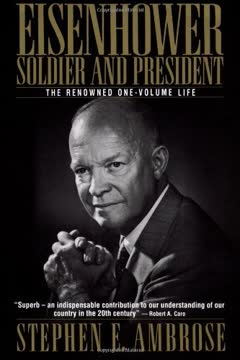
Reviews of Eisenhower: Soldier and President are generally positive, averaging 4.03/5. Many praise Ambrose's balanced, objective treatment of Eisenhower's military and presidential career, highlighting his maintenance of peace, fiscal restraint, and Cold War navigation. Readers appreciate honest critiques of Ike's failures, particularly on civil rights and McCarthyism. Common criticisms include rushed coverage of Eisenhower's early life, gaps from abridging the two-volume original, and occasionally dry writing. Some note the book has been surpassed by more recent biographies, while others still consider it the definitive single-volume Eisenhower biography.