

Key Takeaways
Every beloved platform rots through the same three-act tragedy
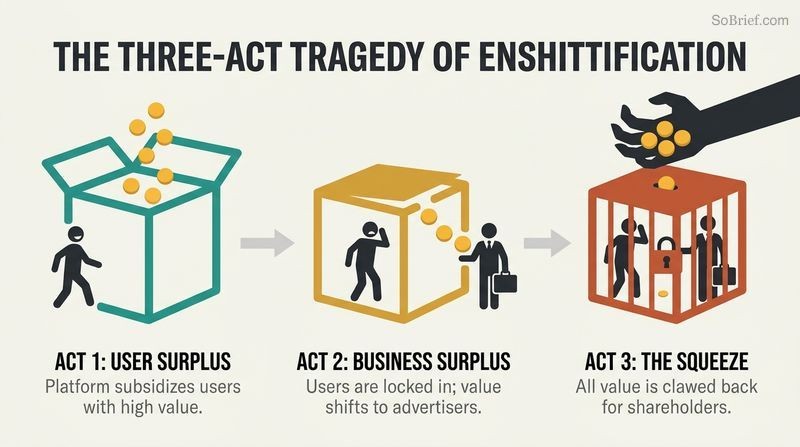
Enshittification names a predictable decay. Cory Doctorow coined the term (the American Dialect Society's 2023 word of the year) to describe how digital platforms die in stages. First, they lavish value on users, subsidizing a great experience with investor cash: early Facebook showed you only the posts you asked for, early Amazon sold goods below cost with free returns. Second, once users are locked in, the platform degrades their experience to woo business customers like advertisers, sellers, and publishers. Third, once those businesses are trapped too, it claws back nearly all value for shareholders, leaving only the crumbs needed to keep everyone stuck.
The end state is a pile of garbage we cannot leave. Facebook, Amazon, the iPhone, and Twitter all walked this path.
What distinguishes this from ordinary product decline is simultaneity. Albert Hirschman's classic 'exit, voice, and loyalty' framework assumes unhappy customers can leave, disciplining firms. Doctorow's insight is that when every major platform rots at once and none dies, the mechanism has broken. The pattern echoes the enshittification of shopping malls, cable bundles, and airlines, suggesting the logic is not uniquely digital. A fair challenge: not all platforms follow the arc so cleanly, and some (Wikipedia, Signal) resist it structurally. The three-stage model is best read as an ideal type, a diagnostic lens rather than an iron law of platform physics.
You stay on terrible platforms because leaving means abandoning your people
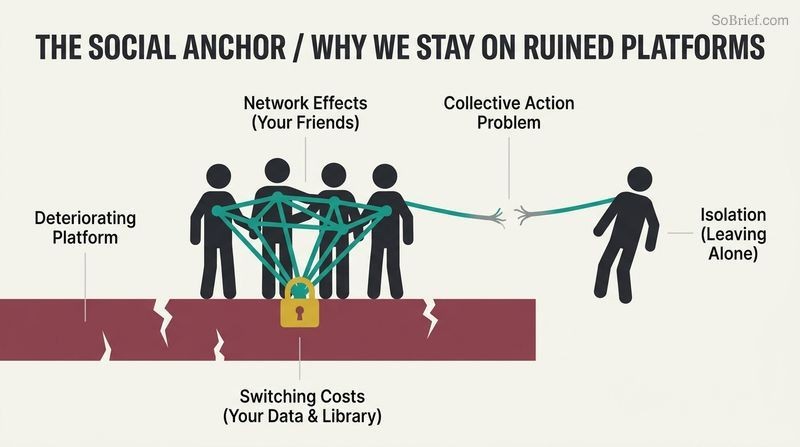
Three forces glue you in place. Network effects mean a service grows more valuable as more people join, so you joined Facebook for the friends already there. Switching costs are everything you forfeit by leaving: your DRM-locked Amazon library, your entire social graph. The collective action problem is the near-impossibility of coordinating a mass exodus, since each friend has their own communities they cannot abandon.
Doctorow calls this the Fiddler on the Roof problem. In the musical, impoverished, persecuted villagers stay in Anatevka because community is both a lifeline and an anchor. That is why Twitter shambles on as a 'zombie platform': journalists, activists, and marginalized users despise Elon Musk's management yet remain, because the only thing worse than being harassed in your community is being isolated without it.
This reframes user 'stickiness' from a marketing virtue into a hostage situation. Coordination-game theory (Thomas Schelling) explains why even universally desired change stalls without a focal point everyone trusts to move toward. The observation that oppressed minorities most need the communities that also trap them is genuinely poignant and underexplored in tech criticism. It also predicts why alternatives like Mastodon and Bluesky grow slowly: individual rationality (stay where your people are) blocks collective benefit. The practical upshot, which Doctorow returns to, is that lowering switching costs matters more than persuading people a rival is better.
Four disciplines once caged tech's greed, and all four broke
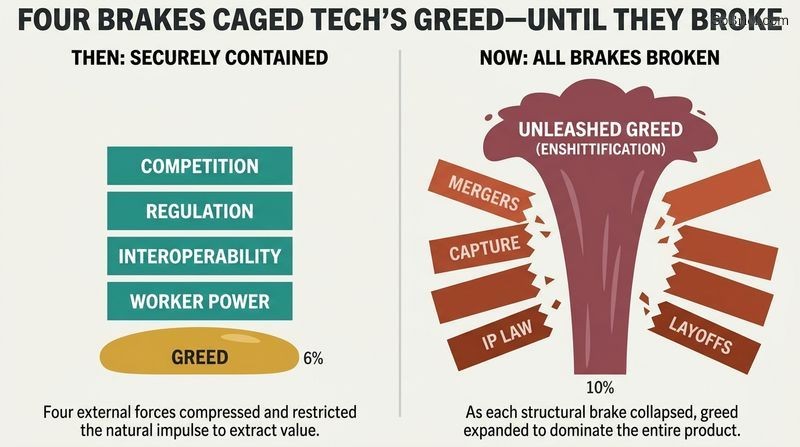
Companies enshittify when they can, not when they turn evil. The same greedy impulse always existed; four external forces kept it in check. Competition meant customers, workers, and suppliers could flee to rivals. Regulation meant fines could exceed the profits from cheating. Interoperability meant third parties could build countermeasures, like compatible printer ink that severs a customer forever. Tech worker power meant scarce, mission-driven engineers refused to wreck the products they had poured themselves into.
Over roughly forty years, each collapsed. Mergers gutted competition, captured regulators stopped enforcing, IP law criminalized interoperability, and mass layoffs (260,000 tech workers in 2023 alone) shattered worker leverage. With every brake released, the greed ran free.
The genius here is locating cause in structure, not villainy, which makes the problem tractable: you cannot legislate away greed, but you can rebuild guardrails. This mirrors institutional economics, where behavior tracks incentives and constraints rather than character. It also resonates with criminology's routine activity theory: crime rises when motivated offenders meet opportunity absent guardians. One nuance worth holding: framing bosses as interchangeable and constraint-driven risks underplaying genuine differences in leadership. Some firms enshittify faster or slower than their constraints alone predict, suggesting culture and individual choice still matter at the margin, even if the structural story dominates.
Digital back ends let companies rewrite prices and rules by the second
Twiddling is enshittification's hidden engine. Because software is endlessly flexible, a platform can continuously adjust prices, wages, search rankings, and recommendation weights through automated systems. Uber can quietly raise your fare when it detects your phone battery is nearly dead. Norwegian grocers using electronic shelf labels reprice goods more than two thousand times a day.
The manipulation hides inside a black box, and the companies lie about it. Black Facebook users have no way to know they are shown pricier financial products than white users with identical histories. Amazon buries the cheapest match roughly seventeen results down while charging sellers for the top spots. The same universal flexibility that makes computers powerful makes them perfect instruments for fine-grained, invisible exploitation.
Twiddling is the mechanism economists call price discrimination, supercharged by surveillance and automation. Classic economics treated perfect price discrimination as a theoretical extreme; personalized digital pricing brings it within reach, letting firms capture consumer surplus that competition once protected. The information asymmetry is the crux: you face a bespoke, opaque market of one while the platform sees everything. This connects to emerging FTC concern over 'surveillance pricing.' A useful extension: twiddling also degrades trust in prices as signals, since a displayed number no longer reflects a stable market rate but a real-time bet on your desperation.
Saying 'we did it with an app' relaunders wage theft as innovation
Apps disguise old exploitation in new clothing. Doctorow highlights algorithmic wage discrimination, a term from legal scholar Veena Dubal: Uber recalculates each driver's pay per ride based on their recent behavior. Drivers who accept everything get squeezed with lower offers, while choosier drivers get bait raises to lure them back. The pay cuts are randomized so drivers cannot detect the pattern.
Two grim concepts complete the picture. Chickenization, borrowed from poultry farming, describes workers forced to borrow money and buy equipment to serve one all-controlling buyer who reveals pay only after the work is done. Reverse-centaurs are humans reduced to serving machines: Amazon drivers urinate in bottles to hit AI-set quotas while cameras track their eyeballs. The 'app' label lets firms dodge labor law entirely.
The 'giant teddy bear gambit' Doctorow describes, where platforms artificially boost a few workers to advertise unattainable earnings, is essentially a variable-ratio reinforcement schedule, the same slot-machine psychology that makes gambling addictive. Behavioral economics has long known intermittent rewards produce the most persistent behavior. What is new is deploying it against workers at industrial scale and precision. The misclassification dodge (contractor, not employee) is the legal keystone. A sharp question this raises: if the underlying conduct would be illegal without the app, courts and regulators could simply look through the interface, which is precisely the reform agenda Doctorow advocates.
Adding a chip can make fixing your own property a felony
IP law is the weapon that outlaws self-defense. Section 1201 of the Digital Millennium Copyright Act makes it a crime to bypass a digital lock guarding a copyrighted work, even on a device you own outright. Put a tiny program on a printer cartridge chip, and refilling it becomes 'circumvention,' punishable by up to five years in prison. Tractors, phones, and ventilators use 'parts pairing' so repairs require a manufacturer's unlock code.
Jay Freeman calls this felony contempt of business model. It explains why every company pushes you toward its app: an app is a website wrapped in enough IP that installing an ad blocker becomes illegal. Adobe held designers' Pantone colors hostage behind a fee; a $1,695 SNOO bassinet suddenly demanded a monthly subscription.
This exposes a startling collision between two legal traditions. Blackstone defined property as 'sole and despotic dominion' over a thing, yet anti-circumvention law lets a manufacturer govern objects after sale. The result is that ownership has quietly become licensing. The right-to-repair movement, now winning state laws from Colorado to Oregon, is the counterforce. Worth noting: DMCA 1201's triennial exemption process grants a right to circumvent but not a right to make or share the tools to do so, rendering it, as Doctorow shows through a Norwegian blind-reader example, almost useless. Rights without delegatable tools are ornamental.
Big Tech profits by owning the tollbooth, not by making things
Rent has quietly triumphed over profit. Borrowing economist Yanis Varoufakis's technofeudalism thesis, Doctorow argues tech giants no longer behave like capitalists who invest, produce, and compete. They behave like feudal lords collecting rent from those who own a chokepoint everyone must pass through. Amazon rakes in $38 billion a year selling search placement and skims 45 to 51 cents of every seller dollar. Apple and Google take up to 30 percent of every app transaction.
The rot spreads to pure extractors. Patent trolls, copyright trolls, and even copyleft trolls (who entrap people making tiny attribution errors on freely licensed photos) produce nothing yet extract fortunes. When the law reliably sides with the owner of a thing over the person doing productive work, you are living under technofeudalism.
Adam Smith and the early capitalist theorists loathed rent precisely because it is income without production; Doctorow and Varoufakis argue we have inverted their project. This connects to Thomas Piketty's finding that returns to capital (r) outpacing growth (g) concentrates wealth in owners. The app-store cut is a clean test case: a 30 percent toll versus the 2 to 5 percent that ordinary payment processors charge reveals rent, not service. The steelman for platforms is that they built valuable infrastructure and coordination. The rebuttal is that legal chokepoints, not superior service, now sustain the tolls, which is what makes it feudal rather than competitive.
The bosses never changed; their leash simply snapped
Enshittification is not just capitalism, ZIRP, or bad founders. Doctorow dismisses the usual explanations. The end of cheap money came years after the decay began. Founder-run firms like Meta enshittified anyway. The same executives who ran the good internet run the bad one. The real story is mechanical: an enshittification lever always sat in every C-suite, but it was jammed by competition, regulation, interoperability, and worker power. Once those constraints failed, the lever moved with a fingertip, all the way to the maximum.
'There is no alternative' is a con. Margaret Thatcher's TINA slogan disguises choices as inevitabilities. Facebook once worked without spying. Google's own founders wrote in 1998 that ad-funded search would be biased against users. These systems ran better before, so they can run better again.
This is the book's philosophical hinge, separating structural from moral explanation. It rhymes with sociologist Dan Davies's idea of the 'accountability sink,' where systems are designed so no individual can be blamed. By insisting alternatives are real and choices are made by named people, Doctorow reopens accountability that TINA rhetoric forecloses. The framing is empowering but carries a tension with the earlier claim that bosses are interchangeable: if constraints alone determine outcomes, blaming individuals seems inconsistent. The resolution is that both matter: constraints set the range of behavior, and named actors chose to yank the lever the moment they could.
Reverse-engineer your way out instead of waiting for slow regulators
Interoperability is fast, self-service disenshittification. Because every computer can run every program, every hostile feature has a potential counter-feature. When a platform abuses you, third parties can build tools to route around the damage, delivering relief while lawsuits and regulators lag. A teenager reverse-engineered iMessage so Beeper Mini could give Android users Apple's security. The Para app exposed the tips DoorDash hid from drivers. In Indonesia, cooperative-built 'tuyul' apps let gig riders modify their dispatch software.
But rights must be delegatable, not just personal. A law that lets you jailbreak your device but bans anyone from giving you the tool is worthless, as Doctorow showed by grilling a Norwegian minister whose 'balanced' law required every blind person to individually crack Adobe Reader in secret. Repealing anti-circumvention law would unleash a repair and adaptation economy.
Security theory illuminates why this works: attackers only need one flaw while defenders must be flawless, so once workers or users go on offense, the advantage flips to them. This is the same asymmetry that makes software piracy uncontainable, redirected toward consumer power. The deeper point is about middlemen: the problem is not intermediaries but powerful ones, so good policy protects helpful third parties while curbing dominant ones. A caveat Doctorow acknowledges: interop is cat-and-mouse, and well-funded incumbents can out-engineer scrappy challengers, as DoorDash's forty-engineer team fighting Para showed. It buys leverage and time, not permanent victory.
The best tech rules are easy to enforce, not merely well-meaning
Administrability should decide which reforms we back. A good rule scores well on two questions: how hard is it to spot a violation, and how hard is it to agree one occurred? Fact-intensive rules, like ordering platforms to police harassment, require endless investigation and hand platforms more surveillance power over users. Doctorow prefers making platforms less important rather than less terrible.
Two highly administrable ideas stand out. A right-to-exit rule would force platforms to let you leave with your data and social graph intact, the way Mastodon lets you switch servers in a click; a regulator just checks whether the file was sent. Applying the end-to-end principle to services would require platforms to deliver what you actually asked for (the album you searched, the newsletters you subscribed to) rather than the boosted ads they wish you wanted.
This is policy design thinking too often missing from tech debates, where good intentions substitute for enforceability. It echoes the legal maxim that a right without a remedy is no right at all. The 'make platforms less important' move is strategically clever: it sidesteps the impossible arbitration of billions of moderation calls and instead attacks lock-in directly, treating the disease (captivity) rather than symptoms (bad behavior). A tension worth naming: right-to-exit does little for users facing physical-safety harms like doxing, which still demand fact-intensive intervention. Doctorow concedes exit should complement, not replace, serious moderation, making it a floor of user power rather than a complete answer.
Grassroots rage, not billionaire money, revived global trustbusting
Antitrust roared back after a forty-year coma. Starting under Carter and accelerating under Reagan, the 'consumer welfare standard' (championed by Robert Bork) held that monopolies were fine as long as prices stayed low, which let nearly every industry collapse into cartels of five firms or fewer. Then came a reversal: Lina Khan's FTC, the EU's Digital Markets and Digital Services Acts, the UK's engineer-heavy Digital Markets Unit, and courts ruling Google an illegal monopolist three times.
No dark-money donor funds this; it is pure political will. Enforcers recycle each other's cases globally, since Big Tech runs the same playbook everywhere, so a UK market study becomes an EU regulation becomes a Japanese case. The Trump era threatens the movement, but the public demand that created it does not vanish when agencies are gutted.
The neo-Brandeisian revival (named for Justice Louis Brandeis, foe of 'the curse of bigness') marks a genuine intellectual regime change, displacing the Chicago School orthodoxy that dominated since the 1970s. Doctorow's flywheel framing is apt: monopoly profits fund the politics that enable more monopoly, but anti-monopoly enforcement erodes profits and clears space for rivals who then police each other. What is striking is the coalitional logic borrowed from environmentalism, uniting disparate grievances under one banner. The sober counterpoint, which the book faces squarely, is fragility: a hostile administration can fire enforcers overnight, so durable change requires sustained pressure, not a single favorable term.
Analysis
Doctorow's achievement is lexical as much as analytical: by naming enshittification, he gave a diffuse public grievance a handle sharp enough to organize around. The book's structure borrows from epidemiology (symptoms, pathology, epidemiology, cure), which disciplines what could have been a rant into a causal argument. Its strongest move is refusing the two lazy explanations on offer: that tech leaders are uniquely evil, or that decay is capitalism's inevitable weather. Instead he offers a materialist account: the same actors behave differently when constraints change. This is genuinely falsifiable and more useful than moral panic.
The weakest seam is the tension between structural determinism (bosses are interchangeable, constraints decide everything) and moral urgency (name the individuals, size their pitchforks). Doctorow wants both the exculpatory power of systems thinking and the mobilizing power of blame. In practice both can be true, but the book does not fully reconcile them.
What elevates the work above other tech critiques is its refusal of fatalism. Where Shoshana Zuboff's surveillance capitalism can leave readers feeling doomed, Doctorow insists the good internet existed within living memory and was destroyed by specific, reversible policy choices. His debt to Varoufakis (technofeudalism), Veena Dubal (algorithmic wage discrimination), and the neo-Brandeisian antitrust movement is generous and clarifying.
The cure section is unusually concrete for the genre, prioritizing administrability, a criterion most manifestos ignore. Right-to-exit and end-to-end-for-services are the book's most exportable ideas. The honest limitation is timing: written as Trump dismantled the very enforcement apparatus Doctorow celebrates, the book reads as both victory lap and eulogy. Its wager, that public will outlasts any administration, is a hypothesis, not yet a proof. But it is the right wager, and the analysis equips readers to act on it.
Review Summary
People Also Read





FAQ
What is Enshittification: Why Everything Suddenly Got Worse and What to Do About It by Cory Doctorow about?
- Core concept: The book explores "enshittification," a term Doctorow coins to describe how digital platforms and tech companies degrade over time, prioritizing profit over users, workers, and society.
- Historical and systemic analysis: Doctorow traces the decline from early internet optimism to the current dominance of monopolistic, rent-seeking tech giants.
- Case studies: The book examines companies like Google, Amazon, Facebook, Apple, and Twitter to illustrate how their services have worsened for users and business partners.
- Purpose: Doctorow not only diagnoses the problem but also proposes actionable solutions to reverse the decline and build a better digital future.
Why should I read Enshittification by Cory Doctorow?
- Comprehensive explanation: The book provides a well-researched, systemic analysis of why digital platforms have deteriorated, moving beyond surface-level critiques.
- Insight into power dynamics: It reveals how corporate greed, regulatory capture, labor suppression, and technological design choices shape the digital economy.
- Practical frameworks: Doctorow introduces concepts like "technofeudalism" and the "shitty technology adoption curve" to help readers understand and resist harmful tech trends.
- Hopeful solutions: Unlike many tech critiques, the book offers concrete strategies and policy proposals for reclaiming digital spaces for the public good.
What are the key takeaways from Enshittification by Cory Doctorow?
- Enshittification is systemic: The decline of digital platforms is driven by business incentives, weakened competition, regulatory failures, and diminished worker power.
- Stages of decline: Platforms move from being user-friendly to prioritizing business customers, and finally to exploiting both groups for shareholder gain.
- Legal and technical lock-in: Intellectual property laws and anti-circumvention measures entrench platform control and prevent user self-help.
- Solutions exist: Restoring competition, regulation, interoperability, and labor power are essential to reversing enshittification and building a healthier internet.
What does Cory Doctorow mean by "enshittification" in Enshittification?
- Definition: Enshittification is the process by which platforms and services start out valuable and user-friendly but gradually degrade to maximize profit, often at the expense of users, workers, and business partners.
- Mechanisms: This happens through increasing fees, reducing service quality, imposing surveillance, and limiting interoperability.
- Case studies: Doctorow illustrates enshittification with examples from Google, Amazon, Apple, and Facebook, showing how each company shifted from innovation to exploitation.
- Broader impact: The phenomenon reflects deeper issues in competition, regulation, and labor, not just isolated tech failures.
What are the stages of enshittification described in Enshittification by Cory Doctorow?
- Stage One – Good to Users: Platforms initially offer valuable, often free or subsidized services to attract users and build network effects.
- Stage Two – Good to Business Customers: Once users are locked in, platforms shift benefits to business customers (advertisers, sellers), often degrading user experience.
- Stage Three – Exploiting All Sides: Platforms then exploit business customers and users alike, raising fees and degrading service quality to maximize shareholder returns.
- Result: Both users and business customers are left worse off but remain locked in due to high switching costs and network effects.
How does Cory Doctorow illustrate enshittification through case studies in Enshittification?
- Facebook: Began as a user-friendly network, then prioritized advertisers and publishers, eventually degrading user experience while locking users in.
- Amazon: Attracted users and sellers with low prices and shipping, then imposed high fees and unfavorable terms, reducing quality for everyone.
- Apple iPhone: Started with a curated, privacy-respecting ecosystem, later imposing high fees and restrictive policies on developers and users.
- Broader pattern: Each case shows how platforms shift from serving users to exploiting all stakeholders for profit.
What is "technofeudalism" as discussed in Enshittification by Cory Doctorow?
- Concept origin: Borrowed from economist Yanis Varoufakis, technofeudalism describes a shift from profit-driven capitalism to rent-seeking dominance by tech giants.
- Rent vs. profit: Companies like Amazon and Apple extract value by controlling digital infrastructure, charging fees, and stifling competition.
- Monopoly and monopsony: Platforms act as both market controllers and sole buyers/sellers, imposing unfair terms on all sides.
- Societal impact: This system concentrates wealth and power, undermines workers’ rights, and exacerbates inequality.
How does Enshittification by Cory Doctorow explain the role of competition and antitrust in the tech industry?
- Decline of competition: Decades of weak antitrust enforcement allowed tech giants to consolidate power and eliminate rivals.
- Antitrust revival: Recent efforts in the US, EU, and UK are challenging mergers, imposing fines, and crafting new laws like the Digital Markets Act.
- Obstacles: Political backlash, judicial hurdles, and regulatory capture threaten progress.
- Global cooperation: International regulatory collaboration is crucial, as tech companies operate across borders.
What is the role of platforms and intermediaries in enshittification according to Enshittification by Cory Doctorow?
- Platforms as middlemen: Platforms connect users and business customers but become problematic when they gain gatekeeper power.
- Disintermediation dream lost: Early hopes of cutting out middlemen faded as platforms consolidated and dominated markets.
- Lock-in and exploitation: Platforms use network effects and high switching costs to lock in users and business customers, enabling progressive value extraction.
- Result: Both sides are exploited, with little recourse due to lack of competition and high barriers to exit.
How does Enshittification by Cory Doctorow explain the importance of interoperability and the problems caused by anti-circumvention laws?
- Interoperability’s value: It allows users to switch platforms, repair devices, and use third-party services, fostering competition and limiting corporate control.
- Legal barriers: Laws like DMCA Section 1201 criminalize bypassing digital locks, preventing users from modifying or repairing devices and software.
- Impact: These laws hinder right-to-repair efforts and block adversarial interoperability, enabling rent-seeking and lock-in.
- Policy recommendation: Doctorow advocates for repealing or reforming such laws to empower users and foster a healthier tech ecosystem.
What is "twiddling" and how does it drive enshittification in digital platforms according to Enshittification by Cory Doctorow?
- Definition: Twiddling refers to the continuous, automated adjustment of prices, fees, content rankings, and other parameters to extract more value from users and business customers.
- Invisible manipulation: Platforms use twiddling to subtly degrade user experience and raise costs without transparent notice.
- Ad tech example: Google and Meta use twiddling to rig ad auctions and inflate prices, harming advertisers and publishers.
- Result: Twiddling accelerates enshittification by making exploitation harder to detect and resist.
What solutions or cures does Cory Doctorow propose in Enshittification to combat the decay of digital platforms?
- Identify responsible actors: Naming individuals and policy decisions that enable enshittification helps hold them accountable.
- Build resistant infrastructure: Create new digital systems designed to resist lock-in, promote interoperability, and empower users and business customers.
- Empower workers and users: Support tech labor rights, adversarial interoperability, and regulatory reforms to restore competition and discipline.
- Policy focus: Doctorow highlights laws like the EU’s Digital Markets Act and privacy-first legislation as promising steps toward a better internet.
Download PDF
Download EPUB
.epub digital book format is ideal for reading ebooks on phones, tablets, and e-readers.








































