Key Takeaways
1. Erebus: From Bomb Vessel to Polar Pioneer
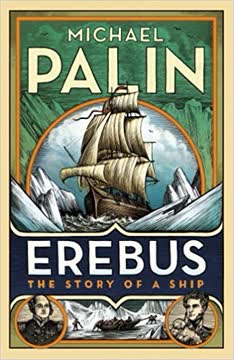
Her name is Erebus. It wasn’t a cheerful name, but then she wasn’t built to cheer; she was built to intimidate, and her name had been chosen quite deliberately.
Born for battle. Launched in 1826 from Pembroke Dockyard, HMS Erebus was initially designed as a bomb vessel, a warship built to carry heavy mortars for coastal bombardment. Her name, derived from the Greek underworld, reflected her intended purpose of destruction and intimidation. This early life saw her patrolling the Mediterranean, a period of relative idleness for the Royal Navy after the Napoleonic Wars, where she never fired a shot in anger.
A new calling. With the end of major conflicts, Britain's naval focus shifted from military glory to scientific exploration. Visionaries like Sir Joseph Banks and Sir John Barrow championed expeditions to expand geographical and scientific knowledge. Erebus, with her sturdy design and reinforced hull, was deemed suitable for these new, non-militaristic goals, marking a dramatic pivot from her original design.
Transformation for the poles. In 1839, after years in "In Ordinary" (temporary retirement), Erebus underwent a significant refit at Chatham Dockyard. Her warship features were stripped away, and her hull was heavily reinforced with thick oak and elm planking, making her an ice-resistant vessel. This transformation prepared her for a destiny far grander and more perilous than any battle: the exploration of the Earth's most extreme regions.
2. Ross's Antarctic Triumph: Charting the Unknown South
Our hopes and expectations of attaining that interesting point were now raised to the highest pitch.
A magnetic crusade. Under the command of James Clark Ross, Erebus, accompanied by her sister ship Terror, embarked on a four-year Antarctic expedition in 1839. The primary objective was to conduct a "Magnetic Crusade," mapping the Earth's magnetic field and locating the South Magnetic Pole, a scientific endeavor that promised to revolutionize navigation. Ross, having already discovered the North Magnetic Pole, was driven by a sense of destiny to complete this extraordinary feat.
Breaking new ground. The expedition pushed further south than any previous vessel, navigating treacherous pack-ice and enduring ferocious storms. On January 11, 1841, they discovered a new continent, which Ross named Victoria Land, and two active volcanoes, one of which he named Mount Erebus, after his ship. This journey not only surpassed Captain Cook's furthest south but also set a record that would stand for nearly sixty years.
A perilous success. Despite the immense challenges—including a near-catastrophic collision between Erebus and Terror in a field of icebergs—Ross brought both ships and 128 men back "unattended by casualty, calamity, or sickness of any kind." This remarkable achievement, a testament to the ships' resilience and the crew's skill, cemented Erebus's reputation as a formidable polar vessel, though Ross himself was exhausted and his hands shook from the ordeal.
3. Life Aboard: Discipline, Discovery, and Daily Drudgery
The expedition had sustained its first loss of life, just short of the first anniversary of its launch.
Structured existence. Life aboard Erebus was a regimented affair, governed by four-hour watches and the ship's bell. Days began early with deck scrubbing and polishing, followed by meals of hardtack, salt beef, and grog. Accommodation was cramped and segregated by rank, with officers enjoying slightly more comfort and privacy than the petty officers, marines, and able seamen who slept in hammocks.
Scientific pursuits. Beyond the daily routine, the expedition was a hive of scientific activity. Officers like Surgeon Robert McCormick and Assistant Surgeon Joseph Hooker meticulously collected specimens, made astronomical and meteorological observations, and recorded ocean currents and depths. Hooker, in particular, thrived, discovering numerous new plant species and finding solace in botany amidst the "utter desolation" of the Antarctic.
Hardship and loss. The voyages were fraught with danger, from violent gales and thick fogs to the constant threat of icebergs. The crew faced freezing temperatures, the risk of scurvy, and the psychological toll of prolonged isolation. The loss of Boatswain Roberts, swept overboard in a storm, and Quartermaster Angelly, who slipped from the rigging, served as stark reminders of the ever-present perils, even on a "very easy" ship like Erebus.
4. The Lure of the Northwest Passage: Franklin's Fateful Command
There is a feeling generally entertained in the several scientific societies, and individuals attached to scientific pursuits ... that the discovery, or rather the completion of a discovery, of a passage from the Atlantic to the Pacific, round the Northern coast of North America, ought not to be abandoned, after so much has been done, and so little now remains to be done.
Barrow's final ambition. The success of Ross's Antarctic expedition rekindled interest in the Arctic, particularly Sir John Barrow's lifelong quest for the Northwest Passage. Nearing eighty, Barrow saw a final opportunity to complete the discovery, arguing that only a hundred miles remained unexplored. He marshaled scientific, political, and economic arguments, including the threat of Russian pre-eminence, to secure funding for a new expedition.
Franklin's appointment. Despite reservations about his age (59) and a recent, contentious dismissal from his governorship of Van Diemen's Land, Sir John Franklin was appointed to lead the expedition. His wife, Lady Jane Franklin, tirelessly lobbied on his behalf, leveraging his fame as "The Man Who Ate His Boots" and his reputation as a humane captain. James Clark Ross, though initially offered command, declined, citing age and a promise to his wife, instead endorsing Franklin.
A confident departure. With Erebus and Terror, now seasoned polar vessels, refitted and provisioned for three years, the expedition departed Greenhithe in May 1845. Franklin, accompanied by his second-in-command James Fitzjames and Captain Francis Crozier, exuded optimism. The nation, riding a wave of Victorian confidence, expected a triumphant return, viewing the expedition as a glorious advertisement for British naval, scientific, and technological prowess.
5. Cutting-Edge Technology: Steam Power and Tinned Food
I conceive that an advantage ... may now be gained from the adoption of a small steam-power (equal to the production of a speed of 3 or 4 knots) in each of the ships employed on this service...
A controversial innovation. For the Franklin expedition, Erebus and Terror underwent further modifications, including the installation of steam-driven screw-propellers. This was a groundbreaking, yet controversial, decision, as steam technology was still nascent for naval vessels. The engines, repurposed from locomotives, were intended to provide auxiliary power for navigating ice-choked channels, though concerns were raised about their weight and potential to weaken the ships' sterns.
Provisions for years. The ships were meticulously provisioned for a three-year voyage, carrying vast quantities of food:
- 18,355 lb of biscuits
- 69,888 lb of flour
- 612 lb of pemmican
- 16,416 lb of beef and 16,320 lb of pork
- Nearly 8,000 tins of preserved meats
The double-edged sword. Crucially, 4,750 lb of lemon juice, cranberries, and pickled vegetables were included to combat scurvy. However, the reliance on tinned foods, supplied by a new, cheaper contractor, Stephen Goldner, would later become a focal point of controversy. Despite the advanced provisions and the innovative steam engines, these technological "advantages" would ironically contribute to the expedition's tragic fate.
6. The Human Element: Leadership, Morale, and Personal Toll
I think perhaps that I have the tact of keeping the officers and men happily together in a greater degree than Ross — and for this reason — he is evidently ambitious and wishes to do everything by himself—I possess not that feeling.
Franklin's affable command. Sir John Franklin, known for his genial nature, fostered a positive atmosphere aboard Erebus. He held open house in his cabin, encouraged scientific pursuits, and led Sunday services with impressive eloquence. His leadership style, focused on camaraderie and mutual respect, aimed to keep officers and men "happily together," a stark contrast to the more reserved and ambitious James Clark Ross.
Crozier's quiet discontent. Captain Francis Crozier, commanding Terror, harbored deep personal and professional frustrations. His unrequited love for Sophy Cracroft, Lady Franklin's niece, left him "sadly lonely." Professionally, he resented being passed over for the expedition's overall command and Fitzjames's appointment to lead magnetic observations, despite Crozier's superior Arctic experience and scientific credentials. His "lowness of spirits" was noted by Franklin, who struggled to address it.
Optimism and underlying anxieties. Despite the outward show of confidence, underlying anxieties permeated the expedition. Fitzjames, while outwardly cheerful, noted Franklin's tendency to sail "too fast" and acknowledged the "one great difficulty" of navigating Baffin Bay's unpredictable ice. The sheer scale of the undertaking, combined with the untested steam engines and the vast, unknown Arctic, created a fragile optimism that would soon be shattered.
7. The Vanishing Expedition: Early Search Efforts and Lingering Hope
I sometimes think it is better perhaps that we should be in happy ignorance of any disaster that may have happened to them, or of any dreadful difficulty they may have yet to overcome than to be viewing as in a magic mirror in a fairy tale their daily vicissitudes.
Last sightings. After leaving Greenland, Erebus and Terror were last seen by whaling ships in upper Baffin Bay in late July 1845. Captain Martin of the Enterprise claimed to have spoken with Franklin, who expressed confidence in reaching Lancaster Sound and boasted of five to seven years' provisions. This optimistic report, coupled with the safe return of the transport ship, initially reassured the Admiralty and the public.
Lady Franklin's growing dread. As 1847 approached with no word, Lady Jane Franklin's initial relief turned to profound anxiety. She wrote to James Clark Ross, expressing her "aspirations for their safety only" and imploring him to lead a search if they did not return. Her letter reveals a deep-seated fear of disaster, hinting at a guilt for having pushed her husband into the expedition.
The first searches. Despite initial complacency from the Admiralty, mounting pressure led to three relief expeditions in 1847-48. Sir James Clark Ross, reluctantly persuaded by Lady Franklin, led one, but found no trace of the missing ships, concluding that Peel Sound was an "unlikely" route. These early, unsuccessful searches, though well-resourced, only deepened the mystery and began to shift public perception from hope of rescue to intimations of tragedy.
8. Rae's Grim Revelation: The First Glimpse of Disaster
From the mutilated state of many of the bodies, and the contents of the kettles [cooking vessels], Rae reported the Inuit telling him, ‘it is evident that our wretched countrymen had been driven to the last dread alternative as a means of sustaining life.’
Inuit testimony emerges. In 1854, John Rae, a Hudson's Bay Company explorer, while surveying the Arctic coast, encountered Inuit with relics from the Franklin expedition. They possessed items like Franklin's Guelphic medal and Crozier's silver spoon, and recounted stories of white men who had died "beyond a large river" four winters prior (1850), having abandoned their ice-crushed ships.
The shocking truth. The Inuit described forty men dragging sledges, weak and thin, unable to communicate beyond signs. Later, they found thirty bodies on the mainland and five on a nearby island, some in tents, others under an upturned boat. Rae's report to the Admiralty included the horrifying detail of "mutilated bodies" and "contents of the kettles," strongly suggesting cannibalism as a last resort for survival.
National outrage and denial. Rae's findings, published in The Times, provoked a wave of horror and revulsion across Britain. Charles Dickens, a prominent champion of Franklin, vehemently rejected the claims, defending the "flower of the trained English Navy" against the "chatter of a gross handful of uncivilised people." Rae, despite providing the first concrete evidence of the expedition's fate, was largely discredited by the establishment and denied public recognition.
9. Theories of Demise: Lead, Scurvy, and the Arctic's Cruelty
The discrepancy between the optimistic tone of the first Victory Point note, dated 28 May 1847, with no mention of any deaths, and that of the postscript, less than a year later, which lists twenty-four, suggests that that last winter in the ice was the killer.
The Beechey Island burials. The discovery of three graves on Beechey Island (John Torrington, John Hartnell, William Braine) from the expedition's first winter (1845-46) provided early clues. Exhumations in the 1980s revealed disturbingly well-preserved bodies and high levels of lead in their hair samples, leading to the "lead poisoning" theory, possibly from sloppily soldered food tins or the ships' modified hot-water systems.
Scurvy's relentless grip. An alternative, and widely accepted, theory points to scurvy as the primary cause of death. The optimistic "All well" message on the Victory Point note, followed by a postscript detailing twenty-four deaths less than a year later, suggests a rapid decline in health during the third winter (1847-48). Scurvy, caused by chronic Vitamin C deficiency, would have weakened the men, making them susceptible to other diseases and unable to endure the arduous overland journey.
A confluence of factors. Ultimately, no single cause can explain every fatality. The men likely suffered from a combination of factors:
- Lead exposure: From food tins or water systems.
- Scurvy: Worsening over time due to diminishing fresh provisions.
- Tuberculosis and other infections: Exacerbated by harsh conditions and weakened immune systems.
- Exposure and starvation: During the desperate overland trek.
The expedition's fate was a tragic confluence of environmental brutality, logistical miscalculations, and the insidious toll of disease.
10. The Inuit's Enduring Testimony: Unraveling the Final Days
For one hundred and forty years the account of the tragedy given to Rae by In-nook-poo-zhe-jook and See-u-ti-chu has been accepted and endorsed ... it was a remarkably accurate recital of events. But it was not the whole story.
Beyond the official record. While official search expeditions often failed, the consistent oral testimonies of the Inuit, gathered by explorers like John Rae, Charles Francis Hall, and Frederick Schwatka, provided crucial insights into the expedition's final days. These accounts, initially dismissed by some, painted a more complete and harrowing picture of the tragedy.
A return to the ships? Inuit stories suggested that Erebus and Terror were seen, and even boarded, by natives in late 1848 or 1849, after the Victory Point note stated the ships had been abandoned. This implies that some survivors, perhaps those too ill to continue the overland trek, or those who had returned from it, reoccupied at least one vessel. The discovery of Lieutenant Irving's properly dug grave at Victory Point further supports the idea of a return to the ships by a party of fit men.
The final chapter. The most likely scenario, pieced together from all available evidence, suggests that after abandoning the ships in April 1848, the main party headed south towards Back's Fish River, leaving a trail of discarded equipment and skeletons. Others, perhaps a smaller, healthier group, may have returned to the ships, surviving a fourth winter before eventually perishing while hunting caribou. By the end of 1850, all 129 men of the Franklin expedition were gone.
11. A Nation's Grief: Memorializing a Heroic Failure
Not here: the white north has thy bones; and thou, Heroic sailor-soul, Art passing on thine happier voyage now, Toward no earthly pole.
The "Franklin problem" solved. By the 1880s, the search for Franklin had largely concluded, with Schwatka declaring the "Franklin problem" settled. The initial outrage over Rae's cannibalism reports had subsided, replaced by a narrative of heroic sacrifice. The return of McClintock's Fox expedition in 1859, bringing definitive evidence of the expedition's demise, allowed the nation to grieve and celebrate the men's courage.
Lady Franklin's enduring campaign. Lady Jane Franklin, a central figure in the search, tirelessly worked to enshrine her husband's reputation. She successfully lobbied for a statue of Sir John in Waterloo Place, London, depicting him as a "Great Arctic Navigator" who "sacrificed their lives to complete the discovery of the North West Passage," a claim she fiercely defended despite conflicting evidence. Her persistence earned her international admiration and the Royal Geographical Society's Founder's Medal.
A legacy of noble failure. Franklin's expedition became an enduring symbol of Victorian heroism and the perils of exploration. Memorials, like the one in Westminster Abbey with Tennyson's poignant lines, transformed the tragedy into a sublime sacrifice, uniting a nation in grief and glory. This narrative of "noble failure" would later resonate with other polar tragedies, such as Robert Falcon Scott's ill-fated South Pole expedition.
12. Erebus Resurfaces: A Modern Quest for Closure
Somebody was pushing us to an answer... Somebody had waited long enough and wanted to solve the riddle.
A Canadian quest. In the 20th century, the "Franklin problem" evolved into a Canadian national story, driven by a desire to unravel the mystery within their own Arctic territories. Early efforts by government officials and Hudson's Bay Company employees, often relying on Inuit knowledge, gradually narrowed the search area, though no definitive solutions emerged.
Beattie's groundbreaking exhumations. The 1980s marked a new era of scientific rigor. Anthropologist Owen Beattie's exhumations of the Beechey Island graves provided sensational revelations, including the well-preserved bodies and high lead levels, reigniting international interest. His work, along with David Woodman's meticulous analysis of Inuit testimony, laid the groundwork for modern search efforts.
The rediscovery. In 1997, a formal agreement transferred custody of the wrecks to Canada, paving the way for government-backed searches. In 2014, the "2014 Victoria Strait Expedition," a high-tech armada, discovered the wreck of HMS Erebus in Wilmot and Crampton Bay, 36 feet below the surface. Two years later, HMS Terror was also found. These discoveries, confirming Inuit accounts, offer unprecedented opportunities to finally understand the fate of Franklin's expedition and bring closure to a 170-year-old mystery.
Review Summary
Most reviewers praise Erebus as a well-researched, engaging account of the ship's polar voyages under James Clark Ross and the doomed Franklin expedition. Palin's storytelling ability and personal travels to key locations are frequently highlighted as strengths. Some critics feel the book reads too much like a textbook, lacks excitement, or spends insufficient time on the Franklin expedition. The blend of primary sources, including diaries and letters, is widely appreciated. Overall, readers interested in polar exploration and naval history find it highly rewarding.