


Plot Summary
Prologue
On a corpse-strewn desert battlefield, a lone Demon with burgundy eyes2 stands amid dying comrades and encircling Angels. Rather than flee, he drops to one knee and slams his fist into the sand, sending a shockwave that reanimates the dead, both Angel and Demon, turning slaughtered bodies into puppets that butcher the living.
When the enemy leader13 begs, this Demon, the Halálhívó,2 spares him only to send a message: he carves an H into the Angel's forehead13 and orders him to tell his masters they started a war. He then rides for the Demon capital to plan the Angels' extinction.
The opening establishes the Halálhívó as a force of orchestrated horror, a necromancer who weaponizes grief itself by making the dead serve him. The carved H is both signature and prophecy, a wound that will return to haunt the narrative through the Angel Zaph. Lehotzky frames war not as clean heroism but as fanaticism and reprisal, immediately complicating allegiance. The reader meets power before personhood, an intentional inversion that makes the later excavation of the man behind the mask more destabilizing. Blood, reanimation, and branding announce the book's central grammar: control, marking, and the thin membrane between reverence and terror.
A Wife Prays For Death
In the southern farming region of Stryi, Assyria1 endures another beating from her noble husband Vagach,4 who cracks her ribs because eight years of marriage have produced no child. Priestess Anara5 observes coldly, insisting Assyria1 must crush her rebellious spirit to please the Fates. Assyria,1 secretly hiding a rare shapeshifting gift tied to her burgundy eyes, has already lost her parents and sister to a plague.
When army officers arrive to conscript one male per household, Vagach4 is chosen for war, and Assyria1 feels a flicker of hope that his death might free her. Ordered to stay home, she instead disguises herself as an ordinary male using her magic and slips into the village square to learn what the commotion means.
The chapter grounds the fantasy in domestic horror, rendering theocratic patriarchy as lived violence rather than abstract worldbuilding. Assyria's concealed magic operates as a metaphor for interiority policed into silence: her mother taught her that visibility equals exploitation, so survival requires self-erasure. Her fantasy of Vagach's death is not villainy but the arithmetic of the trapped. The Fates function as ideological cover, converting cruelty into cosmic order, which the priestess enforces. Assyria's small rebellion, sneaking out, reveals the ember the whole book will fan: a woman who would rather taste an hour of freedom than accept a lifetime of obedient misery.
The Meat Mallet
Chased through Stryi by suspicious soldiers, Assyria1 barely makes it home to find Vagach4 has already returned and beaten her elderly friend Olrus, the groundskeeper,6 bloody. When Vagach4 corners and tries to assault her, she stabs him with a knife, then, fighting for her life, swings a spiked meat mallet and caves in his skull.
Horrified, she realizes killing a noble means execution or worse. Olrus6 offers to take the blame, but Assyria1 devises a bolder plan: she will wear Vagach's face using her magic, march off to war in his place, and slip away later, while Olrus6 stays behind to cover for them both. They bury Vagach's body4 among the roses.
The accidental killing transforms Assyria from victim to fugitive, collapsing her old identity entirely. The mallet, a domestic tool turned weapon, literalizes how oppression breeds its own undoing. Crucially, the plan requires her to inhabit her abuser's body, a psychologically grotesque bargain: to escape a man she must become him daily. This sets up the book's core tension between authentic self and protective mask. Olrus's fatherly sacrifice introduces the recurring wound that everyone who loves Assyria pays a price, seeding the guilt-belief that she is cursed, which will later sabotage her capacity to accept love.
Marching Under A Dead Man's Face
Riding her family's reclaimed horse Blaeze, Assyria1 joins the Lovak Squad under Szazados Jaku,12 flanked by three Vezeto: the teasing Dromak,10 the reserved mated Uzadaan,11 and the magnetic Incubus Izgath.3 Constantly draining her magic to hold Vagach's form for hours, she nearly collapses each night, terrified of exposure during sleep or when her power slips.
Yet she proves a natural leader, earning respect from the conscripts, even inheriting command of a fallen soldier's unit. Izgath3 senses something off about her from the start, hovering close, bringing her food, studying her like a puzzle. The pretense frays her nerves as she is forced to lead daily blood-prayers venerating the Kral9 and the Halálhívó2 she has never met.
Assyria's competence undercuts the ideology that confined her: given a role, she thrives, revealing that her supposed unworthiness was always structural, not innate. The magic drain functions as a stress metaphor, the exhausting labor of performing a self that isn't yours. Izgath's attentiveness introduces a gentler masculinity that reawakens her buried longing for tenderness. The ritual prayers work as insidious indoctrination; even the disguised skeptic finds herself swept into fervor, dramatizing how repetition manufactures belief. The section builds dramatic irony: readers know the mask is one slip from lethal collapse, making ordinary camp life feel like a tightrope walk.
Caught In The River
During a rare private bath at a stream, Assyria1 drops her disguise, only for Izgath3 to catch her fully as herself. He chases her through the reeds, demanding to know what happened to Vagach,4 and briefly uses his Incubus persuasion. Cornered and terrified, she confesses everything: the abuse, the killing in self-defense, her burgundy eyes.
Rather than expose her, Izgath3 swears to protect her, keeping her secret and even shielding her when the squad tests everyone's magic, since she cannot mimic Vagach's4 Corrupter power. Their mutual attraction ignites. In a fallen house in Osijek, then in a shared tent, Izgath3 begins teaching her that intimacy can mean pleasure rather than pain, and promises he will keep her safe.
The unmasking scene reverses the disguise motif: seen at last as herself, Assyria is not destroyed but chosen, offering a corrective to every prior relationship built on domination. Izgath embodies consent and care, redefining desire for a woman conditioned to associate sex with violation. His willingness to lie for her escalates the stakes, binding his fate to hers. Psychologically, the section stages Assyria's slow reclamation of bodily autonomy, learning that wanting is not shameful. Yet the tenderness is shadowed; every protector she gains becomes a hostage to fortune, and the reader senses the tightening noose of the army's rules.
The Deathcaller At Home
The narrative shifts to Rokath, the Halálhívó,2 cousin and war-leader to Kral Xannirin9 and their co-conspirator, the High Priestess Kiira.8 Ruthless, isolated, and haunted by insomnia, Rokath2 manages a losing war: the Angels have pushed deep into Demon territory since a devastating plague. He and Xannirin9 have engineered a theocracy of propaganda to justify conquest.
Kiira,8 the only Demon with true Sight, has begun sending Xannirin9 obsessive charcoal drawings of a single pair of burgundy eyes, then collapses mid-vision declaring a female with devious burgundy eyes is essential to their cause, though she remembers nothing afterward. Rokath,2 disturbed, orders every burgundy-eyed female in the realm found and brought to the capital.
Rokath's introduction complicates the prologue's monster by exposing the crushing solitude beneath the armor: a man who equates feeling with weakness and control with survival. The mysterious eyes function as narrative gravity, pulling the two protagonists toward inevitable collision before they meet. Kiira's fracturing visions destabilize the regime's certainty, suggesting the Fates are steering events beyond their architects' design. The section reframes the war's righteousness as manufactured, positioning the ruling trio as cynics who weaponize faith. Dramatic irony peaks: the reader already knows the burgundy-eyed woman is the impostor marching north, so Rokath's search reads as fate closing a circuit.
Discovered On The Eve Of Parting
The army converges outside Uzhhorod, where Assyria1 endures a terrifying viewing ceremony and first glimpses the horned, masked Halálhívó,2 feeling only fear and rage toward the man she blames for her family's ruin. She and Izgath,3 soon to be separated as he stays and she is slotted for enhanced training, decide to marry secretly and flee to his family.
Mid-embrace in her tent, Jaku12 bursts in and finds a burgundy-eyed female instead of Vagach.4 To shield her, Izgath3 claims he killed the Kormanzo4 himself. Jaku,12 unmoved, drags them both to the whipping post, and when Assyria1 screams the truth to save Izgath,3 the officers prepare a pyre.
The near-escape into a chosen future makes its destruction unbearable, a classic tragic reversal engineered by institutional rigidity: Jaku, previously warm, becomes an instrument of merciless law. The scene tests the book's thesis that patriarchal order sacrifices individuals to preserve itself. Izgath's false confession is love as self-immolation, echoing Olrus's earlier sacrifice and deepening Assyria's cursed-lover pattern. Her scream, an attempt to swap her life for his, reveals a woman who has learned to value another above her own survival. The whipping post looms as the machinery of a state that punishes desire itself, converting private tenderness into public spectacle and warning.
The Bond That Damns Them
Izgath3 refuses under the lash to betray Assyria1 and is burned alive on the pyre, dying to protect her. Wrecked and whipped herself, Assyria1 is hauled before the Halálhívó2 in his bone-throne tent. The instant their burgundy eyes meet, a mating bond sears into place between them, marking each with a circle.
Rokath2 is horrified: a mate is a liability, a weakness the Angels could exploit, and he already senses he could not survive her death. Assyria,1 grieving Izgath3 and recognizing Rokath2 as the architect of her every loss, hurls hatred back through the new bond. He hides her that night, deciding she must be smuggled to the capital rather than executed.
The book's cruelest irony detonates here: the Fates gift Assyria the very partner who embodies the system that murdered her family and her would-be husband. Izgath's death by fire finalizes the cursed-love pattern that will govern her psychology, making the bond feel like punishment rather than blessing. The mate mark literalizes involuntary intimacy, forcing two people who despise each other into shared sensation and thought. Rokath's terror reframes power as vulnerability: the invincible general now has a heart that can be held hostage. This is the hinge on which the whole enemies-to-lovers architecture turns, love arriving pre-poisoned by grief and guilt.
The Halálhívó's Brand
Smuggled to Gyor Palace, Assyria1 is confronted by Xannirin,9 Kiira,8 and Rokath's2 second Rapp.7 They realize she is Kiira's essential burgundy-eyed female8 and that her shapeshifting is unprecedented. To explain her presence in the war camp, they concoct a cover: she is the Halálhívó's2 personal fallen, kept to bear powerful offspring.
When Assyria1 refuses to wear a veil or fake the fallen brand, Rokath2 carves the letter H into her wrists himself, claiming her as his rather than any common fallen. In the aftermath their hatred combusts into their first coupling, easing the frantic bond. Kiira,8 herself a survivor of abuse, quietly becomes Assyria's1 ally, promising to change cruel practices from within.
The branding scene is the book's most morally vertiginous, fusing violation and possession with a strange tenderness as Rokath tends the wounds he inflicts. It literalizes the dark-romance premise that ownership and devotion share a border. Assyria's refusal of the veil is a reclamation of the visibility her mother taught her to fear, now weaponized as defiance. Kiira emerges as a complicating conscience within the regime, a fellow abused woman enacting incremental reform, suggesting systems change slowly and from inside. The consummation, framed through the bond's compulsion, lets both characters disavow feeling while the reader watches attachment quietly root beneath the antagonism.
Into The Killing Desert
Riding north through the Paks Desert toward the besieged oasis of Ustlyak, Rokath2 keeps Assyria1 at his side, refusing to trust anyone else with her protection. Their bond forces constant proximity even as they trade venom.
Rapp,7 warm and mischievous, befriends her, even winning back her dead mother's garnet ring in a card game and revealing the war's buried truth: the plague was created by a captured Demon named Banand,15 forced by the Angels, not conjured by the Angels themselves. Desperate for freedom and believing herself unwanted, Assyria1 flees into the desert night with the hounds.14 A blood cobra, the deadliest serpent in the realm, sinks its fangs into her calf, and she collapses.
Assyria's flight dramatizes the trauma logic that mistakes any cage, even a gilded one, for the old prison, and mistakes Rokath's coldness for rejection. The desert becomes a proving ground where autonomy and survival collide. Rapp's revelation reframes culpability: the plague that killed her family originated in Demon experimentation, implicating the very regime she now travels with and deepening the moral fog. The cobra strike is a brutal externalization of her death-wish-turned-will-to-live; at the threshold she discovers, shocked, that she wants to survive. The section pivots the romance from combat to care, forcing Rokath's buried devotion into the open.
Carried Back From Death
Feeling her agony scream through the bond, Rokath2 abandons a strategic ride to find her, flies her to the healers, and demands anti-venom, pium, and poppy while barely conscious himself from shared pain. He resets her dislocated shoulder, sleeps beside her for days, and personally nurses her, hand-feeding her apples and washing her hair beneath a canyon waterfall.
The frost between them thaws into reluctant tenderness. Rokath2 begins teaching her to scout for danger and to fight, granting her small freedoms and a sense of purpose she never had. He confesses fragments of his past, a worn academy bag he keeps as a reminder of something terrible his father forced him to do.
The rescue inverts the power dynamic: the necromancer who commands death cannot restore life, so all he can do is tend and wait, an unfamiliar helplessness that cracks him open. Caretaking becomes the language of love neither will name. Teaching Assyria to fight and scout is the book's feminist thesis in miniature: dignity restored through capability rather than protection alone. The waterfall intimacy, sensual yet nurturing, rewrites her associations with touch a second time. Rokath's guarded allusions to his father seed the coming revelation, framing his cruelty as inherited trauma. The relationship shifts from bond-compelled to chosen, though both still resist admitting it.
What The Academy Cost
Interwoven memory reveals Rokath's2 origin: as a young officer training at Fured alongside cousin Xannirin9 and friend Rapp,7 he led a hungover patrol ambushed by Angels, losing most of his squad. His sadistic father, brother to the Kral, punished the survivors by forcing Rokath2 to kill his beloved friend Thast with his bare hands and then reanimate the corpse to slaughter the other survivors.
The trauma froze Rokath's2 capacity to feel and fueled his vow of vengeance; he later murdered his own father and Xannirin's9 to clear Xannirin's path to the throne. Meanwhile Assyria1 learns from Kiira8 that Olrus6 was burned for Vagach's4 murder, and cruel Priestess Anara5 was executed too.
Rokath's backstory reframes his tyranny as a survival architecture built over unbearable guilt, the deathcaller cursed to animate the friend he was forced to kill. It explains his hatred of broken rules: discipline is the wall holding back chaos that once devoured him. The parallel news of Olrus's death reactivates Assyria's cursed-love terror at the precise moment intimacy deepens, structurally pairing the two wounds. Both protagonists carry the conviction that loving them is fatal. The revelation invites empathy without absolution, insisting that abusers are often forged by abusers, while refusing to let that lineage excuse the systems they now uphold and profit from.
A Confession Refused
As Rokath's2 forces rout Angel detachments across salt flats and canyons, drawing near a reunion with generals Trol and Rapp,7 the mated pair grow inseparable, sparring, scouting, and coupling with a heat that finally admits affection. After one crushing battle where Assyria1 witnesses Rokath2 reanimate the fallen into a tide of corpses, he tries to tell her he has fallen in love.
She violently refuses to hear it, insisting that everyone who loves her dies: her parents, her sister, Izgath,3 Olrus.6 Terrified that naming love will doom him amid a war he fights daily, she flees his embrace, and Rokath,2 wounded, retreats behind his old ice, hating that he let himself feel.
The rejected confession is the emotional false-summit before catastrophe, where fear masquerades as protection. Assyria's refusal is not disbelief in his love but superstition born of grief, a magical-thinking defense that mistakes control over feeling for control over fate. Witnessing his necromantic power in full makes his mortality feel unbearable to her, so she pushes him away to preempt loss. Rokath's retreat into hatred shows how quickly the newly vulnerable re-armor. The scene stages the book's central psychological knot: two trauma survivors who can conquer armies but cannot risk the defenselessness of being loved, each certain their devotion is a death sentence.
The Sacrifice On The Salt
During the next battle, Angels infiltrate the camp and abduct Assyria,1 drugging her so she cannot reach Rokath2 through the bond and dressing her as a sacrifice. Her captor is Zaph,13 the Angel Rokath once branded with an H, now avenging that humiliation with his wife Hayyel.
Assyria,1 chained in silver that suppresses her magic, discovers other imprisoned Demons: Banand, the plague-maker, and Zurronar, Izgath's supposedly dead brother.15 She defiantly refuses to cower, biting Zaph13 and spitting in his face. Zaph13 then parades her onto the flats between the two armies and offers Rokath2 a monstrous choice: her single life, or the lives of the fifty thousand soldiers standing with him.
Zaph's vengeance closes the prologue's loop, proving that spared enemies breed future ruin and that the Halálhívó's cruelty seeded this reckoning. The captivity strips Assyria of magic and voice, returning her to the powerlessness she fought to escape, yet she refuses submission, her spit and bite acts of sovereignty even in chains. The discovery of living prisoners reframes the war's history and dangles a rescue thread. The bargain weaponizes the mate bond exactly as Rokath feared, making love a lever against duty. It forces the book's ultimate question: is a single beloved life worth more than an army, and who gets to decide?
He Chooses Her
Confronting Zaph13 unarmed with only his officers, Rokath2 maneuvers verbally, but the Angel has planned a decade for this. Through the bond Rokath2 and Assyria1 finally confess mutual love, and he tells her no number of lives outweighs her. He chooses her, kneeling as Zaph13 hammers silver stakes through his hands to pin him while the Angels slaughter all fifty thousand Demon soldiers on the flats.
Assyria,1 tied to a post, is forced to witness the massacre alongside him, sharing his pain through their link. The Angels then depart, leaving the mates staked, chained, and alive amid a field of their dead, a devastating victory of love over strategy.
The climax literalizes the book's title-deep thesis that devotion demands sacrifice, staging a leader who forsakes the many for the one, an ethically shattering inversion of the heroic calculus. Rokath's pierced hands evoke crucifixion imagery, love as self-crucifixion, while the massacre makes clear the appalling cost. Crucially, both finally speak love aloud at the moment it seems most doomed, defeating Assyria's superstition that naming it kills. The scene refuses easy triumph: choosing love here is monstrous and human at once, and the reader must sit in the discomfort of a choice that is both profoundly romantic and strategically catastrophic for a whole people.
Rising From The Ashes
Once the Angels leave, Assyria1 dislocates her own shoulder to slip her bonds, then pries the stakes from Rokath's2 hands and shatters the silver suppressing her magic. She lets him carve an A into his wrists to match her brand, and they exchange unguarded declarations of love, no longer afraid.
They find the loyal hound Zeec14 wounded but alive, guarded by Grem,14 and save him. Amid the ruined camp, Rokath2 vows to reveal the truth to Assyria1 and asks her to help build a female unit for the army, a radical alteration to Demon society. Together they burn their fallen soldiers on pyres and resolve to rejoin the war, twice as strong, hungry for vengeance.
The resolution converts catastrophe into transformation: from the ashes of a slaughtered army rises a reimagined one that will include women, Assyria's long-argued thesis finally enacted by the man who once enforced their subjugation. The matching wrist brands rewrite ownership as mutuality, a shared claim replacing one-sided possession. Saving Zeec offers a small, tender counterweight to mass death, and breaks Assyria's cursed-love spell: someone she loves survives. The vow of vengeance keeps the tone dark rather than saccharine, honoring the genuine loss. Love here is not escape but fuel, a partnership forged to reshape a broken world rather than merely endure it.
Analysis
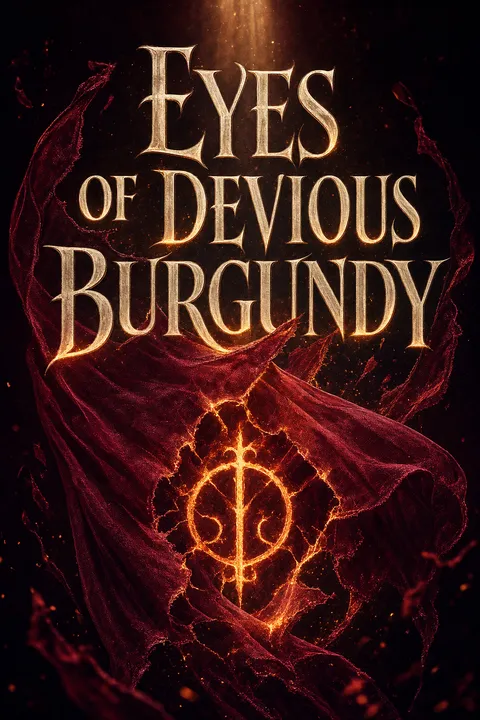
Eyes of Devious Burgundy weds dark romantasy to a pointed critique of theocratic patriarchy, using a world where women are veiled brood-property to interrogate voice, autonomy, and the machinery of manufactured faith. Its structural masterstroke is the delayed collision of dual protagonists: Assyria1 spends half the book disguised as her own dead abuser4 while Rokath2 hunts a prophesied woman, so when the mate bond snaps, the romance arrives pre-poisoned by grief, the Fates gifting Assyria1 the very architect of her losses.2 The book refuses to sanitize this. It sits in the discomfort of loving a man complicit in genocide, insisting that abusers are often forged by abusers while never fully absolving the systems they uphold. The enemies-to-lovers engine runs on a genuine ethical fault line rather than mere misunderstanding. Psychologically, both leads are trauma studies: Rokath2 weaponizes control and namelessness to armor a heart frozen by his father's cruelty, while Assyria's1 magical thinking, the conviction that her love is fatal, becomes the real antagonist of the third act, more dangerous than any Angel. The novel's recurring images, brands, veils, masks, and reanimated corpses, all circle a single question: who owns a self? Possession and devotion share a disturbing border here, dramatized when ownership brands become mutual claims. The climactic bargain, one beloved against fifty thousand soldiers, delivers the title's thesis with brutal literalism, staging love as monstrous sacrifice rather than tidy triumph. Lehotzky keeps the tone dark to the end; the resolution offers transformation, a reimagined army that finally includes women, rather than escape. The takeaway is that reform grows from within broken systems, that survival can be alchemized into purpose, and that naming love, even when terror insists it will kill, is itself an act of defiant courage.
People Also Read





Characters
Assyria
Shapeshifting abused wifeA burgundy-eyed Demon from a farming family, Assyria hides a rare gift: she can wear anyone's form. Married off to a cruel noble4 and battered for failing to conceive, she has learned to mask her fury behind saccharine compliance while a rebellious fire smolders beneath. Grief defines her; the plague took her parents and sister, and she carries a belief that everyone she loves is doomed to die because of her. Sharp-tongued, resourceful, and quietly brilliant, she thrives the moment she is given agency, leading soldiers and mastering scouting and combat. Her arc is a reclamation of voice, body, and worth, learning that desire is not shameful and that survival can become purpose rather than mere endurance.
Rokath (the Halálhívó)
Death-raising war leaderCousin to the Kral9 and supreme commander of the Demon army, Rokath wields the power to reanimate the dead and hides behind a horned skull helmet and an alias, since a name makes a man killable. Ruthless, insomniac, and allergic to feeling, he equates control with survival after a childhood of paternal abuse that forced him to commit an unspeakable act. He carries the crushing solitude of believing millions of lives rest on his perfection. Beneath the villain he cultivates lies a capacity for fierce, protective tenderness he has buried for centuries. His arc thaws the ice around a heart that mistook numbness for strength, until love forces him to redefine what he is willing to sacrifice.
Izgath
Protective Incubus soldierA lean, magnetic Vezeto of the Lovak Squad whose Incubus magic senses desire and lets him sense that Assyria1 is not who she seems. Grieving a brother lost to plague and war15, he offers Assyria1 the first safe, consensual tenderness of her life. Loyal to a fault, he becomes her fierce protector, treating her as an equal and teaching her that intimacy can mean pleasure. His kindness and courage define the early emotional stakes.
Vagach
Abusive noble husbandThe corpulent, drunken Kormanzo of Stryi's largest region, Vagach married Assyria1 coveting her powerful eyes and potential offspring. He beats and violates her for failing to conceive, aided by a complicit priestess5. A social climber obsessed with status, he embodies the theocratic patriarchy the novel indicts. His violence sets the entire plot in motion and his identity becomes Assyria's1 disguise.
Priestess Anara
Cruel religious enforcerAssyria's1 lifelong instructor and tormentor, Anara wields a cane and cold piety, holding Assyria1 down during her husband's4 assaults and blaming her spirit for barrenness. She personifies religion as social control, enforcing female submission as the will of the Fates. Her fanatic obedience makes her one of the story's most chilling agents of institutional cruelty.
Olrus
Kindly old groundskeeperAn ancient Demon who served four Kormanzo, Olrus bonds with Assyria1 over their shared love of roses and becomes her only friend and father-figure in Stryi. Gentle and self-sacrificing, he helps her hide her crime and covers her escape, willingly risking everything so she might finally have a life worth living beyond the estate that imprisoned her.
Rapp
Loyal reckless secondA burgundy-eyed Hadvezer and Rokath's2 oldest friend, Rapp leads the army's winged divisions with unhinged skill and a pierced-lip grin. Escaping an abusive home himself, he balances Rokath's2 grim intensity with irreverent humor and genuine warmth. He befriends Assyria1, treats her as an equal, and quietly roots for the mates to soften toward each other, becoming her closest ally in camp.
Kiira
Haunted High PriestessBastard cousin to Rokath2 and Xannirin9, Kiira is the only Demon gifted with true Sight, whose visions always come to pass. She helped build the regime's propaganda yet privately survived paternal abuse and works to reform its cruelest practices from within. Increasingly drained by relentless, forgotten visions of a burgundy-eyed woman1, she becomes Assyria's1 compassionate confidante and advocate.
Xannirin
The pragmatic KralRuler of the Demon Realm and Rokath's2 cousin, Xannirin can speak with spirits of other worlds, an ability that inspired his ambition to conquer all of Keleti. Charming, vain, and politically ruthless, he handles court while Rokath2 handles killing. Their bond, forged under shared childhood abuse, makes them a formidable, morally compromised team.
Dromak
Brawny joking VezetoA hulking, hammer-wielding officer of the Lovak Squad, Dromak provides camp comic relief with his ego and easy teasing. He befriends the disguised Assyria1, mentors her in combat, and later shows unexpected loyalty and sympathy toward her once her truth emerges.
Uzadaan
Reserved mated soldierA quiet, sharp-toothed Vezeto with a mate and child at home, Uzadaan speaks little but observes much, keeping his rowdier comrades in line and helping train Assyria1 on the road north.
Jaku
Duty-bound squad leaderSzazados of the Lovak Squad, Jaku is a scarred, war-obsessed commander who seems caring toward his soldiers yet enforces army law without mercy. His discovery of Assyria's1 secret and rigid adherence to the Halálhívó's2 rules triggers the story's most devastating turn.
Zaph
Vengeful Angel captorThe Angel officer Rokath once spared and branded with an H at the war's outset. Nursing a decade of humiliation, Zaph orchestrates Assyria's1 abduction and the sacrificial trap alongside his wife Hayyel, embodying the fanatic Angel conviction that Demons must be exterminated. His revenge drives the climax.
Grem and Zeec
Loyal war houndsRokath's2 two black battle-trained dogs, gentle and cuddly with Assyria1 but lethal on the field. They become her constant companions and a rare source of comfort, their fate a tender counterweight to the surrounding carnage.
Zurronar and Banand
Hidden Angel prisonersTwo burgundy and maroon-eyed Demons believed dead, held captive by the Angels. Banand's plague-making power was forced against his own people; Zurronar is Izgath's3 lost brother. Their discovery reframes the war's history and seeds future rescue.
Plot Devices
Impersonation magic
Identity as survival maskAssyria's1 burgundy-eyed gift lets her weave any person's form over her own while remaining herself inside. It drains like a muscle, requiring rest, and can be stripped by Suppressors or silver. The device drives the entire first act, letting her escape execution by becoming her dead husband4 and march to war undetected. Thematically it externalizes the way oppressed women perform selves that aren't theirs to survive, and the exhausting toll of that masking. Later it becomes an asset the regime covets and a battlefield weapon, while her refusal to keep hiding as others signals reclaimed identity. The magic's limits also generate constant suspense, since one lapse means discovery and death.
The mate bond
Forced involuntary intimacyWhen two fated Demons lock eyes, a bond snaps into place, marking each with a circle and linking their thoughts, emotions, and even pain across any distance. It compels proximity, punishing separation with physical agony, and shares sensation between partners. Here it is deployed ironically: it binds enemies who despise each other, forcing the necromancer2 and the woman whose losses he caused1 into unwilling closeness. It literalizes vulnerability, since a mate's death would cripple the invincible general2, making love itself a strategic liability. The bond becomes both the engine of the romance and the mechanism of the climactic hostage bargain, and drugs that suppress it turn the connection into a weapon of war.
The carved H brand
Marking of possession and vengeanceSilver blades let Demons scar permanently, otherwise impossible given their healing. Rokath2 first carves an H into a spared Angel's forehead13 at the war's start, a signature that seeds a decade of vengeance. He later carves the same letter into Assyria's1 wrists, ostensibly a fallen brand but truly a claim of belonging. The recurring mark threads possession, humiliation, and identity through the book, culminating when the branded Angel13 returns to claim Assyria1 and Rokath2 in turn. The device crystallizes the story's uneasy fusion of ownership and devotion, and its eventual mirroring, when Assyria1 brands an A into Rokath2, transforms one-sided possession into mutual claiming.
Kiira's visions
Prophecy driving the searchAs the only Demon with infallible Sight, Kiira8 channels the Fates directly, though visions exhaust her and increasingly vanish from her memory. Her obsessive drawings of a single pair of burgundy eyes and her declaration that a devious-burgundy-eyed female1 is essential create narrative gravity, pulling Rokath2 to hunt for a woman the reader already knows. A separate vision of him walking Sivy's streets carrying two Angel heads becomes a fixed point that shapes his climactic choices. The device injects fate and dread, letting prophecy both promise victory and justify morally fraught decisions, while its fraying reliability hints the Fates are steering events beyond the regime's control.
The blood-prayer religion
Faith as social controlThe realm worships three Fates, the Weaver, the Giver, and the Reaper, through thrice-daily blood offerings, veils, and rigid female submission, all engineered and amplified by Xannirin9, Kiira8, and Rokath2 as propaganda to fuel conquest. Priestesses enforce it in villages, sanctioning abuse as divine will. The device grounds the book's Handmaid's-Tale-inflected critique, showing how ritual repetition manufactures belief even in skeptics like Assyria1, who finds herself swept into fervor while disguised. It also frames the moral rot at the story's center: the leaders faking the depth of the faith they weaponize. The gradual exposure of religion as manipulation drives Assyria's1 radicalization and the promised reforms of the resolution.
Download PDF
Download EPUB
.epub digital book format is ideal for reading ebooks on phones, tablets, and e-readers.








































