
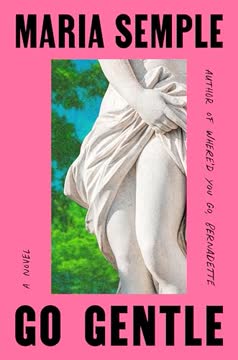

Plot Summary
The Philosopher on Seven
She makes fried egg sandwiches with the precision of a Michelin chef and tutors billionaire eleven-year-olds in the four cardinal virtues — wisdom, courage, justice, and temperance — which they cheerfully recite and immediately ignore.
Adora Hazzard1 is a Stoic philosopher living in Manhattan's legendary Ansonia building, working a fellowship at the Lockwood Library on Fifth Avenue. Her passion project is the coven: she and two friends — theater director Minna14 and lawyer Emily Ann — have bought apartments on the same floor, pooling resources to age in place together.
When apartment 716 becomes available, Adora1 texts her co-conspirators and begins scouting a fourth member. At work, she spots the visitor badge of Blanche Falk,8 the landscape architect who designed the Lockwood family's wild garden. The decision is instant, the invitation extravagant, the universe apparently listening.
The Stranger in Standby
Emily Ann cancels on ballet at Lincoln Center, leaving Adora1 alone with an extra ticket and a head full of coven logistics. She offers the spare to the last man in the standby line. He turns — fifties, full-haired, Italian loafers, a Rolex, and an expression of guileless astonishment.
He recognizes her name on the ticket from her Stoic translations. They take adjacent seats as the oboe sounds its A. During a sensuous pas de deux, Adora1 discovers her hand has turned palm-up toward his, fingers curled open like a question.
She panics, rips her sweat-glued program off her lap with a sound that cracks through a pianissimo, and flees past a dozen swiveling heads. Outside, she gives the ticket to her teenage dog walker Ziggy.11 The man calls her name across the fountain. She vanishes into Broadway.
The Exploded Burrito
In the parterre garden, curator Ravi7 denounces a statue Layla Lockwood5 bought from French aristocrat Celine Montfort6 — a Boy With Apple that appears in no art database. The argument ends when alarms scream.
Adora1 drags the wheelchair-bound Lionel Lockwood4 from his standing frame, nearly collapsing before his ex-Mossad nurse shoulders him to safety. After a controlled detonation of a suspicious briefcase in the lobby, the smoke reveals a foil-wrapped burrito and a cream-colored card engraved with a name — David Ignatius Beale.2
He is the man from the ballet, waiting on a bench across Fifth Avenue, having tracked Adora1 through Ziggy.11 She scrawls a restaurant name on his card and sends it back through the Lockwoods' assistant Hannah.10 She will come to call him Digby.2
Saving Lionel Lockwood
Five years earlier, Layla5 hired Adora1 to reach her husband — a once marble-carved Harvard athlete now one-armed and half-paralyzed from a climbing accident, lying in a mechanical bed, radiating silent fury. Adora1 told him events were neutral; suffering was his construction.
When he scoffed, she rolled up her sleeve and showed him her left wrist: Latin words for Love Fate tattooed in white ink over a faint vertical scar. Lionel4 gripped her hand and recognized a kindred soul. Over the years that followed, they chased ideas through Montaigne, Nietzsche, and Richard Pryor while Blanche's8 untamed garden rioted to life outside the glass walls.
Lionel4 regained mobility, became a Democratic donor, and wept before the armless Venus de Milo in Paris — her limbless beauty giving him permission to see beauty in his own mutilation. Layla5 credited the statue with saving his life. Adora1 let her.
The Hotel Room Reversal
Dinner at Salumeria Rosi is flawless — dolce gorgonzola, fried artichokes, spring pea pasta, banter so precisely calibrated it feels choreographed. He asks her to call him Digby.2 She reveals her tattoo; he calls it kind of hot.
She confesses it has been years since anyone touched her. He takes her hand, and its warmth alone could sustain her. At the Lowell Hotel, they ride the elevator in held-breath silence — then Digby2 sits on the love seat and confesses. He spent all day watching her from a bench across Fifth Avenue.
He followed her to Lincoln Center. Someone has stolen something from his client, and he needs Adora1 to deliver a sealed letter to Layla Lockwood5 without being seen. The romance she had been living for the last three hours was a job interview.
The Mail Cart Deception
Despite her devastation, she studies the Lockwood Library's thirty-camera surveillance grid and discovers one blind spot: the monitor room itself. She lures Hannah10 away by inventing a celebrity sighting, then slips Digby's2 letter into the mail cart.
The thrill surprises her — she is disturbingly good at deception. That afternoon, Digby's2 next note arrives: an address on Madison Avenue. They meet at an STD clinic, test clean in minutes, and share their first kiss in the elevator. At the Lowell, a custom candle burns with a Grateful Dead lyric inscribed on the glass.
What follows is transformative — tender and ravenous, almost unbearably serious, then erupting in laughter. She has forgotten the luxury of skin on skin. With each round she feels cleansed, even the shame washed away. Digby2 asks permission, then makes her beg.
The Bet Under the Table
She is twenty-nine, a struggling comedy writer in West Hollywood, when the call comes: head writer Vince O'Quinn wants her on Laugh Riot, television's hottest sketch show. She joins the writers' room — Elijah Strickland, Matteo Matthams, Andy Galinski, Clyde Chavez, and TJ Steele9 — and becomes one of the guys, typing their sketches and absorbing their fraternity.
She co-writes her first original sketch with TJ9 at his bungalow, cleans his filthy bathroom, and gives him oral sex he frames as not-quite-cheating. At the table reading, as a hundred people laugh at their sketch, TJ's9 hand moves from her knee past elastic, his wedding ring cold against her flesh.
Across the table, Elijah and Matteo convulse — not at the jokes. It was a bet. TJ9 pockets a roll of hundreds. The sketch gets career-making applause. Nobody sees a thing.
Signed Into Silence
Her agent Travis brokers the settlement at WAC, Hollywood's white-hot talent agency. Across the table sit Travis and an unnamed attorney. The contract is backed in sky blue. Adora1 spots a second copy half-hidden in the folder and asks for more — the payout climbs to $350,000.
She signs away her voice forever and reports the income as a phantom script: the Untitled Adora Hazzard Project. The spiral accelerates: isolation, two women colleagues who blame her for ruining it for all female writers, a Nike box packed with XXXL sports bras as a parting prank from the guys.
She writes the actor's name on her thigh, opens a box cutter, and slices her wrist. A roofer finds her. During recovery at her mother's13 house, she discovers Stoicism in a newspaper column. Events are neutral. The judgment can be changed. Something lifts.
The Closing Trap
Still dripping from a shower, Celine Montfort6 summons Adora1 to the guest suite. She has seen the betraying blush — she knows about Digby.2 After his closet meeting with Layla,5 Celine's6 art deal was abruptly canceled.
She demands Adora1 convince Digby2 to stand down, or she will expose everything to the Lockwoods. Adora1 races to the Lowell to confront Digby2 directly. He tries to recruit her deeper, invoking grand language about stepping into the arena and becoming the person she was destined to be.
When she refuses, he dismisses her Stoic principles as an elaborate excuse for playing small. She shoves him hard and walks out. His calls begin immediately. She blocks the number. Both people who want something from her have concluded she is a useful fool.
Arms Deal in Cursive
Adora1 flees to Connecticut with Viv3 and the dog. There, Viv3 drops a bomb: while Adora1 slept, she photographed Digby's2 letter to Layla.5 One line in ornate cursive, claiming knowledge of an arms deal. Meanwhile, Ravi's7 voicemail resurfaces — what the phone transcribed as laughter were actually the double-rings of the Lockwood house phone.
His real tone was terrified. Back in the city, Adora1 recruits the Ansonia's doorman Dante12 to pull Lockwood surveillance footage. They watch Ravi7 in the storage vault with a woman and a mysterious machine, sampling the French crates.
Ziggy,11 who lip-reads for gossip sites, deciphers the footage of Ravi's7 subsequent phone call. The key words: Nazis, Mona Lisa, reputation, arms, C-4. Adora1 becomes certain the crates contain weapons. She reports her findings to the FBI.
Boys Don't Hold Apples
After a day convincing the FBI her tip is credible, Adora1 accompanies the raid on the Lockwood Library. Agents and bomb-sniffing dogs swarm the parterre, where the crates have been moved for the statue's unveiling. All four are empty and clean.
On the plinth stands a marble boy, one hand raised, offering an apple. The crates are labeled C1 through C4 — French for Caisse, standard shipping notation. The arms deal was literally about the statue's arms, shipped in numbered wooden boxes. Celine6 spells it out with acid delight.
Lionel,4 bewildered and heartsick, asks Adora1 why she would call the FBI on his family. Layla5 fires her on the spot. Security escorts her to a waiting car. The only thing in her hands is a childhood drawing by Viv,3 lifted from her office wall, its glass cracked.
The Lawyer in the Room
At the Ansonia, a manila envelope awaits — hand-delivered by Digby.2 Inside: her original 1998 NDA, yellowed and brittle. A letter from TJ Steele's9 grown daughter Evelyn, formally releasing Adora1 from the agreement in a tone both furious and funny, begging her to speak publicly.
And a cover note on law firm stationery, addressed to Travis, signed by David. Adora1 flips to the NDA's appendix and finds the name she never noticed: David I. Beale, point of contact. Digby2 was the unnamed attorney who sat across from her thirty years ago.
He wrote her silence. He watched her wipe condensation off the table with her shirt and thought she was unlike anyone he had met. He willed her to demand more money — and she did. This whole time, he had known her. She collapses in the dog elevator. Dante12 finds her.
The Lectern Epiphany
In Paris, Blanche8 reveals she has been working for Interpol, sent to monitor the Lockwood crates because of terrorist chatter. That morning she brings grimmer news: Ravi7 was found locked inside the Lockwood residence's soundproof room — originally built for Lionel's4 phantom limb episodes — trapped for a week, his kidneys failing.
At the lectern of a centuries-old anatomy theater, Adora1 stares at her prepared speech and feels something detonate. Layla's5 obsessive love. The armless Venus de Milo that cured Lionel.4 A Vegas buffet sign Blanche8 once invoked — anything imagined, instantly consumed.
The arms deal was literal. She abandons her speech, races across the Seine to the Louvre, and confirms through the marble analysis that crate four held stone from a different quarry and era — Hellenistic Turkish marble, not Roman Parian. She texts Digby.2
Behind the Tapestry
Adora1 drives ninety minutes to Chateau Montfort and lays out the full truth. Pierre Montfort did not merely smuggle the Mona Lisa during the Nazi occupation — he also took the real Venus de Milo and replaced her with a forgery that has stood in the Louvre for sixty years.
When a Greek fisherman recently pulled marble arms from the sea, Celine6 flew to Greece and bought them before the museum could investigate, then fabricated Boy With Apple to smuggle the arms out of France. She shoved Ravi7 into the soundproof room when his analysis threatened exposure.
Celine6 throws the evidence into the fire. Copies exist, Adora1 tells her. And she is surrounded. Blanche's8 Peruvian contractor Dorris15 moves through the chateau knocking on walls — and behind a tapestry, in a hidden chamber lit by a single spotlight, finds the real Venus de Milo.
Venus With Arms
Digby2 finds her at the Louvre. He was working for the museum all along, not for Celine's6 half-brother. A terrorist operative drapes the fake Venus in pink netting during their reunion — the blast throws Adora1 onto Viv,3 Digby2 shielding them both. They survive.
Weeks later, at the unveiling of the restored Venus — her arms now holding an apple — Adora1 watches Lionel4 see the statue whole for the first time. The proof of his growth ripples across his face: fear, bracing, nothing, joy. He is fine. Digby2 tells Adora1 he loves her without qualifiers.
They bicker over promises — cut your toenails, never watch that cheesy Phantom concert, never be mean to me again. He buys the apartment above the coven. Ravi7 recovers. Adora1 returns to the Lockwood Library. She starts each morning the same way. Now, the universe has answered.
Epilogue
Blanche8 buys the apartment down the hall and joins the coven. Digby2 acquires the floor above; a remodel creates a separate wing for his quiet, world-tending work. Ravi7 recovers and names his daughter Ravija — daughter of the sun. At the Lockwood Library, Boy With Apple stands on his plinth with replacement arms, and few will ever know the truth.
Adora1 crosses Central Park each morning, past the buskers and the horse hooves, to her office overlooking the garden. Her circle remains small. Inside, she feels vast. She studies philosophy. She loves well, and is well loved. She is whole.
Analysis
Go Gentle interrogates what it costs a woman to be strong. Adora Hazzard1 has constructed an exquisite life from the wreckage of sexual assault, career destruction, and enforced silence — using Stoic philosophy as both medicine and armor. The novel's radical proposition is that the armor worked too well. By training herself to need nothing and no one, Adora1 achieves a serenity indistinguishable from emotional paralysis.
The book structures this insight through an elaborate art mystery whose solution doubles as its metaphor. The Venus de Milo — the world's most famous amputee — was never meant to stay armless. She was mutilated by circumstance, and the culture that celebrates her damage confused accident for intention. The same applies to Adora:1 her independence is not wisdom but scar tissue, and the Stoic philosophy she uses to justify it functions as the most sophisticated NDA ever written — one she signed with herself.
Semple weaponizes her comedy-writing background to embed this argument in a novel that is genuinely hilarious, from exploding burritos to French crate-numbering catastrophes to a Peruvian contractor15 who locates the Venus de Milo by knocking on walls. The comedy is not decoration but architecture. Every farcical misunderstanding in the present mirrors the tragic miscommunication of 1998 — a woman who cannot name what happened to her, and a world that keeps hearing something else.
The title inverts Dylan Thomas's famous injunction to rage against the dying of the light. After a lifetime of raging — against Hollywood, against her body, against her marriage, against desire itself — Adora1 discovers that allowing herself to be loved requires more bravery than any philosophical discipline ever demanded. The Venus gets her arms back. Adora1 gets the man. The implicit argument: wholeness is not weakness, and refusing restoration in the name of resilience is just damage wearing a crown. The coven survives not because love replaced it, but because it was always built to hold more than its architect imagined.
Review Summary
Reviews for Go Gentle are mixed, averaging 3.75/5. Many readers praise Maria Semple's witty, singular writing style and the compelling protagonist Adora Hazzard, a stoic philosopher navigating romance and intrigue in New York City. Fans enjoy the blend of philosophy, feminism, mystery, and humor. However, critics frequently cite the novel's scattered structure, tonally jarring shifts, and abandoned plotlines as weaknesses. The book is widely described as difficult to categorize, feeling like multiple stories merged into one, which some readers found charming and others found frustratingly disjointed.
People Also Read




Characters
Adora Hazzard
Stoic philosopher seeking freedomA fifty-something Stoic philosopher working a fellowship at New York's Lockwood Library, tutoring billionaire twins in virtue and providing philosophical companionship to their father. Divorced from economist Hal Weymouth after political fissures exposed deeper silences in their marriage, she moved to the Ansonia with their daughter Viv3. Adora's devotion to Stoicism—the belief that events are neutral and suffering is chosen—runs deeper than academic interest; it is the operating system she installed after a devastating early career in Hollywood that left her scarred, literally and figuratively. Fiercely intelligent, compulsively enthusiastic, and disarmingly funny, her commitment to emotional self-sufficiency masks a woman who has convinced herself she does not need love. She starts each day asking the universe to surprise her.
Digby (David Ignatius Beale)
Enigmatic fixer and loverA well-dressed, charismatic man in his fifties with impressive hair, impeccable taste, and indefinable authority. He introduces himself as someone who makes people whole—deliberately vague language for deliberately vague work. A former attorney turned pro-bono dispute resolver, Digby is dispatched to New York on a sensitive international matter. Beneath his charm lies a strategic mind trained in the highest-stakes negotiations, one that calculates emotional leverage with terrifying precision. His connection to Adora1 predates their meeting in ways neither anticipates. He smells of fig, quotes the Grateful Dead, orders food with instinctive elegance, and possesses the ability to make a woman feel simultaneously cherished and managed. What drives him is the same thing that haunts him: a need to atone for harm inflicted in a former life.
Viv
Adora's perceptive teenage daughterAdora's1 fifteen-year-old daughter, a creature of beachy waves, hot chocolate pilgrimages, and fierce loyalty disguised as indifference. On the surface, Viv presents as every parent's shallow nightmare—scrolling, consuming, reliably irritable. Beneath the eye rolls and TikTok fluency lives an extraordinarily perceptive young woman capable of articulating emotional truths her philosopher mother cannot. She tracks Adora's1 phone, reads forbidden letters, and sees through adult deceptions with the moral clarity of someone too young to have mastered self-deception. Her relationship with Adora1 is a volatile dance of mutual adoration and exasperation, punctuated by devastating honesty. Viv functions as both conscience and blind spot—the person most attuned to when something is wrong, and least equipped to be told why.
Lionel Lockwood
Billionaire transformed by philosophyThe wheelchair-bound billionaire heir who lost his left arm and half his mobility in a climbing accident. Once suicidally depressed, he was transformed over five years by Adora's1 philosophical companionship and Blanche's8 wild garden. Progressive, courageous, and deeply kind, Lionel treats Adora1 as intellectual kin. His recovery is the novel's proof that philosophy works—and its greatest vulnerability when tested.
Layla Lockwood
Lionel's fiercely devoted wifeLionel's4 wife, a former soap opera actress who reinvented herself as the fierce CEO of their post-accident life. Behind designer outfits and malapropisms lies staggering determination and genuine love. She will stop at nothing—architectural overhauls, private Louvre viewings, international art deals—to protect her husband's wellbeing. Her devotion is both her greatest strength and her most dangerous impulse.
Celine Montfort
French aristocrat with secretsA French cultural advocate and Louvre board member from one of France's most storied families. Elegant, razor-tongued, and aristocratically ruthless, Celine projects old-money assurance that masks financial desperation and a family legacy worth any sacrifice to protect. She befriends Layla5, threatens Adora1, and operates with the calculated charm of someone accustomed to being the most dangerous person in any room.
Ravi Bhardwaj
Passionate curator of Lockwood artThe elegant, aged curator of the Lockwood Library, devoted to its collection with first-person-singular possessiveness. A man of binary taste—things are either tacky or kind of great—Ravi's aesthetic perfectionism makes him the first to notice something wrong with Boy With Apple. Married to Scott16, expecting a baby via surrogate, his dedication to art integrity places him in extraordinary danger.
Blanche Falk
Combative landscape architectA landscape architect whose sun-damaged skin, wild straw hair, and combative directness mark her as the antithesis of Upper East Side polish. She designed the Lockwood residence's celebrated wild garden and teaches at Columbia. Blanche is the woman who stopped trying and dares anyone to comment. Her recruitment into the coven is immediate and instinctive—she and Adora1 recognize something fierce in each other.
TJ Steele
Predatory comedy starA Canadian-born comedy actor on Laugh Riot whose ice-blue eyes and laconic drawl conceal predatory behavior sanctioned by the show's fraternity culture. Married with a young daughter, he selectively invokes family as a moral boundary. His relationship with young Adora1 begins as creative partnership and becomes something far darker, enabled by famous colleagues and industry silence.
Hannah
Lockwood gatekeeperThe Lockwoods' first assistant, an earnest millennial with severe bangs and a gift for slow-motion small talk. She guards access to the family with bureaucratic zeal and an oblivious love of Coldplay.
Ziggy
Lip-reading teenage dog walkerThe Ansonia's teenage dog walker, a LaGuardia art student whose childhood meningitis caused progressive hearing loss. His lip-reading skills make him invaluable to gossip sites—and to Adora's1 investigation.
Dante
Charming Ansonia doormanThe Ansonia's Italian doorman, whose broken-nosed charisma inspires devotion from residents and Viv3 alike. His security camera expertise proves unexpectedly critical when Adora1 needs surveillance footage reviewed.
Phyllis
Adora's narcissistic motherAdora's1 mother in Connecticut, a former actress whose greatest talent is making every conversation about herself. Her cookie-discarding, date-bragging, and Barbra Streisand worship provide comic relief and painful context for Adora's1 emotional armor.
Minna
Theater director, coven founderA divorced theater director and coven co-founder who first championed Adora's1 Epictetus translation, connecting her to a book agent. Practical, irreverent, and the one who bought everyone aluminum bats.
Dorris
Fearless Peruvian contractorBlanche's8 Peruvian contractor, a fearless woman of impeccable craftsmanship and elaborate personal style whose talent for knocking on walls and doing anything asked proves unexpectedly consequential.
Scott
Ravi's devoted husbandRavi's7 husband, a design studio consultant with impeccable style and a matching ruby ring. He and Ravi7 are expecting a baby via surrogate, making Ravi's7 disappearance particularly devastating.
Plot Devices
The NDA
Seal of enforced silenceThe nondisclosure agreement Adora1 signed in 1998 after being sexually assaulted at Laugh Riot. Worth $350,000 with a million-dollar penalty for breach, it silences her in perpetuity. The NDA functions as a second violation—enforced muteness that Adora's1 Stoic philosophy conveniently covers. Its sky-blue backing becomes one of the novel's most charged visual motifs, reappearing thirty years later when Digby2 returns the original along with a release letter from the assailant's9 daughter. The NDA connects Adora's1 Hollywood past to Digby's2 legal career, as he was the attorney who drafted it—a revelation that collapses the distance between the worst thing that happened to her and the best. It transforms from cage to key, freeing her to choose speech rather than have silence imposed.
Boy With Apple
Decoy hiding stolen treasureA marble statue Layla Lockwood5 purchases from Celine Montfort6. Curator Ravi7 insists no such statue exists in any historical record—in antiquity, boys held shields and lutes, not apples. He is correct. The statue is a composite: a Roman-era boy's body fitted with Hellenistic-era arms from a different quarry. Those arms belong to the Venus de Milo. Celine6 fabricated this Frankenstein figure to smuggle incriminating marble out of France under the guise of a legitimate art deal. Its four shipping crates, labeled C1 through C4 in standard French convention, are misread by Adora1 as references to C-4 plastic explosive—triggering the disastrous FBI raid that costs her everything. Boy With Apple is the novel's central puzzle: every character sees something different in a statue that does not exist.
The Coven
Architecture of chosen familyAdora's1 communal living arrangement: divorced or widowed women buying apartments on the same Ansonia floor, pooling resources—dog walkers, cleaning, streaming subscriptions, a parking spot split four ways—to age in place together. It begins practically, born from splitting celery and bread at a grocery store, and evolves into a feminist alternative to nursing homes. The coven encompasses shared ballet tickets, a monthly seamstress, and plans for eventual nursing care. It represents Adora's1 answer to the devastating statistic that women who divorce after fifty have an 85% chance of dying single. But it also functions as her most elaborate defense against admitting she wants romantic love—a brilliantly designed life that happens to contain no room for a man. Its architecture proves more flexible than its creator imagined.
The Venus de Milo
Icon of beautiful damageThe ancient Greek statue of Aphrodite, celebrated for her missing arms, functions as the novel's central symbol and plot engine. For Lionel4, she represents beauty in mutilation—her armless majesty helped him accept his own amputation. For Layla5, she is a talisman whose limbless state must be preserved to protect her husband's mental health. For Celine6, she conceals a family secret stretching back to World War II. For Adora1, the Venus mirrors her own condition: a woman admired for surviving damage who must decide whether restoration constitutes betrayal or liberation. The statue's literal arms—lost for millennia, recovered by a fisherman, hidden inside a composite forgery—become the mystery's solution, encoded in a phrase everyone misreads.
Amor Fati Tattoo
Philosophy inscribed over traumaTwo Latin words meaning Love Fate, tattooed in white ink across Adora's1 left wrist, covering the scar from a suicide attempt. The phrase represents Stoicism's most demanding principle: not merely accepting what happens but actively loving it. The tattoo bonds Adora1 to Lionel4 during their first meeting, when she exposes her wrist and he recognizes a kindred soul who crossed the same line. It becomes an intimacy gauge—each person who notices it reads something different. And it provides Digby2 with his most manipulative line, when he calls himself fate incarnate and demands she love him. The tattoo is the novel's most compact irony: a philosophy of radical acceptance inscribed over an act of radical refusal, suggesting the armor was forged in the very fire it claims to have extinguished.








































