
Plot Summary
The Submerged Van's Secret
Harper1 feeds a dismembered tourist into her woodchipper when Nolan2 storms into the manor garden, no longer the lover she has come to know. At low tide he found her sunken van, traced its number through an online forum, and learned that Harper Starling1 is really Autumn Bower,1 a vanlife vlogger who vanished four years ago.
Worse, he realizes she was the woman who fled the crash that killed his brother, leaving him screaming on the road. Harper1 confesses she stole a dead drunk driver's identity to escape her own infamy after surviving the serial killer Harvey Mead. Nolan,2 anguished that he nearly murdered an innocent, demands an end to the killing. A distant siren freezes them both before resolving harmlessly into an ambulance.
The opening weaponizes intimacy: the man who knows Harper's body now knows her name, and knowledge becomes the central currency of the book. Weaver inverts the romance meet-cute into a confession extracted under threat, establishing that love here is built atop attempted murder. Harper's identity theft dramatizes trauma's logic, that survival sometimes means erasing the self. The siren that proves false trains the reader to live in dread, a structural promise that real catastrophe is coming. Crucially, Nolan's horror at almost killing the wrong woman reframes his vengeance as fallible, planting the theme that misread instincts carry fatal weight.
Burning the Kill List
Back at the Capeside Inn, Nolan2 empties his backpack of garrotes, blades, and the scrapbook cataloguing the people he tortured to avenge his brother Billy. The blank page once reserved for Harper1 sends him retching to the toilet. He tears out every trophy and burns them in the bathtub, choosing protection over punishment.
Stepping outside, he is ambushed by Sheriff Yates,4 arm in a sling, who asks the Search and Rescue specialist2 to organize the hunt for a missing tourist named Evanston, the man Arthur3 recently killed. Nolan2 agrees, calculating he can steer volunteers away from the town's hidden graves and stay near Harper.1 He fails to register the danger when Yates4 orders a forensic crew to test the bloodstain in the parking lot.
Nolan's bathtub immolation is a literal purging of identity, the killer's archive reduced to ash so a guardian can replace him. Yet the same impulse, obsessive documentation, simply migrates to a new object, foreshadowing that he cannot stop cataloguing the woman he loves. The recruitment scene is a masterstroke of dramatic irony: the predator invites his rival into the machinery of the investigation, granting access disguised as oversight. Weaver lets Yates seem bumbling while quietly demonstrating competence (the blood test), seeding doubt about who is really hunting whom and rewarding rereaders who track the sheriff's controlled performance of incompetence.
A Bear, A Shovel, A Confession
Torn between her vow to Arthur3 and her feelings, Harper1 texts Nolan2 to leave Cape Carnage before more amateur investigators descend. Walking to Arthur3's riverside burial ground that night, she mistakes Nolan2 in the dark for a bear and clubs him with a shovel, dousing him with spray.
Soaked and seething, he refuses to go, cupping her throat and confessing that he loves her while forbidding her to say it back until she truly means it. They come together desperately on the silt above Arthur3's dead, and afterward he gently rinses the grit from her skin. Harper1 recognizes that Nolan2 defends his promises with the same ferocity she defends hers, and that recognition unnerves her more than any of his threats ever did.
The slapstick of the shovel cushions a genuinely radical romantic gesture: Nolan declares love while denying himself reciprocity, refusing to let her speak words she might regret. This is consent reframed as restraint, control surrendered as proof of devotion. Setting their union on a graveyard literalizes the book's thesis that desire and death are inseparable for these two. Harper's fear is psychologically precise, she dreads not his violence but his constancy, because attachment is what trauma taught her to flee. The riverside baptism, washing her clean while sins remain buried below, captures the impossibility of full absolution that haunts the romance.
Exhuming Sixteen Secrets
Working through the night, the pair unearth sixteen bodies from Arthur3's riverbank graves before the estate sale closes, bagging bones for the woodchipper. Nolan2 installs himself in the cottage to protect Harper,1 sleeping in the guest room until she silently slips into bed beside him.
Their domesticity, handwritten coffee notes and shared dinners, blossoms amid the carnage. Then a Sleuthseeker calling himself KnightofTruth8 posts a photograph the dead documentarian Sam once took: a woman walking Main Street, distressed, leaving Maya11's shop.
The amateur detectives beg the group to identify her. Harper1 recognizes the back of her own head at once. The net she has dodged for four years begins, thread by patient thread, to cinch shut around her fragile sanctuary.
Weaver braids tenderness and atrocity until they become indistinguishable, the lovers exhuming corpses by lantern light as a courtship ritual. The cottage cohabitation, with Nolan giving Harper space she then voluntarily closes, models a relationship negotiated rather than assumed. Against this warmth, the Discord photograph introduces surveillance as the antagonist's true weapon: Harper can be undone not by violence but by being seen. The image of her own back, unrecognized yet recognizable, dramatizes the precariousness of a constructed self. The chapter's engine is contrast, the more livable the love becomes, the more catastrophic its exposure would be.
The Sheriff's Casual Interrogation
At the search command center, Yates4 peppers the couple with unnervingly precise questions about vanished men: Jake Hornell, Sean McMillan, and a stranger named Bryce Mahoney whose remains only Harper1 knows she keeps. The missing man's tiny dog inexplicably worships Harper,1 snagging the sheriff4's curious attention.
Meanwhile Harper1 slips into the distillery's derelict grain shed, Arthur3's earliest graveyard with sixteen more bodies beneath its floor, to stash his murder bag and a victim's clothing.
There she overhears Lukas,5 Arthur3's grandson, reuniting awkwardly with Maxine,6 the sheriff4's daughter and his childhood crush, and gleefully appoints herself matchmaker. Every buried secret, Harper1 senses, behaves like bindweed: sever one tendril and another instantly coils up to choke them both.
Yates's interrogation works as horror precisely because it masquerades as folksy concern, each name a probe testing how much the couple flinch. The adoring dog functions as an uncanny truth-teller, animal instinct piercing the human masks the chapter is otherwise about maintaining. The grain shed expands the scale of Arthur's evil while binding Harper deeper into complicity. The Lukas and Maxine subplot offers tonal relief and a mirror: another pair frozen by fear of love, letting Harper diagnose in others the paralysis she cannot cure in herself. Bindweed becomes the governing metaphor, secrecy as an organism that strangles faster the harder you fight it.
The Story of Marcus
Nolan2 repurposes his trophy scrapbook into a ledger of Harper1's habits, no longer to destroy her but to guard her. When she catches him moving the black knight on her chessboard, an object fused to her grief over her dead boyfriend Adam, she demands a confession as the price of pleasing him.
On her knees and bound by his belt, she makes him recount his first murder: not the crash avengers, but Marcus, the eighteen-year-old who beat his stuttering brother Billy into a coma.
At sixteen, Nolan2 framed a registered predator and strangled Marcus without a flicker of remorse. Harper1 receives the story not with revulsion but with acceptance, naming him a villain and loving him precisely for it. Two predators raised in the same hell finally recognize each other.
The scene fuses eroticism and confession so that vulnerability becomes the truest intimacy, Nolan's secret extracted in the same breath as his pleasure. Weaver complicates the vigilante myth: Nolan's first kill targets a bully, not a stranger, exposing that his moral architecture was always personal vengeance dressed as justice. Harper's absolution rewrites the romance ideal of being seen, she does not redeem his darkness but blesses it. The transformed scrapbook is the chapter's quiet thesis, that obsession is morally neutral and takes the shape of its object, capable of destruction or devotion. Their mutual recognition is the book's emotional core: love as the cessation of hiding.
The Cellar Door
Obsessively monitoring the Sleuthseekers as KnightofTruth8 vows to expose her, Nolan2 gently coaxes Harper1 to let him inside her past. She finally splits open the wound of Harvey Mead's farm, where the killer shattered her boyfriend Adam's legs and held them naked in a freezing cellar for three weeks.
When Adam spiked a fever, Harper1 pounded the iron door begging for medicine, and the monster came and dismembered Adam above her with a chainsaw. She insists rescuers were only an hour away, that had she waited, Adam would have lived. Nolan,2 startled, presses her on who would have come, but Arthur3 interrupts at the door demanding his latte. Harper1's slip hints at a buried truth she still cannot bring herself to speak aloud.
Harper's testimony reframes survivor's guilt as a logic trap: she blames herself not for failing to save Adam but for the timing of her plea, converting helplessness into culpability she can at least control. The chainsaw heard from below renders trauma acoustic, a horror she experienced without seeing, mirroring the book's motif of partial knowledge. Nolan's question, who would have rescued you, cracks the official narrative and seeds a mystery the reader files away. Arthur's intrusion for a latte performs the brutal comedy of caregiving, grief perpetually interrupted by the mundane needs of the man whose disease is itself a slow bereavement.
La Plume Wears a Badge
In chilling flash-forwards, Sheriff Yates4 moves through Harper1's cottage handling her photographs in gloved hands, revealing he has always known her true identity. He is La Plume,4 the artist-killer who carved poetry into Arthur3's daughter Poppy thirty years ago, then hid in plain sight as the bumbling lawman who helped Arthur3 hunt him.
He covets Autumn1 as his masterpiece, his legacy, and intends to surgically peel away every layer of her chrysalis. Separately, Yates4 lets slip to Nolan2 that he long suspected Arthur3 of killing his wife Vivian. Harper1 confirms it was mercy, Vivian, dying of bone cancer, begged Arthur3 to end her agony. The reader now sees a predator orbiting both lovers, patient and invisible to his prey.
The reveal converts the entire narrative into dramatic irony: every folksy question and fatherly clap on the shoulder rereads as a brushstroke. Weaver casts Yates as the anti-Arthur, a killer who achieved camouflage so total that mask and flesh fused, a study in how performance becomes identity. His aesthetic framing of murder as poetry positions him as the book's perverse artist, with Autumn his intended canvas, escalating the threat from death to forced transformation. The Vivian mercy-killing deepens the moral spectrum, contrasting Arthur's love-driven violence with Yates's narcissistic cruelty, and asks whether intention can ever cleanse the act of killing.
The Topiary Moose
Harper1's failed topiaries, which Arthur3 cheerfully insists resemble penises, are secretly replaced overnight by Nolan2 and the town handymen12 with a majestic moose, a fox, and a squirrel.
The gesture demolishes Harper1's defenses, and weeping at the foot of the moose she realizes she loves Nolan,2 though terror of losing him locks the words in her throat. In a lucid hour, Arthur3 confesses that he too once feared love yet would choose his late wife Vivian again despite the grief.
The warmth curdles when Yates4 arrives uninvited at the cottage, tightening a loose door knocker with a screwdriver, sipping Nolan2's beer, and casually asking to borrow her woodchipper. Harper,1 deeply unsettled, feels a predator circling but cannot yet put a face to the threat.
The replaced topiaries externalize the romance's central act, Nolan reshaping the grotesque into something beautiful on Harper's behalf. Her tears at the moose stage emotional breakthrough as bodily event, love arriving as something done to her rather than chosen. Arthur's wisdom, that love is worth its inevitable grief, supplies the philosophical key the plot will test to destruction. Yates's intrusion is the chapter's dread-injection: domestic objects (knocker, beer, woodchipper) become instruments of menace, and his request for the very tool of body disposal signals that the predator is studying their methods. Comfort and threat are deliberately fused so the reader cannot relax.
Feeding the Shark Legend
Hearing the handymen12 blame Jake Hornell's vanishing on a mythical great white they call Sharkimedes, Harper1 seizes the cover story. Nolan2 admits he kept part of Jake's leg, the gym creep he garroted for spying on her.
At midnight they break into Wallie's Watersports, Harper1 flinging her shirt over the security camera, and snap the fin off Jake's stored surfboard. On a fog-drowned beach Nolan2 plants the defleshed bone and broken fin at the tide line so searchers will conclude Jake drowned while surfing.
Their criminal teamwork has ripened into a strange intimacy, two predators tending one another's tracks. Yet a calendar in the shop's back office warns that Sheriff Yates4 himself is scheduled to visit the watersports store the very next morning.
The chapter elevates cover-up logistics into a love language: collaboration as courtship, evidence-planting as shared labor. Weaver leans into the dark-comedy of folklore, letting a town's shark myth do the framing work the couple needs, satirizing how communities author their own comforting fictions. Nolan having saved Jake's leg as a future prank, then converting it to alibi, blurs sentiment and pragmatism in characteristically grotesque fashion. The looming Yates calendar entry is a precise suspense mechanism, dropping a fuse into a scene that otherwise reads as triumph and reminding readers that the lovers are always one beat behind the man tracking them.
Blood Tears at the Festival
At the Taste of Terror festival, Tylor Knightsbridge8 returns, the man Nolan2 deduced is KnightofTruth, flashing Harper1's photo and naming her aloud to Lukas.5 Refusing to let him close the gap, Harper1 drops a half dose of Arthur3's poison, Red Tide, into his drink.
During the chili-eating contest, Tylor8 weeps blood, vomits crimson across the screaming crowd, and collapses. Harper1 assures a horrified Nolan2 that the toxin is undetectable and that the man will survive, just barely.
Arthur3 appears, having driven himself on an expired license, and grumbles that mere maiming squandered his precious poison. Nolan2 watches the woman he loves bicker affectionately with her octogenarian mentor and accepts that her bond with Arthur,3 perilous as it is, is the thing that makes her whole.
The public poisoning fuses spectacle and dread, Weaver staging horror as carnival so the festive crowd amplifies the violence. Harper's choice to maim rather than kill marks character growth bent through her own ruthless logic, a compromise between Nolan's no-murder rule and her instinct for protection. The three-way bickering between Harper, Nolan, and Arthur crystallizes the book's domestic strangeness, a found family negotiating love over a vial of poison. Nolan's acceptance of Arthur is the emotional pivot: relinquishing his urge to remove the old man signals trust in Harper's autonomy, even as the reader knows the predator is using that very bond as leverage.
Three Toes and a Vow
Harper1 nervously invites Nolan2 to the residents-only Murder Mash Barn Dance, where he earns his place by toasting three pickled severed toes. The night sours when Yates4 publicly announces the search is winding down and thanks Nolan2 for his service, dragging the question of his return to Tennessee into the open.
Outside, watching horses penned behind an electric fence, Harper1 breaks her own cage and tells Nolan2 she loves him and cannot bear for him to leave. He weeps, swears he is staying, that distance can be crossed, that she is his. They dance for the whole town to witness, then go home and make love as equals at last. For the first time in years, Harper1 lets herself believe she is allowed to keep something precious.
The toe initiation crowns the book's macabre communitarianism, belonging in Cape Carnage requires swallowing its grotesquerie, and Nolan's compliance literalizes his absorption into Harper's world. The penned horses give Harper her own metaphor: freedom limited by self-built barriers that wound only when struck. Her confession reverses the dynamic of the riverbank, where Nolan forbade reciprocity, completing the romance's arc from withheld words to spoken vow. Weaver places this peak of safety immediately before catastrophe, a deliberate structural cruelty that ensures the coming betrayal lands on the highest possible ground. Joy here is not relief but ammunition for grief.
The Dog Unearths Betrayal
During the garden competition's final judging, the missing man's widow10 confronts Arthur,3 who blurts incriminating hints about her vanished husband. Her dog then digs Bryce Mahoney's titanium-plated bone from the flowerbed, the remains Harper1 kept frozen and known only to Nolan.2
Reeling, Harper1 pockets the evidence and shields Arthur,3 who, mind slipping, calls her by his dead daughter's name. Convinced Nolan2 planted the bone as revenge for the crash, she waits at home with a loaded gun.
When he returns and drops to one knee with a ring, the raven croaks her secret name, Autumn,1 in a man's voice. Reading the bird as proof of his betrayal, Harper1 forces him out at gunpoint, weeping, and the abandoned engagement ring sits glinting on the table.
Catastrophe arrives through an animal and a slip of the tongue, the book's recurring devices, dog and raven, weaponized by an unseen hand. Weaver engineers tragic misreading: every fact points to Nolan because the real author of the frame has studied exactly what only Nolan should know. The proposal interrupted by accusation is operatic dramatic irony, Harper destroying her future at the precise instant it is offered. Arthur naming her Poppy fuses the two losses, mentor and lover slipping away in the same breath. The chapter dramatizes how trauma calcifies into certainty: Harper trusts the pattern over the person, and the predator counts on it.
A Throat Cut in Mercy
While Harper1 fetches Arthur3's mysteriously missing pills, Yates4 infiltrates the manor, reveals himself as La Plume,4 and stabs the old man.3 Arthur3 smashes a sugar bowl over his attacker's head and, refusing to become Yates4's instrument of transformation, draws the blade across his own throat, prophesying that Harper1 will be the one to destroy the killer.
Harper1 returns to find Arthur3 dead beneath a message written in blood, words lifted from Nolan2's love note: time demands its toll. Every clue, the bone, a repaired watch, the raven trained to her name, points to Nolan.2 Numb with grief and rage, she buries Arthur3 and vows his killer must die by her hand. At the cemetery gate, a tow truck hauls her drowned van from the sea.
Arthur's suicide is the book's most defiant act, denying the artist-killer his masterpiece by authoring his own ending and seeding the prophecy that frames the trilogy's revenge. Weaver pays off every planted device at once, demonstrating that the antagonist's genius lies in turning the lovers' own intimacies into the instruments of their ruin. The recovered van completes the noose, dragging Harper's literal past from the depths just as her constructed present collapses. The chapter is grief weaponized: Harper's love for Nolan inverts into murderous certainty, and the reader, knowing the truth, watches her aim her righteous fury at exactly the wrong target.
Epilogue
Nolan2 wakes chained inside a remote cabin, scratching tally marks into the floor, helpless for the first time in his life. After six days his captor arrives: Sheriff Yates,4 who tips his hat and names himself La Plume.4 He gloats that Harper Starling1 is dead at the bottom of the sea while Autumn Bower1 lives, that Nolan2 will be blamed for Arthur3's murder, and that he orchestrated everything to force Autumn's metamorphosis into his legacy.
Nolan,2 choking on terror for the woman he unwittingly led the killer straight to, grasps his fatal mistake: he ignored every instinct that warned him about Yates.4 The villain promises that although Nolan2 loved Harper,1 it is Autumn Bower1 who will ultimately kill him.
The epilogue completes the role reversal: the hunter who arrived to torture Harper now sits chained, experiencing the helplessness he once inflicted, a karmic symmetry the narration explicitly names. Weaver leaves the romance suspended in maximum jeopardy, a cliffhanger that withholds resolution to set the trilogy's final movement. Yates's distinction between the dead Harper and the living Autumn restates his thesis that transformation requires destruction, casting grief as his chosen chisel. Nolan's recognition that intuition, not evidence, held the truth retroactively indicts the entire investigation he led. The closing prophecy hands agency back to Autumn, promising that the villain's masterpiece may become his executioner.
Analysis
Harvest Season is a dark romantic comedy that treats love as the most dangerous act two killers can commit. Weaver's central provocation is that intimacy and exposure are the same gesture: to be loved is to be known, and to be known, for a woman living under a stolen name above sixteen graves, is to be destroyed. The romance between Harper1 and Nolan2 inverts genre convention by beginning with attempted murder and proceeding through confession, the lovers earning trust not by hiding their darkness but by blessing it in one another. Their relationship argues that being truly seen, scars, sins, and all, is salvation, even as the plot weaponizes that very visibility against them. The novel's structural masterstroke is its dramatic irony. By interleaving flash-forward fragments from the antagonist's perspective, Weaver lets readers watch a predator4 turn the lovers' most private rituals, a chessboard piece, a love note, a household raven, a frozen bone, into the instruments of their ruin. The result is a tragedy of misreading: Harper,1 conditioned by trauma to trust patterns over people, aims her grief at exactly the wrong target, while the reader, helplessly ahead of her, absorbs the horror of righteous certainty pointed askew. Running beneath the carnage is a tender meditation on caregiving and memory loss. Arthur3's Alzheimer's makes him both a danger and a slow bereavement, and Harper1's refusal to abandon him, even at lethal cost, defines her loyalty and her doom. The book asks whether intention can ever cleanse violence, contrasting Arthur3's love-driven and mercy killings against the antagonist's narcissistic cruelty.4 Its harvest metaphor governs everything: beauty grown from buried death, transformation demanding destruction, and the brutal truth that what blooms is rooted in rot.
Review Summary
People Also Read



Characters
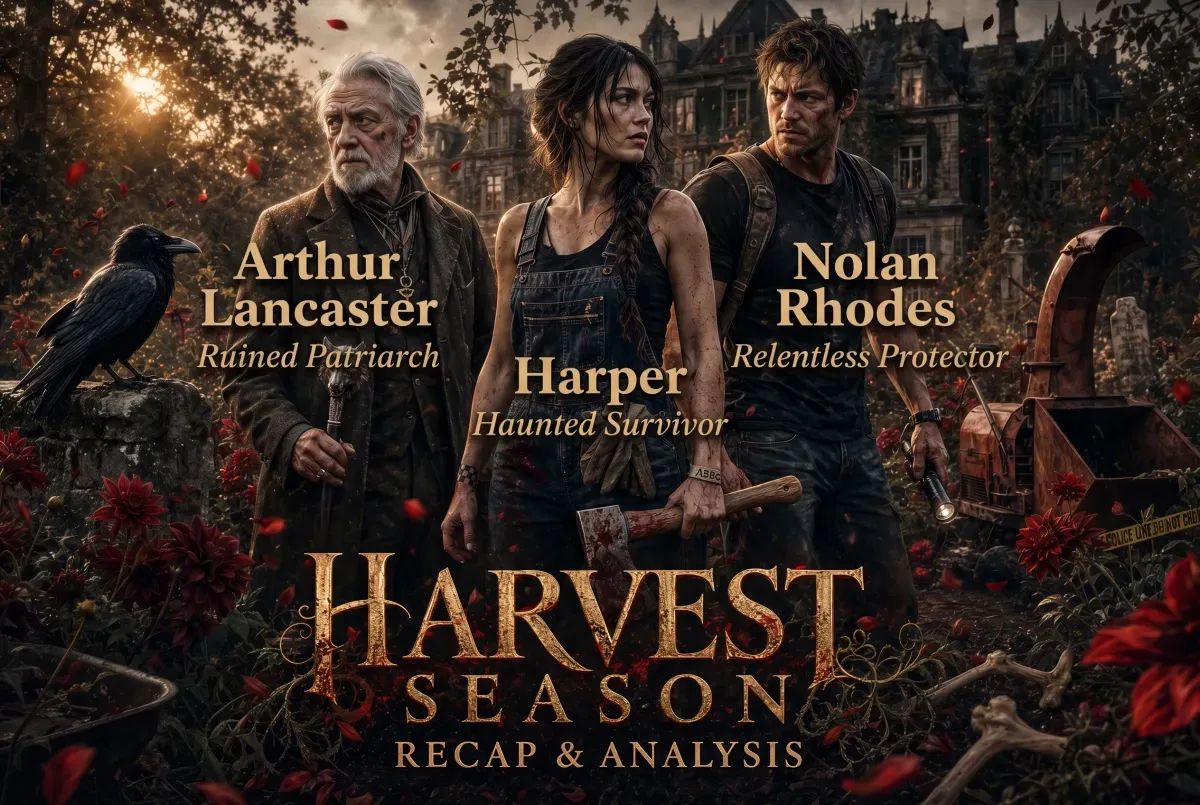
Harper Starling (Autumn Bower)
Haunted gardener killerThe protagonist, a serial killer and devoted caregiver living under a stolen name. Once Autumn Bower, a vanlife vlogger, she survived captivity at serial killer Harvey Mead's farm where her boyfriend Adam died, then faked her death and fled to Cape Carnage. Fiercely loyal, she keeps her promises even at lethal cost, tending Arthur3 and his garden as penance and purpose. Quick-witted and defiant, she masks grief with sharp humor and a chessboard ritual tied to Adam. Her core wound is the conviction that loving someone guarantees losing them, so she guards her heart like a fortress. Tough, capable, and self-punishing, she fears not pain but the vulnerability of attachment, which makes her romance with Nolan2 the bravest and most terrifying thing she has ever risked.
Nolan Rhodes
Reformed avenger loverA Search and Rescue specialist and former firefighter who came to Cape Carnage to kill Harper1, believing she caused the crash that killed his brother Billy and left him scarred. A methodical serial killer who tortured those connected to the accident, he is undone by obsession that curdles into love. Steady, controlling, and darkly tender, he expresses devotion through caretaking, coffee notes, careful hands, and a refusal to abandon her. Driven by guilt over surviving and over failing to protect Billy, he channels rage into protection. His central conflict is whether he can separate obsession from love and whether his violent instincts serve devotion or threaten it. Beneath the menace lives a man desperate to be the kind of person his brother could admire.
Arthur Lancaster
Aging killer mentorThe formidable, acid-tongued patriarch of Lancaster Manor, an octogenarian serial killer with Alzheimer's who took Harper1 in and made her his apprentice and caregiver. A connoisseur of fine suits, opera, gardening, and elaborate poisons, he has spent decades culling tourists he deems unworthy while keeping Cape Carnage his domain. He is impetuous, manipulative, and increasingly unpredictable as his memory frays, sometimes mistaking Harper1 for his murdered daughter Poppy. Yet his bond with Harper1 is genuine, a chosen family forged from mutual loneliness. Grief over his late wife Vivian and his stolen daughter shaped his life's mission. His decline drives the book's most tender and heartbreaking material, the slow erosion of a brilliant, fierce mind.
Sheriff Yates
Folksy small-town lawmanThe genial, country-music-loving sheriff of Cape Carnage who recruits Nolan2 to lead the search for missing tourists. He plays the affable, slightly inept good ol' boy, clapping shoulders and dispensing fatherly warmth, yet his questions land with unnerving precision and his observations cut sharper than his manner suggests. Patient and watchful, he seems always to know more than he reveals, circling Harper1 and Nolan2 with a curiosity that reads as either kindness or threat. A devoted family man married to Fiona and father to Maxine6, he embodies the book's theme that masks can fuse to flesh until camouflage becomes character.
Lukas Lancaster
Oblivious grieving grandsonArthur3's grandson, restoring the family distillery and wrestling with whether to move his grandfather into care. Kind, hardworking, and endearingly clueless about the violence around him, he treats Harper1 as a beloved sister. Long pining for his childhood crush Maxine6, he is paralyzed by old heartbreak. He provides warmth, comic relief, and the painful realism of a relative shouldering a loved one's decline.
Maxine Yates
Returned hometown flameThe sheriff4's polished, sharp-edged daughter, back in Cape Carnage to develop a boutique resort on land Arthur3 once owned. Elegant but determined, with a hidden steel beneath delicate features, she rekindles a tentative connection with Lukas5. Warm toward Arthur3 and quick to help Harper1, she becomes the focus of Harper1's matchmaking, a softer thread of romance woven through the darkness.
Morpheus
Mimicking macabre ravenHarper1's resident raven, who steals shiny trinkets, devours suspicious jerky, and chatters phrases like murder and pretty murder bird in Harper1's own voice. Equal parts comic familiar and ominous omen, he hovers at windows and graves. His uncanny mimicry, learned from those around him, makes him an instrument of revelation as much as a darkly charming companion.
Tylor Knightsbridge
Relentless amateur sleuthA member of the online Sleuthseekers collective, revealed to be the user KnightofTruth, who arrives obsessed with solving the deaths and disappearances plaguing Cape Carnage. Armed with a photograph of Harper1, he refuses to give up the hunt for her identity, making him the most persistent external threat to her exposure and a magnet for danger.
Irene
Gossiping innkeeperThe kindly, sharp-eyed proprietor of the Capeside Inn who knows everyone's business and dispenses both gossip and grandmotherly advice. She runs the toe-toast ritual at the barn dance and offers Nolan2 unexpected encouragement when his world falls apart.
Mrs. Evanston
Frantic searching widowThe distraught wife of missing tourist Peter Evanston, who haunts the search with her yapping Maltese, Queenie. Her grief makes her a relentless, sympathetic presence, and her dog's strange devotion to Harper1 triggers pivotal suspicion and discovery.
Maya
Loyal shopkeeper allyThe chemistry-minded owner of Maya's Magical Mixtures, who concocts homemade repellents and quietly shields Harper1 from prying Sleuthseekers. A true Carnagean, she values protecting her own over outsiders chasing fame on the town's pain.
The Bobs
Bickering town handymenBob, Bobby, and Bert, three inseparable, perpetually arguing local fixtures who hang flower baskets, drive the party bus, and spin the shark legend of Sharkimedes. They supply comic texture, local color, and the folklore Harper1 exploits for cover.
Plot Devices
The black knight chessboard
Trauma anchor and tauntA chess set in Harper1's living room, perpetually mid-game, tied to memories of playing with Adam in their broken-down van the day before their captivity. The misplaced black knight signals intrusion into her grief, and she ritually resets it to feel control over a chaotic world. When pieces move without explanation, the board becomes a barometer of violation, registering that someone has been inside her sanctuary. Weaver uses it first as a tender symbol of loss, then as an instrument of psychological warfare, a quiet, recurring signal that Harper1's private space, and private self, is being invaded by a hand she cannot identify until far too late.
Cookie Monster the woodchipper
Grisly body disposalThe industrial woodchipper Harper1 uses to mulch Arthur3's victims into compost for her award-winning garden, affectionately nicknamed Cookie Monster. It opens the book mid-grind and recurs as both practical horror and dark comedy, the literal engine that turns murder into flourishing flowers. Harper1 sprays it down and runs real branches through it to maintain cover. Beyond gore, the device embodies the book's central image of growth feeding on death, the harvest that names the title, and becomes a point of dread when the sheriff4 casually asks to borrow it, threatening to bring the lovers' methods within the predator's reach4.
Nolan's scrapbook
Obsession's shifting objectA leather scrapbook in which Nolan2 once mounted trophies, photographs, names, and tanned skin, from the people he tortured to avenge his brother Billy, including a blank page reserved for Harper1. After falling for her, he burns the trophies and repurposes the book into a log of her habits and history, reframing the same obsessive impulse as protection rather than destruction. The device dramatizes the book's argument that fixation is morally neutral and takes the shape of its object. It also becomes evidence of how intimately Nolan2 knows Harper1, a knowledge that will be turned against them both.
Bryce Mahoney's titanium implant
The frame-up keystoneA surgical plate screwed to a bone fragment, the remains of a man Harper1 killed, kept hidden in her freezer and known to only one other person. When it surfaces in Arthur3's garden flowerbed, dug up by a dog during the competition judging, it becomes the single most damning piece of evidence pointing to a betrayer. Because its location was a guarded secret, its appearance forces Harper1 into a catastrophic conclusion about who put it there. Weaver uses the implant as the linchpin of the climax's misdirection, proof that the antagonist's true weapon4 is intimate knowledge weaponized into apparent treachery.
The mimicking raven
Speech as accusationMorpheus7, who parrots phrases in Harper1's voice, becomes a vehicle of revelation when he suddenly croaks her secret name, Autumn1, in a man's lower register at the worst possible moment. The bird's learned speech, absorbed from whoever spends time near him, turns him into an unwitting witness and accuser. The device exploits the eerie unreliability of overheard words and the human tendency to read meaning into them. It crystallizes how the climax's betrayal is engineered: even the household animal has been turned into a tool, its mimicry stripping away Harper1's disguise at the instant her trust is most fragile.
Download PDF
Download EPUB
.epub digital book format is ideal for reading ebooks on phones, tablets, and e-readers.








































