
Key Takeaways
1. Discipleship is about "Hearing and Doing" God's Word.
genuine faith in Jesus Christ as Lord and Savior involves both hearing (understanding) and doing (obedience) as well as heartfelt trust.
Beyond mere knowledge. True discipleship transcends intellectual assent to biblical truths; it demands active obedience and heartfelt trust, mirroring the "hearers and doers" principle from James 1:22-25. Simply hearing without doing is akin to spiritual amnesia, forgetting one's true identity in Christ and failing to behave like a child of the King.
God's curriculum. The Lord's forty-year wilderness training for Israel, and Jesus' own forty-day desert trial, illustrate that discipleship is an "Upward Bound" expedition, not a "cakewalk." It's a rigorous program designed to form a holy nation, citizens fit for God's kingdom, where members are "crew, not passengers" on a journey through the world.
Practical theology. Theology, far from being abstract, is an eminently practical affair, teaching how to live the good life in light of the good news to God's glory. The Great Commission emphasizes making disciples by baptizing and teaching them to observe all Christ commanded, signifying entry into a bound-to-Christ way of life.
2. Secular Culture's "Social Imaginaries" Captivate Hearts, Distorting Discipleship.
what rules our imaginations—the pictures and stories that yield self-understanding and give coherence to everyday life—orients us to the world and directs our steps toward success.
Cultural conditioning. Contemporary culture, through its pervasive "social imaginaries"—implicit pictures and stories of the good life—acts as a powerful, often subconscious, disciple-making force. These narratives shape our desires, values, and understanding of human flourishing, often subtly replacing biblical truths and conditioning us to think certain pictures are "normal."
Idolatrous influences. Just as ancient Israel's kings were captivated by secular notions of kingdom success, leading to idolatry and wrong "walking," so too today's church risks adopting cultural ideals like romanticized love, self-help salvation, or physical perfection. These secular gospels offer counterfeit paths to well-being, shrinking "shalom" to mere physical or individualistic terms, and encouraging trust in human resources over the Lord.
Wellness obsession. The modern obsession with wellness, health, and fitness, fueled by a multi-trillion-dollar industry, exemplifies a secular social imaginary that prioritizes physical longevity and self-actualization. This "gospel of wellness" often denies the limits of the body and the inevitability of death, creating a spiritual vacuum that the church must address with the true gospel of Christ.
3. Pastors are "Eye Doctors" who Correct Vision with Scripture.
If the imagination pertains to what Paul calls the "eyes of the hearts" (Eph 1:18), then pastors ought to be eye doctors who correct the astigmatisms and myopias of the local church.
Reforming vision. Pastors, as "doctors of the church," are called to correct the church's vision, which often suffers from culturally induced myopia or astigmatism, preventing it from seeing reality biblically. Their vocation is to fit congregations with the "spectacles of faith"—the corrective lenses of Scripture—to discern God's truth amidst secular distortions.
Sola Scriptura's role. The Reformation principle of sola Scriptura is crucial for this, asserting that Scripture alone should rule the Christian social imaginary, providing the authoritative metaphors and narratives for life. This means taking "every thought captive to obey Christ," including the imagination, freeing it from non-biblical stories that enslave rather than liberate.
Imagination as faculty. The imagination is not merely a picture-making factory but a vital cognitive tool for discerning meaningful patterns and making connections, engaging mind, will, and emotions. Scripture, as God's verbal creativity, addresses this faculty, enabling us to "see as" God sees and to inhabit the world as God's creation, not a disenchanted system.
4. The Church is a "Fitness Culture" for Spiritual Training.
Make no mistake: a church vested in making disciples must become a fitness culture.
Gym for godliness. Paul's exhortation to Timothy to "train yourself for godliness" (1 Tim 4:7) uses the Greek term gymnazō, explicitly framing the church as a "gym" for spiritual training. This fitness culture aims to make disciples "fit for purpose"—ready, willing, and able to act as heralds and representatives of God's kingdom.
Beyond physical. While secular fitness cultures focus on physical appearance or self-actualization, the church's fitness is holistic, encompassing mind, body, and soul, oriented towards Christlikeness and gospel citizenship. This involves cultivating canonical and theological literacy—catechesis—to equip believers with the "core Christian knowledge" needed to function effectively in God's city.
Core exercises. Discipleship involves "theological exercises" that strengthen the "core" of both the individual disciple and the church body, improving stability, flexibility, and mobility for Christly action. These exercises are regenerative, designed to renew energy and conform deepest convictions, desires, and practices to the gospel, ensuring good posture in the spiritual battle.
5. Doctrine is the "Health-Giving Diet" for Discipleship.
Christian doctrine is the disciple’s meat and drink.
Sound doctrine's vitality. Paul's use of "sound doctrine" (Greek: hygiainō didaskalia) highlights that doctrine is not merely true but "health-giving" or "hygienic" for the body of Christ. It corrects error, deepens understanding, and fosters wisdom, directing disciples in the Way of Jesus Christ, away from illusions and foolishness.
Beyond assent. For doctrine to be truly sound and transformative, it must be "heard and done," not just intellectually assented to. Just as a physical diet requires discipline beyond mere information, spiritual fitness demands active engagement with doctrine, empowered by the indwelling Holy Spirit who renews minds and frees from cultural "junk food."
Gospel-defined wellness. The church, as an "evangelical fitness culture," must counter secular narratives like the "health and wealth gospel" by defining wellness, health, and fitness primarily by the gospel. This means understanding that Christ is the disciple's strength, enabling them to "do all things through him who strengthens me," fostering Christlikeness through grace, not self-effort.
6. The Church is the "Company of the Gospel," Enacting God's Drama.
The church, as the gathering of the word, is that peopled place where Christians are built up by the written and proclaimed word into the living Word of God, Jesus Christ.
Theodrama in action. The church is not just an institution but the "company of the gospel," a gathering of disciples called to proclaim, celebrate, and "act out" God's historical self-presentation—the "theodrama" of redemption. This five-act play, from creation to consummation, culminates in Jesus and continues through Spirit-empowered disciples.
Liturgy as rehearsal. Worship, as the church's "spoken and enacted interpretation of the reality attested in and by Scripture," serves as a prime training ground for discipleship. Liturgical practices like baptism and the Lord's Supper are "theodramatic," inserting believers bodily into Jesus' story, teaching them to "get real" by rehearsing eschatological reality and their union with Christ.
Improvising Christ. Disciples are trained not merely to repeat lines but to be "free and faithful improvisers," embodying the mind of Christ in new situations, always true to the gospel's premise. This "core mobility" allows them to make "Christly gestures"—acts of radical hospitality, compassion, and witness—that transcend cultural conventions and invite others into the drama.
7. "Sola Scriptura" Requires "Catholicity" for Unified Discipleship.
Sola Scriptura is "Christianity’s dangerous idea" only when it is untethered from the church’s catholic tradition.
Beyond solo Scriptura. While sola Scriptura affirms Scripture as the sole supreme authority, it does not mean "Scripture alone" in isolation from the church or its tradition. The Reformers advocated for the "priesthood of all believers," not the "popehood of every believer," emphasizing communal interpretation guided by the Spirit and aided by the wisdom of the universal church.
Catholicity's role. True Protestantism embraces "Reformed catholicity," where canonicity (Scripture's supreme authority) and catholicity (the Spirit-led theological tradition) are held together. Church councils like Jerusalem and Nicaea, in improvising authoritative dogma from Scripture, demonstrate how tradition serves as a "lesser light" reflecting Scripture's truth, guiding the church into all truth.
Dialogical unity. Denominations, like houses, offer shelter but should foster "table talk" and "dialogical unity," recognizing that each tradition offers partial insights. Disciples are called to be "catholic Protestants"—first followers of Christ, then members of a specific tradition—learning humility, interpretive conscientiousness, and endurance in living with doctrinal differences for the sake of the one, holy, apostolic, and catholic body of Christ.
8. Discipleship's Goal: Becoming a "Fitting Image" of Christ.
Christlikeness is the goal of discipleship. It is not only a way of walking but a state of being.
Conformed to Christ. The ultimate aim of discipleship is to be "conformed to the image of his Son" (Rom 8:29), bearing the image of "the man of heaven." This transformation is a gift of God, uniting us to Christ through the Spirit, and a task requiring active participation in becoming who we truly are "in Christ."
Learning Christ. "Learning Christ" involves more than intellectual knowledge; it's about adopting his habitual attitudes, reflexes, and disposition—his "mind"—and improvising his way in new situations. Scripture, acting as "spectacles" and a "pedagogue," trains our faculties to discern what is fitting for Christians to say and do, cultivating wisdom and practical knowledge.
Putting on Christ. "Putting on the Lord Jesus Christ" (Rom 13:14) is both a spiritual reality (baptized into Christ) and a daily performance. Empowered by the Spirit, disciples act out their eschatological reality, embodying Christ's life from the inside out, not as pretense but as a demonstration of the new humanity. This collective "commentary" of the church, through its Christly gestures, glorifies God.
Review Summary
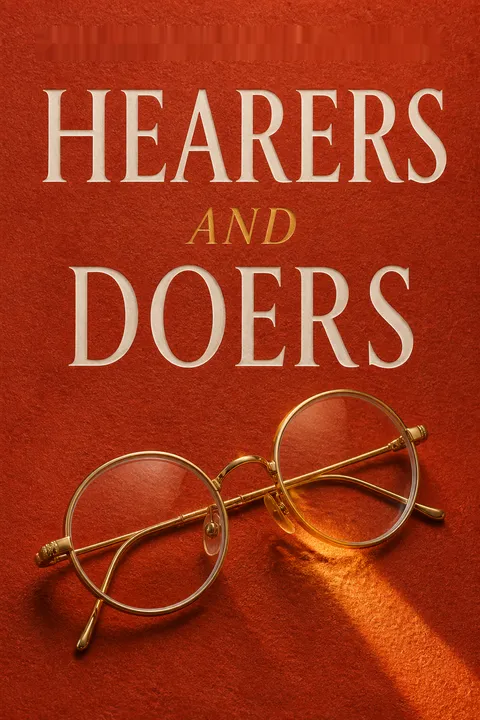
Hearers and Doers receives strong praise from readers, averaging 4.2 stars. Reviewers consistently highlight Vanhoozer's rich theological framework for discipleship, particularly his use of "social imaginaries," fitness culture, and theater metaphors to illustrate how Scripture and doctrine shape believers. Many commend the book as essential reading for pastors, praising its depth, biblical grounding, and engagement with cultural critique. Common criticisms include repetitiveness across chapters, occasional lack of cohesion, and a desire for more concrete practical application. Despite these minor critiques, most reviewers consider it an exceptional contribution to discipleship literature.
People Also Read





About the Author
Other books by Kevin J. Vanhoozer
Download PDF
Download EPUB
.epub digital book format is ideal for reading ebooks on phones, tablets, and e-readers.








































