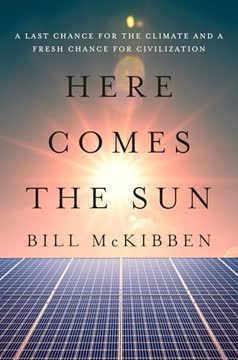
Key Takeaways
1. The Climate Crisis Demands Urgent Action, Yet a Viable Solution is Here
And yet, right now, really for the first time, I can see a path forward. A path lit by the sun.
A dire reality. The planet is experiencing unprecedented warming, with 2024 being the hottest year in 125,000 years, leading to extreme weather events like record heatwaves, floods, and wildfires that are causing fundamental damage to Earth's systems. Scientists warn of potential collapses in crucial systems like the Gulf Stream and boreal forests, pushing humanity into "climatic conditions never witnessed by us or our prehistoric relatives." This is an emergency, not a gradual problem.
A sudden shift. Despite the grim outlook, a revolutionary transformation is underway: the cost of solar and wind energy has plummeted, making them the cheapest forms of power. This economic tipping point, crossed in the early 2020s, means we are now installing a gigawatt of solar panels every 18 hours globally, scaling faster than any energy technology in history. This exponential growth offers a tangible, immediate path to decarbonization.
The "finding out" part. We are no longer just predicting future climate impacts; we are living through them, with devastating consequences for vulnerable populations and even wealthy regions. The urgency of cutting emissions in half by 2030 is paramount, and this rapid deployment of sun and wind power is the only technically and financially viable way to meet that deadline and offer a chance for a survivable future.
2. Renewable Energy Has Become the World's Cheapest Power Source
Sometime in the early part of the 2020s we crossed an invisible line where the cost of producing energy from the sun dropped below the cost of fossil fuel.
The great bargain. Contrary to outdated perceptions, solar and wind power are no longer "alternative" or expensive; they are the most affordable ways to generate electricity. This dramatic cost reduction, described as "the steepest drop in the price of one of the basic factors of production that the world has ever seen," is due to continuous technological improvements and economies of scale, primarily driven by manufacturing in China.
Fossil fuel's hidden costs. Continuing to rely on fossil fuels incurs a "combustion penalty," not only through environmental damage but also through ongoing fuel costs and geopolitical instability. Unlike fossil fuels, which require constant extraction and burning, solar and wind provide free energy once the initial infrastructure is built. This fundamental difference means a rapid transition to renewables could save the world trillions of dollars in energy costs.
Economic advantages. The shift to renewables offers significant economic benefits beyond just cheaper energy. It creates millions of new jobs, often in regions where fossil fuel industries are declining, and provides energy independence for nations currently reliant on imported fuels. Even traditionally fossil-fuel-rich countries like Saudi Arabia are investing heavily in solar, recognizing the undeniable economic logic.
3. Electrification is the Efficient Path to a Post-Combustion Economy
For over a century we’ve been using the hammers of heat supply to bash in the screws of work demand. We got quite good at it and made it work—as long as you ignore the incredible inefficiency of the botched job. Now, with renewable electricity, we’ve found a screwdriver.
Beyond burning. The core of the energy transition is moving from a system based on burning things for heat to one based on electricity for "work." Fossil fuels are inherently inefficient, converting only about 30% of their energy into useful work, with the rest lost as heat. Renewable electricity, by contrast, directly powers motors and pumps, making it 3 to 5 times more efficient.
Transformative technologies. This efficiency revolution is evident in key technologies:
- Electric Vehicles (EVs): Require 3-5 times less energy than internal combustion engines, offer instant torque, and have fewer moving parts, leading to lower maintenance. Regenerative braking further enhances efficiency.
- Heat Pumps: 3-5 times more efficient than gas boilers, moving existing heat rather than creating new heat, and working effectively even in cold climates.
- Induction Cooktops: Boil water faster with a third of the energy of gas stoves, eliminating indoor air pollution linked to childhood asthma.
Massive energy savings. Stanford's Mark Jacobson calculates that converting the world to solar, wind, geothermal, and hydro by 2050 would reduce total energy consumption by 56%. A significant portion of these savings comes from electrifying transport and heating, demonstrating that clean energy is not just about cleaner power, but vastly more efficient power.
4. The Global South is Forging a Liberated Energy Future
The silent energy revolution in Pakistan isn’t just about keeping the lights on; it’s a fundamental restructuring of power—both electrical and political.
Breaking dependency. Eighty percent of humanity lives in countries that are net importers of fossil fuels, trapping them in cycles of debt and vulnerability to global price shocks. Solar and wind power, being diffuse and abundant, offer these nations a path to energy self-sufficiency and liberation from this economic burden. The sun shines most strongly near the equator, where many developing nations are located.
Grassroots adoption. Countries like Pakistan are experiencing a bottom-up solar revolution, with citizens and businesses installing panels at an astonishing rate, often without government intervention. This surge in distributed generation is driven by the desire for reliable, affordable power, leading to significant drops in diesel consumption and empowering local communities. In Africa, mini-grids are transforming villages, providing power for clinics, education, and income-generating machinery.
China's pivotal role. While Western nations debate, China has strategically invested in clean energy manufacturing, becoming the "Saudi Arabia of sun." Its affordable solar panels and EVs are flooding global markets, particularly in the developing world, enabling rapid transitions in countries from Pakistan to Nigeria. This shift is not only reshaping global energy but also geopolitics, with China emerging as a dominant player in climate diplomacy and technology export.
5. Concerns Over Minerals and Land for Renewables are Largely Misplaced
All the refined metals needed to reach net zero by 2050 will add up to less than the amount of coal mined in 2023 alone.
Less extraction, more efficiency. While the clean energy transition requires minerals like lithium, copper, and rare earths, the total material footprint will be significantly smaller than that of the fossil fuel industry. Fossil fuels are "incinerated" after use, requiring continuous mining, whereas minerals in renewables are used for decades and are increasingly recyclable.
Abundant resources and innovation. Claims of mineral shortages echo past "peak oil" scares and are largely unfounded. Reserves of key minerals are growing, and new discoveries are frequent. Furthermore, technological innovation constantly reduces the amount of material needed per unit of energy and explores alternative, more abundant materials:
- Lithium reserves grew 52% between 2021-2024, with new sources like Arkansas brine.
- Sodium, the sixth most common element (abundant in seawater), is emerging as a substitute for lithium in batteries.
- New turbine blade materials replace balsa wood, and old blades are repurposed or recycled into cement.
- Battery recycling is becoming highly efficient, with plants recovering 95% of minerals, creating a closed-loop system.
Land use comparison. Renewable energy infrastructure requires far less land than the fossil fuel system, which includes mines, wells, pipelines, and power plants. Moreover, innovative approaches like agrovoltaics (combining solar with farming) and "crustivoltaics" (restoring desert biocrust under panels) demonstrate that solar can coexist with, and even enhance, ecological and agricultural productivity.
6. Overcoming Inertia and Vested Interests Requires Inspired Activism
But I very much fear that, without a burst of inspired activism, we’ll blink again and turn away. We won’t abandon energy from the sun—there’s too much momentum—but we’ll slow our pace, and as a consequence the world will fatally overheat.
A history of missed chances. The 1970s saw a promising push for solar under President Carter, only to be dismantled by Reagan, setting back the US transition by decades. This historical lesson underscores the fragility of progress against powerful vested interests and political inertia. Today, the fossil fuel industry actively funds misinformation and lobbying to slow the renewable transition, exemplified by efforts to block solar farms and promote false solutions like carbon capture.
Shifting activism's focus. While past activism focused on blocking fossil fuel expansion, the new imperative is to actively build and accelerate renewable deployment. This means:
- Overcoming local opposition: Countering NIMBYism and misinformation with facts and community engagement, highlighting local economic and environmental benefits.
- Protecting and expanding funding: Safeguarding initiatives like the Inflation Reduction Act and advocating for global climate aid to unlock private capital for developing nations.
- Streamlining regulations: Fighting bureaucratic hurdles and outdated permitting processes that inflate costs and delay projects, especially for rooftop solar and grid connections.
The power of collective action. Grassroots efforts, like Greenlight America and Solar United Neighbors, are proving that even small groups can significantly impact policy and accelerate deployment. Retirees, for instance, are effectively engaging with public utility commissions, demonstrating that patient, persistent advocacy can dismantle regulatory roadblocks and ensure the rapid, equitable transition needed to avert catastrophic warming.
7. A Decentralized Energy System Fosters Community and Equity
But I want to suggest that they’re probably the most potentially liberatory technology loose in our world, the single thing most likely to subvert the cartoonish inequality and eat away at the grotesque privilege that dominates our world.
Democratizing power. Unlike fossil fuels, which are geographically concentrated and lead to centralized wealth and authoritarian tendencies, sun and wind are diffuse and universal. This inherent characteristic allows for decentralized energy production, empowering communities and individuals to generate their own power, reducing reliance on distant, often monopolistic, energy providers.
Building virtual power plants. The rise of smart grids and distributed energy resources (DERs) like rooftop solar, home batteries, and even smart appliances is enabling "virtual power plants." These networks aggregate small contributions from millions of homes, allowing utilities to manage demand and supply more efficiently, enhancing grid resilience and saving consumers money. This fosters a new form of collective action and shared benefit.
Resilience and local control. Decentralized energy systems are inherently more resilient to disruptions, as demonstrated in Ukraine where distributed solar farms were far quicker to repair after missile attacks than centralized gas plants. This local control over energy infrastructure strengthens communities and reduces vulnerability to geopolitical conflicts or natural disasters.
8. Turning to the Sun Offers a Profound Reconnection to Our World
If there is one thing we have in common, it’s that we live beneath the same sun; learning to face it together, instead of tending the myriad individual flames we’ve lit over the last few centuries, might connect us in ways that we dearly need.
Beyond the rational. While the economic, political, and environmental arguments for solar are compelling, the transition also holds a deeper, spiritual dimension. In an age of increasing disconnection from the natural world and absorption in digital screens, turning to the sun for energy offers a chance to reconnect with the most powerful and charismatic object in our natural environment.
Ancient reverence, modern relevance. Throughout human history, diverse cultures have revered the sun as a source of life, justice, and divinity. From ancient Egyptian sun gods to Indigenous traditions and even Christian hymns, the sun has been a central metaphor for light and energy. This primordial connection can be rekindled as we consciously harness its power.
A unifying project. Embracing solar energy can be a unifying global project, transcending divisions and offering a positive vision for the future. It's a chance to move beyond merely "reducing emissions" to actively building a better world, fostering a collective sense of purpose and shared destiny under the same sun. This shift from destructive combustion to harmonious harnessing of solar energy can heal our relationship with nature and each other.
Review Summary
Here Comes the Sun receives overwhelmingly positive reviews, with readers praising its rare optimism within climate change literature. Most reviewers highlight McKibben's compelling case that solar and wind energy are now cheaper than fossil fuels, with China leading the transition. Readers appreciate the book's hopeful yet realistic tone, noting it inspired action rather than despair. Critical reviews cite missing citations, lack of an index, concerns about Jevons paradox, and overly optimistic assumptions about fossil fuel displacement. The audiobook format also receives positive mentions.
People Also Read





 Immersive