

Plot Summary
The Black Rose Returns
Harper-Rayn Madden,1 a twenty-eight-year-old forensic pathology resident who chats to corpses to keep herself company on the night shift, feels her skin crawl while finishing a report on a poisoned father of three. Convinced she is alone behind a card-locked door, she flees to the bathroom. When she returns, a single black rose waits on her autopsy table.
Since no one could have entered, the gift detonates her sense of safety. She bolts, clipping her shoulder on the doorframe, abandons her Honda when she finds its lights mysteriously on, and Ubers home shaken. Laith,3 her casual lover, promises to come comfort her but never shows, leaving her to spend the night flinching at shadows and second-guessing her own sanity.
The opening weaponizes Harper's professional intimacy with death against her. A woman who calmly cracks open chests is unraveled by a flower, establishing the gap between clinical control and primal dread that the novel will exploit. The black rose is a perfect uncanny object: beautiful, deliberate, and logically impossible inside a sealed room. Anne plants the seed of unreliability immediately, framing terror as something Harper cannot verify, only feel. Her instinct screams while her scientific mind demands evidence, dramatizing the war between intuition and reason that defines her. The abandoned car and the no-show lover deepen her isolation, signaling that the people meant to anchor her will keep slipping just out of reach.
The Step-Uncle at Dinner
Dragged to her mother Mae's5 lavish anniversary dinner with billionaire Elias Slater,6 Harper1 is seated beside Elias's younger brother Knight,2 a six-foot-four SWAT team leader who nicknames her Morticia for her morgue work.
The chemistry is instant and dangerous since he is technically her step-uncle. When Mae5 publicly belittles Harper's career and pushes her toward surgery, Harper detonates, mocking her mother's gold-digging marriage before storming out. Knight2 follows, agreeing Mae is a narcissist, and insists on driving her home.
In the truck she confesses the morgue incident, the watching feeling and the black rose. He stops cold, programs his number into her phone, shares his location, and makes her promise to call if she ever feels unsafe again.
This chapter braids the two engines of the book: taboo desire and creeping menace. Knight functions as both forbidden fruit and protector, a duality that complicates every safety he offers. The dinner stages Harper's deepest wound, a mother who treats her daughter's accomplishments as social embarrassment, explaining Harper's compulsive independence and allergy to vulnerability. Her public takedown of Mae is catharsis dressed as cruelty, a woman finally refusing to shrink. Crucially, Knight is the first person to take the stalker seriously, making him the keeper of her fear. The age gap and family entanglement raise the emotional stakes, ensuring that leaning on him will cost her something, even as it feels like salvation.
Her Name in the Flesh
Detective Gray7 and a coroner deliver an urgent, brutally mutilated body with almost no paperwork. Working alone, Harper1 discovers the slashes are not random: the chest reads a taunt about smiling for the camera, the knuckles spell HARPER-RAYN when read in reverse, and the heart bears the words tag, you're it.
Worse, a black rose has been shoved inside the ribcage among displaced organs. Realizing a man was slaughtered purely to send her a message, she breaks down, then races to Knight's2 house in the rain near two in the morning. He takes her in, holds her, and vows to investigate quietly while keeping her name out of any official report, the first of many nights she crumbles in his arms.
The escalation from passive surveillance to active homicide transforms Harper from observer to participant in a game she never agreed to play. The carved messages literalize a stalker's fantasy of inscription, of writing himself onto her life through another's body. Her guilt, the conviction that a stranger died because of her, becomes the moral engine that keeps her from quitting the night shift, a self-punishing loyalty that endangers her. The scene also cements the pattern of her seeking Knight in crisis, establishing him as her emotional refuge. Anne carefully layers the procedural impossibilities here, missing paperwork, a hidden rose, that readers register as ominous but that will later read very differently.
Crossing the Forbidden Line
Sheltering at Knight's2 after the carved body, Harper1 overhears him in the shower and boldly intervenes, dropping to her knees at his command. He leaves her aching and unfulfilled, sparking a teasing power struggle that culminates the next morning when she returns the favor, then later when he takes her over his kitchen counter.
They agree to a no-strings, non-exclusive arrangement, with Harper admitting she also occasionally sleeps with Laith.3 Knight2 claims he is not the jealous type while privately seething. Their banter masks deepening feeling, but Harper insists this can never be more than sex given that he married into her family. The taboo only sharpens the heat between them as both pretend they can keep it casual.
The eroticism here is also a coping mechanism. Harper uses Knight's body as an anesthetic against terror, naming his touch a magic pill that makes the fear fade. Their dominance games are a negotiation of control between two people who refuse to be controlled, each insisting on the upper hand precisely because vulnerability frightens them more than danger. The non-exclusivity clause is Harper's armor, a preemptive refusal of attachment born from a mother who made love conditional. Knight's flares of possessiveness, contradicting his stated indifference, foreshadow that casual is a fiction. The forbidden framing, step-niece and step-uncle, intensifies desire by making it transgressive, transforming family scandal into aphrodisiac.
The Vanishing Corpse
When Knight2 visits the morgue to examine the carved victim, the corpse is simply gone from its locker, with no chain-of-custody record to explain it. The implication chills them both: the stalker returned and removed the evidence. Harper1 refuses to abandon her career despite Knight's urging.
On a later shift, hearing repeated failed keycard swipes and the door rattling, she panics and climbs inside an empty refrigeration unit, only to be locked in. She pries the jammed latch open with a soda tab, freezing and bloodied, and flees again to Knight.2 Reviewing security footage, he shows her the intruder was only Vincent14 the janitor flipping a lock he assumed was accidentally left open, leaving Harper humiliated by her own paranoia.
The disappearing body deepens the impossible-crime architecture while the freezer sequence stages Harper's terror in its purest form, a woman entombing herself among the dead to escape a threat that may not exist. The footage revelation introduces the novel's central instability: what Harper experiences and what cameras record diverge. Her humiliation is psychologically precise, the shame of a competent professional discovering her instincts cannot be trusted. Yet she rationalizes it away, choosing delusion over the alternative. Anne uses surveillance, the supposed arbiter of objective truth, as a tool that should reassure but instead quietly destabilizes, training readers to wonder which version of events is real long before the characters dare to ask.
Hide and Seek Begins
Alone in her apartment after a shower, Harper1 finds the bloodied black rose on her dresser, then sees a massive masked figure behind her in the mirror. Wearing a gothic skull mask with fangs, he clamps a hand over her mouth and lays out his game: if she screams, she fails; if she runs, she dies; she will hide, and he will find her, and when he does, she becomes his.
Terrified yet helpless, she does not fight as he brings her to climax with his fingers, hating that her body responds. He vanishes with a promise that he is coming for her. Shaken, she resolves to play along to survive, hiding this violation even from Knight.2
The stalker crystallizes into a defined antagonist with explicit rules, transforming amorphous dread into a structured ritual of dominance. The hide-and-seek framework is brilliant precisely because it makes Harper complicit, recasting victimhood as participation. Her arousal amid fear is the book's most uncomfortable and honest territory, dramatizing how trauma and desire can become neurologically entangled, how the body can betray the mind's revulsion. Her decision to conceal the encounter from Knight is the fatal secret that will compound her isolation. Psychologically, the masked man embodies the fantasy of total surrender that Harper, a control freak, cannot consciously permit herself, surfacing as an external monster she can blame rather than own.
A Stranger in the Club
Out drinking with her best friend Izzy,4 Harper1 feels the familiar chill and spots the masked figure watching from the shadows of the nightclub. She uses two men she is dancing with to provoke him, then abandons them and approaches him directly. In a dark booth she takes control, going down on him before riding him, reversing the power dynamic of their previous encounters.
Afterward he warns her that now he knows how she feels, he will never let her out of his sight. Izzy4 arrives and the figure vanishes instantly. Harper, drunk and reckless, tells a confused Knight2 outside the bar that the bossy stalker who keeps touching her might be him, hinting she has let the masked man have her again.
Harper seizes agency by inverting the game, turning prey into aggressor, which reveals how desperately she needs to feel in command of her own terror. Her conflation of the stalker with Knight, hoping they are the same man, exposes the wishful logic underneath her fear: she wants the danger to be safe, the monster to be her lover. This blurring is the keystone of the eventual revelation. The public setting, surrounded by oblivious revelers, underscores her dissociation, a private apocalypse unfolding amid ordinary nightlife. Anne stages desire as self-destruction here, with Harper risking everything for a high that her healthier relationship cannot replicate, signaling that something in her perception is dangerously off.
Dead Men From the Dance Floor
Two bodies land on Harper's1 table: the men she danced with at the club, their palms burned and their arms carved with a warning about paying the fine for touching what is his. She is certain her stalker murdered them for putting hands on her. She summons Knight2 to witness the carvings, but disturbingly he cannot see the letters she points to and cannot determine any cause of death.
He investigates Detective Gray,7 who insists he never logged such cases and that no records exist anywhere in the system. Meanwhile their affair intensifies as Knight2 takes her on the autopsy table itself, defiantly marking her as his before the cameras, daring the stalker to watch.
The discrepancy sharpens unbearably: Knight, a trained professional, literally cannot perceive what Harper perceives, the clearest signal yet that the messages exist only in her mind. Gray's denials and the vanished records accumulate into a pattern too large to be coincidence, yet Harper interprets the absence of evidence as proof of the stalker's omnipotence, a paranoid logic that converts every contradiction into confirmation. The morgue sex amid corpses is darkly thematic, eros and death fused on the same steel table. Knight's territorial performance for the cameras shows his own descent into the game's possessive logic, suggesting the contagion of Harper's obsession is spreading to the man trying to save her.
Dinner Two and the Bathroom
At a mandatory family dinner, Mae5 stages another humiliation, demanding Harper1 cover her outfit while Elias6 openly leers at her. Harper unleashes a blistering speech about a lifetime of being treated as the inferior child, and this time her brother Jonah11 finally takes her side and walks out with his family, leaving Mae's victim act exposed.
Knight2 applauds Jonah and follows Harper, finding her shaking in the guest bathroom. He calms her, then takes her against the wall even as Elias6 pounds on the door demanding to talk about Knight's rudeness to Mae. Knight covertly warns his brother off Harper, having earlier learned Elias harbors predatory designs on his stepdaughter, then sneaks Harper out for burgers.
The repeated dinner structure shows Mae's cruelty as compulsive ritual rather than misunderstanding, and Jonah's defection marks a quiet healing of sibling estrangement, the first crack in the family's machinery of diminishment. Elias emerges as a second predator, a reminder that Harper is hunted on multiple fronts, by an imagined monster and by an all-too-real one wearing a suit. The bathroom encounter, conducted inches from oblivious authority, reprises the couple's pattern of finding intimacy in transgressive proximity to threat. Knight's protective intervention against his own brother reveals the depth of his investment, repositioning him from casual partner to fierce guardian whose love is outpacing the rules they agreed to.
Laith on the Table
Returning to work, Harper1 unzips a body bag and finds Laith,3 her trusted friend and lover, dead. Devastated, she performs only the external exam, discovering carvings declaring she broke the rules and a chilling line: the clock is ticking, I'll get you at Knight.2
His bound wrists suggest he was held captive for a week, even as she believed she had been texting him. She realizes the stalker has been using Laith's phone all along. Unable to cut into her friend, she seals him in locker thirty-six and flees to Knight,2 who holds her through the night as she grieves and warns that Knight himself is now the stalker's next target.
Killing Laith escalates the stakes from strangers to intimates, and the double-meaning threat against Knight weaponizes Harper's love against her, the stalker promising to dismantle her support system one person at a time. The bound wrists and hijacked phone create a horrifying retroactive intimacy, the idea that her comfort texts were exchanged with her tormentor. Grief here is also guilt, Harper convinced that proximity to her is a death sentence. The number thirty-six, which she vows will haunt her, anchors the loss in concrete, unforgettable detail. For readers attuned to the unreliability thread, the impossibility of a week-long captivity overlapping with daily contact is another fracture in the narrative's reality, hiding in plain sight.
MINE Carved in Skin
While Knight2 is called away to a shooting, the stalker invades his supposedly secure home. Enraged over Laith,3 Harper1 screams that she will not play anymore, but the masked man overpowers her, binds her wrists and ankles, and carves the word MINE into her ribs with a blade, alternating pain with pleasure until she climaxes and is taken in Knight's bed.
He threatens to kill Izzy4 or Knight2 next if she breaks his rules again, then leaves. Knight2 returns to find blood, shredded blankets, and a discarded kitchen knife, but no rope and no sign of forced entry on his alarmed security system. He bandages her wounds, troubled that the physical evidence contradicts her account.
The carving makes the stalker's claim literal and permanent, branding ownership into flesh in a grotesque parody of devotion. The violation occurring in Knight's home, his fortress, shatters the last sanctuary and signals that no place is safe, or that the threat travels with Harper herself. The crucial detail is the mismatch: a knife from Knight's kitchen, no ropes, unmarked wrists, an undisturbed alarm. Anne lays the revelation's foundation precisely here, the scars are real but their origin is not what Harper believes. The scene interrogates consent and dissociation at their most disturbing, asking whether the body's response can coexist with genuine terror, and whether Harper is victim, participant, or, devastatingly, both author and instrument.
Left for Dead in an Alley
Heartbroken after Knight2 admits doubts about her story, Harper1 gets a voodoo-doll tattoo for stress relief, a private tribute to his pet name for her. Leaving the parlor, she is cornered by Trystin Black,12 the aggressive new morgue janitor who has unsettled her for weeks, and his four friends.
They drag her into an alley, beat her savagely, steal her car, and leave her bleeding until a passerby calls for help. Drifting in and out of consciousness, she is driven to the hospital by someone she perceives as the masked stalker demanding to know who hurt her. She undergoes emergency surgery on her liver and spleen, and the driver calls Knight2 so she will not wake alone.
This is the hinge where verifiable, public violence finally enters Harper's world, and tellingly it comes not from the elaborate masked phantom but from a crude, ordinary predator. The contrast is the novel's quiet thesis: the monsters we construct can obscure the dangers that are real. Her perception of her rescuer as the stalker, when it was almost certainly someone benign, demonstrates how thoroughly her mind overlays the mask onto reality. The voodoo-doll tattoo, a permanent mark she chooses, poignantly mirrors the MINE she did not, contrasting self-authored love with traumatic branding. Her survival depends on a stranger's kindness, underscoring how isolated her secret-keeping has left her.
The Footage Tells the Truth
At Harper's1 bedside, Knight2 plays the security footage he obtained. The first carved body was actually an elderly fire victim; the double homicide was two unrelated car-crash victims; the club men she believed murdered are alive, and the footage shows her grinding on and bedding an ordinary stranger, not a masked man.
Laith,3 he reveals, is alive and confused, having simply visited her apartment. Every detective, colleague, and record contradicts her memories. Most devastating, Knight2 theorizes the MINE carved into her ribs was self-inflicted during a hallucination, the shredded sheets the ropes she imagined, since her wrists bore no marks. Harper, shattered, accuses him of not believing her and orders him out, refusing to accept she is unwell.
The great reversal recontextualizes the entire novel as a chronicle of psychosis rather than a stalker thriller, and Anne earns it through the breadcrumbs of impossible crimes, missing records, and unseen carvings planted throughout. The horror shifts inward: the call was coming from inside Harper's own mind. Knight's act is an agonizing betrayal of trust performed out of love, the cruelty of forcing someone to confront a truth that annihilates their reality. Harper's denial is textbook anosognosia, the inability to recognize one's own illness, and her rage protects a self-image of competence and sanity. The self-harm theory is the most unbearable revelation, transforming her from hunted heroine into someone unknowingly wounding herself.
The Seventy-Two-Hour Hold
When Harper1 still insists the stalker is real, she sees him materialize in her hospital room, blade raised, advancing to kill both her and Knight.2 She screams a warning, but Knight sees no one and gently coaxes her back to reality as the masked figure dissolves into a transparent ghost before vanishing. Knight2 authorizes a sedative, and she is placed on a psychiatric hold.
Devastated and restrained, she finally accepts the truth. Laith3 visits alive, and they reconcile their friendship. The head psychiatrist, Dr. Carzy,13 diagnoses a manageable psychotic episode, likely worsened by stress including her forbidden relationship, and starts her on medication and therapy. Harper draws the mask on paper, stripping it of its power.
Watching the stalker disintegrate before her eyes is Harper's moment of devastating clarity, the externalized monster finally exposed as a projection of her own fractured psyche. The hospital hold reframes the romance genre's possessive fantasy as a symptom requiring treatment, a bold metatextual move that interrogates the very tropes the book has indulged. The diagnosis offers hope without minimizing the difficulty, recovery as labor rather than cure. Drawing the mask is an act of reclamation, converting terror into an object she controls. Laith's living return resolves her crushing guilt, and her reconciliation with Knight, who betrayed her trust to save her, begins the slow work of distinguishing love that wounds from love that heals.
Burning Together
Three weeks later, recovering well on medication and in therapy, Harper1 has returned to the morgue. Knight2 arrives at her apartment and announces he is moving her into his home, brushing off her furious protests. When she demands to know how he could love someone broken, he tells her she is his peace and declares his love outright.
She finally admits she loves him too, surrendering the non-exclusivity rule. His SWAT brothers Ace9 and Diesel10 and her friend Izzy4 arrive to pack her things, and Knight beats the truth out of her by sharing his own scars, three bullet wounds and the brotherhood that keeps him alive. He has already brutally punished Trystin12 for the alley attack. They build a life together.
The resolution honors the romance contract while complicating it: Knight loves Harper not despite her illness but as a whole person, redefining the possessive hero archetype as steadfast partnership rather than ownership. His vulnerability, finally cataloguing his own scars, balances the power dynamic that has favored him, making intimacy mutual at last. Harper's surrender of her independence clause marks genuine growth, a woman scarred by conditional maternal love daring to accept unconditional love. The found family of Ace, Diesel, and Izzy supplants the toxic biological one. Yet the resolution feels almost too neat, a calm that the narrative has trained us to distrust, setting an emotional trap for the reader.
Epilogue
Weeks into her recovery, medicated and stable, Harper1 finishes a clean night shift and crosses the dark parking garage to her car. The familiar chill returns, and the masked figure steps from the shadows. She insists he is not real, and he agrees, her stalker was always a hallucination. But this man bleeds.
He explains he obtained her psychiatric notes, every detail she gave the doctors, her drawing of the mask, and used them to make her delusion flesh. Wrapping his hand around her throat, he plunges a blade into her side and walks away, wiping it clean. As she collapses in her own blood, his words loop in her mind: who would ever believe her now?
The final twist is a masterstroke of cruelty, weaponizing Harper's recovery against her. The very institutions meant to heal, psychiatric records, diagnostic notes, become the blueprint for a real predator to impersonate her imagined one. Her hard-won sanity is now the perfect prison: having accepted that the stalker is fictional, she has been stripped of all credibility, the boy who cried wolf rendered unbelievable precisely when the wolf arrives. The gaslighting becomes structural rather than personal, society itself complicit. Anne inverts the recovery narrative into a horror trap, suggesting that being labeled unreliable is its own form of erasure. The cliffhanger reframes everything, setting up a sequel where truth and madness become indistinguishable weapons.
Analysis
Beneath its explicit dark-romance surface, Hide and Seek is a study of perception, trauma, and the unreliability of the self. Anne constructs a stalker thriller only to dismantle it, revealing the predator as a hallucination born of stress, isolation, and a lifetime of conditional love. The genre's most fetishized fantasy, the possessive masked pursuer, is reframed as psychosis requiring medication and therapy, a bold interrogation of the tropes the book simultaneously indulges. This doubled posture, delivering the fantasy while questioning it, is the novel's central tension and its riskiest gambit. The carved corpses, missing records, and unseen letters function as a fair-play mystery whose true solution is the heroine's fractured mind. Harper's1 arousal amid terror dramatizes the uncomfortable entanglement of fear and desire, asking whether the body can betray the mind's revulsion and whether surrender can be both violation and wish-fulfillment for a woman who cannot otherwise relinquish control. Her relationship with Knight2 reworks the controlling-hero archetype toward partnership, his eventual vulnerability balancing their power dynamic, though the forbidden framing keeps desire transgressive. The maternal wound supplies the psychological foundation: a daughter starved of approval who weaponizes independence against intimacy, whose found family of friends and SWAT brothers ultimately supplants the toxic biological one. The most provocative move is the ending's inversion. Having taught Harper,1 and the reader, to distrust her perceptions, Anne reveals a flesh-and-blood predator who exploits her diagnosis, using her own psychiatric notes to make the delusion real. Recovery becomes a trap; sanity becomes a prison of disbelief. The book's enduring unease lies in this structural gaslighting, the horror not of a monster but of being rendered permanently unbelievable. It asks what it costs to be labeled unreliable, and who gets to define reality when a woman's word is already discredited.
People Also Read





Characters
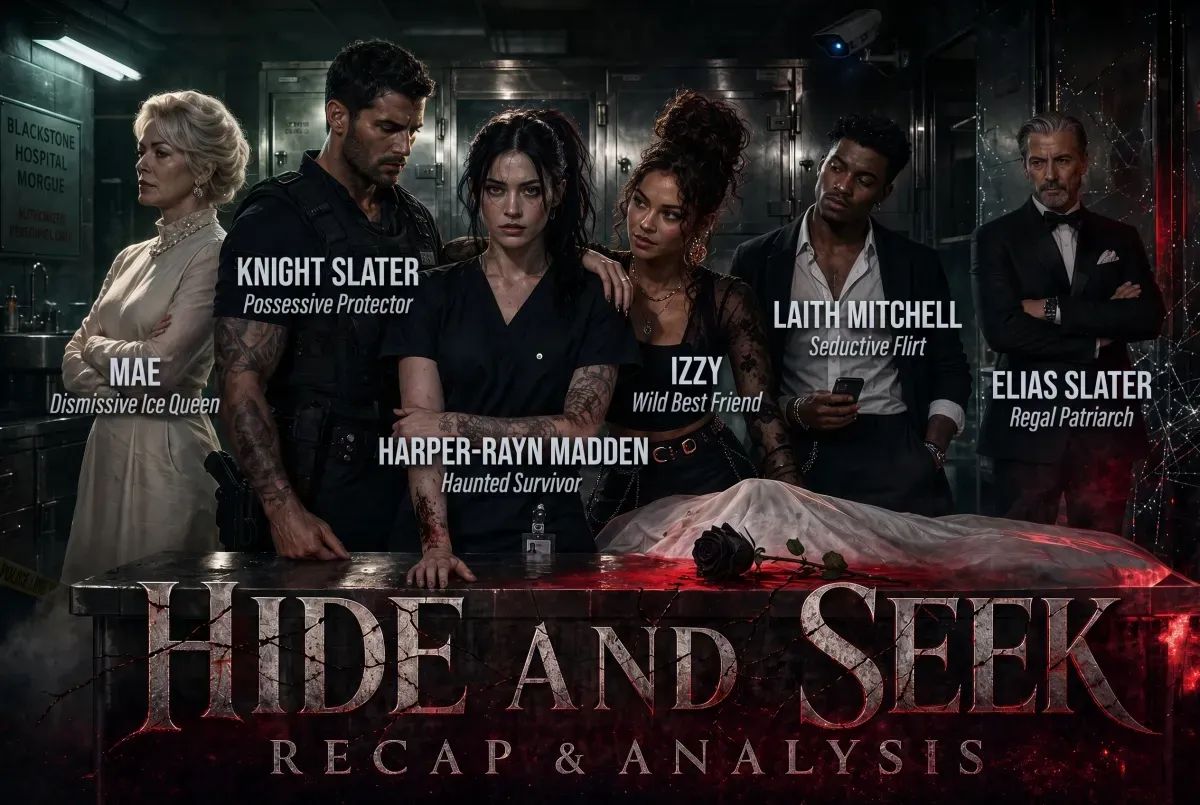
Harper-Rayn Madden
Haunted forensic pathologistA twenty-eight-year-old forensic pathology resident who thrives on the solitude of the night-shift morgue, talking to corpses to stave off loneliness. Fiercely independent and armored in black, tattoos, and dark humor, she built a career and identity in defiance of a mother5 who treats her work as shameful. Beneath the bravado lies a woman starved of unconditional approval, which makes her allergic to attachment and quick to choose casual arrangements over intimacy. Sharp, profane, and self-reliant to a fault, she would rather endure terror alone than appear weak. Her clinical detachment toward death contrasts with a fragile inner world increasingly unable to distinguish dread from danger, making her both a brilliant professional and an unreliable witness to her own life.
Knight Slater
Protective SWAT team leaderA six-foot-four SWAT team commander, tattooed and dominant, who happens to be Harper's1 step-uncle through his brother's6 marriage. Raised with affection by his mother after his cold father groomed his older brother6 into a clone, he is a man of action who distrusts his family's wealth and values loyalty above all. He has quietly watched over Harper1 for years, his attraction simmering beneath duty. Bossy, possessive, and blunt to the point of cruelty, he refuses to soften hard truths even when kindness would be easier. His protectiveness borders on obsession, yet it is rooted in genuine devotion. Trained to stay calm under fire, he finds Harper to be the one situation that consistently shatters his composure and tests his control.
Laith Mitchell
Harper's loyal friend-loverA successful criminal lawyer and Harper's1 casual partner of three years, saved in her phone under a crude nickname. Confident, playful, and proudly bachelor, he keeps things light yet genuinely cares for her wellbeing, never pushing for more than she offers. He is the rare man who respects her boundaries, making him her safest emotional connection outside of family. Their bond is friendship first, sex second, built on dark humor and mutual honesty.
Izzy
Outrageous best friendIzabelle Grace Davenport, a talented fashion designer and Harper's1 inseparable college friend. Crude, sex-positive, and relentlessly loyal, she dresses Harper for battle, defends her ferociously, and lightens the darkest moments with shameless humor. Her bawdy obsession with attractive men masks a deeply protective nature. She is the chosen sister who shows up unbidden, ready to fight twice as hard on Harper's behalf as Harper would for herself.
Mae
Harper's narcissistic motherHarper's1 mother, a social climber who married into billionaire wealth and treats her daughter's morgue career as a personal embarrassment. Cold, performative, and addicted to victimhood, she stages elaborate dinners to display a life she was not born into. She weaponizes tears and public criticism, favoring her son Jonah11 while diminishing Harper1 at every turn. Her conditional love is the original wound shaping Harper's defenses.
Elias Slater
Predatory billionaire stepfatherKnight's2 older brother and Mae's5 wealthy husband, a self-made billionaire molded by a callous father into something cold beneath a charming facade. He plays the doting husband for appearances while controlling Mae through an ironclad prenup. Privately arrogant and entitled, he harbors disturbing intentions toward Harper1, making him a quiet menace within the family.
Detective Gray
Evasive homicide detectiveA pretentious Blackstone detective who clashes with Knight2 professionally. He delivers urgent bodies to the morgue, then later denies any knowledge of the cases, his contradictions fueling suspicion that he may be connected to the deaths.
Dr. McKullan
Esteemed morgue supervisorThe senior forensic pathologist who mentors Harper1, one of the best in the country. Demanding but fond of her, he reviews her work and grows quietly concerned by her erratic behavior and claims of cases and carvings he has no record of.
Ace
Reckless SWAT brotherOne of Knight's2 two closest SWAT teammates since their rookie days. A relentless flirt with a one-track mind and a fear of dogs, he stirs trouble and chases the same women as Diesel10, but is fiercely loyal and treats Knight's woman as family.
Diesel
Brooding SWAT brotherKnight's2 other longtime SWAT teammate, a silent, intense fighter and gifted hostage negotiator. Protective and no-nonsense, he gets the job done without theatrics and quietly extends his loyalty to Harper1, clashing only with Ace9 over women.
Jonah
Estranged golden-child brotherHarper's1 older brother, long the favored child, now a devoted father living out of state. Their relationship is strained but warming. Once blind to their mother's5 cruelty, fatherhood opens his eyes, and he finally stands up for Harper.
Trystin Black
Aggressive replacement janitorThe hostile new night-shift janitor who replaces the kindly Vincent14. Drug-dealing and menacing, he makes Harper1 deeply uncomfortable at work before escalating into real, brutal violence outside the morgue.
Dr. Carzy
Head psychiatristThe respected head of the psychiatric ward who evaluates Harper1. Cautious, professional, and compassionate, she diagnoses Harper's condition, frames recovery as hard but achievable work, and gathers the detailed notes that prove fateful.
Vincent
Kindly night janitorThe gentle, grieving single-father janitor who chats with Harper1 on quiet shifts. Squeamish around corpses, he is the only colleague who treats her warmly, and his innocent presence is mistaken for menace during one of her panics.
Plot Devices
The Black Rose
Recurring uncanny omenA single black rose appears at each escalation: on the autopsy table, hidden inside a corpse's ribcage, on Harper's1 dresser, and in the masked man's hand. It functions as the stalker's calling card, a beautiful object made grotesque by its impossible placements. Because roses are tokens of romance, the black variant fuses courtship with death, signaling that the pursuit is both adoration and threat. Its repeated, logically inexplicable arrivals build the sense of an omnipotent watcher while quietly serving the deeper design: an object Harper alone perceives in impossible contexts, seeding doubt about whether anything she witnesses is truly there.
Carved Corpse Messages
Escalating personalized threatsBodies arrive in the morgue bearing words sliced into skin, knuckles, and even a heart, spelling Harper's1 name and taunts about a game. Each message personalizes the menace, transforming Harper from bystander to target and seeding crushing guilt that strangers die because of her. The carvings drive her repeatedly into Knight's2 arms and propel the investigation. Crucially, Knight2 cannot see the letters she points to, and no records of the cases exist, making the carvings a barometer of the gap between Harper's perception and verifiable reality. They escalate from strangers to her closest friend3, tightening the noose of her terror and grief.
The Hide-and-Seek Game
Rules-based predatory ritualThe masked man imposes a game with fixed rules: if she screams she fails, if she runs she dies, she must hide and he will find her, and when he does she becomes his. This framework converts amorphous dread into structured ritual and, disturbingly, makes Harper1 complicit, recasting her as a player rather than pure victim. It rationalizes her decision not to fight or flee, justifying her dangerous compliance and her hidden arousal. The game's rules also become the metric of transgression, with violations punished by fresh murders, weaponizing her loved ones against her and binding her ever tighter to the fantasy.
Surveillance Footage
Objective truth versus memorySecurity and club camera footage recur as supposed arbiters of fact. Early on, footage reassures Harper1 that a freezer scare was only the janitor. Later, Knight2 assembles recordings that systematically contradict her memories: ordinary victims instead of carved corpses, a regular stranger instead of a masked lover. The device pits recorded reality against subjective experience, the heart of the novel's unreliable-narrator engine. By making cameras the agents of revelation, Anne uses technology to expose the unbearable gap between what Harper lives and what actually happened, turning the genre's promise of evidence into an instrument of devastating disillusionment.
The MINE Carving
Physical proof of ownershipThe masked man carves the word MINE into Harper's1 ribs, leaving permanent scars she offers as undeniable proof her stalker is real. The wound becomes the central battleground between her account and the contradicting evidence: a kitchen knife present, ropes absent, wrists unmarked, alarm untriggered. It anchors the novel's most disturbing question about the origin of her injuries and mirrors the voodoo-doll tattoo she chooses for Knight2, contrasting branding she did not consent to with a mark she authored herself. The carving makes the abstract battle over reality agonizingly literal, written into her flesh.


Download PDF
Download EPUB
.epub digital book format is ideal for reading ebooks on phones, tablets, and e-readers.








































