Key Takeaways
1. The Resurrection: A Historical and Reasonable Foundation for Faith
Make no mistake: if He rose at all It was as His body.
Historicity is paramount. Christianity is unique among faiths because it hinges on specific historical events, not just ethical teachings or spiritual feelings. Paul's testimony in 1 Corinthians 15, written merely 15-20 years after Jesus's death, cites an early gospel summary formulated within months of the event, directly refuting theories that the resurrection was a legend developed much later. This immediate, widespread belief among thousands of Jews, who found the idea of a single bodily resurrection inconceivable, points to a momentous occurrence.
Compelling evidence. The historical case for the resurrection rests on two hard-to-refute facts: the empty tomb and hundreds of eyewitness accounts. If the tomb wasn't empty, the movement would have been easily debunked. The diverse circumstances of Jesus's appearances—to individuals and groups of up to 500, in various locations and times—make hallucinations or hoaxes highly improbable. Furthermore, the "strangeness" of Jesus's resurrected body, neither a dazzling apparition nor a merely resuscitated corpse, defies existing ancient literary categories, suggesting genuine historical reminiscence rather than fabrication.
Reasonable faith. While no past event can be empirically proven like a laboratory experiment, the resurrection leaves an enormous historical footprint that demands explanation. The radical "mutations" in early Christian belief about resurrection, departing from both Greco-Roman and Jewish worldviews, are inexplicable without it. Belief in the resurrection is not a blind leap but a reasonable conclusion that transcends, yet includes, historical and scientific inquiry, challenging our paradigms and inviting us to consider a God who acts in history.
2. The "Already-But-Not-Yet" Kingdom: Future Hope in the Present
The resurrection means not merely that Christians have a hope for the future but that they have hope that comes from the future.
Kingdom inaugurated. Jesus's resurrection was not just a miracle; it was the breakthrough of God's future kingdom into the present. This "already but not yet" reality means that while the world is still marked by sin and decay, the liberating, world-renewing power of God has begun to operate. Paul prays for believers to grasp this "incomparably great power" that raised Christ, a power available to us now.
Freedoms of the kingdom. This present-future kingdom brings profound freedoms. It frees us from the fear of guilt and shame, as the resurrection serves as God's "Paid in full" stamp on Jesus's atoning death. It also frees us from the fear of death itself, as Christ's resurrection guarantees our own future bodily resurrection, defanging death and transforming it into a gateway to God's love. Finally, it frees us from the enslaving "powers and authorities" of false gods—idols like money, sex, and power—that control us when we seek our identity and security in them.
A present verdict. The resurrection brings the future verdict of "no condemnation" into the present. Just as a prisoner is released when their debt is paid, or a receipt confirms a purchase, Christ's resurrection assures us that our sin debt is fully paid. This knowledge, rooted in God's unchanging love, frees us from the crushing weight of self-salvation and the need to earn our worth, allowing us to confess our flaws without fear and experience deep, lasting peace.
3. Reuniting with God's Glory: Heaven on Earth
Jesus does not merely have God’s glory or bring it—he is God’s glory.
Glory lost, glory restored. Humanity was created for intimate fellowship with God, to reflect His glory, but sin banished us from His presence. The flaming sword at Eden's entrance and the veiled Holy of Holies in the tabernacle and temple symbolized this separation, where God's raw presence was fatal to sinners. Moses's yearning to see God's face, to have intimate fellowship, remained unfulfilled in its fullness.
Jesus as the new temple. The Gospel of John declares that Jesus "tabernacled among us, and we beheld his glory." Jesus claimed his resurrected body would be the new temple, fulfilling all the old temple's functions. At His death, the temple veil tore, signifying open access to God's presence. Now, through union with the risen Christ by the Holy Spirit, believers become "temples of the Holy Spirit," gaining access to God's glory and presence in a way previously unimaginable.
Colonies of Heaven. This reunion with God's glory transforms individuals and creates a new kind of human community—the church. As "living stones" in this spiritual house, Christians form an "alternate society," a "heavenly commonwealth" whose laws and loyalties are based on heaven. These communities, whether a humble shack in Kibera or a chalet in the Alps, become "pilot plants" demonstrating the healing and energizing power of God's kingdom, offering glimpses of a new humanity reordered around His glory and love.
4. The Great Reversal: God's Upside-Down Logic of Salvation
In God’s economy the high will be brought low and the low lifted up.
Subversive pattern. The resurrection is the ultimate embodiment of the "Great Reversal," God's ironic overturning of human wisdom. This pattern, woven throughout Scripture, shows God choosing the weak over the powerful, the foolish over the wise, and saving not despite weakness but through it. It reveals two trajectories: retributive reversal (sin's desired successes become curses) and redemptive reversal (faith in hard things turns them into blessings).
Old Testament examples. From Genesis onward, God consistently chose the less powerful: Abel over Cain, Isaac over Ishmael, Jacob over Esau, and later, Moses and David over their older, more prominent brothers. He worked through barren women like Sarah and Hannah, and socially marginalized figures like Tamar and Rahab. Even Israel, a small, powerless nation of slaves, was chosen to bring salvation to the world, demonstrating that God works through what the world deems insignificant.
Gospel's core. Jesus's incarnation, death, and resurrection are the climax of this Great Reversal. He, though rich, became poor; though God, took the form of a servant; though innocent, became sin for us. He was "lifted up" on a cross to die, yet this ultimate humiliation led to His exaltation as Lord. This gospel message, offensive to human pride, is good news for everyone, as it offers salvation not through strength or merit, but through admitting utter weakness and receiving God's undeserved grace.
5. Personal Encounter: Meeting the Risen Christ
Unless he calls us by name, we would never come to him.
Beyond intellectual assent. While the resurrection is historically verifiable, true, life-changing faith comes from a personal encounter with the risen Lord, not just mental agreement. This encounter is diverse, ranging from dramatic events like Paul's conversion to quiet, internal awakenings like Lydia's or Ruth Bell Graham's. The "how" of conversion varies, but the "what"—a profound inner transformation—remains constant.
Mary's encounter. Mary Magdalene, consumed by grief and her own narrative of loss, failed to recognize Jesus even when He stood before her. It was only when Jesus called her by name, "Mary," that her eyes were opened, and she recognized her Teacher. This illustrates that God initiates the relationship, breaking through our preconceived notions and self-centered narratives, calling us out of our spiritual blindness.
Thomas's journey. Thomas, the ultimate skeptic, demanded to physically touch Jesus's wounds to believe. Yet, when Jesus appeared and offered him this proof, Thomas's decisive confession, "My Lord and my God!", likely stemmed from Jesus's intimate knowledge of his exact demands. This revealed Jesus's unseen presence and personal care, transforming the wounds from mere evidence of power into proof of sacrificial love for him, overcoming his deepest doubts.
6. Transforming the Self: Dying to Sin, Rising to New Life
Nothing in you that has not died will ever be raised from the dead.
Spiritual resurrection. Paul teaches that believers are not just promised a future bodily resurrection, but are already spiritually "raised with Christ" and "seated with him in the heavenly realms." This profound union means we participate in Christ's life now, experiencing foretastes of our final, glorious state—a freedom to change, a sense of God's reality, and new solidarity with fellow believers.
Two-stroke change. Christian growth is a continuous process modeled on the Great Reversal: a "death and resurrection" dynamic. This involves "putting off the old self" by identifying and killing inordinate, enslaving desires (idols like power, approval, comfort) that drive sinful behaviors. Simultaneously, it means "putting on the new self" by "setting the heart on things above," inflaming our affections for Christ through meditation on His glory and gospel.
Grace-fueled transformation. This process is not about self-shaming or earning salvation, but about responding to God's already-secured grace. Knowing we are "hidden with Christ in God," fully loved and accepted, frees us to admit our sins without fear of condemnation. This "godly sorrow" for grieving our loving Savior, rather than self-pity, genuinely weakens sin's hold and draws us into deeper intimacy and conformity to Christ's image.
7. Hope for Relationships: Grace-Driven Unity and Love
God did not enter into fellowship with you on the basis of your cultural pedigree, so how can you have fellowship with people only on the basis of theirs?
Racial reconciliation. The resurrection and new creation radically relativize racial and ethnic distinctions. Paul confronted Peter for allowing racial identity to supersede their common identity in Christ, arguing that justification by faith alone means God accepts us regardless of cultural pedigree. In Christ, there is "neither Jew nor Gentile," fostering the first multiethnic faith communities where diverse cultures are celebrated, purified, and united in a deeper bond.
Class and wealth. Jesus challenged the transactional nature of social relationships, urging His followers to invite the poor, crippled, lame, and blind to their banquets, knowing they "cannot repay you." This radical generosity, mirroring Christ's own act of becoming poor to make us rich, transforms our attitudes toward wealth and social status. It calls us to live in light of the "resurrection of the righteous," where sacrifices for justice will be infinitely recompensed.
Sexual ethics. The resurrection affirms the profound importance of the physical body, redeemed by Christ and destined for renewal. Paul argues that the body is "for the Lord," and sexual intimacy is meant to signify and strengthen a whole-life, permanent, exclusive covenant between spouses, reflecting our spiritual union with Christ. This high Christian valuation of sex, rooted in God's self-giving love, contrasts sharply with modern culture's transactional or individualistic views, offering a path to deeper freedom and fulfillment.
8. Hope for Justice: A Foretaste of God's Renewed World
The resurrection guarantees that this renewal is certain, and is also a call for Christians to work now against what is wrong and unjust.
World renewal. The resurrection is the down payment on a future where "the creation itself will be liberated from its bondage to decay." This means not only individual salvation but the complete healing of the material world from all effects of sin—disease, death, and social injustices like poverty, war, racism, and crime. The new heavens and new earth will be filled with dikaiosune—justice—a world finally put fully right.
Biblical justice. Rooted in the Genesis truth that all humans are made in God's image, biblical justice is comprehensive. It demands:
- Equal treatment for all: Regardless of race, nationality, or class, as seen in Mosaic law's provisions for foreigners and prohibitions against bribery.
- Radical generosity: Recognizing God as the ultimate owner of all, we are stewards called to share with the poor, exemplified by gleaning laws and Sabbath year debt forgiveness.
- Advocacy for the powerless: Speaking up for the destitute, widows, fatherless, and immigrants, as Jesus did in denouncing those who exploited the vulnerable.
Corporate and individual responsibility. Biblical justice acknowledges both individual moral responsibility and systemic evil. While individuals are accountable for their sins, groups and nations can also be corporately responsible for injustices, even those perpetrated by ancestors or embedded in social structures. This rich analysis avoids reductionism, recognizing that injustice stems from sin in the heart, in society, and in the spiritual realm, making the resurrection's promise of holistic healing profoundly relevant.
9. Hope in Suffering: Strength Through Weakness
For when I am weak, then I am strong.
The Sermon on the Mount. Jesus's Beatitudes in Luke 6 present an "upside-down" kingdom where the poor, hungry, weeping, and hated are blessed. This challenges the world's values of wealth, comfort, success, and recognition. Jesus isn't advocating for suffering, but teaching that when hard things inevitably come, a faith-filled response can turn curses into blessings, leading to the "best things"—the kingdom of God, spiritual fullness, joy, and eternal reward.
Joseph's story. Joseph's life, summarized by "You intended to harm me, but God intended it for good," perfectly illustrates this principle. His brothers' evil actions led to his slavery and imprisonment, but these "deaths" refined his character, broke his arrogance, and ultimately positioned him to save many lives. Like Jesus, Joseph "overcame by being overcome," demonstrating that God works through suffering and apparent defeat to bring about greater good and redemptive influence.
Joy through sorrow. Paul's "thorn in the flesh" taught him that God's "power is made perfect in weakness." His "light momentary affliction" was "preparing for us an eternal weight of glory." Suffering, when embraced in faith, drives us to rely on God, renewing us inwardly and cultivating virtues like love, joy, and peace. This "godly sorrow," rooted in Christ's own suffering and resurrection, transforms grief into a deeper happiness, knowing that His tears produced our ultimate joy and that our own tears, sown in faith, will yield a harvest of lasting joy.
10. Cultural Hope: A Realistic Vision for Humanity's Future
The building block that was rejected became the cornerstone of a whole new world.
Secular hope's decline. Western culture's once-dominant secular hope in linear historical progress, detached from its Christian roots, has waned significantly. Two world wars, pandemics, and the realization that technological advancement can exacerbate global problems have eroded confidence in humanity's ability to achieve inevitable progress through reason and science alone. This loss of hope contributes to widespread cynicism and boredom.
Design flaws. Secular hope is fundamentally flawed by two problems. First, the problem of human nature: it assumes humanity will use increasing knowledge for good, ignoring the "barbarism within us" that leads to cruelty and oppression, as tragically demonstrated by events like the Holocaust. Second, the problem of ultimate oblivion: without a belief in anything beyond this material world, all human endeavors, loves, and accomplishments are ultimately meaningless, destined to disappear with the universe.
Christian hope's strength. Christian hope offers a uniquely reasonable, full, realistic, and effective vision for the future. It is reasonable because it's grounded in the historical evidence of the resurrection. It is full because it promises not just a spiritual afterlife but a renewed physical world, a "new heaven and new earth" where justice and peace reign. It is realistic, offering a "v-shaped" view of history—descent through suffering leading to ascent and glory—rather than naive, unbroken progress. Finally, it is effective, transforming defiance into self-forgetful courage, rooted in the certainty that God's good plan, secured by Jesus's death and resurrection, will ultimately prevail.
Review Summary
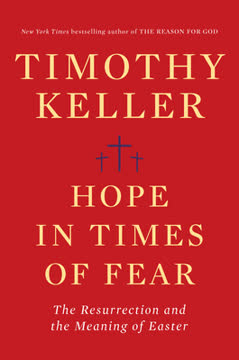
Reviews for Hope in Times of Fear are overwhelmingly positive, averaging 4.41 out of 5. Readers praise Keller's exploration of the resurrection as "The Great Reversal" and its implications for everyday life, faith, justice, and relationships. Many found it deeply encouraging, particularly given it was written during COVID-19 and Keller's cancer diagnosis. Some criticism centers on dense writing style, limited practical application, and occasional frustration with political framing. Several readers noted it as one of Keller's finest works, highlighting chapters on suffering and future hope as standouts.
People Also Read