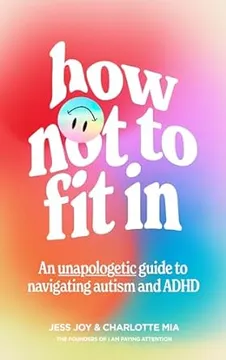
Key Takeaways
1. Late realization is a valid, life-changing journey of self-discovery
For us, the moment of change came not because of a medical professional, but because of ourselves.
The power of realization. For many late-realized adults, the journey to understanding their neurodivergence begins with a profound personal awakening rather than a clinical assessment. Jess and Mia discovered their AuDHD (autism and ADHD) in their late twenties during the isolation of the COVID-19 pandemic, realizing that their lifelong struggles with jobs, relationships, and mental health were not personal failures but the result of navigating a world not built for their brains.
Validating self-discovery. Accessing a formal clinical diagnosis is often an inaccessible, expensive, and non-neurodivergent-friendly process characterized by endless paperwork and years of waiting. Self-diagnosis or self-realization is a completely valid pathway that allows individuals to reclaim their agency and begin implementing life-changing accommodations immediately.
Reclaiming your narrative. Embracing your realization helps dismantle the deep-seated shame of feeling "not enough" and allows you to build a supportive community. Key benefits of this self-discovery include:
- A dramatic reduction in internalized shame and self-blame
- A better understanding of how to emotionally regulate your nervous system
- The ability to communicate your boundaries and needs clearly
- Finding a community of "safe people" who truly understand your experience
2. The social model of disability reframes neurodivergence from a personal deficit to a societal mismatch
The social model of disability says that disability is caused by the way society is organised, rather than by a person’s impairment or difference...
Shifting the paradigm. The traditional medical model of disability views autism and ADHD as individual pathologies or disorders that need to be "cured" or "fixed." In contrast, the social model of disability argues that society's rigid, capitalist structures and lack of accommodation are what actually disable neurodivergent people.
Ditching harmful labels. Traditional functioning labels like "high-functioning" and "low-functioning" are deeply flawed because they reduce a person's worth to how well they can perform for neurotypical society. These labels ignore the immense internal effort, exhaustion, and burnout that hidden struggles require, masking the true support needs of individuals who appear to be "managing."
Dismantling capitalist expectations. No one is biologically wired to thrive under the relentless productivity demands of modern capitalism, but neurodivergent brains feel this friction most acutely. Reframing your struggles through the social model allows you to:
- Stop viewing your natural traits as inherent flaws or deficits
- Recognize that your value is not tied to your economic productivity
- Demand systemic accommodations rather than forcing yourself to conform
3. Underdiagnosis is a systemic issue driven by sexism, racism, and classism
Let’s kick this off by saying outright that underdiagnosis isn’t just a women’s issue: it’s a sexism, racism and classism issue.
The historical bias. The diagnostic criteria for autism and ADHD were historically researched and established using young, white, hyperactive boys as the default standard. This narrow lens has left a "lost generation" of women, non-binary individuals, trans people, and racial minorities completely undiagnosed, misdiagnosed, or neglected by medical systems.
The intersectional barrier. Marginalized communities face compounded barriers to diagnosis, as their neurodivergent traits are often weaponized, misinterpreted, or dismissed due to systemic racism and cultural stigma. For example, Black and brown individuals displaying autistic traits are frequently perceived as aggressive rather than overwhelmed, leading to dangerous encounters with authority.
The cost of being missed. Going undiagnosed for decades takes a devastating toll on mental health, leading to high rates of depression, anxiety, and suicidal ideation. Key statistics highlight the severity of this crisis:
- Autistic girls and women are frequently misdiagnosed with borderline personality disorder or eating disorders
- Autistic adults are nine times more likely to die by suicide than non-autistic peers
- Minority groups are diagnosed significantly later and have less access to support services
4. Masking is an exhausting survival mechanism that leads to identity loss and trauma
The effort and masking involved in actually keeping up that act is exhausting.
The cost of fitting in. Masking involves consciously or unconsciously hiding, suppressing, or mimicking behaviors to blend into a neurotypical world and avoid discrimination or rejection. While it can help neurodivergent people secure jobs or make friends, keeping up this constant performance acts like running twenty background programs on a computer, eventually leading to total system collapse.
Internalized ableism. Years of being told to "stop fidgeting," "make eye contact," or "stop being so sensitive" force neurodivergent people to internalize the belief that their natural state is shameful. This internalized ableism drives chronic masking, causing individuals to lose touch with their authentic feelings, preferences, and needs.
Recognizing the mask. Masking is highly complex and manifests in various subtle, daily behaviors that drain your energy. Common examples of masking include:
- Forcing eye contact or staring intensely to appear engaged
- Rehearsing and scripting conversations in your head before they happen
- Suppressing natural self-soothing movements and stims
- Mimicking the interests, gestures, and vocal tones of those around you
5. Unmasking is a liberating but nuanced process that requires prioritizing safety
Knowing you’re autistic or ADHD doesn’t always prompt an unmasking celebration – it’s far more nuanced than that.
The path to authenticity. Unmasking is the radical, transformative process of stripping away societal expectations to honor your true sensory, emotional, and cognitive needs. It is incredibly liberating to finally wear sunglasses indoors, use fidget toys, or allow yourself to do a happy dance when eating good food without feeling childish or weird.
The privilege of safety. Unmasking is not a safe or viable option for everyone in every environment. Because society favors conformity, displaying natural neurodivergent behaviors can be perceived as rude, suspicious, or threatening, particularly for Black, brown, trans, or marginalized individuals who already face systemic bias.
Strategic unmasking. Navigating this journey requires finding a balance between protecting your energy and ensuring your physical and emotional safety. Consider these steps:
- Identify "safe spaces" and trusted people where you can unmask completely
- Gradually lower your mask in low-stakes environments to test your comfort
- Accept that you may choose to mask selectively in public to keep yourself safe
6. Grieving your past self and navigating chronic burnout are essential steps to healing
Maybe if I’d known I was neurodivergent, I wouldn’t have carried pain like this for so long.
Processing the grief. Discovering you are neurodivergent later in life triggers a profound grieving process for the "what-ifs" of your past. You must grieve for the younger version of yourself who struggled without support, the relationships that fractured due to miscommunication, and the career setbacks that chipped away at your self-esteem.
Understanding neurodivergent burnout. Autistic and ADHD burnout is not just everyday tiredness; it is a state of profound physical, mental, and emotional exhaustion caused by the cumulative strain of masking and surviving in an unaccommodating world. During burnout, executive functions collapse, leaving you temporarily unable to speak, wash, eat, or make simple decisions.
Recovering through radical rest. Healing from chronic burnout requires letting go of capitalist productivity standards and embracing radical self-compassion. Effective recovery strategies include:
- Practicing "energy accounting" to balance draining tasks with energy-restoring activities
- Lowering your standards and embracing the bare minimum (e.g., eating convenience foods, working from bed)
- Communicating your low energy levels to loved ones using simple, pre-written stock phrases
7. Traditional education and workplaces are built for polytropic minds, requiring proactive adjustments
Respect that we work differently, not incorrectly.
The cognitive mismatch. Traditional schools, universities, and corporate offices are designed for polytropic minds that can easily multitask, switch rapidly between subjects, and process overwhelming sensory environments. For monotropic minds—which focus deeply on one interest or task at a time—these open-plan, brightly lit, and highly social settings cause severe cognitive overload.
Advocating for accommodations. Under the law, educational institutions and employers are required to provide "reasonable adjustments" to remove barriers for disabled and neurodivergent individuals. Asking for accommodations is not asking for a favor; it is your legal right to ensure you can perform on an equal playing field.
Implementing practical adjustments. Small, simple changes in how work and study are structured can dramatically improve your focus and well-being. Examples of effective accommodations include:
- Receiving lecture slides, meeting agendas, or feedback in written, bullet-point form in advance
- Working from home or in quiet, low-sensory spaces to avoid overstimulation
- Wearing noise-canceling headphones or earplugs to block out distracting background noise
- Swapping tasks with colleagues or classmates to align with your unique strengths
8. True relationships and friendships thrive in "sorry-free zones" built on mutual accommodation
Among us, we call it: THE SORRY-FREE ZONE.
Navigating family dynamics. Telling family members about your neurodivergence can be incredibly complex, often bringing up parental guilt, denial, or generational trauma. Because autism and ADHD are highly genetic, parents may resist your realization because they see their own undiagnosed traits reflected in you, requiring you to set firm, loving boundaries to protect your peace.
Ditching friendship expectations. Neurotypical friendship scripts often demand constant text communication, attendance at loud group gatherings, and adherence to unwritten social rules. Unmasking allows you to step away from draining, one-sided dynamics and seek out reciprocal friendships where your need to retreat and recharge is fully respected.
The sorry-free zone. Creating a "sorry-free zone" with your safe people means establishing a relationship dynamic where no one has to apologize for their natural neurodivergent needs. In this safe space, you can:
- Cancel plans last-minute due to overstimulation without guilt or shame
- Go quiet for weeks at a time, knowing your bond remains secure and loved
- Communicate your boundaries directly and honestly without fear of rejection
9. Ditching conventional relationship scripts allows for authentic sexual and gender expression
A neuroqueer individual is any individual whose identity, selfhood, gender performance, and/or neurocognitive style have in some way been shaped by their engagement in practices of neuroqueering...
The neuroqueer connection. There is a massive, documented overlap between neurodivergence and LGBTQIA+ identities, as autistic and ADHD individuals are naturally less inclined to conform to arbitrary societal norms. The concept of "neuroqueering" represents the liberating practice of subverting both heteronormative gender roles and neurotypical cognitive expectations to live authentically.
Sensory and emotional sex. Sex can be highly complex for neurodivergent people, acting as either a source of intense sensory overload or a compulsive tool for stimulation-seeking. Understanding your sensory boundaries—such as how lighting, bedding textures, or specific sounds affect your ability to relax—is crucial for experiencing genuine pleasure.
Consonance over compromise. Conventional relationship advice tells couples to compromise, but in neurodiverse relationships, compromise often forces both partners into an unhappy middle ground. Instead, aim for "consonance"—creating unique, unconventional relationship structures where everyone's individual sensory, social, and emotional needs are fully met by:
- Ditching the expectation of eating together every night if sensory needs clash
- Finding other friends to share specific interests with rather than relying solely on your partner
- Allowing partners to recharge in separate spaces without viewing it as a relationship failure
10. Self-care and life admin must be adapted to fit an interest-based nervous system
The key is to work out which works best for you.
The interest-based nervous system. Unlike neurotypical individuals who are motivated by importance, rewards, and consequences, people with ADHD possess an interest-based nervous system. This means that boring, repetitive life admin tasks like paying bills, doing laundry, or booking appointments are incredibly difficult to initiate, regardless of how critical they are.
Hacking executive dysfunction. Executive dysfunction can make simple self-care tasks like showering or brushing your teeth feel like climbing a mountain due to the overwhelming number of steps involved. To bypass this mental freeze, you must inject novelty, urgency, competition, or play into your daily routines to engage your brain's natural motivation.
Practical life admin hacks. Adapting your environment and utilizing collaborative strategies can help you conquer the "ADHD tax" of late fees and forgotten tasks. Try these highly effective hacks:
- Use "body doubling" by having a friend present (in person or on a call) while you complete boring tasks
- Keep important items in plain sight, as "out of sight, out of mind" is a literal reality for neurodivergent brains
- Simplify self-care by reducing steps (e.g., using flavored toothpaste, keeping a towel on the radiator, or task-swapping chores)
I confirm that I have written detailed takeaways for ALL 10 key takeaways in the format requested.








































