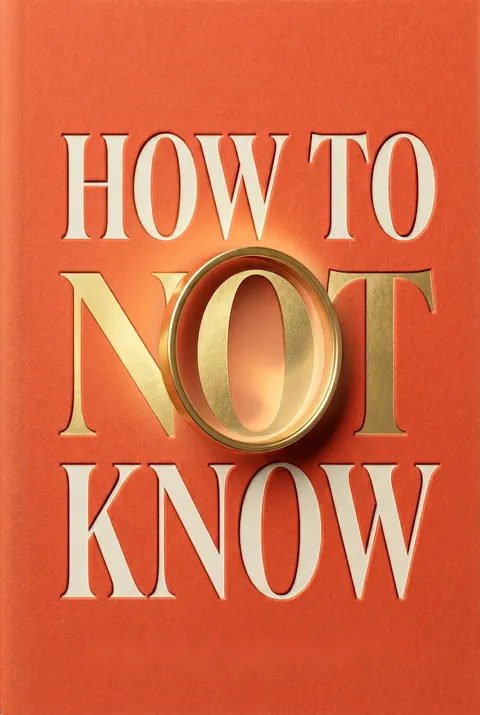

Key Takeaways
1. Embrace Uncertainty for Growth and Discovery
Uncertainty gives our life texture. Without it, there would be no serendipity or surprise.
Value of the unknown. Humans are biologically wired to seek certainty, as it makes prediction easy and fosters a sense of security. However, constantly seeking definitive answers can lead to stagnation, preventing us from experiencing the richness and unexpected delights that uncertainty offers. Embracing the unknown is crucial for personal and collective growth.
Beyond prediction. Our brains are prediction machines, and our capacity to plan for the future is both a blessing and a curse. While it allows for incredible advancements, it also fuels needless worry and rumination. Experts, from economists to forecasters, are often no better than "dart-throwing chimpanzees" at predicting the future, highlighting the futility of absolute certainty.
Cultivating tolerance. Our tolerance for uncertainty is not fixed; it's a skill that can be learned and developed. Individuals with higher uncertainty tolerance are often more creative, open-minded, and resilient. By confronting discomfort and pushing through limitations, much like athletes build pain tolerance, we can transform fear into curiosity and open ourselves to discovery.
2. Escape the Prison of Your Preferences
When you have a fixed plan, a fixed identity, a fixed routine, it’s easy to become trapped in a prison of your preferences.
The comfort trap. Our desire for comfort often leads us to optimize our lives, seeking out familiar experiences and environments. While this provides a sense of safety, it can also create a "filter bubble" that limits new possibilities and makes life feel predictable and unfulfilling. Max Hawkins's story of algorithmic living illustrates how over-optimization can lead to feeling trapped.
Randomness as liberation. Max, a Google software engineer, felt his life was too programmed. He built apps to randomize his daily decisions—from restaurants to travel destinations—to break free from his predictable routines. This "uncertainty exposure therapy" brought him to unexpected places and experiences, revealing sides of the world and himself he never knew existed.
Balance exploration and exploitation. While extreme randomness can lead to a lack of direction, a balance between exploring the unknown and exploiting the known is crucial. Like ant foraging, which combines seeking new food sources with returning to reliable ones, we need both novelty and tradition. Infusing daily life with small doses of serendipity can build uncertainty tolerance and resilience without sacrificing stability.
3. Trade Hubris for Humility and Better Decisions
We assume unwavering confidence breeds credibility, when in fact, research shows that those who admit what they don’t know are perceived as more credible.
The hubris trap. Overconfidence in our own beliefs, or hubris, blinds us from reality and prevents us from learning. Experts, despite their knowledge, are often more susceptible to cognitive biases like confirmation bias and the overconfidence effect, especially in uncertain environments. This was evident in the lead-up to the 2008 financial crisis, where many economists failed to foresee the housing bubble.
The Department of Doubt. Meg McConnell, an economist at the New York Fed, recognized the need for more humility in decision-making. She created the "Department of Doubt" (Applied Critical Thinking Unit) to challenge assumptions and expose blind spots. Their methods included:
- Documenting predictions to compare with reality.
- Running "premortems" to imagine worst-case scenarios.
- Using "red teams" to provide adversarial perspectives.
Humility as strength. Admitting what we don't know is not a sign of weakness but of intellectual humility, which fosters trust and better outcomes. While red teams can create friction and slow processes, their value lies in promoting divergent thinking and preventing groupthink. Leaders must cultivate doubt as an organizational value, understanding that the cost of slower, more reflective decision-making is often less than the cost of unchecked hubris.
4. Cultivate Doubt to Uncover Truth
Scientists prioritize the pursuit of truth over the desire to be right.
Scientific ideals vs. reality. The scientific method, built on rejecting the null hypothesis and embracing uncertainty, ideally champions the pursuit of truth. However, scientists, being human, are susceptible to biases, leading to issues like the "replication crisis." Daryl Bem's controversial ESP study, "Feeling the Future," highlighted how even rigorous methods could yield seemingly false positives.
The garden of forking paths. Researchers can inadvertently manipulate data or retroactively weave narratives to support desired outcomes, a problem known as the "garden of forking paths." This, combined with pressure to publish positive results, led to many published findings being unreplicable. The Bem paper served as a catalyst for social psychology to confront its flaws and improve research rigor.
Normalizing change. The replication crisis taught us that even with objective evidence, we can be wrong. Cultivating "negative capability"—the ability to sit "in uncertainties, mysteries, doubts"—and treating beliefs provisionally is crucial. Detaching opinions from identity and normalizing changing our minds, as Bem himself eventually did, enhances credibility and moves us closer to the truth.
5. Relinquish Control to Find Freedom
The more of it we seek, the more we become enslaved by the illusion of it.
The control trap. The desire for control is a fundamental psychological need, often rooted in a fear of uncertainty. However, when this desire becomes all-consuming, especially over uncontrollable aspects of life, it can lead to debilitating anxiety and paralysis, as seen in Adam Strauss's struggle with Obsessive-Compulsive Disorder (OCD).
The doubting disorder. OCD, colloquially known as the doubting disorder, causes individuals to second-guess what they know to be true, driven by deep discomfort with uncertainty and unusually high self-doubt. Adam's obsessive quest for the "right" MP3 player or shirt illustrates how trivial decisions can become life-or-death matters when control is paramount.
Acceptance as liberation. Adam's journey, including his "heroic dose" psychedelic experience, taught him that true freedom came from surrendering the impulse to control. For those with or without OCD, recognizing the mismatch between a decision's impact and the effort spent deliberating is key. Tools like Annie Duke's "Happiness Test" and "Only-Option Test" help us quickly identify low-consequence decisions, allowing us to deliberate less and accept that "you can't possibly be that wrong."
6. Practice Faith as Active Hope
I see faith as putting hope into practice.
Faith beyond dogma. Faith isn't just blind belief; it's a conscious choice to place your heart on something and give it energy, even when the outcome is uncertain. Nurya Parish's journey to establish Plainsong Farm, a land-based ministry, exemplifies this "putting hope into practice." She kept "rowing through the fog" despite not knowing how her vision would materialize.
Pragmatic persistence. Cultivating faith is a pragmatic skill in an uncertain world. It's a precursor to creating original work and a capacity built through time and effort. Entrepreneurs, like artists, need faith to persist through problems until breakthroughs occur. Nurya's decision to get baptized, despite limiting job opportunities, was a "risk that I had to take to discover what I needed to know."
Kill criteria and action. Conscious faith allows for ongoing dialogue with what you believe, rather than suppressing doubts. Establishing "kill criteria"—pre-committed conditions for abandoning an initiative—prevents escalating commitment to failing paths. Nurya's one-year deadline for Plainsong Farm was a kill criterion. Her vision, combined with the practical action of finding farmers and raising funds, transformed uncertainty into a thriving community.
7. Confront Mortality to Live Fully
The biggest cost of not acknowledging death is that you don’t show up fully for life.
The ultimate uncertainty. Our mortality is the ultimate limit to our control; we know we will die, but not when or how. Many cultures embrace death, but Western society often avoids, sanitizes, and denies it, leading to practical and emotional costs. This denial deprives us of the opportunity to clarify how we want to live.
Death doulas as guides. Death doulas, like Sarah Hill, provide nonmedical support to the dying and their loved ones, helping them navigate the emotional and practical aspects of end-of-life. Sarah's work, inspired by her mother's early death, helps clients like Jackie, who wished to see penguins, or Morgan, who left messages for her son, find meaning and autonomy in their final days.
Meaning in loss. Confronting death allows us to practice choosing possibility over comfort, humility over hubris, and openness over control. It's a "cosmic rightsizing" that brings proportionality to our lives. As Sarah learned from her own grief and her clients, "We hurt in proportion with how much we care." Acknowledging loss helps us recognize love and find agency, even when we cannot control the outcome.
8. Design Personal Experiments for Clarity
Compared with the brittleness of a rigid plan, an experimental mindset allows you to adapt as you go.
Beyond analysis paralysis. When faced with significant life decisions, we often fall into "analysis paralysis," cycling through familiar thoughts without moving forward. Connie and Andrew's "Year of Living Dangerously" was a personal experiment designed to break this cycle, allowing them to "live the questions" of their relationship without rushing to a definitive answer.
Prototyping life choices. Personal experiments offer a structured way to gain clarity in uncertain situations. They involve testing a clear hypothesis with a defined end date, providing real-world experience that a pros-and-cons list cannot. Examples include:
- Living in a new city for a week before committing to a move.
- Creating a website for a potential business idea.
- Taking a sabbatical to explore a new career path.
Learning through experience. Connie's year apart allowed her to rediscover her own preferences and identity, separate from Andrew's influence. The experiment wasn't about finding a "right" answer but about gathering new information and experiencing what life felt like without each other. This approach fosters adaptability and resilience, enabling decisions to be made based on lived experience rather than just speculation.
9. Regulate Your Inner World During Crisis
When our body is in a fight-flight response, it’s really difficult to make good decisions.
Crisis as a catalyst. A crisis is a turning point, a crossroads that can lead to either recovery or decline. Leaders often face unprecedented challenges, and as Mike Tyson famously said, "Everyone has a plan until they get punched in the mouth." Meredith Wilson Parfet's experience with a Ponzi scheme that jeopardized her firm illustrates how a crisis can strip away certainty and identity.
Beyond logistics. In a crisis, leaders need strategic, operational, and emotional support. Meredith realized that traditional consultants often overlook the emotional toll, leaving leaders isolated in their shame and fear. Regulating the nervous system through techniques like meditation or breathwork is crucial, as it allows the brain to move out of survival mode and access analytical thinking, revealing more options.
Principle-driven action. Meredith's crisis management firm emphasizes three questions: What is the crisis? What are the trade-offs? What are your priorities? This framework helps leaders make "principle decisions, not business decisions," aligning actions with values even when outcomes are uncertain. Focusing on "the next right action" grounds leaders in the present, fostering agency and hope amidst chaos, as seen in Tuvalu's response to climate change.
10. Anchor Your Life and Trust Your Future Self
A certainty anchor is a practice or process that adds something known and reliable to your life when you may otherwise feel you’re spinning off in a million different directions.
Finding stability in flux. In a world of constant change, establishing "certainty anchors" provides stability. These can be routines, rituals, or unwavering relationships. For creative individuals like Twyla Tharp or Barack Obama, strict routines provide a foundation that supports their ability to face uncertainty in their work. Our core values serve as the most important anchors, guiding us when external circumstances are turbulent.
Trusting your capacity. When faced with overwhelming uncertainty, it's easy to catastrophize and suffer needlessly over future problems that may never materialize. The advice "trust your future self to handle future problems" empowers us to release the burden of dealing with hypothetical challenges. This mindset, which helped Emily Anhalt cope with her mother's illness, prevents unproductive anxiety and allows us to focus on what we can control in the present.
Letting go of ghost ships. Life involves making choices, and each choice means relinquishing a "fleet of other possibilities"—the "ghost ships" of lives we might have lived. The art of not knowing is to courageously make commitments despite doubt, accepting that every path involves some loss. By finding our anchors, choosing curiosity, and trusting our evolving selves, we can navigate the fog, salute the fading ghost ships, and keep moving forward, embracing the mystery of what lies ahead.
Review Summary
Reviews for How to Not Know are overwhelmingly positive, averaging 4.67 out of 5. Readers praise Stolzoff's skillful blending of research, storytelling, and real-life case studies to explore humanity's discomfort with uncertainty. Many highlight the book's relevance to modern anxieties around career, relationships, and identity. Reviewers appreciate that it avoids lecturing, instead guiding readers through others' experiences. One critical review argues the book takes an insufficiently political lens, neglecting systemic inequalities. Overall, most find it comforting, thought-provoking, and practically valuable.
Download PDF
Download EPUB
.epub digital book format is ideal for reading ebooks on phones, tablets, and e-readers.








































