

Key Takeaways
Clarity lives in your reader's mind, never in your words
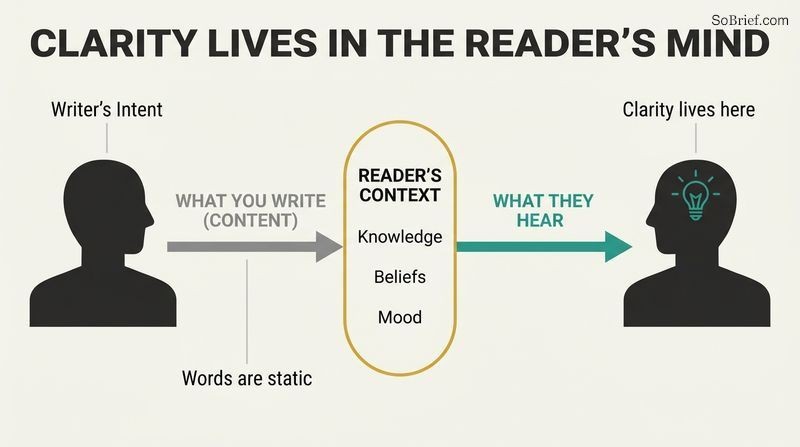
Writing is a conversation, not a monologue. Albrighton's core claim: you cannot declare your own writing clear. The only measure is whether your reader understood. If someone misreads you, protesting "but I explained it perfectly" is meaningless. The meaning of your message is the response it gets. This flips responsibility onto the writer. You want the message across, so you do the work.
Content is what you say; context decides what they hear. A teenager cannot parse a particle physics paper, and the physicist is baffled by a teenager's Instagram feed. Same words, different context, different outcome. Because readers arrive with their own knowledge, beliefs, and mood, clear writing starts where the reader already stands rather than where the writer wishes they stood.
This reframing echoes the communications maxim that the sender owns the transmission. It aligns with reader-response theory in literary criticism, where meaning emerges in the act of reading, not the author's intent. What's useful is the accountability it forces: blaming a confused audience becomes intellectually dishonest. A caveat worth noting: some texts (legal contracts, scientific proofs) prioritize precision over universal comprehension, and "clarity to this reader" can conflict with "accuracy for all." Still, the principle guards against the writer's most seductive error, mistaking the feeling of having expressed something for the fact of having communicated it. Understanding, not eloquence, is the scoreboard.
Profile your reader with a user story before writing a word
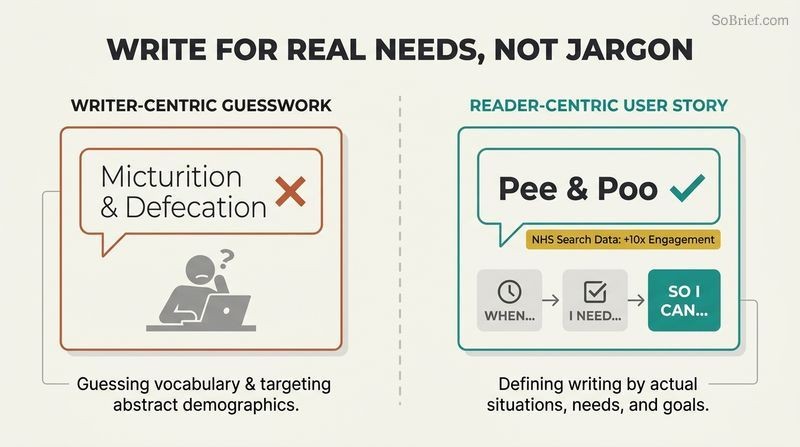
Two tools replace guesswork. A persona is a fictional but research-based profile: Marcus, a 30-something pizza-shop owner worried about new tax rules. A user story is sharper for shared problems, following the shape: when [situation], I need to [task] so I can [goal]. Example: when my child is sick, I need to learn measles symptoms so I can decide whether to see a doctor. This cuts across demographics to focus on need.
Research their actual words, not your jargon. Google autocomplete reveals real questions (people literally ask whether lawnmowers can explode). The NHS website adopted "pee" and "poo" over Latin terms after checking search data, and positive feedback rose tenfold. Amazon reviews, Reddit threads, and answerthepublic.com expose the language, fears, and misconceptions your reader brings.
The user-story format is borrowed from agile software development, where it keeps teams anchored to outcomes rather than features. Applied to writing, it is quietly radical: it de-centers demographics (age, gender, class) in favor of the job to be done, echoing Clayton Christensen's "jobs to be done" theory of why people "hire" products. The autocomplete tactic is a democratized form of ethnographic research. One limitation: search data captures stated questions but misses the anxieties people never type. The persona risk Albrighton flags, reducing a diverse readership to one imaginary individual, is real; personas work best as a corrective to writer-centric drift, not as literal targets.
Climb the five-rung ladder from read to remember to act
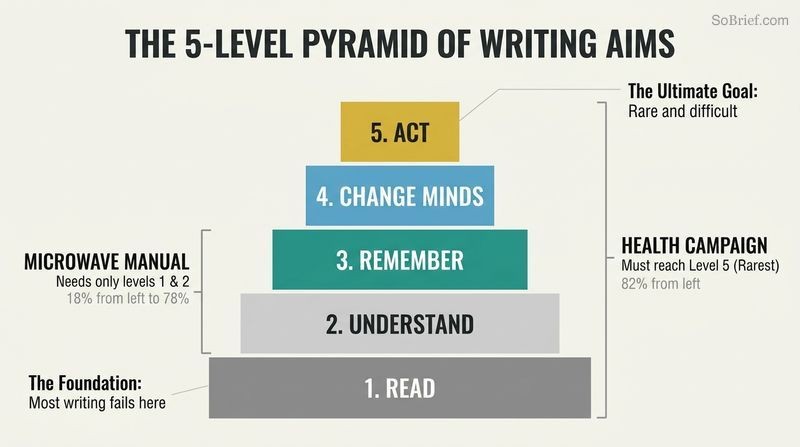
Every writing aim stacks like a pyramid. You cannot achieve a higher rung without securing the ones below:
1. Get them to read it at all
2. Get them to understand it
3. Get them to remember it
4. Get them to change what they think or feel
5. Get them to act differently
Most writing fails at rung one. A microwave manual only needs rungs one and two; a health campaign reaches for rung five, the rarest.
A one-sentence mission statement keeps you honest. Before writing, state what the reader must understand, feel, or do. Example: a one-page letter making parents grasp new parking rules and park correctly. This becomes your compass, guarding against "kitchen sink syndrome," where a project collapses under bolted-on extras that serve nobody.
The escalating-difficulty model resonates with advertising's classic AIDA funnel (attention, interest, desire, action) and with persuasion research showing behavior change is the steepest climb of all. The genius is diagnostic: when writing fails, you can ask which rung broke rather than despairing globally. The mission statement functions like a product brief or a thesis statement, and its power is subtractive, giving you permission to cut anything that does not serve it. A subtle tension: Albrighton warns against too many aims, yet real documents often juggle audiences and goals. The discipline of naming one primary aim, then ruthlessly subordinating the rest, is the practical takeaway.
Measure writing in reading minutes, and kill the goldfish myth
Every word spends your reader's life. Adults read roughly 238 words per minute, slower than long assumed. A 70,000-word book demands nearly five hours. Reframing length as time (Medium's reading-time labels reportedly lifted engagement by 40%) exposes the real cost you impose. When unsure, err toward brevity; almost no reader complains a text was too short.
Attention isn't a fixed, shrinking span. The viral claim that human attention dropped to eight seconds, below a goldfish, doesn't hold up. If it did, nobody would finish a film. Attention is contextual: people binge shows for hours when engaged. Readers aren't lazy, they're prudent with cognitive investment. A length limit (like Twitter's character cap) forces prioritization, turning "should I include this?" into "which of these earns its place?"
The debunking of the goldfish statistic is a valuable public service; the figure was never grounded in credible research, yet it circulates endlessly, a case study in how a memorable number outruns its evidence. The economic framing of attention as investment aligns with behavioral economics: readers perform a rapid cost-benefit calculation on whether to continue. Pascal's famous apology for writing a long letter because he lacked time to write a short one captures the counterintuitive truth that brevity is expensive labor. One nuance: not all long writing is padded. Depth sometimes demands length, and reader-chosen immersion (novels, deep reports) shows engagement can expand attention rather than exhaust it.
Choose the simplest, most concrete word unless you have a reason not to
Plain language is measurable value, not dumbing down. When FedEx rewrote its procedures plainly in 1998, it saved at least $400,000 a year. Simple words are shorter, learned earlier, more concrete, and unambiguous. Concrete language ("car," not "vehicle") triggers the embodied simulation the brain runs when reading: say "apple on a beach" and the reader half-sees it. Abstract nouns give the mind nothing to grip.
The curse of knowledge sabotages experts. Once you know something, you cannot imagine not knowing it, a distortion the French call deformation professionnelle. Experts fixate on detail and miss what novices need. Counterintuitively, over-complicated writing makes authors seem less intelligent, not more. Working memory holds only five to nine items, so every fancy word and tangled clause raises cognitive load and pushes meaning out.
The embodied simulation hypothesis draws on neuroscience showing that reading action words activates motor and sensory brain regions, lending concrete language its vividness. Oppenheimer's playful study, which found needlessly long words lowered perceived intelligence, punctures the academic instinct to inflate. The curse of knowledge, named by economists and popularized by the Heath brothers, explains why brilliant specialists write impenetrable prose. There is a defensible counterpoint: precise technical vocabulary can be the clearest option for expert-to-expert communication, where a shared term compresses meaning efficiently. Albrighton's rule handles this by permitting complexity when justified. The default, though, is simplicity, and the courage to be simple is itself a mark of mastery.
Say who does what: subject, verb, object, in the active voice
Build meaning on basic sentences. The strongest sentence names the doer, the action, and the receiver, in that order, like "the cat sat on the mat." Long sentences can still be clear if they are right-branching, keeping subject and verb close, then adding detail: the trouble comes when a verb is stranded far from its subject and the reader holds their breath waiting for the point.
Prefer active voice and positive framing. The passive voice hides agency ("mistakes were made"), which can dodge blame or drain writing of humanity. Add "we" or "you" to fix it. Say what is, not what isn't: Nixon's "I am not a crook" planted the very word he denied. "Keep to the path" beats "keep off the grass" because it pictures the desired action rather than the forbidden one.
Cognitive processing research supports the subject-verb-object preference: readers begin building a mental model word by word, so early clarity about the actor reduces working-memory strain. The passive-voice caution has moral weight, as linguist analyses of phrases like "violence against women" show how grammar can quietly erase perpetrators and shift focus to victims. The negation point connects to what psychologists call the ironic process, where suppressing an idea makes it more salient ("don't think of a white bear"). One refinement: passive voice is genuinely the right tool when the receiver matters more than the doer ("the president has been shot"), so the lesson is intentionality, choosing voice by what the reader cares about most.
Front-load the essentials with the inverted pyramid's five Es
Say the most important thing first. Borrowed from journalism, the inverted pyramid puts key information up top and detail below, so every reader, however impatient, leaves with the core. Albrighton's version uses five Es:
1. Essentials: what they absolutely must know
2. Explanation: detail linking to what they know
3. Examples: metaphors, stories, perspectives
4. Externals: authoritative outside voices for credibility
5. Extras: nice-to-haves and memory aids
Write each section as if the reader might quit right after it.
Structures are tools, not templates. Other useful shapes include step-by-step (for processes), group-by-group (for distinct audiences), question-and-answer (mirroring real queries, good for search), and problem-solution (which marketers exploit by "poking the problem"). Each frames the subject a certain way, so bend the structure to your message, not the reverse.
The inverted pyramid emerged in telegraph-era journalism, when transmission could cut off mid-story, forcing reporters to lead with the payload. In the age of skimming and mobile screens, that constraint returns with force. What Albrighton adds is honesty about trade-offs: the problem-solution structure, beloved of copywriters, subtly railroads readers toward a foregone conclusion by inflating the problem and positioning one solution. Framing something as a "problem" is itself a value judgment, as media studies of immigration coverage show. The reader-empowering virtue of the inverted pyramid is transparency, it lets people decide how far to read from a clear sense of what is on offer, rather than dangling a withheld payoff.
Hunt down padding, jargon, officialese, and weasel words in your draft
Ten traps dilute meaning. Among the worst: padding (swap "in order to" for "to"), nominalisations (verbs frozen into abstract nouns like "implementation" or "consideration" that no one can picture), and weak adverbs ("transform" beats "completely change"). Jargon signals in-group membership but alienates outsiders; officialese ("prohibited," "these premises") mistakes formality for authority; commercialese ("leverage synergies") is verbal smoke and mirrors.
Weasel words and hedging quietly betray you. "Up to," "most," "research shows," and "helps to" imply commitments they never make. Hedging verbs ("I think," "we suggest," "just") shrink your authority; "can," "could," and "should" inject uncertainty that leaves the reader unsure what to do. The fix throughout: ask what is actually happening, name who does what, and cut every word that isn't earning its place for the reader.
This catalogue is essentially a field guide to what George Orwell attacked in "Politics and the English Language," where vague, pretentious diction serves to obscure rather than reveal. The status research is striking: a study found low-status people use more jargon, apparently to compensate for insecurity, which inverts the assumption that big words signal importance. The point about nominalisations reflects a deep cognitive truth, that verbs carry action and abstractions carry fog. A fair challenge: some hedging is intellectually honest, signaling genuine uncertainty rather than evasion. Albrighton grants this. The discriminating skill is distinguishing weasel words that hide from qualifiers that accurately reflect the limits of knowledge.
You cannot win a feeling fight with facts
Beliefs resist evidence through motivated reasoning. Psychologist Ziva Kunda found heavy coffee drinkers were the ones who doubted an article on caffeine's risks. We use reasoning to defend what we already believe, and experts are better at it, not worse, because they marshal more counter-arguments. On emotionally charged topics, piling on facts can strengthen the opposing belief. Knowledge updates easily; beliefs, tied to identity and emotion, do not.
Persuasion works through the reader, not on them. The Elaboration Likelihood Model describes two routes: a shallow peripheral path (used by ads, exploiting emotion and cues) and a deep central path, where careful thought produces lasting change. To change minds, start where the reader is, acknowledge their view, appeal to a higher shared value, and let them decide. Pushing triggers reactance, the reflex to resist being told what to do.
This is among the book's most important lessons and it lands against a culture that believes more data wins arguments. The backfire dynamic on hot-button issues has been documented in political science, though its universality is debated. Kunda's motivated reasoning dovetails with Jonathan Haidt's metaphor of reason as a press secretary rationalizing decisions the emotional "elephant" already made. The Tuskegee example, where Black patients' vaccine hesitancy traced to a real history of medical abuse, reframes "irrational" belief as evidence-based distrust, a crucial corrective. The practical humility here is that a writer is the reader's servant, not their conqueror, empowering rather than manipulating, which paradoxically makes persuasion more durable.
Make it stick: keep the SCORE and tell a human story
Memorable messages share five traits (SCORE): Short, Conversational, One-to-one, Relevant, and Elevated (from a higher-status source). Lincoln's 1864 slogan, urging voters not to swap horses midstream, shows how a vivid, spoken-feeling line lodges in memory. Repetition helps too, especially spaced repetition and restating an idea in fresh words, which persuades where clumsy echoes annoy.
Stories outperform facts because they're built for the brain. Narrative is memorable, concrete, and compelling: readers run an internal movie using the same brain regions as lived experience. A good story needs a human character, relatable stakes, vivid detail, and drama. Even a company's origin can follow a classic arc like rags-to-riches or the quest. Intrigue works by promising value while withholding it, and curiosity comes in two flavors: needing to know and wanting to know.
The SCORE acronym compresses three decades of "memorable messages" research from health communication. Its emphasis on the conversational and one-to-one aligns with findings that the brain processes text as recorded speech, hearing an inner voice. The storytelling claims rest on solid ground: neuroscience shows narrative synchronizes speaker and listener brain activity, and the Heath brothers' "Made to Stick" independently converges on concreteness and emotion. A caution on intrigue: the line between honest curiosity gaps and manipulative clickbait is thin, and readers increasingly punish the latter. The most defensible use ties every hook to value actually delivered. Borrowed interest (attaching a celebrity to a dull topic) is a last resort, effective but risky.
Speak Adult to Adult and name the reader's feelings first
Empathy has two halves. Cognitive empathy means knowing what the reader thinks; emotional empathy means feeling with them. Because emotions govern whether a message gets processed, acknowledging feelings before correcting them disarms resistance. Naming a difficult feeling in the reader's own words ("many people find making a will upsetting") has been shown to make people feel better even when nothing else changes.
Transactional Analysis maps your tone. Each person carries three states: Parent (copied authority), Adult (responding to the here and now), and Child (early reactions). Clear writing usually aims Adult to Adult, describing things plainly without controlling or manipulating. Slip into commanding Parent ("you must," "always," "never") and you provoke reactance, the impulse to rebel, which sabotages health campaigns telling people to quit smoking or drinking.
Transactional Analysis, developed by psychiatrist Eric Berne in the 1960s, is an unusual but productive lens for prose, treating a document as a social transaction that can be complementary or crossed. The insight that labeling emotions reduces their grip is backed by UCLA neuroimaging showing "affect labeling" dampens amygdala activity, the basis of much mindfulness practice. Reactance theory explains a paradox marketers know well: explicit commands can lower compliance. The person-first and inclusive-language guidance extends empathy structurally, and the observation that military metaphors for cancer can make patients more fatalistic is a sharp reminder that word choice carries psychological consequences beyond mere tone.
Writing is rewriting: draft fast, then cut a quarter
The first draft is a bridge, not the destination. Albrighton debunks the fantasy, symbolized by a 1980s TV logo of a writer yanking a finished page from a typewriter, that good prose flows out complete. Real writing starts messy and gets simplified through rewriting. Separate the modes: create freely first, then switch to a cold reader's mindset to edit. Reading on paper beats screen for catching errors.
Learn to love cutting. Aim to remove 15 to 50 percent; Albrighton routinely trims client work by 15 percent with zero loss of meaning. "Kill your darlings" means deleting the clever lines you're proudest of when they serve your ego rather than the reader, a tell is that your eye avoids them while editing. Get feedback from first-time readers similar to your reader, and treat their confusion as a flaw in your draft, not their comprehension.
The write-then-edit separation reflects cognitive research on divergent versus convergent thinking, two modes that interfere when run simultaneously. The paper-versus-screen finding is corroborated by meta-analyses showing deeper comprehension and error-catching on print, likely due to spatial memory and reduced distraction. "Kill your darlings," traced to Arthur Quiller-Couch, endures because it names a specific self-deception: mistaking authorial pleasure for reader value. The subtraction bias is notable, recent research in Nature found people default to adding rather than removing when solving problems, which explains why cutting feels like loss. The feedback principle, that a reviewer's misreading exposes the writer's weakness, restates the book's opening thesis and closes the loop elegantly.
Analysis
Tom Albrighton's "How to Write Clearly" belongs to a crowded genre yet distinguishes itself through a single organizing commitment: relentless psychological realism about the reader. Where Strunk and White prescribe style rules and most guides offer tips, Albrighton builds his entire method on a communications axiom, that meaning is the response you get. This shifts writing from a performance to a transaction, and it licenses him to import findings from cognitive science, social psychology, linguistics, and persuasion research rather than relying on taste alone.
The book's intellectual spine is the pyramid of aims (read, understand, remember, believe, act), which functions as both a diagnostic and a humility check. Its most valuable and least comfortable teaching is that facts do not defeat feelings; motivated reasoning and the Elaboration Likelihood Model reframe persuasion as service rather than conquest. This is genuinely contrarian in a data-worshipping culture and connects Albrighton to Haidt, Kahneman, and the Heath brothers without derivativeness.
What makes the work trustworthy is its refusal of false certainty. Albrighton repeatedly insists that clear writing is compromise, that structures are tools not templates, and that every technique carries a cost in the reader's finite attention. He debunks fashionable myths (the goldfish attention span, SEO word counts) with the same rigor he applies to building his own frameworks like the five Es and SCORE.
The limitations are mostly scope-related. The advice targets functional nonfiction and explicitly excludes literary ambiguity, so poets and novelists will find it narrow. Some prescriptions (avoid all metaphors for low-literacy readers) sit in tension with others (use vivid metaphors to persuade), resolved only by context-dependent judgment. But that tension is the point. Albrighton's deepest argument is that clarity cannot be automated or reduced to rules; it demands empathy, iteration, and the courage to be simple. That framing elevates a craft manual into something closer to an ethics of communication.
Review Summary
How to Write Clearly receives strong praise with a 4.32/5 rating. Readers appreciate its practical, logical approach to improving writing clarity. The book is lauded for being entertaining, educational, and useful, with memorable concepts like "weasel words" and topic sentences. Reviewers value that the author practices what he preaches, making it a pleasure to read. Some note it works best as a reference guide rather than cover-to-cover reading. Minor criticisms include self-published formatting choices and brief sections on the writing process that feel less original than the rest.
People Also Read





Download PDF
Download EPUB
.epub digital book format is ideal for reading ebooks on phones, tablets, and e-readers.








































