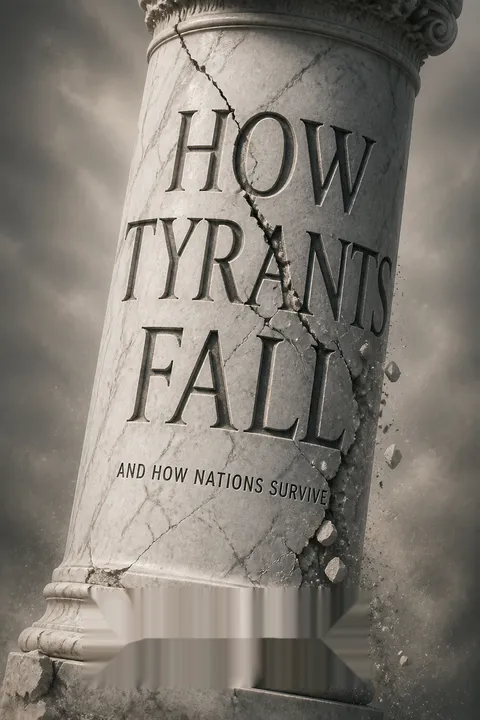

Key Takeaways
1. Tyranny is inherently perilous, especially for the tyrant.
The most powerful tyrants on earth are condemned to live their life in fear.
Life is precarious. Despite outward displays of absolute power, tyrants live in constant fear of losing everything—exile, prison, or death. This fear is inescapable, regardless of wealth or control. Muammar Gaddafi, for instance, built extensive underground tunnels and fortified compounds, yet ultimately met a brutal end.
High risk of bad outcomes. Compared to other rulers, personalist dictators face significantly higher odds of a negative fate after leaving office. While most rulers are fine, nearly 70% of personalist dictators end up exiled, imprisoned, or killed, a stark reversal of the general trend across all political systems.
Fear drives behavior. This pervasive fear explains many seemingly irrational actions by dictators. Strategies like torture, killing opponents, and hoarding wealth while the population starves are often rational survival tactics within the brutal system they inhabit, not necessarily signs of madness.
2. Dictators are trapped; stepping down is often riskier than staying.
Being a dictator is like being stuck on a treadmill that one can never get off.
Stepping down is dangerous. Voluntarily relinquishing power is incredibly risky for tyrants. They have broken laws, stolen vast sums, and made powerful enemies. Stepping down requires finding a successor willing and able to protect them, a challenging task as such a person could also destroy them, as seen with Kazakhstan's Nazarbayev and his successor Tokayev.
Democracy is not a safe exit. While democratisation increases the chance of a "good" outcome for leaders overall, it's still risky for personalist dictators. Empowered parliaments or independent judges can hold them accountable. Furthermore, the elites around the tyrant, who benefit from the current system, often oppose a transition to democracy, effectively forcing the tyrant to stay on the treadmill.
Exile is fraught with difficulty. Fleeing abroad is usually a last resort taken during crisis. Finding a safe haven is hard, as many countries, especially democracies, are susceptible to pressure to extradite or prosecute former tyrants accused of atrocities, as Charles Taylor discovered when Nigeria handed him over. Fellow autocracies are preferable but must be stable and strong enough to resist external pressure.
3. The greatest threat to a tyrant comes from regime insiders.
Often, the real danger isn’t those who openly oppose the leader, but those who see him regularly, smiling while they plot their next move.
Power is relational. Tyrants depend on a small "winning coalition" of elites—generals, party officials, oligarchs—to stay in power. These insiders, not the masses, are the most immediate threat, responsible for removing 65% of authoritarian leaders between 1950 and 2012.
The dictator's dilemma. To maintain control, tyrants create a climate of fear, which silences dissent but also prevents the dictator from knowing the true loyalty or intentions of those around them. This opacity forces tyrants to assume the worst, making every decision based on filtered, unreliable information.
Competence vs. Loyalty. Faced with this dilemma, tyrants often prioritize loyalty over competence, surrounding themselves with sycophants who pose less of a threat. However, this can lead to poor decision-making based on distorted reality and weaken the regime's ability to govern effectively or respond to crises.
4. Controlling the military is a constant, difficult balancing act.
A weak military can create threats from the outside; a strong military can create threats from within.
The Catch-22 of military power. Tyrants need a strong military to defend against foreign threats and internal rebels, but empowering the military risks making it strong enough to stage a coup. This is a fundamental dilemma for most dictatorships.
Coup-proofing strategies. To mitigate the risk of coups, tyrants employ strategies to divide and weaken the military:
- Counter-balancing: Creating parallel security forces (e.g., Republican Guard, palace guard) that compete with the regular military.
- Reducing trust: Constantly shuffling personnel and creating overlapping intelligence agencies to prevent coordination.
- Strategic deployment: Keeping loyal forces near the capital and regular troops further away.
The paradox of military violence. Coups often succeed by creating an impression of inevitability, not necessarily through intense violence. Soldiers are often reluctant to shoot comrades or unarmed civilians. Tyrants exploit this by signaling a willingness to use force, but the deterrent only works if parallel forces are perceived as loyal and effective.
5. Repression is a double-edged sword that can backfire.
When regimes turn their guns on their own people, they risk becoming brittle.
Protest is contagious. Dictators fear public protest because it signals vulnerability and can spread rapidly through diffusion and emulation, solving the coordination problem for disgruntled citizens. Even non-violent resistance campaigns can mobilize vast numbers, potentially reaching a critical mass (like the 3.5% rule) that overwhelms the regime.
The repression dilemma. Cracking down on protests can escalate the situation, radicalizing protestors and drawing in more people, as seen in Ukraine's Maidan protests. However, allowing protests without repression risks encouraging further dissent and demonstrating weakness.
Ruthless brutality can work. Some regimes, like China in 1989, commit to extreme, indiscriminate violence to crush dissent and deter future protests. This "go big" approach aims to make participation too costly, but it requires total commitment to horrific brutality and risks international condemnation and internal fracturing.
6. External powers exploit internal weaknesses, but intervention is complex.
Tyrants are often much weaker than they appear.
Internal focus creates external vulnerability. Tyrants prioritize internal security (coup-proofing, repressing dissent) over external defense, leaving their conventional military often ineffective against foreign powers. This makes them vulnerable to external pressure or attack.
Dictatorships' battlefield disadvantages. While autocracies may have lower "casualty sensitivity" and fewer constraints on extreme violence than democracies, these are often outweighed by the costs of coup-proofing:
- Incompetent, politically appointed officers.
- Fear leading to lying and paralysis among commanders.
- Intelligence focused inward, neglecting external threats.
Covert action's allure and risks. External powers, particularly democracies, are tempted by covert action to destabilize tyrants due to its perceived deniability and lower political cost than open war. However, covert operations often fail due to high risk appetite, the need for secrecy hindering effectiveness, and blunders, as exemplified by the Bay of Pigs invasion.
7. Assassination is a persistent threat, sometimes increased by security measures.
Oddly enough, the better he gets at preventing the other threats, the more attractive assassinations become because there are simply no other options – even for those who are part of the regime.
A constant, unpredictable danger. Assassination attempts have a long history and remain a threat to dictators. While complex plots can sometimes be foiled by effective security, attacks by lone wolves or small groups are extremely difficult to prevent, requiring only proximity and opportunity.
Increased risk from success. As a tyrant successfully eliminates other threats (coups, rebellions, mass protests) by concentrating power and dismantling alternative power centers, assassination can become the only viable option for rivals or disgruntled insiders seeking change, paradoxically increasing the risk of targeted killing.
Protection methods create new vulnerabilities. Tyrants employ bodyguards (risking betrayal by compatriots or dependence on foreigners like Wagner) and isolation (risking disconnection from reality). Some even cultivate personality cults or use extreme repression to deter attacks, but these methods are not foolproof and can create new problems or simply delay the inevitable.
8. The fall of a tyrant frequently leads to chaos or a new tyrant.
Most are replaced by new dictators.
Succession is rarely smooth. When a tyrant falls, the outcome is often not democracy but continued tyranny or violent conflict. Only about 20% of fallen autocratic leaders are followed by democracy; the majority are replaced by new dictators.
"No man, many problems." Dictatorships, especially personalized ones, often lack clear succession rules or strong institutions independent of the leader. The tyrant's removal blows the lid off simmering tensions among competing elites vying for power and resources, frequently leading to infighting and violence.
The cycle of tyranny. Countries can get stuck in a cycle where one dictator is replaced by another, sometimes after a period of conflict. This is partly because the underlying issues (like exclusion or resource control) persist, and new leaders, often from the old guard, have little incentive or ability to fundamentally change the system.
9. Dictatorial succession is a major vulnerability, often leading to conflict.
no man, many problems.
Lack of clear rules. Unlike democracies with established processes for leadership change, personalized dictatorships often have no formal or respected rules for succession. This uncertainty creates a power vacuum when the tyrant is gone, inviting challenges.
Elite competition. When the tyrant falls, palace elites and other power brokers who were previously kept in check by the dictator's authority begin to openly compete for the top position. This competition, fueled by the desire to maintain access to power and wealth, frequently escalates into violent conflict.
Impact of succession method. The manner in which a new leader comes to power significantly impacts stability. Leaders who seize power through force (coups, civil war) are often more vulnerable to future challenges because they lack legitimacy and rely on violence, potentially trapping the country in a cycle of instability and conflict.
10. Non-violent resistance offers the best path to democracy, but is rare.
Generally speaking, there’s the best chance of breaking through the cycle of tyranny if tyrants can be toppled through non-violent protest.
Higher success rate for democracy. Research shows that successful non-violent resistance campaigns are significantly more likely to lead to democracy (57%) compared to violent campaigns (less than 6%). This is partly due to the broad popular participation and the need to establish peaceful means of conflict resolution.
Legitimacy and broad support. Non-violent movements mobilize large segments of the population, giving the resulting transition a strong popular mandate. This broad support makes it harder for old elites to resist change and provides a foundation for democratic institutions.
Building political skills. Movements that succeed through non-violence develop skills in organization, negotiation, and mass mobilization—skills essential for functioning in a democracy. This contrasts with groups that seize power violently, who are better equipped for fighting than governing inclusively.
11. Outsiders can influence outcomes, but intervention is difficult and risky.
Few things in politics are as hard as toppling tyrants, but that doesn’t mean all attempts are doomed to fail.
Limited but possible influence. While the primary agents of change are usually domestic, outsiders can influence the likelihood of a tyrant's fall and the subsequent outcome. Influence is often limited but can be significant depending on the outsider's tools and the target regime's vulnerabilities.
Strategies for chipping away. A cautious approach involves weakening the tyrant and strengthening opponents over time:
- Stopping arms exports usable for internal repression.
- Restricting access to surveillance technology.
- Targeting financial flows that fund patronage networks.
- Supporting independent media and civil society.
Direct intervention is high risk. More direct methods like supporting armed rebels, encouraging coups, or military intervention are more likely to topple a tyrant quickly but carry high costs (financial, political, human) and are less likely to result in sustainable democracy. Foreign-imposed regime change has a poor track record of creating democracies.
Review Summary
How Tyrants Fall offers a comprehensive analysis of authoritarian regimes, their vulnerabilities, and eventual downfall. Readers praise Dirsus's engaging writing style, global perspective, and use of historical examples. The book explores the psychology of dictators, their strategies for maintaining power, and the complex dynamics leading to their demise. While some found certain topics underdeveloped, most reviewers commend the book's insights into tyrannical governance and its relevance to current global politics. Many recommend it as an enlightening read for those interested in political science and the nature of autocratic rule.
People Also Read






FAQ
1. What is How Tyrants Fall: And How Nations Survive by Marcel Dirsus about?
- Comprehensive study of tyranny: The book analyzes how authoritarian regimes maintain power, the internal and external threats they face, and the mechanisms that lead to their downfall.
- Focus on regime survival and collapse: Dirsus explores the strategies tyrants use to survive, the role of elites, military, and masses, and what happens to nations after a tyrant falls.
- Historical and contemporary examples: Drawing on political science research and real-world cases, the book illustrates its arguments with examples from Libya, Kazakhstan, China, Ukraine, and more.
- Explores aftermath and risks: It also discusses the risks of chaos, civil war, or new forms of tyranny that can follow the fall of a dictator.
2. Why should I read How Tyrants Fall by Marcel Dirsus?
- Understanding authoritarian resilience: The book provides a nuanced explanation of why dictatorships often appear stable despite underlying fragility and opposition.
- Relevance to current events: It connects historical patterns to contemporary issues, helping readers make sense of global political developments and regime changes.
- Practical insights for change: Dirsus offers guidance on how tyrants can be weakened or toppled, and the complexities involved in regime change.
- Valuable for diverse audiences: Policymakers, scholars, and anyone interested in political stability, civil resistance, or international relations will find actionable insights.
3. What are the key takeaways from How Tyrants Fall by Marcel Dirsus?
- Tyranny is inherently unstable: Dictatorships require constant vigilance and balancing of competing interests, making voluntary exit dangerous for tyrants.
- Internal threats are paramount: Most tyrants fall due to betrayal or loss of support from elites and military insiders, not from popular uprisings alone.
- Coup-proofing has trade-offs: Efforts to prevent coups often weaken the military’s effectiveness against external threats, creating a central dilemma for dictators.
- Regime change is risky: The aftermath of a tyrant’s fall is unpredictable, with high risks of instability, violence, or the rise of another autocrat.
4. What are the main strategies tyrants use to stay in power according to Marcel Dirsus?
- Managing elites and military: Tyrants use patronage, repression, and parallel security structures to maintain loyalty and prevent coups.
- Controlling the masses: Propaganda, cults of personality, and selective repression suppress dissent and create an illusion of legitimacy.
- Exploiting external support: Security guarantees from foreign powers can bolster regimes but also create dependencies and moral hazards.
- Balancing rewards and fear: Tyrants must carefully distribute privileges while using purges and violence to deter betrayal, maintaining a delicate equilibrium.
5. How does How Tyrants Fall by Marcel Dirsus explain the “dictator’s treadmill” and “dictator’s dilemma”?
- Dictator’s treadmill: Tyrants are trapped in a cycle of constant vigilance, where stepping down is often more dangerous than clinging to power.
- Dictator’s dilemma: Fear and repression silence honest feedback, so tyrants never truly know who is loyal, leading to the promotion of sycophants and increased risk of mistakes.
- Balancing act: Managing elites requires a mix of rewards and repression, but excessive purges can backfire and provoke elite defection (“Icarus Effect”).
- Perpetual insecurity: These dynamics make authoritarian rule inherently precarious, despite outward appearances of strength.
6. What is the “Golden Gun paradox” in How Tyrants Fall by Marcel Dirsus?
- Definition of the paradox: The “Golden Gun paradox” illustrates that symbols of power, like a golden gun, only have meaning as long as people believe in the tyrant’s authority.
- Example of Gaddafi: Muammar Gaddafi’s golden gun symbolized his rule, but when rebels captured him, the symbol became meaningless—power depends on perception, not objects.
- Fragility of authoritarian power: The paradox highlights that a dictator’s power is ultimately based on legitimacy and support, not just force or wealth.
- Broader implication: When belief in the regime fades, even the most powerful symbols and tools become useless.
7. How do tyrants “coup-proof” their regimes according to Marcel Dirsus?
- Divide and weaken the military: Tyrants split armed forces into competing factions and create parallel security units to prevent unified opposition.
- Reduce trust among commanders: Frequent reshuffling and fragmentation of intelligence agencies prevent alliances and coordinated coups.
- Spoil loyalists and use identity: Parallel forces are better equipped and paid, and ethnic stacking ensures loyalty from favored groups.
- Trade-off with effectiveness: These measures increase regime security but often reduce the military’s ability to defend against external threats.
8. How do rebels and insurgencies threaten tyrants in How Tyrants Fall by Marcel Dirsus?
- Requirements for rebellion: Rebels need people, weapons, and money, often relying on natural resources, black markets, or foreign sponsors.
- Geography and state strength: Difficult terrain and porous borders aid insurgencies, but modern states’ surveillance and military power make rebellion challenging.
- Civil wars and foreign involvement: External powers often support either rebels or regimes, complicating conflicts and increasing suffering.
- Regime responses: Tyrants may buy off rebels or engage in prolonged, brutal wars that do not guarantee regime change.
9. What role do foreign powers play in the survival or fall of tyrants according to Marcel Dirsus?
- Covert and overt interventions: External states may attempt to overthrow dictators through covert operations, support for rebels, or direct military action.
- Security guarantees and alliances: Some regimes rely on powerful allies for protection, reducing the risk of coups or invasions (e.g., US bases in Gulf monarchies).
- Trade-offs and vulnerabilities: Dependence on foreign powers can provoke domestic resentment and limit a tyrant’s autonomy.
- Sanctions and isolation: International pressure can weaken regimes but may also entrench authoritarianism if not carefully managed.
10. How do popular uprisings and protests contribute to the fall of tyrants in How Tyrants Fall by Marcel Dirsus?
- Protests as coordination solutions: Mass protests help overcome the coordination problem in authoritarian regimes, making resistance more effective.
- Non-violent participation advantage: Non-violent movements can mobilize diverse groups quickly, overwhelming regimes unprepared for mass dissent.
- The 3.5% rule: Research cited in the book shows that no regime has survived once 3.5% of the population actively participates in a peak protest event.
- Risks of violent repression: Using force against protestors can backfire, radicalizing opposition and increasing the likelihood of regime collapse.
11. What happens after a tyrant falls, according to How Tyrants Fall by Marcel Dirsus?
- High risk of instability: The aftermath often involves power struggles, violence, or the rise of another dictator, with only about 20% of cases leading to democracy.
- Succession challenges: Personalized regimes lack clear succession rules, causing uncertainty and conflict when the leader is gone.
- Mode of exit matters: Non-violent overthrows are more likely to result in democracy, while violent removals often lead to continued authoritarianism or chaos.
- Long-term rebuilding: Regime change is just the beginning; rebuilding institutions and society is a complex, ongoing process.
12. What are the best quotes from How Tyrants Fall by Marcel Dirsus and what do they mean?
- “Political power lies with those who don’t need to use guns.” This challenges the idea that violence is the ultimate source of power, emphasizing the importance of legitimacy and consent.
- “No revolutions have failed once 3.5% of the population has actively participated in an observable peak event.” Highlights the critical mass needed for successful non-violent uprisings.
- “Assassination was ‘incompatible with American principles, international order and morality’.” Reflects the ethical and legal complexities of tyrannicide in international relations.
- “A revolution is like getting an empty new house; you still have to fix it up and furnish it.” Reminds readers that regime change is only the start of a long, difficult process of rebuilding society.
Download PDF
Download EPUB
.epub digital book format is ideal for reading ebooks on phones, tablets, and e-readers.








































