Key Takeaways
1. Prussia was an artificial, geographically vulnerable state forged by dynastic ambition.
It was an assemblage of disparate territorial fragments lacking natural boundaries or a distinct national culture, dialect or cuisine.
Geographical vulnerability. Unlike states with natural defensive borders, the core of Prussia—the Mark Brandenburg—was a landlocked, resource-poor territory often referred to as the "sandbox of the Holy Roman Empire." Lacking natural boundaries, its survival depended entirely on the political and military ingenuity of its rulers, the Hohenzollerns.
Dynastic expansion. The Hohenzollerns, a family of south-German magnates, systematically expanded their patrimony through a calculated strategy of marriages, inheritance pacts, and opportunistic acquisitions. Key milestones in this territorial assembly included:
- The acquisition of the Mark Brandenburg in 1417.
- The inheritance of the Duchy of Prussia in 1618.
- The acquisition of the Rhenish territories of Cleves, Mark, and Ravensberg in 1614.
An abstract polity. This scattered, non-contiguous layout meant that "Prussia" was initially an abstract, administrative concept rather than a cohesive cultural entity. The state had to invent itself, gradually welding disparate populations—from the Rhenish west to the Baltic east—into a unified political structure.
2. The trauma of the Thirty Years War catalyzed the rise of the Prussian military state.
The country is in such a miserable and impoverished condition that mere words can scarcely convey the sympathy one feels with the innocent inhabitants.
Existential catastrophe. The Thirty Years War (1618–1648) devastated Brandenburg, wiping out nearly half of its population through warfare, famine, and pestilence. This trauma left an indelible mark on the ruling dynasty, convincing them that absolute vulnerability was the natural condition of an undefended state.
The Great Elector's response. Elector Frederick William (r. 1640–1688) resolved that Prussia must never again be a passive theater for foreign armies. He initiated a program of rapid military and administrative centralization, laying the foundations of the Prussian standing army. To finance this force, he bypassed the traditional provincial Estates, establishing:
- The General War Commissariat to centralize military tax collection.
- An urban excise tax that bypassed noble tax immunities.
- A professional, state-dependent bureaucracy.
The philosophy of necessity. This concentration of power was legitimized by the political philosophy of Samuel Pufendorf, who argued that the state's authority derived from its duty to protect its citizens from ambient violence. The memory of the "Swedish terror" was thus converted into a powerful rationale for monarchical absolutism.
3. The Hohenzollern crown was a self-made, extra-imperial foundation of sovereignty.
His Majesty, who has not received His Kingdom through the assistance of the Estates or of any other [party], had no need whatever of such a handing-over, but rather received his crown after the manner of the ancient kings from his own foundation.
The royal elevation. In 1701, Elector Frederick III crowned himself "King in Prussia" in a lavish ceremony in Königsberg. This self-coronation was a calculated political statement, demonstrating that his royal title was not a gift from the Holy Roman Emperor or the provincial Estates, but an autonomous foundation of his own making.
Geopolitical leverage. The title was made possible by the sovereign status of the Duchy of Prussia, which lay outside the legal boundaries of the Holy Roman Empire. Frederick traded his military support in the War of the Spanish Succession for the Emperor's recognition of his new title. This elevation had profound consequences:
- It integrated the scattered Hohenzollern territories under a single royal brand.
- It elevated Prussia's diplomatic status to parity with other European crowns.
- It initiated a cultural revolution at court, characterized by baroque display and representative architecture.
The name of Prussia. Ironically, the name "Prussia" was taken from a Baltic territory that was not the historical heartland of the dynasty. Yet, over the course of the eighteenth century, this name would eclipse "Brandenburg" to become the collective designation for all the Hohenzollern lands.
4. Pietism and the state forged a unique culture of discipline, duty, and social reform.
The Prussian monarchy is not a country which has an army, but an army which has a country, in which – as it were – it is just stationed.
The alliance with Pietism. Under King Frederick William I (r. 1713–1740), the Prussian state entered into a close partnership with the Protestant revivalist movement known as Pietism. Centered on the Halle Orphanage founded by August Hermann Francke, Pietism emphasized practical Christian activism, self-discipline, and duty.
The socialization of the elite. The state co-opted the Pietist movement to train its civil servants, schoolteachers, and military officers. This partnership produced a distinctive "Prussian" ethos characterized by frugality, obedience, and a sacralized sense of vocation. Key institutional innovations included:
- The "canton system" of conscription, which integrated the peasantry into the military.
- The Berlin Cadet School, which transformed the Junker nobility into a service caste.
- The introduction of compulsory elementary schooling on the Halle model.
The social monarchy. This unique blend of militarism and social reform established the state as an instrument of moral and material improvement. The Pietist emphasis on the "priesthood of all believers" helped to create a broad-based, active constituency for the monarchical project.
5. Frederick the Great established Prussia as a great power through high-risk military and political gambles.
Someone ought to write a little piece on what is happening at present... to explain how the sandy country of Brandenburg came to wield such power that greater efforts have been marshalled against it than were ever mustered against Louis XIV.
The Silesian invasion. In December 1740, the young King Frederick II (r. 1740–1786) launched a pre-emptive invasion of the wealthy Habsburg province of Silesia. This high-risk gamble shattered the traditional imperial order and committed Prussia to a three-decade struggle for survival against a coalition of Austria, France, and Russia.
The Seven Years War. During the Seven Years War (1756–1763), Prussia faced near-total annihilation. Frederick's military genius, characterized by the use of oblique attack formations and rapid maneuvers, kept the state afloat against overwhelming odds. The conflict was marked by:
- Spectacular victories at Rossbach and Leuthen in 1757.
- Catastrophic defeats at Kunersdorf in 1759.
- The "Miracle of the House of Brandenburg"—the sudden death of Tsarina Elisabeth in 1762, which broke the anti-Prussian coalition.
The cost of greatness. The Peace of Hubertusburg (1763) confirmed Prussian possession of Silesia, establishing the state as a European great power. But this greatness was purchased at a terrible cost: over 400,000 Prussians died, and the central provinces were left in ruins, initiating a long phase of post-war reconstruction.
6. The catastrophe of 1806 triggered a revolutionary, bureaucratic modernization of the state.
The carefully assembled and apparently unshakeable military structure was suddenly shattered to its foundations.
The collapse of Jena. In October 1806, Napoleon's armies routed the Prussian forces at Jena and Auerstedt. The subsequent collapse of Prussia's fortresses and the occupation of Berlin revealed the utter obsolescence of the old Frederician military and administrative system.
The era of reform. Under the leadership of Stein, Hardenberg, Scharnhorst, and Humboldt, a new generation of reform-minded bureaucrats launched a comprehensive modernization program. They aimed to transform passive subjects into active citizens of the state through:
- The October Edict of 1807, which abolished serfdom and deregulated the land market.
- The introduction of municipal self-government in 1808.
- The Humboldtian educational reforms, culminating in the foundation of the University of Berlin in 1810.
The military reorganization. Scharnhorst and his colleagues rebuilt the army, introducing the "canton system" of conscription, meritocratic officer promotions, and the Landwehr militia. This "revolution from above" aimed to weld the state and the nation into a single, highly motivated entity capable of throwing off the French yoke.
7. The Wars of Liberation birthed a powerful, contested myth of popular patriotic sacrifice.
This war... generated a love of fatherland that had until then been unknown in the German lands.
The national uprising. In the spring of 1813, King Frederick William III issued his famous address "To My People," calling for a popular uprising against Napoleon. The subsequent Wars of Liberation (1813–1815) witnessed an unprecedented mobilization of the Prussian public, with thousands of volunteers joining the Landwehr and the free corps.
The symbols of sacrifice. The war generated a powerful repertoire of patriotic symbols and rituals that would shape Prussian and German political culture for a century. These included:
- The Iron Cross, the first military decoration awarded to all ranks regardless of class.
- The secular canonization of the deceased Queen Luise as a patriotic icon.
- The rise of the gymnastic movement (Turnbewegung) founded by Friedrich Ludwig Jahn.
The contested memory. After the final defeat of Napoleon at Waterloo in 1815, the memory of the war became a political battleground. While the conservative court camarilla sought to reclaim the victory for the dynasty, radical nationalists and liberals celebrated it as a "War of Liberty," setting the stage for the constitutional struggles of the post-war era.
8. Austro-Prussian dualism structured the struggle for mastery over the German lands.
Never will Austria get over the pain of Silesia’s loss... Never will it forget that it must now share its authority in Germany with us.
The post-Napoleonic settlement. The Congress of Vienna in 1815 established a loose association of thirty-nine states known as the German Confederation. Within this system, Prussia and Austria competed for pre-eminence. This dualism structured the political and economic life of the German lands for half a century.
The Customs Union. While Austria dominated the political institutions of the Confederation, Prussia established its economic hegemony through the creation of the German Customs Union (Zollverein) in 1834. This union integrated the markets of most German states, excluding Austria, and demonstrated Prussia's capacity for progressive, rational administration.
The constitutional crisis. The dualist rivalry came to a head in the 1860s, when King William I's plans for military reform triggered a bitter constitutional conflict with the liberal majority in the Prussian parliament. The standoff was resolved only by the appointment of Otto von Bismarck as minister-president in 1862.
9. Bismarck unified Germany by exploiting mass nationalism to preserve Prussian monarchical power.
Prussia is henceforth merged in Germany.
The white revolutionary. Otto von Bismarck was a political realist who recognized that the forces of mass nationalism could be harnessed to preserve the authority of the Prussian crown. Through a sequence of three calculated wars, he systematically dismantled the old German Confederation and established a Prussian-dominated nation-state.
The wars of unification. Bismarck's diplomacy, supported by the strategic genius of Chief of Staff Helmut von Moltke, delivered a succession of decisive victories:
- The Danish War of 1864, which secured Schleswig-Holstein.
- The Austro-Prussian War of 1866, which excluded Austria from Germany.
- The Franco-Prussian War of 1870–71, which triggered the proclamation of the German Empire.
The Prussian empire. The German Empire of 1871 was a federal structure, but its institutions were designed to secure Prussian hegemony. The King of Prussia reigned as German Emperor, the Prussian army formed the core of the imperial military, and the Prussian three-class franchise anchored conservative power at the heart of the new state.
10. Prussia's structural flaws and militarism led to its ultimate downfall and formal abolition.
The Prussian State, which from early days has been a bearer of militarism and reaction in Germany, has de facto ceased to exist.
The praetorian state. The imperial constitution of 1871 left the relationship between civil and military authority unresolved. The Prussian army remained a praetorian guard under the personal command of the Kaiser-king, shielded from parliamentary scrutiny. This structural flaw facilitated the rise of a military dictatorship under Hindenburg and Ludendorff during the First World War.
The democratic interlude. Following the collapse of the monarchy in 1918, Prussia was reconstituted as a democratic republic within the Weimar system. Under the leadership of Social Democrat Otto Braun, "republican Prussia" became a bastion of political stability. But this democratic interlude was cut short in July 1932 by Franz von Papen's putsch, which dissolved the Prussian government and cleared the way for the Nazi seizure of power.
The final excision. In February 1947, the Allied Control Council signed Law No. 46, formally abolishing the state of Prussia. The Allies passed judgment on Prussia as the historical source of German militarism and reaction. Shorn of its territories and its elites, Prussia was expunged from the map of Europe, its history transformed into a cautionary tale of political malformation.
Review Summary
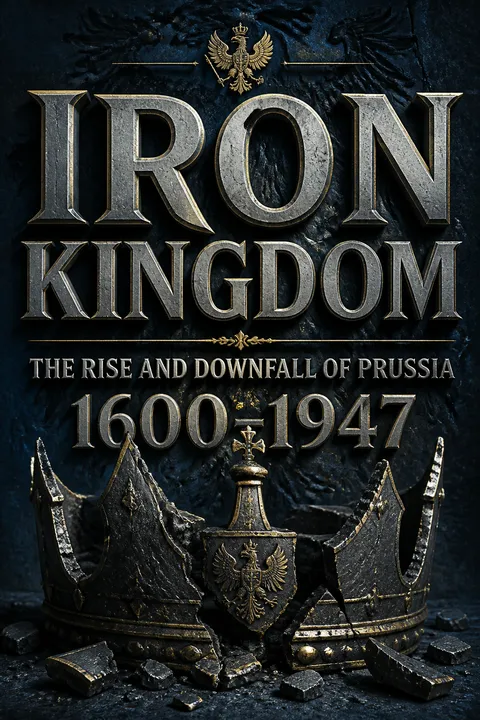
Reviews of Iron Kingdom are overwhelmingly positive, averaging 4.17/5. Readers praise Clark's comprehensive, nuanced approach to Prussian history, highlighting his ability to blend political, military, cultural, and social perspectives. Many appreciate his challenge to the stereotype of Prussia as solely militaristic, revealing its progressive, enlightened aspects. Clark's engaging prose makes dense material accessible. Common criticisms include uneven pacing, rushed coverage of post-1871 events, and occasionally overly academic writing. Several reviewers note the book successfully dismantles simplistic connections between Prussian traditions and Nazism.
People Also Read