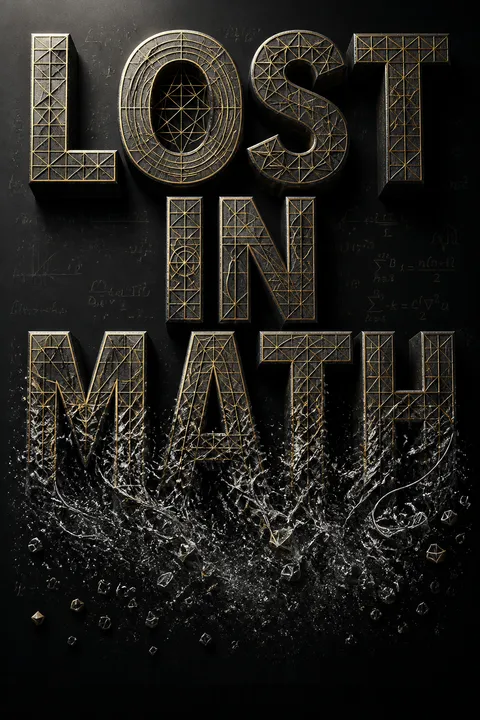

Key Takeaways
1. Foundational Physics Faces a Crisis of Discovery.
What failed physicists wasn’t their math; it was their choice of math.
Decades of stagnation. For over thirty years, foundational physics has been stunningly unsuccessful in finding new laws of nature beyond the Standard Model and General Relativity. Despite billions spent on experiments like the Large Hadron Collider (LHC) and dark matter detectors, expected breakthroughs haven't materialized. This lack of new data leaves theorists without empirical guidance.
Experiments yield nulls. The LHC found the predicted Higgs boson but nothing else that supports new theories like supersymmetry or extra dimensions. Dark matter and dark energy are observed gravitationally but remain unidentified microscopically, despite extensive searches for candidate particles. This experimental drought highlights a fundamental problem in how new theories are being developed.
Confusion and disillusionment. Many physicists, including the author and her colleagues, express confusion and disillusionment. The expectation that new physics must appear at accessible energies, often based on theoretical preferences, has been unmet. This raises questions about the validity of the criteria used to guide research in the absence of data.
2. Beauty, Not Just Data, Guides Modern Theorists.
Lost in Math is the story of how aesthetic judgment drives contemporary research.
Aesthetic criteria abound. In the absence of new experimental data, theoretical physicists increasingly rely on aesthetic criteria to judge the promise of new theories. Concepts like simplicity, elegance, and beauty, often formalized into mathematical requirements like symmetry and naturalness, become primary guides. This practice is deeply ingrained, passed down through generations.
Subjective yet universal? Physicists describe this aesthetic sense as a "gut feeling" or "physical intuition," sometimes claiming it's universally recognized, like appreciating art. They argue that theories feel "too good to not be true" if they possess these qualities. However, the author questions why the laws of nature should care about human aesthetic preferences, especially for phenomena far removed from direct experience.
Historical roots. The use of beauty dates back centuries, from Kepler's Platonic solids to Newton's divine harmony. While early scientists often linked beauty to divinity, modern physicists formalize it mathematically. This historical reliance, particularly its success in developing the Standard Model, reinforces the belief that beauty is a reliable guide, even when current results contradict this.
3. The "Naturalness" Criterion is an Aesthetic Bias, Not a Scientific Principle.
In summary, numbers that are very large, very small, or very close together are not natural. In the standard model, the Higgs mass is not natural, which makes it ugly.
Dislike of "ugly" numbers. A key aesthetic criterion is "naturalness," which dictates that fundamental theories should not contain dimensionless parameters that are extremely large or small, or require fine-tuning (delicate cancellation between large numbers). The Higgs boson's mass, for example, requires an unnatural fine-tuning of parameters in the Standard Model to match observations.
Formalized preference. This preference for numbers close to 1 has been formalized into "technical naturalness," particularly in quantum field theories. While presented as a mathematical principle, the author argues it's fundamentally an aesthetic one. There's no mathematical reason why parameters shouldn't be large or small; the discomfort arises from a human dislike of seemingly arbitrary coincidences.
A circular argument. The argument that unnatural numbers require explanation often relies on an implicit assumption of a uniform probability distribution for parameters. However, choosing this distribution is itself an arbitrary, aesthetic choice. The author contends that if we accept selecting assumptions to match observations (like vacuum stability), why not accept selecting parameters? Naturalness, in this context, becomes a subjective preference dressed up in math.
4. History Shows Beauty Can Lead Physics Astray.
Aesthetic criteria work until they don’t. The most telling evidence for the ineffectiveness of experience-based aesthetic guidance may be that no theoretical physicist has won a Nobel Prize twice.
Past failures of beauty. The history of science is littered with beautiful ideas that turned out to be wrong. Examples include:
- Kepler's initial model of planetary orbits based on Platonic solids (preferred over ellipses by Galileo and others).
- Galileo's insistence on perfect circular motion for celestial bodies.
- Einstein's initial rejection of an expanding universe ("abominable") in favor of a static one with a cosmological constant.
- The steady-state model of the universe (preferred by Fred Hoyle due to "aesthetic bias") over the Big Bang.
- Vortex theory, which proposed atoms were knots in the ether, widely praised for its beauty despite lack of evidence.
Ugly truths prevailed. Conversely, some successful theories were initially considered ugly or unintuitive. Maxwell's electrodynamics lacked a mechanical model, which was the aesthetic standard of the time. Quantum electrodynamics was initially seen as "ugly and incomplete" by Dirac due to its reliance on renormalization to handle infinities. These examples suggest that aesthetic appeal is not a reliable indicator of truth.
Experience is limited. While some physicists, like Steven Weinberg, argue that aesthetic judgment is like a horse breeder's intuition refined by experience, the author counters that experience with past theories doesn't guarantee success with fundamentally new ones. The fact that no theoretical physicist has won a Nobel twice for distinct theoretical work might suggest that past successes don't reliably predict future ones based on the same guiding principles.
5. The Multiverse Emerges from Unchecked Theories and Biases.
The origin of the multiverse fad, therefore, is that some physicists are no longer content with a theory that describes observation. In trying to outdo themselves, they get rid of too many assumptions, and then they conclude we live in a multiverse because they can’t explain anything anymore.
A consequence of failed prediction. When theories like string theory or inflationary cosmology fail to predict the specific parameters of our universe, some physicists invoke the multiverse. The idea is that if a theory allows for a vast landscape of possible universes with different laws or constants, then our universe is just one realization among many. This shifts the goal from explaining why our universe is the way it is to calculating the probability of observing a universe like ours (using the anthropic principle).
Controversial and untestable. The multiverse is highly controversial, with critics calling it "dangerous to science," "theology," or "fiction." A major objection is its apparent untestability, as other universes are causally disconnected. While proponents argue some variants might leave observable traces (like bubble collisions), the vastness of the proposed multiverse makes direct verification impossible for most scenarios.
Abandoning explanation. The author argues that the multiverse arises when theorists abandon the goal of explaining observed parameters. Instead of admitting the theory is incomplete or wrong, they posit that all possible outcomes exist elsewhere. This move, often framed as a logical consequence of the math, is seen by critics as a way to avoid confronting the theory's predictive failures and a departure from the core scientific mandate of explaining observations.
6. Quantum Mechanics Works Perfectly, Yet Feels Repulsive and Unintuitive.
My own conclusion is that today there is no interpretation of quantum mechanics that does not have serious flaws.
Spectacular success, conceptual discomfort. Quantum mechanics is one of the most successful scientific theories ever, explaining phenomena from atomic structure to particle interactions with incredible precision. Yet, many physicists find its core concepts deeply counterintuitive and "repulsive." Issues include the wave function (an unobservable mathematical object), its instantaneous "collapse" upon measurement, and nonlocality ("spooky action at a distance").
Interpretations abound. The discomfort has led to numerous competing interpretations of the math, such as:
- The Copenhagen interpretation ("shut up and calculate") which avoids asking what happens between measurements.
- Psi-epistemic views (like QBism) where the wave function represents knowledge, not reality.
- Psi-ontic views (like pilot wave theory) where the wave function is real but requires a nonlocal guiding field.
- Many-worlds interpretation, where the wave function never collapses, and all possible outcomes occur in parallel universes.
- Spontaneous collapse models, which amend the theory to include a physical collapse process.
A philosophical, not empirical, debate. These interpretations yield the exact same predictions for all current experiments. The choice between them is purely aesthetic or philosophical, based on which conceptual "ugliness" one finds most tolerable (e.g., discontinuous collapse vs. infinite parallel universes). This lack of empirical distinction makes progress on understanding the "meaning" of quantum mechanics difficult, leading some to call it a "losing game."
7. Dominant Theories Like String Theory Persist Despite Lack of Evidence.
The almost irresistible beauty of string theory has seduced many theoretical physicists in recent years.
A beautiful, unproven framework. String theory, which posits that fundamental particles are tiny vibrating strings in higher dimensions, is a dominant candidate for a theory of everything, aiming to unify quantum mechanics and general relativity. Its mathematical structure is widely praised for its beauty, rigidity (few free parameters once assumptions are made), and unexpected connections (like the gauge-gravity duality and insights into black holes).
Decades without empirical support. Despite its aesthetic appeal and mathematical richness, string theory has no direct experimental evidence supporting it. Its predictions, like supersymmetry and extra dimensions, have not materialized at the LHC or other experiments. The theory also faces internal challenges, such as the vast "landscape" of possible solutions and the black hole "firewall" paradox.
Persistence despite setbacks. The continued dominance of string theory, despite decades of unconfirmed predictions and conceptual problems, is a prime example of how aesthetic criteria and community momentum can drive research in the absence of data. Proponents remain convinced of its underlying truth due to its mathematical elegance and connections, hoping that experimental evidence will eventually emerge, perhaps at much higher energies or through subtle effects.
8. Social and Cognitive Biases Distort Scientific Progress.
Scientists are human. Humans are influenced by the communities they are part of. Therefore, scientists are influenced by the communities they are part of.
Beyond the ideal. While science aims for objectivity, it is a human endeavor subject to social and cognitive biases. These biases, often beneficial in everyday life, can hinder scientific progress. Examples include:
- Confirmation bias: Seeking and interpreting information that confirms existing beliefs.
- Sunk cost fallacy: Continuing to invest in a failing project due to prior investment.
- In-group bias: Favoring members and ideas within one's own field or research group.
- Mere exposure effect: Preferring ideas simply because they are familiar or frequently repeated.
- Social desirability bias: Presenting ideas in a way that is likely to gain peer approval.
Academic pressures. The modern academic system, with its emphasis on constant publication, grant acquisition, and peer review, exacerbates these biases. Researchers are incentivized to pursue popular topics and produce results quickly, leading to:
- Increased specialization and reduced cross-field pollination.
- A decline in risky, long-term projects.
- Exaggeration of results and impact in proposals and papers.
- Conformity and resistance to unconventional ideas.
Echo chambers. These pressures can turn scientific communities into echo chambers where dominant ideas are reinforced through communal repetition, making it difficult for dissenting views or alternative approaches to gain traction, regardless of their scientific merit.
9. Lack of Experimental Guidance Makes These Biases Dangerous.
Data don’t come to us anymore—we have to know where to get them, and we can’t afford to search everywhere. Hence, the more difficult new experiments become, the more care theorists must take to not sleepwalk into a dead end while caught up in a beautiful dream.
The cost of searching. As experiments become larger, more complex, and vastly more expensive (billions of dollars and decades of effort), theorists play a crucial role in guiding where to look for new physics. This requires assessing theories based on criteria beyond existing data, making the influence of aesthetic and social biases particularly problematic.
Misguided predictions. Reliance on criteria like naturalness has led to repeated predictions for new physics at energies accessible to current experiments (like the LHC or dark matter detectors). When these predictions fail, the criteria are often re-evaluated or the theories are fine-tuned, rather than questioning the guiding principles themselves. This cycle risks sending experimentalists down unproductive paths.
A failure of self-correction. The author argues that the current situation represents a failure of science's self-correcting mechanisms. In the past, experimental results quickly challenged flawed aesthetic ideals. Now, the long delay in obtaining decisive data allows biased theoretical preferences to persist and dominate research directions, potentially leading the field into a dead end.
10. Physics Needs to Re-Embrace Testability and Question Assumptions.
Physics isn’t math. It’s choosing the right math.
Beyond aesthetic appeal. The author concludes that relying on beauty, simplicity, or naturalness as primary guides for fundamental theory development is flawed. These are aesthetic preferences, not guarantees of truth. The history of physics shows that while successful theories can be beautiful, beauty itself is not a reliable predictor of success, especially when our aesthetic sense is shaped by past, potentially incomplete, knowledge.
Return to core principles. To move forward, foundational physics must:
- Identify real problems: Focus on genuine inconsistencies or tensions with data, not just aesthetic discomforts (like fine-tuning). The quantization of gravity is a real problem; the "ugliness" of parameters is not.
- State assumptions clearly: Be explicit about the philosophical or intuitive assumptions underlying theories (e.g., naturalness, infinite reality, specific probability distributions) rather than letting them get "lost in math."
- Prioritize observational guidance: Derive testable predictions whenever possible, even from highly abstract theories. Non-empirical assessment should be a temporary necessity, not a new standard.
A call for critical self-reflection. The current stagnation is a symptom of systemic issues, including academic pressures and unchecked biases. Scientists must become more aware of their own cognitive and social influences and actively work to mitigate them. This requires fostering a culture of open criticism, supporting diverse research approaches, and ensuring that the pursuit of knowledge is not overshadowed by the pursuit of popularity or funding.
Review Summary
Lost in Math by Sabine Hossenfelder critically examines the current state of theoretical physics, arguing that the pursuit of mathematical beauty has led the field astray. Hossenfelder interviews prominent physicists, questioning their reliance on aesthetic criteria like symmetry and naturalness in developing theories. The book highlights the lack of experimental evidence for popular theories and the challenges facing modern physics. While some readers find the technical content challenging, many praise Hossenfelder's honest and thought-provoking approach. The book sparks important discussions about the scientific method and the future of physics research.
People Also Read





FAQ
What is Lost in Math: How Beauty Leads Physics Astray by Sabine Hossenfelder about?
- Exploration of beauty in physics: The book investigates how aesthetic ideals like beauty, elegance, and symmetry have shaped modern theoretical physics, sometimes leading research astray.
- Crisis in foundational physics: Hossenfelder discusses the current crisis where many popular theories remain untested, and the gap between theory and experiment has widened.
- Critique of scientific practice: The author questions the reliance on non-empirical criteria and highlights the influence of social and cognitive biases in the physics community.
- Call for reform: The book advocates for clearer assumptions, stronger empirical guidance, and cultural changes in how physics is practiced.
Why should I read Lost in Math by Sabine Hossenfelder?
- Insider’s perspective on physics: The book offers a candid look at the culture, sociology, and psychology of physicists, revealing how community beliefs and biases shape research.
- Accessible explanations: Hossenfelder explains complex topics like supersymmetry, string theory, and the multiverse in clear, non-technical language suitable for a broad audience.
- Critical reflection on science: Readers are encouraged to question the role of beauty and aesthetics in scientific progress and to think critically about how science is conducted.
- Practical advice for improvement: The book provides suggestions for scientists, administrators, and the public on how to foster objectivity and progress in physics.
What are the key takeaways and warnings from Lost in Math by Sabine Hossenfelder?
- Beauty can mislead science: While aesthetic criteria have guided successful theories, they are subjective and can bias research, leading to dead ends.
- Empirical test is essential: Reliance on beauty without experimental confirmation risks turning physics into speculation rather than science.
- Need for new methods: As experiments become more difficult, physicists must develop better criteria for theory assessment and remain cautious about overvaluing aesthetics.
- Awareness of biases: Recognizing and addressing social and cognitive biases is crucial for scientific self-correction and progress.
What are the main concepts of beauty and naturalness in Lost in Math by Sabine Hossenfelder?
- Beauty as a scientific guide: Physicists often equate beauty with symmetry, simplicity, and explanatory power, but Hossenfelder warns this is subjective and potentially misleading.
- Naturalness and fine-tuning: Naturalness is the idea that fundamental parameters should not require improbable fine-tuning, but the book argues this is an aesthetic, not a scientific, criterion.
- Problems with these criteria: Many beautiful and “natural” theories, like supersymmetry, have not been experimentally confirmed, suggesting these concepts may not reliably guide discovery.
- Call for explicit assumptions: Hossenfelder stresses the importance of clearly stating when aesthetic judgments are influencing theory choice.
How does Sabine Hossenfelder define and critique "naturalness" in Lost in Math?
- Definition of naturalness: A theory is considered natural if it avoids unexplained fine-tuning of parameters, meaning it does not require very large or small numbers without reason.
- Aesthetic and historical roots: Naturalness originated as an aesthetic preference for proportion and order, later formalized in technical terms.
- Failures in practice: The Higgs boson mass and the lack of supersymmetric particles challenge the reliability of naturalness as a guiding principle.
- Circular reasoning risk: Hossenfelder argues that naturalness is often circular and lacks a rigorous mathematical or empirical foundation.
What is the role and status of supersymmetry (susy) in Lost in Math by Sabine Hossenfelder?
- Supersymmetry’s appeal: Susy is praised for its mathematical elegance, unification of forces, and potential to solve the Higgs mass naturalness problem.
- Lack of experimental evidence: Despite decades of searches, no supersymmetric particles have been found at the LHC or elsewhere, challenging the theory’s naturalness argument.
- Social reinforcement: The book discusses how belief in susy is partly driven by social dynamics and collective momentum within the physics community.
- Future prospects: Continued non-detection may require physicists to accept fine-tuning or reconsider the value of naturalness and beauty in theory development.
How does Lost in Math by Sabine Hossenfelder address string theory and its controversies?
- String theory’s mathematical beauty: The book acknowledges string theory’s rich mathematical structure and its unification of gravity and quantum mechanics.
- Lack of uniqueness and testability: String theory predicts a vast landscape of possible solutions, making it unclear if it uniquely describes our universe and currently lacks testable predictions.
- Community dynamics: Hossenfelder describes string theory as having devoted followers and internal controversies, such as the firewall paradox and failure to predict new particles.
- Philosophical concerns: The reliance on non-empirical theory assessment in string theory raises concerns about loosening the scientific method’s requirement for testability.
What does Lost in Math by Sabine Hossenfelder say about the multiverse and anthropic reasoning?
- Multiverse as a response to fine-tuning: The multiverse hypothesis is proposed to explain why fundamental constants appear fine-tuned for life, suggesting many universes with different laws exist.
- Scientific and philosophical challenges: Multiverse theories are difficult or impossible to test experimentally, raising questions about their scientific legitimacy.
- Emotional and intellectual struggle: Some physicists find the multiverse unsettling, as it challenges hopes for unique, elegant explanations of nature.
- Caution urged: Hossenfelder and others warn against treating the multiverse as established science and emphasize the importance of empirical testability.
How does Lost in Math by Sabine Hossenfelder describe the relationship between mathematics and physics?
- Mathematics as a tool: Physics uses mathematics to enforce logical rigor, internal consistency, and clear communication.
- Math keeps physicists honest: While one can be wrong with math, it prevents self-deception and ensures reproducibility.
- Physics is not just math: Theories must also be consistent with observations; having the right math is only part of having the right theory.
- Limits of mathematical beauty: Mathematical elegance alone is not sufficient for scientific truth without empirical support.
What alternative theories and approaches are discussed in Lost in Math by Sabine Hossenfelder?
- Garrett Lisi’s E8 theory: Lisi proposes a geometric unification using the exceptional Lie group E8, aiming to describe all particles and forces, though it remains incomplete and not widely accepted.
- Xiao-Gang Wen’s qubit model: Wen suggests that space and particles emerge from fundamental quantum bits, challenging conventional assumptions about the nature of reality.
- Other alternatives: The book mentions loop quantum gravity, asymptotically safe gravity, technicolor, and causal fermion systems as other frameworks with different assumptions.
- Importance of openness: Hossenfelder encourages considering diverse ideas and warns against social biases that marginalize unconventional theories.
How does Lost in Math by Sabine Hossenfelder explain the impact of social and cognitive biases in physics?
- Human nature in science: Scientists are influenced by desires for beauty, social acceptance, and career pressures, leading to confirmation bias and groupthink.
- Echo chambers and popularity: Theoretical physics communities often reinforce popular ideas, making it difficult for alternative views to gain traction.
- Impact on progress: These biases slow scientific self-correction and contribute to the persistence of untested or unfalsifiable theories.
- Need for reform: The author calls for education about biases, cultural changes in academia, and institutional measures to promote critical thinking and diversity.
What practical advice and methods does Sabine Hossenfelder offer in Lost in Math to improve scientific progress?
- State assumptions clearly: Researchers should explicitly declare their assumptions, especially when based on aesthetic or philosophical grounds.
- Focus on empirical guidance: Theories must be connected to observations and experiments; non-empirical assessments are insufficient.
- Learn about biases: Scientists and administrators should educate themselves about cognitive and social biases and implement measures to counteract them.
- Encourage criticism and diversity: Scientific communities should foster open debate, support negative results, and allow researchers to change fields without penalty.
What are the best quotes from Lost in Math by Sabine Hossenfelder and what do they mean?
- On beauty and science: “If the laws weren’t beautiful, we wouldn’t have found them.” —Frank Wilczek. This reflects the belief that beauty has historically guided successful theories, but the book questions whether this remains valid.
- On the scientific method: “To my mind that’s a step backwards by a thousand years... it’s undermining the nature of science.” —George Ellis, criticizing attempts to loosen testability requirements in physics.
- On cognitive biases: “The most problematic distortion in science is that we consider a fact to be more likely the more often we have heard of it.” —Sabine Hossenfelder, highlighting attentional bias and echo chambers.
- On the state of physics: “The old rules for theory development have run their course.” —Sabine Hossenfelder, emphasizing the need for new standards in theory assessment and scientific practice.
- On the pursuit of knowledge: “Physics, it might seem, was the success story of the last century... The next breakthrough in physics will occur in this century. It will be beautiful.” —Sabine Hossenfelder, ending on an optimistic note about future discoveries.
About the Author
Other books by Sabine Hossenfelder
Download PDF
Download EPUB
.epub digital book format is ideal for reading ebooks on phones, tablets, and e-readers.








































