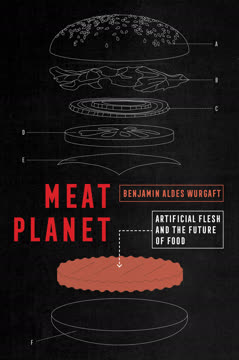
Key Takeaways
1. Cultured Meat: A Paradoxical Promise of the Future
Meat that never had parents. Meat that never died (in the sense that a whole animal dies) and, in the eyes of some critics who define their meat narrowly, never properly lived.
A weird future. The book opens with the author's experience watching Mark Post's 2013 cultured hamburger demonstration, a moment billed as a historical pivot point for food. This "frankenburger," grown from bovine muscle cells, represented a radical departure from traditional meat production, promising to transform our relationship with animals, land, and the environment. The initial spectacle, however, also highlighted the inherent strangeness of meat that bypasses the life and death of an animal.
Beyond the burger. This event wasn't just about a hamburger; it was an effort to position cultured meat as a solution to civilizational-scale problems. The promotional film linked meat consumption to:
- Environmental damage (greenhouse gas emissions, water/land use)
- Animal cruelty in industrial agriculture
- Public health risks (antibiotic resistance, diet-related illnesses)
- Global food security for a growing population
Human agency and emergence. The author notes that the "emergence" metaphor, often used for new technologies, subtly hides the human agency and diverse agendas driving innovation. Cultured meat, despite its novelty, is shaped by a complex interplay of scientific ambition, venture capital, ethical concerns, and a pervasive culture of prediction, often influenced by science fiction.
2. Meat's Shifting Identity: From Food to Industrial Commodity
Our modern usage of the word meat betrays little of the indeterminacy and flexibility previously carried by a term that once meant “item of solid food,” though in some turns of phrase, such as “nutmeat” or “sweetmeat,” we can hear echoes of that old meaning.
A protean concept. The word "meat" itself has a fluid history, originally referring to any solid food before narrowing to animal flesh around 1300 C.E. This semantic shift mirrors a broader historical trend of narrowing what counts as meat, even as modern industrial processes have made it ubiquitous. The first famous piece of cultured meat being a hamburger is symbolic, representing abundance, industrial production, and American convenience.
Industrial transformation. Modern meat consumption, particularly in the Western world, is characterized by high volume and a narrow range of species (cows, pigs, chickens). This is a recent phenomenon, driven by:
- Industrialization and urbanization
- New forms of infrastructure (refrigerated transport, breeding systems)
- "Animal science" replacing traditional husbandry
- Government subsidies and grading systems (e.g., USDA beef grades)
Experiential cheapness. The industrialization of meat has not only made it economically "cheap" but also experientially distant. Consumers are increasingly isolated from the processes of animal husbandry and slaughter, leading to a disconnect between the product and its origins. This distancing is a key context for understanding the appeal of cultured meat.
3. The Power of Promises: Hype, Hope, and the "Haste Function"
To breed an animal with the right to make promises—is not this the paradoxical problem nature has set itself with regard to man? And is it not man’s true problem?
Anticipated certainty. Cultured meat is deeply intertwined with the act of promising, a "speech-act" that projects certainty into an uncertain future. Statements like "We proved it's possible" or "It will reduce carbon emissions" function as promises, creating a "haste function" that makes the future seem closer and more inevitable. This dynamic is crucial for attracting funding and public interest.
Nietzsche's paradox. Drawing on Nietzsche, the author explores how promising defines humanity, creating "islands of certainty" in an unknowable future. Technological promises, however, often rely on the impersonal credit of "technological determinism"—the belief that progress is an autonomous force. This can lead to a "trough of disillusionment" if promises are not met.
Communities of promise. The cultured meat movement fosters "communities of promise," groups of scientists, entrepreneurs, and activists united by the hope for a better future through this technology. These communities, like patient networks awaiting medical cures, navigate long waiting periods and the need to maintain morale, often through strategic hype.
4. Technical Hurdles and Philosophical Doubts Challenge Progress
The magic wand of scale, Agapakis added, had been waved over other foods in the past.
Persistent roadblocks. Despite the initial hype, significant technical challenges persist in cultured meat research. The two most prominent are:
- Serum-free growth medium: Replacing expensive, non-vegan fetal bovine serum with an affordable, animal-free alternative.
- Three-dimensional tissue: Growing complex, "thick" muscle tissue that requires vascularization (artificial blood vessels) to overcome nutrient and oxygen diffusion limits.
The "bugbear of scale." Scaling up from laboratory bench to industrial production remains a formidable obstacle. Critics like Christina Agapakis highlight how the "magic wand of scale" has failed other promising food technologies, such as algae in the 1950s. The sheer energy, cost, and engineering complexity of bioreactors capable of producing tons of meat are staggering.
Doubt as a productive force. Skepticism, from scientists, journalists, and consumers, is a constant companion to cultured meat. This doubt, however, can be productive, prompting deeper questions about:
- The "naturalness" of lab-grown food
- The ethical implications of industrializing biological processes
- The potential for unintended consequences, echoing Ursula Franklin's critique of "industrial models" that ignore externalities.
5. Moral Imperatives Drive Innovation, But Not Without Contradictions
Morality is not something that must simply respond to new technologies as they arrive, throwing us into confusion; rather, morality may champion and assist in the development of new technologies.
Ethical motivations. The most impassioned arguments for cultured meat stem from moral imperatives, primarily:
- Animal protection: Ending the suffering and death of animals in industrial agriculture.
- Environmental defense: Mitigating climate change and reducing resource consumption.
- Food security and human health: Providing sustainable protein for a growing population and reducing zoonotic disease risks.
Technology as moral agent. Some proponents view cultured meat as a moral obligation, a technological means to achieve a world that "mirrors the moral vision we possess for it." This perspective suggests that technology can actively "disclose worlds of ethical possibility," rather than merely responding to existing moral dilemmas.
The "new prosthetic technological morality." The author questions whether hoping for technological solutions to animal suffering implies an abandonment of the older dream of improving human moral character. Cultured meat, in this light, could be seen as a "prosthetic technological morality," where external solutions replace internal ethical transformation, allowing appetites to remain unchanged.
6. Mimesis vs. Invention: Copying Nature or Creating New Forms?
But if the goal of the burger is ultimately to undermine the animal-grown version of meat by offering an exact replacement, what happens when we offer people forms of lab-grown meat that don’t copy nature?
The mimetic imperative. Mark Post's strategy for cultured meat's success is rooted in mimesis: the lab-grown burger must perfectly replicate the taste, texture, and price of its conventional counterpart. This "beef mimesis" aims to overcome consumer resistance by appealing to existing gastronomic inertia rather than demanding new tastes.
Benjamin's aura. Walter Benjamin's concept of "aura" in art, diminished by mechanical reproduction, offers a lens to view copied food. While hamburgers are already mass-produced, the act of copying meat in a lab raises anxieties about "liveliness" and originality. The Slow Food movement, by contrast, seeks to restore "aura" to food through artisanal production.
Beyond the copy. Despite the mimetic drive, the technical challenges and the inherent plasticity of tissue culture open doors to invention. The "In Vitro Meat Cookbook" fantasizes about:
- "Meat paint"
- In vitro oysters with "oceanic terroir"
- Translucent fish muscle for see-through sushi
This tension between imitating nature and creating entirely new, "rebellious" forms of protein highlights a philosophical shift from Aristotelian mimesis (technology extending nature) to a modern, "groundless" invention, where human will sets itself up as creator.
7. Philosophical Debates: Utilitarianism, Rights, and Speciesism
The question is not, Can they reason? Nor, Can they talk? But, Can they suffer?
Expanding the moral circle. Peter Singer's utilitarian philosophy, particularly his book Animal Liberation, is a foundational text for many cultured meat advocates. Singer argues for "expanding the moral circle" to include animals, based on their capacity for suffering and happiness, rather than their ability to reason or speak. This consequentialist approach aims to maximize happiness and minimize suffering for the greatest number of beings.
Critiques of utilitarianism. Singer's position, while influential, faces critiques from other philosophers:
- Gary Francione: Argues that Singer misunderstands sentience by focusing only on suffering/happiness, neglecting its role in an animal's survival. He believes animal death itself is a harm.
- Tom Regan: Advocates for animal rights based on "inherent value," arguing that animals, as "subjects of a life," possess rights that utilitarianism cannot fully account for. He sees instrumental use of animals as a deeper wrong than mere suffering.
Speciesism and human distinctiveness. The concept of "speciesism"—prejudice against non-human animals—is central to these debates. While some philosophers, like Michael Allen Fox, defend human moral distinctiveness, even they often condemn industrial animal cruelty. The core question remains: can there be a compelling moral defense of cheap, industrial meat?
8. The Political Economy of Food: Markets, Modernization, and "Cheapness"
Our inability to think seriously about changing our food system through collective action and political will encourages us to turn to technology and the market for solutions.
Silicon Valley's influence. The cultured meat movement is deeply embedded in Silicon Valley's culture of "disruption" and "innovation." Venture capitalists, often impatient for quick returns, drive the narrative of rapid technological change, sometimes overlooking the complexities of biological systems. This approach often frames market forces as the primary means for achieving positive social change.
Malthusian vs. Cornucopian. Debates about the future of food often echo historical tensions between Malthusian pessimism (population outstrips food supply) and Cornucopian optimism (human ingenuity and technology will always find solutions). Cultured meat, by promising to decouple meat production from land and animals, aligns with a modern cornucopian view that growth can continue indefinitely through technological "substitution."
The problem of "cheapness." Cultured meat implicitly promises to remedy the "cheapness" of industrial meat, a phenomenon where costs (environmental, social, ethical) are externalized and made invisible to consumers. This "cost-transference" has democratized meat but at immense hidden expense. Cultured meat aims to make meat's cheapness unproblematic by reducing these externalities.
9. Kashrut and Cleanliness: Redefining "Fit" in a New Food World
What mental operations are needed to place a new form of meat in our picture of the world, and within the regulatory system that governs our eating?
Talmudic precedents. The question of cultured meat's kosher status has ancient roots, appearing in the Talmud. Rabbinic discussions ponder whether a man-made calf is a "real animal" requiring shechitah (kosher slaughter) or if it's pareve (neither meat nor dairy), thus challenging traditional definitions of "fit" food.
"Clean meat" and its implications. The term "clean meat," favored by some advocates, implicitly labels conventional meat as "dirty," sparking controversy with traditional farmers. This highlights how new terminology can create new "systematic orderings of ideas" about food purity and morality, echoing Mary Douglas's work on defilement.
Regulatory complexities. Determining kosher status for cultured meat involves inspecting the original cells, growth medium, and scaffolding. Principles like aver min hachai (limb from a living animal) and panim chadashot (radical transformation of substance) are debated. This mirrors the broader regulatory challenges cultured meat faces, as governments grapple with how to classify and regulate this novel food.
10. Historical Precedents: The Whale Oil Myth and the Ballistic Imagination
A single technological development, in other words, led to an alternative to dependency on an animal product.
The whale oil story. Paul Shapiro of the Humane Society often cites the decline of the 19th-century whaling industry, replaced by kerosene, as a precedent for cultured meat. This narrative suggests that a technological breakthrough, driven by market forces, can save animals and the environment by providing a superior alternative.
A "whale oil myth." The author, however, reveals the "whale oil myth" to be an oversimplification. Kerosene's rise was not solely due to its superiority or market forces, but significantly aided by government taxation on competing alcohol-based fuels during the Civil War. This historical nuance underscores the crucial role of political and regulatory intervention in technological transitions.
Lessons for cultured meat. The whale oil story, despite its complexities, serves as a powerful "natural resource" for futurists. It exemplifies the "ballistic imagination" that collapses time and simplifies history to promote a vision of inevitable technological progress. This approach, however, risks overlooking the intricate interplay of technology, markets, and government in shaping the future of food.
11. The "Pig in the Backyard": A Utopian Vision for Ethical Futures
In a city, a neighborhood contains a yard, and in that yard there is a pig, and that pig is relatively happy.
A Dutch bioethical fantasy. This scenario, proposed by Dutch bioethicists, imagines urban neighborhoods communally raising a happy pig. Small, harmless biopsies are taken weekly to produce hundreds of pounds of cultured pork for the community. The pig lives out its natural lifespan, fostering intimacy and community.
Cockaigne's echo. The "pig in the backyard" resonates with the medieval fantasy land of Cockaigne, where food is abundant and animals willingly offer themselves for consumption. It's a cornucopian vision that inverts traditional labor and moral strictures, offering appetites fulfilled without guilt.
An experiment in ethical futures. This scenario is not merely a fantasy but an "experiment in ethical futures." It challenges our moral imagination by:
- Creating intimacy with food animals, transforming them from anonymous commodities to known individuals.
- Proposing a new form of relation between a living animal and its extended flesh.
- Asking whether a more fulfilled animal, living within our moral concern, would change our own ethical character.
12. Epimetheus's Hindsight: The Perils of Unexamined Progress
For an urban modern like myself, it is harder to imagine a world in which all meat is obtained by hunting than it is to imagine meat growing in gleaming bioreactors.
The ballistic imagination. Advertisements for cultured meat often collapse millennia, linking ancient spears to modern bioreactors, implying a continuous arc of technological progress. This "ballistic imagination" simplifies history, making the future seem a natural extension of our past, rather than a complex, contested space.
Prometheus vs. Epimetheus. The book contrasts Prometheus ("forethought," technology, progress) with his brother Epimetheus ("hindsight," "late counsel," regret). While Prometheus's gift of fire brought civilization, it also led to an industrial order where long-term thinking often trails behind production. The current climate crisis, exacerbated by industrial meat, suggests a failure of Promethean forethought.
Obsolescence upon conception. Drawing on William Gibson, the author argues that "every vision of the future begins to obsolesce upon conception." Cultured meat, as a piece of "biotechnological nature walk," serves as a mirror on the present, reflecting our anxieties and aspirations. It forces us to confront the moral claims embedded in conventional meat, often unnoticed due to familiarity.
Beyond technological fixes. The book concludes that cultured meat, while offering new moral options, also highlights our "impoverished sense of possibility." Our reliance on technology and markets for solutions to problems like climate change and animal suffering stems from an inability to imagine and enact collective action and political will. The "pig in the backyard" is a reminder that becoming what we might be starts with asking fundamental questions about our moral architecture.
People Also Read