Key Takeaways
1. Embrace Death as a Transformative Tool for a Richer Life
Paradoxically—or so it might seem to us—by forging a relationship with death, our ancestors mitigated their fear of it, and were able to live fuller and more meaningful lives.
A counterintuitive approach. Many in contemporary Western society view death as purely negative, something to be avoided and pushed from our minds. However, for millennia, cultures worldwide actively cultivated a relationship with death, not as an end, but as a powerful tool for living and dying well. This ancient wisdom suggests that confronting our mortality can lead to profound personal growth.
Wisdom from the past. Contemplating death, or memento mori, was a widespread practice used to reduce fear, gain perspective on life's difficulties, and align actions with higher values. Figures like Buddha and Socrates considered death the greatest teacher, while Indigenous cultures regularly asked if today would be a good day to die to inspire present-moment living. Steve Jobs famously used this awareness to make major life choices.
Modern affirmation. Science, too, supports these benefits. Sustained reflection on death can mitigate fear and deepen connections, while "morbid curiosity" (a motivation to learn about death) correlates with greater positive resilience during uncertain times. By changing how we feel about death, we can transform our lives, clarify our values, and live more authentically.
2. Western Culture's Denial of Death is a Recent Anomaly
This distancing from death—and our expectation that we will enjoy a long, healthy, happy, and pain-free life—is, so far as I can tell, an anomaly in all of human history.
A historical shift. Until recently, death was an intimate, everyday part of life in the Western world. In the 19th century, average life expectancy was around forty, and children often died young. People died at home, surrounded by family, and bodies were prepared and mourned within the community, often with elaborate rituals and formal mourning periods.
The rise of medicalization. From the late 19th to early 20th century, medical and hygienic advances led to longer lives, shifting death from the home to hospitals. Professional funeral homes took over body care, and personal mourning became less visible, even pathologized if prolonged. This cultural "whitewashing" removed death from daily experience, making it uncanny and frightening.
Science as the new myth. Simultaneously, death moved from the realms of religion and mythology to science and medicine. While science offers facts, it provides little meaning, often viewing death as a "failure of intervention." This leaves many in a secular world without traditional frameworks to understand or cope with mortality, making death an enemy rather than a meaningful rite of passage.
3. Life, Death, and Rebirth are Interconnected Cycles
Birth is the death of the life we have known. Death is the birth of the life we have yet to live.
Nature's eternal rhythm. For most of human history, death was not seen as an end, but as a transition within eternal cycles of life, death, and rebirth. Our ancestors, deeply connected to nature, observed these rhythms in the sun, moon, seasons, and seeds, understanding death as a transformation.
Archetypal transformation. This cyclical view is a universal archetype, appearing in myths, religions, and personal experiences worldwide.
- Ancient goddesses (Osiris, Freyja, Shiva) embodied life, death, and rebirth.
- The Maya and Hindu cosmologies describe cyclical apocalypses and rebirths.
- The butterfly's metamorphosis symbolizes the soul's survival and regeneration.
Carl Jung saw death not as an end, but as an initiation into a new, unimaginable life, a broader perspective of the Self.
Psychological descents. The metaphor of "descent and return" (shamans, Persephone, Gilgamesh) illustrates psychological transformation. Dark, transitional times, or "dark nights of the soul," are painful but necessary journeys into the unconscious, leading to growth, increased self-knowledge, and a "psychological treasure." These personal "deaths" of old identities pave the way for rebirth into a more authentic self.
4. Memento Mori Clarifies Values and Inspires Authentic Action
Remembering that I’ll be dead soon is the most important tool I’ve ever encountered to help me make the big choices in life.
Ancient wisdom, modern relevance. A memento mori—Latin for "remember you will die"—is any practice, object, or artwork designed to evoke a visceral awareness of life's brevity. This ancient tool, found in cultures from ancient Egypt and Rome to Buddhist and Christian traditions, was meant to encourage living in alignment with one's true values before it's too late.
Inspiring action. By confronting the inevitability of death, individuals are prompted to shed external expectations, pride, and fear of failure, focusing only on what is truly important. Steve Jobs' daily mirror ritual, asking "If today were the last day of my life, would I want to do what I am about to do today?", exemplifies how this awareness can drive significant life changes.
Clarity and courage. This practice cuts through confusion, offering profound clarity on life's big decisions. It inspires the courage to pursue one's heart and intuition, rather than wasting time living someone else's life. The WeCroak app, sending daily mortality reminders, is a modern memento mori designed to spur needed change, accept what must be, and honor what truly matters.
5. The Mystery of Afterlife: Beyond Scientific Materialism
The boundaries which divide Life from Death are at best shadowy and vague. Who shall say where the one ends, and where the other begins?
A universal belief. For most of human history, it was a near-universal belief that a life force or soul continued after bodily death, often journeying to an afterworld or being reincarnated. Cultures imagined multiple souls, psychopomps (soul guides like Hermes or Saint Michael), and diverse afterlife destinations ranging from fertile abundance to punitive realms.
Challenging the "end" narrative. While scientific materialism posits death as the absolute end of consciousness, compelling peer-reviewed studies are emerging that seriously explore the possibility of continuation.
- Near-Death Experiences (NDEs): Vivid, life-changing experiences reported by those physiologically or psychologically close to death, often involving out-of-body sensations, encounters with light beings or loved ones, and a profound sense of peace. Veridical NDEs, where patients report verifiable observations while clinically dead, are particularly baffling.
- Past-Life Memories: Research by Dr. Jim B. Tucker documents young children recalling verifiable details of previous lives, sometimes speaking unexposed languages or exhibiting birthmarks corresponding to past injuries.
Blurred boundaries. Other phenomena further challenge the materialist worldview:
- Quantum Physics: Demonstrates particles existing as both waves and particles, and entanglement ("spooky action at a distance"), suggesting a stranger reality.
- Mind-Body Problem: Terminal lucidity (dementia patients regaining faculties before death) and the placebo effect (belief healing the body) highlight the mind's profound influence.
- Synchronicities: Meaningful coincidences without direct causal connection, like the author's "butterfly of death" during writing, suggest deeper, underlying patterns in the universe.
6. Grief is a Natural Expression of Love, Not a Pathology
When you are sorrowful look again in your heart, and you shall see that in truth you are weeping for that which has been your delight.
The cost of love. To love is to make oneself vulnerable to grief, an inevitable part of the human experience. The Buddhist parable of the mustard seed illustrates that suffering from loss is the common lot of humanity, and recognizing this can open us to compassion and enlightenment.
The danger of unexpressed grief. Author Martín Prechtel, drawing on Tzutuhil Maya wisdom, argues that if grief is not properly expressed, it can solidify into depression, physical illness, or even ancestral trauma passed down generations. Sigmund Freud concurred, stating that "unexpressed emotions will never die. They are buried alive and will come forth later in uglier ways."
Treasures in sorrow. Despite its pain, grief can yield unexpected gifts. Individuals facing profound loss, like Karen Montgomery caring for her terminally ill father, report finding joy, deep gratitude, heightened senses, and a renewed appreciation for life. This mirrors kintsugi, the Japanese art of repairing broken pottery with gold, celebrating the wound as an essential part of its beauty and history.
7. Communing with the Dead Enriches the Living
There is a land of the living and a land of the dead and the bridge is love, the only survival, the only meaning.
Continuing relationships. Many cultures, and even modern psychological studies, reveal that people maintain relationships with their deceased loved ones. Psychologist George Bonanno found that a majority of bereaved individuals feel their loved ones are still with them, and regularly speaking to them aids healing and meaning, regardless of literal belief.
Ancestor veneration. This ancient, global practice, once called ancestor worship, involves honoring the dead with offerings, prayers, and remembrances. It stems from the belief that ancestor spirits can become powerful allies, offering guidance and assistance.
- Benefits: Reduces anxiety and depression after loss, fosters gratitude, and strengthens community bonds.
- Practices: Jewish sitting shiva and yahrzeit candles, Buddhist offerings to monks, Catholic indulgences, and the use of physical remains (mummies, relics, ancestor statues).
Talking to the dead. Techniques for direct communication with the deceased have existed for millennia, often through mediums or at "oracles of the dead."
- Historical examples: Hebrew Bible's Witch of Endor, ancient Greek Necromanteion, Japan's Itako mediums at Osore-zan.
- Spiritualism: A 19th-century religion based on communicating with the dead via séances, attracting figures like Lincoln and Edison.
- Modern innovations: Japan's kaze no denwa (wind phone) allows symbolic conversations with lost loved ones, a practice now spreading globally.
Festivals of the Dead. Special times of year, like Celtic Samhain, Japanese Obon, Chinese Qingming Festival, and Mexico's Día de Muertos, are dedicated to welcoming returning ancestor souls. Families gather to clean graves, make offerings, and celebrate, reinforcing the bonds between the living and the dead. These vibrant traditions highlight that death is not an end to love or connection.
8. Confronting the Fear of Death Unlocks Deeper Living
People living deeply have no fear of death.
Culturally constructed fear. The pervasive fear of death in the contemporary West is not a universal human characteristic but a culturally conditioned response. Indigenous cultures, like Hawaiians welcoming Pele's volcanic eruptions, demonstrate a serene acceptance of nature's cycles, including death. This fear, some scholars argue, emerged historically from societal instability and the division of life-death goddesses into separate, fearful entities.
The denial of death. Ernest Becker's "Denial of Death" posits that humans repress the knowledge of their mortality to avoid existential angst. This repression, however, can lead to "immortality projects" (seeking fame, children, or national identity) and, dangerously, to hostility towards "out-groups" when mortality is triggered (Terror Management Theory).
Antidotes to fear. Conscious reflection on death, as advocated by psychologist George Bonanno, can mitigate this fear and foster stronger connections.
- Right-brain cultivation: Neuroscientist Jill Bolte Taylor found that operating from the right brain (holistic, connected, emotional) eliminates the fear of death. Practices like meditation, yoga, and spending time in nature can cultivate this state.
- Stoic philosophy: Figures like Marcus Aurelius argued that fearing death is illogical, as it is either "extinction or change," and therefore, "it is not death that a man should fear, but rather he should fear never beginning to live."
Beyond security. An overzealous pursuit of security, often driven by a subconscious avoidance of death, can ironically diminish life. Experiences of controlled danger, like the author's lost boat trip on Lake Pátzcuaro, can be exhilarating, fostering a deep sense of being alive and a trust that things "just work out," as in Mexico's "always a way" philosophy.
9. Prepare for Your Own Death to Live More Fully
Dying is nothing to fear. It can be the most wonderful experience of your life. It all depends on how you’ve lived.
Conscious planning. Preparing for one's own death, far from being morbid, is a proactive way to ensure a "good death" and a life lived without regret. This can involve thoughtful decisions about one's final moments, body disposition, and legacy.
- Personalized spaces: Designing the room one wishes to die in, or embroidering a burial shroud.
- Legacy projects: Writing letters to be sent after death, or creating heirlooms for future generations.
Reimagining memorials. Many seek to transform traditional, somber funerals into joyous celebrations of life.
- Cultural examples: The lively Irish wake, the cathartic New Orleans jazz funeral, Ghana's "fantasy coffins" reflecting the deceased's personality, and Puerto Rico's "nontraditional wakes" posing bodies in life-like dioramas.
- Pre-funerals: "Living funerals" in Japan and South Korea allow individuals to celebrate their lives with loved ones before death, fostering gratitude and resolving unfinished business.
Practical preparations. Beyond the ceremonial, practical steps ease the burden on loved ones.
- Advance directives: Legal documents outlining medical wishes and designating a healthcare proxy.
- "Swedish Death Cleaning": Decluttering and organizing possessions to simplify the after-death process for family.
- Funeral planning worksheets: Documenting explicit desires for body disposition, service details, and memorial contributions.
- Japanese jisei: Writing a brief poem as a formal farewell to life, a poignant legacy.
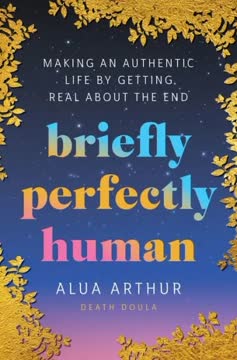
The death doula. These "midwives of death" provide physical, psychological, spiritual, and emotional guidance through the dying process, helping resolve regrets, unfinished business, guilt, and shame. They act as modern psychopomps, ensuring a calm, peaceful transition.
10. Play with Death to Neutralize its Sting and Foster Resilience
If we’re honest with ourselves, we have to admit we enjoy our tears just as much as we enjoy our laughter. The only moments of life that are a bore are when we don’t care one way or another.
Entertainment as exploration. Death-themed amusements, from 19th-century penny arcade executions to Parisian phantasmagorias and Grand Guignol theater, proliferated as traditional ways of understanding death receded. These popular cultural forms explored the taboo, bringing death from the cultural shadow into a disreputable but accessible light.
The benefits of pleasurable fear. Experiencing simulated death and violence, like in haunted houses or horror films, can be surprisingly beneficial.
- Self-challenge: Learning about oneself by confronting fear.
- Confidence: Mastering something frightening.
- Mindfulness: Quieting inner chatter and grounding oneself in the present moment, akin to meditation.
- Laughter: Humor, especially black humor, can neutralize the sting of fear, reduce stress, and foster social bonding.
Morbid curiosity and resilience. Individuals with "morbid curiosity"—an interest in death, violence, and the macabre—often exhibit "positive resilience," allowing them to find threatening situations interesting and experience less psychological distress. This curiosity can also foster empathy and a more inclusive understanding of human history.
Public engagement with remains. Exhibitions like Gunther von Hagens's Body Worlds, historical anatomical theaters, and anatomical museums have long blended entertainment and education by displaying human remains. While controversial, these displays offer a direct confrontation with mortality.
The death-positive movement. Modern initiatives like Death Cafes, Death Over Dinner, and The Death Deck actively challenge societal taboos around death. By creating safe spaces for open, thoughtful, and even fun conversations, they aim to reduce death-related anxiety and promote diverse, meaningful end-of-life options, fulfilling Geoffrey Gorer's call to "readmit grief and mourning."
11. Live Authentically by Your Own Values, Not Others' Expectations
Your time is limited, so don’t waste it living someone else’s life. Don’t be trapped by dogma—which is living with the results of other people’s thinking.
Clarity through mortality. Regularly asking memento mori-like questions—"If I die on this flight, what would I regret?" or "Is this what I want to do with my time on earth?"—cuts through confusion and clarifies personal values. This practice, embraced by figures like Steve Jobs, helps shed external expectations and fears, revealing what is truly important.
Finding your purpose. From a shamanic perspective, each person is born with a unique purpose, expressed through innate passions and talents. Christina Pratt advises identifying what you'd happily discuss at 2 AM, as passion is the "hotter-hotter" signal guiding you toward your soul's purpose. Living this purpose not only satisfies the individual but also enriches the community.
Beyond fleeting happiness. Western culture's "pursuit of happiness," often tied to consumerism, can lead to dissatisfaction. Finnish wisdom, like the author's oma, suggests seeking "contentment" over fleeting "happiness." Buddhist philosophy highlights sankhara-dukkha, where perceived pleasures cause suffering due to illusions about self and objects. Death awareness helps distinguish between superficial desires and genuine fulfillment.
Cultivating gratitude and connection. Bringing death into awareness fosters deep gratitude for life's precarious gifts. Daily gratitude practices, like listing five things you're thankful for, shift perspective and increase optimism.
- Regrets of the dying: Bronnie Ware's research reveals common regrets: not living true to self, working too hard, not expressing feelings, losing touch with friends, and not letting oneself be happier.
- Social connections: Studies consistently show that strong social connections are the strongest predictor of a fulfilling, long, and healthy life, impacting mood, motivation, and physical health more than wealth.
12. Forge Your Personal Myth of Death for Wholeness and Meaning
You must have your own ideas about it. You have to have your own myth. To have your own myth means to have suffered and struggled with a question until an answer has come to you from the depths of your soul.
Jung's call to wholeness. Carl Jung believed that developing a personal myth about death is crucial for a mature, well-lived life. This myth, born from deep introspection and struggle, provides a psychological framework to grapple with death's inevitability and find meaning, rather than relying on inherited or unexamined beliefs. It's about integrating all aspects of the psyche, including the "shadow," to achieve individuation and wholeness.
Balancing the opposites. Jung emphasized the "tension of opposites"—life and death, light and dark—as complementary forces. A culture that privileges one over the other (e.g., life over death) becomes "one-sided" and "barbaric." Artists, writers, and creatives play a vital role in restoring this balance by excavating and expressing the cultural shadow, making the ineffable mysteries of life and death comprehensible through symbolic language.
The treasure of creativity. Delving into one's psyche, especially through creative expression, yields a "treasure" that benefits both the individual and the community. Creativity is a fundamental human drive, a tool for connecting with the unconscious, and essential for the soul's vitality. It allows us to safely process dark emotions and affirm life in the face of death, leaving a unique mark on the world.
Santa Muerte: A modern symbol. When the psyche is out of balance, the unconscious generates compensatory images. In Mexico, Santa Muerte, a female grim reaper, has emerged as a powerful symbol.
- Counterbalance: She balances the punitive Western grim reaper with a loving, compassionate, feminine guide.
- Inclusivity: She embraces all, especially the marginalized, reflecting death's lack of discrimination.
- Holistic view: She embodies "life, death, and everything in between," echoing ancient goddesses and offering a nuanced, positive relationship with mortality.
Santa Muerte exemplifies how new symbols can rebalance cultural perceptions of death, transforming fear into an appreciative, conscious relationship.
People Also Read