

Key Takeaways
That bottomless longing you mistake for romance is hunger for a mother
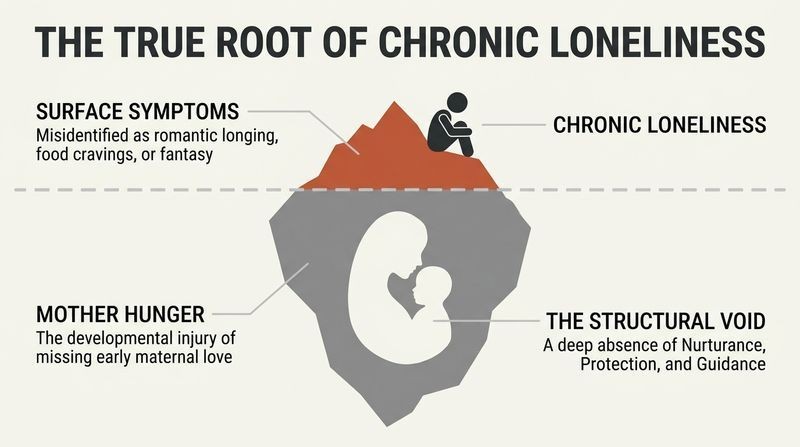
Mother Hunger names a nameless ache. Kelly McDaniel coined this term for the persistent emptiness women carry when they grew up without a quality of maternal love that imprints emotional worth and security. It often sets in before language forms, so it feels less like a memory and more like a permanent mood. Women routinely misread it as a craving for romantic love, chasing partners, food, or fantasy to fill the hole.
The wound, she argues, is not a disorder but an injury, a complicated grief carried silently and alone. Naming it is the first relief. McDaniel insists this is not about blaming mothers, who can only give what they themselves received, but about identifying which developmental needs went missing so an adult daughter can reclaim them.
What's striking is how the framing shifts shame into clarity. Calling insecure attachment an injury rather than a defect echoes trauma researchers like Bessel van der Kolk, who argue the body stores what the mind cannot narrate. The reframe is therapeutically shrewd: people heal faster when their suffering has a name and a cause. One caution worth noting is that a label this capacious risks explaining everything and therefore nothing. Still, for women told their longing is mere neediness, the diagnostic precision offers a genuine foothold.
Mothering reduces to three teachable elements: nurturance, protection, guidance
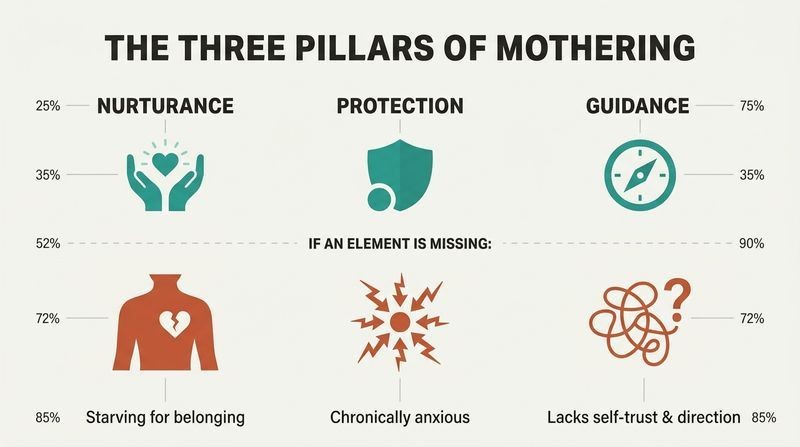
Vague ideals become a usable map. Frustrated that dictionaries define mothering as merely giving birth, McDaniel built a working framework of three essential elements. Nurturance is responsive touch, feeding, and soothing that teaches a baby she matters and that love feels good. Protection is the buffering of threats, beginning in the womb, that lets a child feel safe rather than chronically afraid. Guidance comes later, as a daughter studies her mother to learn how to be a woman.
Deprivation in each produces a signature symptom:
1. Missing nurturance leaves you hungry for touch and belonging.
2. Missing protection leaves you anxious and braced for danger.
3. Missing guidance leaves you without an internal compass for your own choices.
Mistakes do not cause Mother Hunger; unrepaired, unacknowledged absence of these elements does.
The framework's strength is diagnostic specificity. Rather than a generic wound, a woman can locate which nutrient was scarce and target healing accordingly. This parallels how attachment theorists distinguish dimensions of caregiving, and how Donald Winnicott's good-enough mother captured the reassuring truth that repair matters more than perfection. McDaniel pointedly rejects good-enough as too minimizing. The triad is clean, perhaps too clean: real families blur these categories, and fathers and allomothers complicate the maternal monopoly. Yet as a clinical compass, the three-part split makes an overwhelming subject actionable.
Your body remembers what your mind cannot, encoded before words
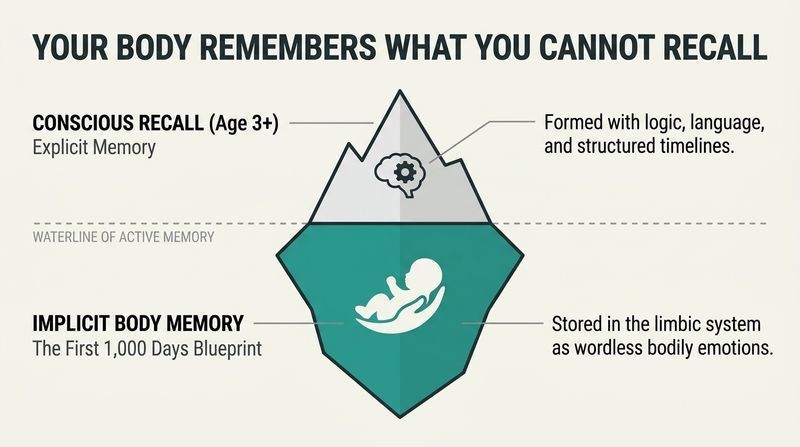
Feelings became facts before logic existed. Because the thinking brain develops after roughly age three, an infant's experience is body-based and emotional. These sensations become implicit memory, unconscious and wordless, lodged in limbic structures that quietly broadcast safety or danger. This is why a woman can act from a wound she cannot recall.
McDaniel leans on Allan Schore's emphasis on the first 1,000 days (conception to age two), when the brain doubles in size and depends on a caregiver's regulation. Edward Tronick's still face experiment shows the stakes: when mothers go briefly blank-faced, joyful babies grow frantic within minutes, then resigned. Neuroscience adds that the brain processes emotional and physical pain similarly, so a lonely infant genuinely hurts. The remedy is integrating implicit sensation with explicit, conscious narrative.
This rests on solid ground. The still face paradigm is among developmental psychology's most replicated demonstrations, and implicit memory research from Graf and Schacter underpins the claim. The bridge to adult behavior is more interpretive than proven, since reconstructing preverbal states is inherently speculative. What deserves emphasis is the hopeful corollary in Daniel Siegel's work: making implicit memory explicit, through coherent narrative, measurably changes outcomes. The book turns a deterministic-sounding neuroscience into an argument for agency, which is both its appeal and the point most vulnerable to overreach.
Unmet needs don't vanish, they get outsourced to surrogate comforts
Children are resourceful self-soothers. When maternal care is missing, a child finds substitutes. McDaniel argues that hunger and bonding are biologically fused: a baby learns that a full belly, mother's smell, and her voice are one thing. When that bonding is compromised, food becomes the first stand-in for love, which is why women with Mother Hunger struggle with both eating and relationships, never one without the other.
The substitutes escalate with age, from cake and stuffed animals to alcohol, compulsive sex, and headlong romance. She is skeptical of sleep training and cry-it-out methods, arguing that a baby who stops crying has not learned independence but resignation, a freeze response masquerading as a good baby. Touch deprivation, she notes, can even leave girls vulnerable to mistaking exploitative contact for affection.
The food-love linkage is well supported, echoing Geneen Roth and broader research on emotional eating and loneliness activating hunger-like cravings. The sleep-training claims are where the book takes a contested stance. Large studies on graduated extinction have found no lasting harm to attachment, and many developmental pediatricians disagree sharply with the framing here. McDaniel's position aligns with attachment-parenting advocates like Sears and McKenna but represents one pole of a genuinely unsettled debate. Readers benefit from her compassion for the resigned child while holding the sleep verdict more loosely than she does.
Mothers can fiercely love yet completely fail to protect
Love and protection are not the same skill. A frightened mother, carrying her own unhealed trauma, may adore her child and still be unable to shield her. McDaniel illustrates this with the true crime saga Dirty John, where Debra Newell, in the grip of love addiction, repeatedly overrides her daughters' pleas about a dangerous new husband, even apologizing to him for a daughter's tears. The man eventually tries to kill that daughter.
She introduces neuroception, Stephen Porges's term for the nervous system's radar for safety and danger. Daughters co-regulate with mothers, so a chronically afraid mother can damage a daughter's ability to detect threat at all. Protection failures cluster into two types: the too-vulnerable mother and the threatening mother. Either way, the daughter inherits a defensive armor McDaniel calls earned protection.
Decoupling love from protection is the chapter's sharpest move, because cultural mythology insists maternal love is automatically protective. The Dirty John case vividly shows how a mother's unmet needs can hijack her radar for her children's safety. The neuroception concept usefully explains intergenerational danger, though attributing impaired threat detection primarily to maternal transmission underweights peer, cultural, and temperamental factors. The book situates these failures inside patriarchy and the ACEs research, a strong systemic move that resists easy mother-blame while still holding the wound as real and consequential.
You swim in patriarchal water so pervasive you can't see it
Mother Hunger is cultural, not just personal. Borrowing David Foster Wallace's parable of fish who cannot perceive the water they swim in, McDaniel argues that misogyny is the invisible medium shaping how women see themselves. The mother wound passes matrilineally: a mother's internalized self-hatred becomes binding rags for her daughter's psyche.
She maps the forces that erode protection:
1. The male gaze, which trains women to see their own bodies as objects existing for others.
2. Rape culture and Judith Leavitt's sexual alarm system, a chronic low hum of vigilance women carry.
3. Pornography as default sex education for children.
Shelley Taylor's tend-and-befriend research reframes the female stress response: rather than fight or flight, women often appease and connect, which explains why daughters learn to placate volatile mothers as a survival tactic.
Embedding a psychological wound in a sociological frame is intellectually honest and prevents the analysis from collapsing into individual pathology. The tend-and-befriend research genuinely revolutionized stress science, which had been built almost entirely on male subjects. The appease response illuminates why victims comply rather than flee, dissolving a persistent strain of victim-blaming. The chapter's polemical heat occasionally outruns its evidence, treating contested cultural claims as settled, but the core insight, that protection failures are often downstream of a culture that disempowers mothers, is both sound and frequently omitted from attachment literature.
A mother who treats you as her best friend is harming you
Enmeshment is neglect wearing affection's mask. Guidance, the third element, goes wrong when a mother uses her daughter to meet her own needs. McDaniel uses Adrienne Brodeur's memoir Wild Game, in which fourteen-year-old Adrienne is recruited as confidante and accomplice in her mother Malabar's affair. Being chosen feels like a privilege, which is precisely the trap.
Key distortions of guidance include:
1. Enmeshment, where a daughter caters to her mother's moods and loses access to her own.
2. Carried shame, where a shameless parent's disowned shame lands on the child.
3. Competing with a daughter for attention or beauty.
The cultural myth of mother-daughter as besties hides the power imbalance. A daughter needs nurturance, protection, and guidance, a job description far beyond friendship. Enmeshed daughters often avoid intimacy, feeling already married to mom.
Enmeshment, named by family therapist Salvador Minuchin and extended by Kenneth Adams as covert incest, is underrecognized precisely because it looks like closeness rather than cruelty. The carried-shame concept connects to research on how children of narcissistic or boundaryless parents internalize responsibility that was never theirs. The insight that being the favorite is itself a wound counters intuition powerfully. A useful extension: enmeshment frequently coexists with apparent material privilege, which is why these daughters are so often disbelieved and why their resentment gets pathologized as ingratitude rather than recognized as injury.
When the source of comfort is the source of terror, attachment shatters
Maternal cruelty is the worst adversity. McDaniel reserves a separate category, Third-Degree Mother Hunger, for daughters of abusive, frightening mothers, naming it after a relational third-degree burn. She traces it through the lives of Judy Garland and Edith Piaf, both born to mothers who did not want them, both dead at 47 from addiction-related causes. This wound produces disorganized attachment, the fourth attachment style Mary Main identified, where a child runs toward and away from the parent at once.
Because a child cannot survive without bonding, instincts for self-preservation surrender to attachment, creating a betrayal bond: danger fuses with love. The brain copes through dissociation and pruning, literally weakening neural circuits that detect a dangerous mother. The tragic result is damaged radar that leaves survivors prone to revictimization, plus toxic shame that convinces them they are defective.
This maps onto Judith Herman's complex PTSD and Jennifer Freyd's betrayal trauma theory, both rigorously developed frameworks. Freyd's insight, that dependence on an abuser motivates blindness to the abuse, elegantly explains why survivors forget or excuse. The neurobiological pruning claim is plausible but presented more confidently than the evidence strictly warrants. The most clinically important point is that disorganized attachment heals through relationship, not insight alone, which is why McDaniel insists residential programs without a single trusted bond often fail. Healing the attachment, she argues, is healing the trauma.
You can grow earned security without your mother's apology or presence
The wound heals relationally, not alone. Mother Hunger can be healed without a mother's recognition, death notwithstanding. The goal is earned secure attachment, building inner security through new relationships and deliberate self-nurturance. McDaniel borrows Bowlby's image of the therapist as a secure base, noting that right-brain wounds heal through the music of connection, tone and gaze, not just words.
Practical moves include matching the missing element to its remedy: more self-nurturance for lost touch, safety-building for lost protection, new role models for lost guidance. She names apology ache, the longing for a mother to say a genuine sorry, and warns that waiting for it stalls grief. A real apology requires recognizing the harm and repairing it, not excuses, denials, or self-pitying manipulation.
The apology-ache concept is quietly profound, because so many adults organize their lives around an acknowledgment that will never come. Releasing that wait is consistent with acceptance-based therapies and with research showing forgiveness benefits the forgiver regardless of the offender's participation. The taxonomy of fake apologies (excuse, denial, manipulation) is a portable tool useful far beyond this context. The relational emphasis aligns with findings that the therapeutic alliance predicts outcomes more reliably than technique. The honest limitation: building a secure base requires access to at least one safe person, a resource not equally available to everyone.
Frozen grief, not pathology, is the true core of Mother Hunger
Name the grief to thaw it. Drawing on Kenneth Doka's disenfranchised grief, mourning a loss society refuses to acknowledge, McDaniel argues women cannot grieve a mother who is still alive or whose harm is invisible. Without public validation, grief stalls in patterns of protest, pining, despair, and disconnection. What psychology labels abnormal grief is, in her view, simply the normal shape of this particular sorrow.
Her prescription is counterintuitive: stop performing okayness and actively wallow. Borrowing Tina Gilbertson's reframe of wallowing as allowing, she urges women to give buried emotions room rather than repressing them into depression or leaking them into addiction. She offers a 21-day detox from contact with the mother, paired with sleep, real food, journaling, and solitude, to reset the nervous system and finally let the grieving begin.
Disenfranchised grief is a well-validated construct, and applying it to living-mother loss is a genuine contribution, since cultural scripts grant no funeral for a mother who simply could not love you. The wallowing prescription runs against productivity-culture instincts but aligns with emotion-focused therapy and the paradox that accepting feelings reduces their grip. One nuance: the line between constructive wallowing and rumination, which research links to worsening depression, is thin and matters clinically. The 21-day detox is sensible boundary-setting, though framing contact as something to detox from may not suit every family's reality.
Heal yourself and you quietly interrupt the chain for your children
Oxytocin is nature's bonding switch. McDaniel closes by reframing motherhood as the chance to break the cycle. She argues that even mothers with deep wounds possess a biological ally: oxytocin, the bonding hormone released through holding, breastfeeding, and skin contact, which slows a mother down and pulls her toward her baby. The culture, not biology, is what sabotages this, through six-week leaves, sleep-training advice, and isolation from supportive women.
Her epigenetics argument raises the stakes: citing Rachel Yehuda's studies of Holocaust survivors' descendants and the fact that the egg you grew from existed inside your grandmother's body when your mother was a fetus, she suggests trauma and resilience pass down matrilineally. Healing is therefore not self-indulgence but intergenerational repair. A mother who metabolizes her own pain spares her children the inheritance.
The epigenetics framing is scientifically fashionable and emotionally potent, though it deserves caution: human transgenerational epigenetic inheritance remains hotly debated, and Yehuda's findings, while real, are correlational and contested in magnitude. The stronger, less disputed mechanism is behavioral transmission, the Meaney rat studies showing nurturing mothers raise nurturing daughters. Either way, the practical conclusion holds. What elevates this beyond typical self-help is the moral reframe: healing as a gift flowing both backward to ancestors and forward to descendants. That sense of purpose, research suggests, is itself a powerful motivator for sustaining difficult therapeutic work.
Analysis
Mother Hunger is a thesis-driven clinical self-help book aimed at adult women who feel a chronic, shameful emptiness they cannot explain. Its central move is taxonomic: McDaniel takes the unwieldy construct of insecure attachment and renames it as a felt experience (hunger), then decomposes mothering into three teachable elements (nurturance, protection, guidance) with a severe variant (Third-Degree Mother Hunger) for maternal abuse. This architecture is the book's chief intellectual contribution and its primary liability. The strength is that it converts an inchoate ache into a diagnosable, addressable pattern, which is therapeutically powerful; naming reliably reduces shame and mobilizes agency. The liability is that a construct broad enough to encompass food issues, love addiction, anxiety, perfectionism, and dissociation risks unfalsifiability.
The book is strongest where it synthesizes established science: Tronick's still face, Bowlby and Ainsworth's attachment work, Main's disorganized category, Herman's complex PTSD, Freyd's betrayal trauma, Taylor's tend-and-befriend, and Doka's disenfranchised grief. These are load-bearing and credible. It is weakest where it presents contested positions as settled, most notably the categorical condemnation of sleep training and the strong reading of transgenerational epigenetics, both areas where the evidence is genuinely mixed. McDaniel writes as an advocate, not a neutral reviewer, which gives the prose conviction but occasionally outruns the data.
What distinguishes the book within the attachment-trauma genre is its refusal of mother-blame while still honoring the daughter's injury, achieved by situating individual mothers inside patriarchal constraint and intergenerational inheritance. This is a delicate ethical balance that most trauma memoirs fail. The healing model is relational rather than insight-based, consistent with current alliance research, and the named tools (apology ache, the taxonomy of false apologies, constructive wallowing, the celestial mother) are memorable and portable. The audience that will benefit most is women with living, disappointing mothers who have never had permission to grieve. The audience it may underserve is those seeking balanced guidance on infant-care controversies, where the book reads as one committed voice in an unsettled debate.
Review Summary
Mother Hunger receives mostly positive reviews, with readers finding it validating and insightful. Many appreciate the book's exploration of attachment styles and healing from maternal wounds. Some criticize it for unrealistic expectations of mothers, lack of practical advice, and narrow focus on traditional family structures. Readers value the book's emphasis on nurturing, protection, and guidance in mother-daughter relationships. However, some find it repetitive or too basic. Overall, it resonates deeply with many women seeking to understand and heal from maternal trauma.
Glossary
Mother Hunger
Longing from inadequate maternal careMcDaniel's coined term for the persistent, often preverbal emptiness women carry when they did not receive a quality of mothering that imprints emotional worth and security. She frames it not as a disorder but as an attachment injury and a form of complicated grief, frequently misread as a craving for romantic love. It stems from missing nurturance, protection, or guidance in early development.
Nurturance, Protection, Guidance
Three essential elements of motheringMcDaniel's framework defining maternal love as three teachable elements. Nurturance is responsive touch, feeding, and soothing that teaches a child she matters. Protection is buffering threats so a child feels safe. Guidance, arriving later, is modeling how to be a woman. Deprivation in each yields, respectively, hunger for touch, chronic anxiety, and a missing inner compass.
Third-Degree Mother Hunger
Wound from maternal cruelty or abuseMcDaniel's name for the most severe form, caused by an abusive or frightening mother, likened to a relational third-degree burn. It produces disorganized attachment and symptoms overlapping complex PTSD: dissociation, toxic shame, betrayal bonds, and revictimization. She illustrates it through Judy Garland and Edith Piaf, and stresses it heals only through a safe, trusted relationship.
Apology Ache
Longing for mother's genuine apologyMcDaniel's term for the yearning that a mother will recognize the harm she caused and offer sincere remorse. Because many mothers never apologize, waiting for one stalls a daughter's grieving. A true apology, she specifies, requires acknowledging the pain and repairing the behavior, not offering excuses, denials, or self-pitying manipulation.
Earned Secure Attachment
Built security despite insecure childhoodA researched concept McDaniel applies to healing: an adult can develop secure attachment they lacked in childhood through deliberate effort and safe relationships. It involves replacing the missing maternal elements via self-nurturance, safety-building, new role models, and often a trauma-informed therapist who functions as a secure base, growing new neural pathways over time.
Carried Shame
Absorbing another's disowned shameA psychological dynamic in which a person behaving in offensive or violating ways, without feeling appropriate shame, transfers that disowned shame onto a more vulnerable party, often a child. McDaniel uses it to explain how daughters of shameless, enmeshing, or abusive mothers come to feel defective for harms that were never theirs.
FAQ
1. What is "Mother Hunger" as defined in Mother Hunger: How Adult Daughters Can Understand and Heal from Lost Nurturance, Protection, and Guidance by Kelly McDaniel?
- Definition of Mother Hunger: Mother Hunger is an attachment injury that results from missing one or more essential elements of maternal care: nurturance, protection, and guidance during formative years.
- Not a Disorder, but an Injury: McDaniel emphasizes that Mother Hunger is not a psychological disorder but a relational wound or heartbreak that impacts emotional well-being and relationships.
- Symptoms and Impact: It manifests as a persistent yearning for a certain quality of maternal love, often leading to issues with self-worth, relationships, and addictive behaviors.
- Origins: Mother Hunger can arise from a variety of circumstances, including maternal absence, emotional unavailability, or cultural and intergenerational factors.
2. What are the three essential elements of maternal care described in Mother Hunger by Kelly McDaniel?
- Nurturance: This is the foundational element, involving physical and emotional care, touch, feeding, and soothing that teaches a child they are loved and matter.
- Protection: Maternal protection buffers a child from external threats and fear, providing a sense of safety and security necessary for healthy development.
- Guidance: As children grow, mothers provide guidance by modeling values, boundaries, and self-worth, helping daughters navigate the world and their own identities.
- Interdependence of Elements: Missing any of these elements can result in insecure attachment and the development of Mother Hunger.
3. How does Mother Hunger by Kelly McDaniel explain the origins and causes of Mother Hunger?
- Attachment Theory Foundation: The book draws on attachment theory, explaining that early experiences with caregivers shape our ability to trust, bond, and feel secure.
- Intergenerational Transmission: Mother Hunger can be passed down through generations, as mothers who lacked nurturance, protection, or guidance may be unable to provide it to their daughters.
- Cultural and Societal Factors: Patriarchal values, lack of support for mothers, and societal devaluation of caregiving roles contribute to the prevalence of Mother Hunger.
- Early Life Events: Events such as maternal separation, adoption, trauma, or maternal mental health issues can disrupt the essential elements of care.
4. What are the main symptoms and signs of Mother Hunger according to Kelly McDaniel?
- Emotional Symptoms: Persistent feelings of emptiness, loneliness, anxiety, shame, or a sense of being "broken" or "unlovable."
- Relationship Patterns: Difficulty forming secure attachments, patterns of codependency, love addiction, or repeatedly seeking unavailable or unsafe partners.
- Addictive Behaviors: Use of food, sex, work, or other substances as substitutes for missing maternal nurturance or comfort.
- Body-Based Symptoms: Chronic stress, touch deprivation, and physical health issues linked to early attachment injuries.
5. How does Mother Hunger by Kelly McDaniel connect attachment styles to the experience of Mother Hunger?
- Insecure Attachment Styles: The book explains that Mother Hunger is essentially a form of insecure attachment, manifesting as anxious, avoidant, or disorganized attachment patterns.
- Attachment Style Development: Early experiences with maternal care (or lack thereof) shape whether a child develops secure or insecure attachment.
- Impact on Adult Relationships: Insecure attachment leads to difficulties in trusting others, regulating emotions, and forming healthy relationships in adulthood.
- Possibility of Change: The book emphasizes that attachment styles are not fixed; with awareness and healing, individuals can develop "earned secure attachment."
6. What is the role of food, touch, and surrogate comforts in the development and expression of Mother Hunger, as described by Kelly McDaniel?
- Food as Substitute for Love: When maternal nurturance is missing, food often becomes a primary source of comfort, leading to emotional eating or disordered eating patterns.
- Touch Deprivation: Lack of affectionate, safe touch in childhood can result in touch aversion, intimacy intolerance, or seeking comfort through self-soothing behaviors.
- Surrogate Comforts: Children and adults may turn to objects (blankets, stuffed animals), pets, or addictive behaviors to fill the void left by inadequate maternal care.
- Long-Term Impact: These surrogate comforts can persist into adulthood, complicating relationships and self-care.
7. How does Mother Hunger by Kelly McDaniel address the impact of cultural, societal, and intergenerational factors on the mother-daughter relationship?
- Patriarchal Culture: The book discusses how patriarchal values devalue caregiving and women, making it harder for mothers to provide the necessary elements of care.
- Mother Wound and Internalized Misogyny: Intergenerational transmission of self-loathing, low expectations, and victimization can perpetuate Mother Hunger across generations.
- Societal Pressures: Lack of support for mothers, unrealistic expectations, and conflicting advice contribute to maternal stress and compromised caregiving.
- Media and Sexualization: The sexualization of girls and women, exposure to pornography, and rape culture further complicate the ability of mothers to protect and guide their daughters.
8. What are the different degrees or severities of Mother Hunger described in Kelly McDaniel's book, and what is "Third-Degree Mother Hunger"?
- Mother Hunger Spectrum: The book describes Mother Hunger as existing on a spectrum, from mild to severe, depending on which elements of care were missing and to what extent.
- Third-Degree Mother Hunger: This is the most severe form, resulting from maternal cruelty, abuse, or extreme neglect, often leading to complex trauma and disorganized attachment.
- Symptoms of Third-Degree: Includes symptoms similar to complex PTSD, such as dissociation, self-harm, addiction, and profound difficulties in relationships.
- Need for Specialized Healing: Third-Degree Mother Hunger often requires trauma-informed, specialized therapeutic support for recovery.
9. What healing methods and practical exercises does Kelly McDaniel recommend in Mother Hunger for adult daughters seeking to recover from lost nurturance, protection, and guidance?
- Self-Nurturance Practices: Techniques such as self-touch, restorative yoga, bodywork, and mindful self-care to reclaim lost nurturance.
- Building Protection: Creating safe environments, setting boundaries, and practicing relaxation techniques like alternate nostril breathing.
- Finding Guidance: Seeking out role models, mentors, or therapists who can provide healthy guidance and help rewrite internal narratives.
- Therapeutic Approaches: The book recommends trauma-informed therapy, EMDR, support groups, and, in severe cases, considering a temporary or permanent separation from a harmful mother.
10. How does Mother Hunger by Kelly McDaniel address the challenges of mothering when you have Mother Hunger yourself?
- Awareness and Healing: Recognizing your own Mother Hunger is the first step to breaking the cycle and providing better care for your children.
- Support Systems: Emphasizes the importance of building a support network (friends, family, doulas, therapists) to help meet your own needs for nurturance, protection, and guidance.
- Mothering as Healing: The process of mothering can be an opportunity for self-healing, as caring for a child may awaken and help repair your own attachment wounds.
- Practical Advice: The book offers guidance on bonding, breastfeeding/nursing, and responding to your child's needs, while also caring for yourself.
11. What are the key takeaways and most important lessons from Mother Hunger by Kelly McDaniel?
- Naming the Pain: Giving a name to the experience of missing maternal care is a powerful step toward healing and self-compassion.
- Healing is Possible: With awareness, support, and intentional practices, it is possible to heal from Mother Hunger and develop secure attachment.
- No Blame, Just Understanding: The book encourages moving beyond blaming mothers, recognizing the broader cultural and intergenerational context.
- Relational Repair: Healing Mother Hunger requires relational experiences—whether with therapists, friends, or chosen family—that provide the missing elements of care.
12. What are the best quotes from Mother Hunger by Kelly McDaniel, and what do they mean?
- "Mother Hunger is a heartbreak that touches everything in your world, particularly your relationships with others and your own sense of worth."
This quote highlights the pervasive impact of missing maternal care on all aspects of life. - "You simply can’t heal what you can’t see."
Naming and recognizing Mother Hunger is essential for beginning the healing process. - "A mother can only give her child what she has."
This emphasizes the importance of compassion and understanding for mothers who may themselves be wounded. - "Healing Mother Hunger doesn’t happen in isolation. Mother Hunger is a relational wound that wants relational repair."
Recovery requires connection and support from others, not just self-help. - "As you work to replace lost nurturance, protection, and guidance, remember that this is an ongoing process. You’re building a new brain, and like any new routine, it takes time before you feel the results."
Healing is a gradual, ongoing journey that requires patience and persistence.
Download PDF
Download EPUB
.epub digital book format is ideal for reading ebooks on phones, tablets, and e-readers.








































