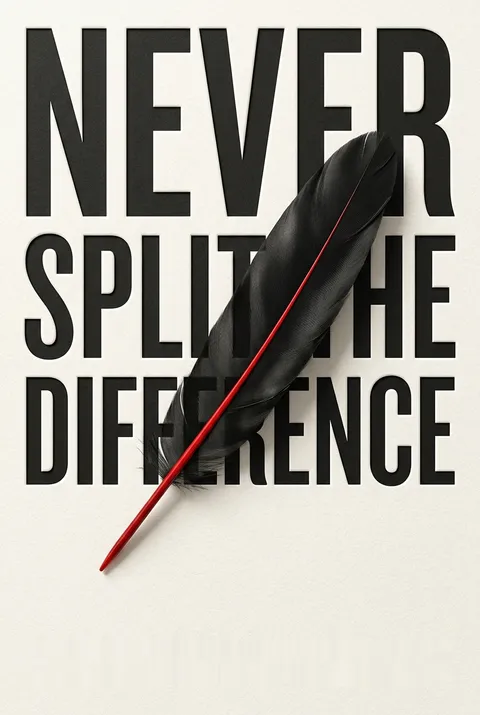
Key Takeaways
1. Master Emotional Intelligence: The New Rules of Negotiation
In my short stay I realized that without a deep understanding of human psychology, without the acceptance that we are all crazy, irrational, impulsive, emotionally driven animals, all the raw intelligence and mathematical logic in the world is little help in the fraught, shifting interplay of two people negotiating.
Beyond logic. Traditional negotiation theory, often taught at institutions like Harvard, emphasizes rational problem-solving, logic, and objective value. However, real-world interactions, especially high-stakes ones like hostage negotiations, reveal that humans are primarily emotional beings. Our "System 1" (fast, instinctive, emotional) heavily influences our "System 2" (slow, logical) thinking, meaning emotions guide our rational thoughts.
FBI's approach. The FBI, after experiencing failures with purely rational methods, developed a system rooted in psychology, counseling, and crisis intervention. This approach, termed "Tactical Empathy," focuses on understanding and influencing the emotional underpinnings of human behavior. It acknowledges that emotions are not obstacles to be overcome, but rather the means to effective negotiation.
Life is negotiation. Every interaction, from securing a contract to setting a child's bedtime, involves negotiation. The core principle is communication with results, aiming to get what you want from and with other people. By embracing negotiation as an emotional game and applying psychological insights, one can transform conflict into meaningful and productive collaboration, achieving desired outcomes while affirming relationships.
2. Listen Actively: Mirroring and the Late-Night FM DJ Voice
Listening is the cheapest, yet most effective concession we can make to get there.
Quiet the voices. Most people approach negotiation preoccupied with their own arguments, leading to a "schizophrenic" state where no one truly listens. The key to disarming your counterpart and making them feel safe is to make your sole focus what they have to say. This active listening helps quiet their internal voice, allowing for genuine connection and the revelation of their true needs.
Voice as a tool. Your voice is a powerful instrument for influencing emotions. There are three main tones:
- Late-Night FM DJ Voice: Calm, slow, deep, and downward-inflecting. Conveys control and reason, creating an aura of authority without triggering defensiveness. Use selectively for impact.
- Positive/Playful Voice: Your default. Easygoing, good-natured, light, and encouraging. A smile, even on the phone, impacts tone, increasing mental agility and fostering collaboration.
- Direct/Assertive Voice: Use rarely, as it signals dominance and invites pushback.
Mirroring for rapport. Mirroring, or isopraxism, is the unconscious imitation of another's speech patterns, body language, or words. Consciously, it's repeating the last one to three critical words your counterpart just said. This simple technique triggers a sense of similarity and rapport, encouraging them to elaborate and bond, as people are drawn to what's similar and fear what's different.
3. Label Emotions: Tactical Empathy Disarms
Exposing negative thoughts to daylight—“It looks like you don’t want to go back to jail”—makes them seem less frightening.
Empathy as a tactic. Tactical Empathy is the ability to recognize and vocalize a counterpart's perspective and underlying feelings in the moment. It's not about agreement or sympathy, but deep understanding. By identifying and naming emotions, you validate their experience, creating intimacy and trust, even in tense situations.
The power of labeling. Labeling involves giving a name to an emotion you observe, often starting with "It seems like...", "It sounds like...", or "It looks like...". This process shifts brain activity from the fear-generating amygdala to areas governing rational thought, disrupting the emotion's raw intensity. After labeling, remain silent and let the counterpart elaborate.
Neutralize and reinforce. Labeling is versatile:
- Labeling negatives: Diffuses anger and fear by bringing them into the open. Acknowledging a counterpart's anger or frustration ("It seems like you're angry") can de-escalate conflict.
- Labeling positives: Reinforces desired behaviors and perceptions.
- Accusation Audit: Proactively list and voice all the negative things your counterpart could say about you. This disarms them, makes you appear honest, and often prompts them to contradict the accusations, seeking common ground.
4. Embrace "No": The Start of True Negotiation
“No” is the start of the negotiation, not the end of it.
"No" is gold. We are conditioned to fear "No," but it's often a temporary decision to maintain the status quo, a statement of perception rather than fact. "No" provides a sense of safety, security, and control for the speaker, allowing them to relax and consider new possibilities. Great negotiators seek "No" early, as it signals engagement and opens the door to deeper understanding.
The three "Yeses." Not all "Yeses" are equal:
- Counterfeit "Yes": The counterpart plans to say "No" but uses "Yes" as an easy escape or to gather more information.
- Confirmation "Yes": A reflexive, innocent affirmation without commitment to action.
- Commitment "Yes": The true agreement that leads to action and a signed contract. This is the desired outcome.
Triggering "No." To get to a genuine "Yes," invite "No." Instead of asking "Do you have a few minutes to talk?", ask "Is now a bad time to talk?". This gives the other person autonomy and makes them feel in control. If they say "No, it's not a bad time," they are fully engaged. If they say "Yes, it is," they'll likely offer a better time.
5. Seek "That's Right": The Breakthrough Moment
When your adversaries say, “That’s right,” they feel they have assessed what you’ve said and pronounced it as correct of their own free will.
Beyond "Yes." While "Yes" is the ultimate goal, the true breakthrough in a negotiation often comes with the phrase "That's right." This signifies that your counterpart feels truly understood, that you have accurately summarized their worldview, feelings, and situation. It's a subtle epiphany for them, a moment of genuine connection and acceptance.
"You're right" is a trap. Conversely, hearing "You're right" is a warning sign. It's often a dismissive phrase used to end a conversation without actual agreement or commitment. When someone says "You're right," they haven't internalized your perspective; they're simply trying to get you to stop talking.
Triggering "That's Right." To elicit "That's right," use a combination of active listening techniques:
- Effective Pauses: Allow silence for reflection.
- Minimal Encouragers: Simple affirmations like "Uh-huh" or "I see."
- Mirroring: Repeat key words to encourage elaboration.
- Labeling: Name their emotions ("It seems like you're frustrated").
- Paraphrasing: Rephrase their statements in your own words.
- Summarizing: Combine paraphrasing and labeling to articulate their entire perspective.
The power of understanding. Once "That's right" is achieved, barriers dissolve, and the counterpart becomes more open to your influence. It allows for a shift from confrontation to collaboration, as they feel respected and understood, making them more likely to embrace solutions as their own.
6. Bend Their Reality: Leverage Deadlines and Fairness
To get real leverage, you have to persuade them that they have something concrete to lose if the deal falls through.
Compromise is often bad. The "win-win" compromise, or "splitting the difference," often leads to suboptimal outcomes, satisfying neither side. It's a safe, easy choice driven by fear of conflict, not actual goals. Great negotiators embrace the "hard stuff" to find creative solutions, understanding that "no deal is better than a bad deal."
Deadlines are fluid. Deadlines are often arbitrary and self-imposed, creating unnecessary pressure and impulsive decisions. Good negotiators resist this urge and exploit it in others. Revealing your deadline can actually lead to better deals, as it reduces impasse risk and prompts quicker concessions from the other side.
The F-word: "Fair." "Fair" is a powerful, emotional word that can be used to manipulate.
- "We just want what's fair": An implicit accusation designed to trigger defensiveness and concessions. Respond by asking, "Okay, I apologize. Let's stop everything and go back to where I started treating you unfairly and we'll fix it."
- "We've given you a fair offer": A jab to distract and manipulate. Mirror "Fair?" and follow with a label like, "It seems like you're ready to provide the evidence that supports that."
- Positive use: State early, "I want you to feel like you are being treated fairly at all times. So please stop me at any time if you feel I’m being unfair, and we’ll address it." This builds a reputation for honesty.
Loss aversion. People are more motivated to avoid a loss than to achieve an equal gain. To gain leverage, persuade your counterpart that they have something concrete to lose if the deal falls through. Anchor their emotions by acknowledging their fears and then present your offer as a way to avoid that loss.
7. Calibrated Questions: Create the Illusion of Control
The secret to gaining the upper hand in a negotiation is giving the other side the illusion of control.
Coaxing, not overcoming. Negotiation is about getting your counterpart to do the work for you, to suggest your solution themselves. Calibrated, or open-ended, questions are the tool for this. They remove aggression, acknowledge the other side without resistance, and introduce ideas without sounding pushy, nudging them towards your desired outcome.
The power of "How" and "What." Calibrated questions avoid "yes/no" answers and typically start with "What" or "How." "Why" is generally avoided as it can sound accusatory. These questions inspire expansive thinking and speaking, making your counterpart feel in control while you subtly frame the conversation.
- "How am I supposed to do that?" (a gentle "No" that invites collaboration)
- "What is the biggest challenge you face?"
- "How can I help to make this better for us?"
Forced empathy. By asking "How am I supposed to do that?" in a deferential tone, you invite the other side to participate in your dilemma, forcing them to consider your situation and often leading them to offer a better solution. This leverages reciprocity, as you've shown empathy towards them.
Self-control is key. Even with the best techniques, emotional regulation is paramount. If you can't control your own emotions, you can't influence others. When verbally assaulted, bite your tongue, pause, and ask a calibrated question instead of counterattacking. This disarms your counterpart and lowers their "hostage mentality," creating an environment where solutions can be found.
8. Guarantee Execution: "Yes" Is Nothing Without "How"
Success isn’t the hostage-taker saying, “Yes, we have a deal”; success comes afterward, when the freed hostage says to your face, “Thank you.”
Beyond agreement. The goal of negotiation isn't just to reach an agreement, but to ensure its successful implementation. A "Yes" is meaningless without a clear "How." Negotiators must act as "decision architects," designing interactions to gain both consent and execution.
The Rule of Three. To ensure genuine commitment, get your counterpart to agree to the same thing three times in the same conversation. This can be done by:
- Initial agreement (No. 1)
- Labeling or summarizing their agreement to elicit a "That's right" (No. 2)
- Asking a calibrated "How" or "What" question about implementation (No. 3)
This process uncovers falsehoods and incongruences, making it harder to fake conviction.
Influencing behind the table. Few negotiations involve only the people directly at the table. There are almost always "Level II" players—deal makers or deal killers—whose motivations must be identified and influenced. Ask calibrated questions like "How does this affect the rest of your team?" or "How on board are the people not on this call?" to uncover these hidden dynamics and prevent last-minute derailments.
Nonverbal cues. Pay close attention to the 7-38-55 rule (7% words, 38% tone, 55% body language). Incongruence between words and nonverbal signals often indicates lying or discomfort. Use labels to address these discrepancies gently, ensuring true understanding and commitment.
9. Bargain Hard: The Ackerman System for Success
To be good, you have to learn to be yourself at the bargaining table. To be great you have to add to your strengths, not replace them.
Know your type. Understanding your own negotiation style and that of your counterpart is crucial. People generally fall into three categories:
- Analysts: Methodical, diligent, data-driven, reserved, hate surprises. Respond to clear data, avoid ad-libbing, and need time to think.
- Accommodators: Relationship-focused, sociable, peace-seeking, prone to concessions. Need calibrated questions for action and help uncovering objections.
- Assertives: Time-is-money, love winning, direct, want to be heard. Respond well to mirrors, labels, and summaries; need to feel understood before listening.
The "I am normal" paradox often blinds us to others' styles; instead, treat others as they need to be treated.
Taking a punch. Experienced negotiators often lead with extreme anchors. Be prepared to deflect these with "How am I supposed to accept that?" or by pivoting to non-monetary terms. Let the other side anchor first to gain information, but be ready to withstand the initial shock without immediately going to your maximum.
The Ackerman Bargaining System. This offer-counteroffer method is highly effective for price negotiation:
- Target Price: Set your goal.
- First Offer: Start at 65% of your target price (extreme anchor).
- Decreasing Increments: Plan three raises (e.g., to 85%, 95%, 100% of target) with diminishing amounts.
- Empathy & "No": Use calibrated questions and various ways of saying "No" to encourage the other side to counter before you raise your offer.
- Non-Round Numbers: Use precise figures (e.g., $37,893) for credibility.
- Non-Monetary Item: On your final offer, add a non-monetary item (they likely don't want) to signal you're at your limit.
10. Find the Black Swan: Uncover Hidden Leverage
In every negotiation each side is in possession of at least three Black Swans, three pieces of information that, were they to be discovered by the other side, would change everything.
Unknown unknowns. Black Swans are hidden, unexpected pieces of information—things we don't know we don't know—that, if uncovered, can fundamentally alter the negotiation dynamic. They are leverage multipliers, shifting the game from a predictable exchange to a three-dimensional, adaptive process.
Leverage types:
- Positive Leverage: Your ability to provide or withhold things your counterpart wants ("I want..."). This gives you power over their desires.
- Negative Leverage: Your ability to make your counterpart suffer, based on threats of loss (e.g., reputation damage). Use subtly, by labeling, to avoid triggering autonomy resistance.
- Normative Leverage: Using the other party's norms, standards, or moral framework to advance your position. Showing inconsistencies between their beliefs and actions (hypocrisy) is powerful.
Uncovering Black Swans. Finding these game-changing insights requires a shift in mindset:
- Intense Listening: Go beyond surface-level communication. Listen for subtle pauses, discomfort, and inconsistencies.
- Interrogate the World: Ask lots of questions, read nonverbal clues, and voice observations. Don't just confirm expectations; be open to factual reality.
- Know Their Religion: Understand your counterpart's worldview, their reason for being, their core beliefs (sometimes literal religion, sometimes market principles, etc.). This provides normative leverage and deep influence.
- Hopes and Dreams: Identify their unattained goals and express passion for their ability to achieve them, offering a "map to joy."
- "It's not crazy, it's a clue": When something seems "crazy" or doesn't make sense, it's often a Black Swan. Push into that discomfort to uncover crucial information, rather than dismissing it.
People Also Read



Download PDF
Download EPUB
.epub digital book format is ideal for reading ebooks on phones, tablets, and e-readers.








































