
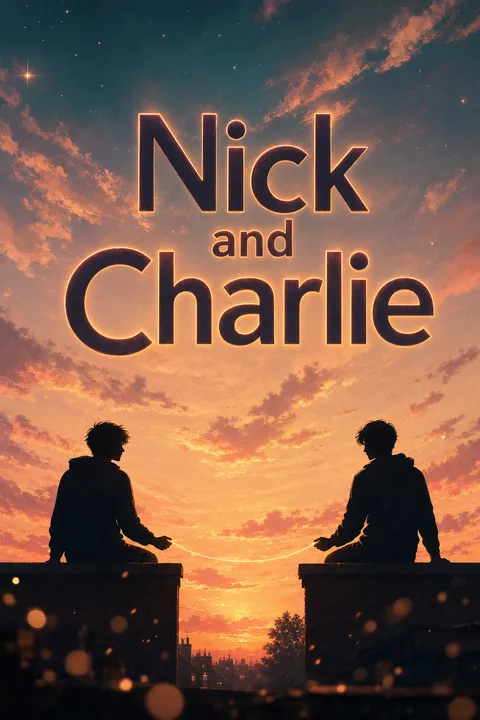


Plot Summary
Last Day at East High
On the final day of school, dressed up as a High School Musical fever dream complete with a cardboard fort and stolen barbecue, Charlie Spring,1 the Head Boy who never actually enforces anything, is sent to shut down the fun and cheerfully refuses. He weaves through the sea of red costumes to find his boyfriend of two years, Nick Nelson,2 in basketball shorts.
Nick2 has bought a disposable camera, wanting real photographs for his university wall, and keeps snapping candid shots of Charlie.1 Beneath the clowning, Charlie1 feels the ground shifting: this is the last time they will share a school. Six years of the same corridors end here, and one of them is leaving.
Oseman opens on manufactured nostalgia (the HSM theme, the collective performance of goodbye) to expose a private grief underneath. The disposable camera is introduced as both prop and thesis: Nick instinctively tries to preserve an ending he cannot stop. Charlie's Head Boy role, all charm and quiet noncompliance, mirrors his emotional strategy, managing everyone's feelings while hiding his own. The dual first-person structure lets us feel the asymmetry immediately: Nick reads the day as a threshold to freedom, Charlie as the countdown to abandonment. The chapter establishes their intimacy as domestic and unspoken, setting up a conflict rooted not in absence of love but in fear of it ending.
The University Onslaught
Nick,2 bound for the University of Leeds two hundred miles away in September, floods Charlie1 with texts about double beds, IKEA, kitchen utensils and rugby tryouts. Each message lands like a small wound. Charlie,1 still facing another year at school, dreads being the one left behind, but refuses to spoil Nick's2 joy, so he fakes enthusiasm and deletes his Tumblr, where anonymous strangers keep insisting long-distance relationships always collapse.
His friend Aled4 gently suggests he simply talk to Nick.2 Charlie1 can't; every honest sentence would make Nick2 feel guilty. Instead, at home, he combats his fear by flirting hard and going quiet, swallowing the anxiety until it curdles into a bad mood he won't explain.
This section anatomizes avoidant coping. Charlie's silence is not indifference but a distorted form of care: he protects Nick's happiness by starving his own needs, a pattern the text quietly links to his eating disorder, another arena where he denies himself. Oseman weaponizes the ordinary cruelty of the internet, letting faceless followers externalize Charlie's worst fears until they feel like prophecy. The irony is structural: two people terrified of losing each other cannot say so, because each believes honesty is a burden. Nick's obliviousness is not callousness but the tunnel vision of someone leaping toward a future, unable to see the person he is inadvertently leaving in shadow.
The News That Breaks Charlie
At Harry Greene's7 leaving party, Charlie1 drinks himself unsteady and deliberately keeps his distance from Nick,2 unable to bear more university talk. When Nick2 checks on him, Charlie1 snaps at him publicly, then contradictly hints he wants a bathroom hookup.
In the basement, Aled4 lets slip that Tao5 and Elle,8 together nearly as long as Nick2 and Charlie,1 have decided to break up at summer's end rather than attempt long distance, because Elle8 wants a fresh start. The revelation guts Charlie.1 If a couple that solid can simply dissolve, he reasons, maybe Nick2 secretly wants the same escape. Crying on the floor beneath flashing fairy lights, he convinces himself he is boring, disposable, and about to be discarded.
The Elle and Tao subplot functions as a warped mirror, a cautionary tale Charlie misreads as inevitability. His drunkenness dismantles the emotional regulation he has clung to, and the alcohol turns suppressed fear into projection: he assigns Nick a desire Nick has never expressed. The whiplash between hostility and seduction reveals a self-worth in freefall; Charlie oscillates between pushing Nick away and clutching at physical closeness, unable to trust that he is wanted for himself. Oseman captures the specific adolescent terror of being ordinary, the belief that a quiet love is a lesser love, one that cannot survive the glamour of new places and new people.
The Storm-Lit Argument
Dragged upstairs to the empty conservatory as rain hammers the glass roof, Charlie1 tells Nick2 he can break up with him if he wants a fresh start, citing Elle and Tao. Nick,2 blindsided and hurt, hears it as cowardice, an attempt to force him into ending things. The fight escalates into shouting and tears from both.
Charlie1 finally erupts: he is the one being abandoned, stuck in their dead town while Nick2 chases a shiny new life and talks about it like escape. Nick2 counters that he cannot refuse university. When Charlie1 coldly calls him mate, a word they never use, and tells him to leave, Nick2 storms out, sits in his car for twenty minutes hoping, then drives home alone.
The thunderstorm is unabashedly pathetic fallacy, but Oseman earns it by keeping the fight psychologically precise. Neither says what they mean; both hear the opposite of what is intended. Charlie's offer to be dumped is a test disguised as generosity, a bid for reassurance that backfires because Nick cannot decode it through his own fear. The word mate becomes a scalpel, weaponizing casual masculinity to signal emotional demotion. What ruptures here is not love but communication: two people fluent in each other's silences suddenly speak past one another. Nick lingering in the car, hoping Charlie will run out, is the ache of a door left painfully ajar.
Two Weeks of Silence
Neither boy reaches out. Charlie1 wakes hungover and hollow, the old emptiness he associates with his illness creeping back; his sister Victoria3 finds him crying on the sofa and insists he must say something, anything. But days bleed by. Charlie1 sits his exams mechanically, checking his silent phone obsessively.
Nick,2 meanwhile, collapses into his duvet, skips walking his dog, and tells his worried mother9 that Charlie1 broke up with him, a conclusion he has invented from the wreckage. Each believes the relationship is over; each is too frightened of confirmation to ask. The silence hardens into a fact neither chose, a breakup made real only by mutual paralysis rather than by any actual decision.
This is the novella's cruel middle: a relationship dying not from conflict but from a stalemate of assumptions. Oseman renders depression with unshowy accuracy, Nick's unwashed hair and neglected dog, Charlie's returning numbness, showing how heartbreak reactivates older wounds. The parallel POVs generate dramatic irony that borders on unbearable; the reader knows both boys are grieving the same phantom loss, each certain the other has moved on. It dramatizes a distinctly modern intimacy where a read receipt carries the weight of a verdict, and where pride and terror conspire to keep two people apart. The tragedy is entirely preventable, which is precisely what makes it agonizing.
Friends Force the Reckoning
The stalemate cracks thanks to people who see clearly from the outside. Nick's2 Cambridge-bound friend Sai6 stages a gaming-and-sweets intervention and demolishes Nick's2 theory that they are a boring, doomed teenage couple, arguing that most couples never come close to their closeness, and that Elle and Tao's ending says nothing about them.
He orders Nick2 to talk to Charlie.1 At Charlie's1 end, Aled4 makes the pivotal observation: Nick2 never once said he wanted to break up; if he thought Charlie1 wanted out, he would simply be heartbroken and let him go. Victoria,3 exhausted by her brother's misery, bluntly commands him to act. Slowly, each boy begins to grasp that the breakup exists only inside their own fear.
Oseman uses the supporting cast as diagnostic instruments, articulating truths the protagonists are too enmeshed to see. Sai's dismantling of the boring relationship narrative directly rebuts Charlie's chapter-three spiral, reframing ordinariness as intimacy rather than deficiency. Aled's insight is the emotional hinge of the book: it exposes the symmetrical misreading at the core of the conflict, that both boys interpreted the other's silence as rejection. This is the wisdom of friendship as external cognition, a reminder that love sometimes requires witnesses to survive its own distortions. The scenes also quietly rehabilitate Tao and Elle from villains to simply a different couple making a different, valid choice.
The Camera Full of Charlie
Victoria3 discovers Nick's2 lost disposable camera wedged in the sofa. Charlie1 has it developed, and on the bus home the photographs undo him: nearly every frame is of him, asleep in Nick's2 bed under orange streetlight, hugging the dog, laughing mid-blur, curled in the car. Nick,2 who never cared about art, had been quietly hoarding their unremarkable life to carry to Leeds.
Charlie1 understands at last that he was never boring to Nick;2 he was the whole point. He texts the images one by one, then posts a developed photo through Nick's2 letterbox with a note confessing his love and inviting Nick2 to the Truham Primary School summer fete the next day.
The camera's payoff completes the arc begun on the first page: what looked like Nick's inability to let go is revealed as devotion made tangible. The photographs answer Charlie's central fear (that he is disposable) with overwhelming visual evidence of his centrality. Oseman stages an epiphany through objects rather than dialogue, letting the images speak the reassurance the boys could not. Charlie's shift from passive suffering to romantic gesture marks genuine growth; the boy who avoided every hard conversation now risks humiliation to reach out. The physical photo through the letterbox, analog and vulnerable, becomes a rebuke to the read receipts and blank texts that failed them.
The Fete, the Chocolate, the Beach
At the fete's tennis court, Nick2 appears. It emerges that his cracked phone never received Charlie's photo texts, only blank messages he assumed were a glitch, so the silence was partly technological accident. Scrolling through their pictures together, both finally say aloud that they never wanted to break up, trading apologies for the party.
Charlie1 hands Nick2 the chocolate he bought and, in a small triumph over his eating disorder, eats a piece himself. They ditch the fete for their favorite quiet beach, the arcade, and the pier at sunset, then spend the night together, tender and unhurried. Nick2 admits he loves Charlie1 more than anyone. The next morning, he coaxes Charlie1 to skip school and simply stay.
The resolution reframes the entire crisis as a failure of communication compounded by literal signal loss, a wink at how fragile modern connection is. Crucially, reconciliation does not erase the university problem; it dissolves the fear around it, and the couple emerges, in Charlie's words, into a new era, sturdier for having survived the rupture. Charlie eating the chocolate is the book's most understated victory: recovery and love braided together, trust in Nick spilling into trust in himself. Oseman resists a tidy fix to long distance, insisting instead that security comes from chosen honesty. The final morning inverts the opening's dread, turning the ordinary act of staying in bed into quiet defiance of everything trying to separate them.
Analysis
Nick2 and Charlie1 is a novella about the specific dread of being left behind, and about how love can nearly die from a failure of nerve rather than a failure of feeling. Oseman sets her crisis at a threshold, the end of school, when one boy leaps toward a future and the other counts down toward loss. The genius of the book is that nothing external destroys the couple: no infidelity, no cruelty, no fading affection. The rupture is manufactured entirely from fear, projection, and silence, then sealed by a literal phone malfunction. This makes the pain both mundane and universal, the argument every insecure lover has rehearsed in their head. The dual narration weaponizes dramatic irony, letting readers ache with the knowledge that both boys are grieving the same imaginary breakup. Thematically, the novella interrogates the myth that ordinary love is lesser love. Charlie's1 conviction that he and Nick2 are boring, that quiet domesticity cannot compete with university's glamour, is the wound the whole plot pressures. Sai's6 rebuttal and, more powerfully, the camera full of Charlie's face, reframe unremarkable intimacy as the deepest kind. Oseman threads mental health through the romance with care: Charlie's1 anorexia and the returning emptiness during the silence show how heartbreak reactivates older damage, and the shared chocolate turns recovery and reconciliation into a single gesture. The book also captures a distinctly digital adolescence, where anonymous strangers seed doubt, read receipts function as verdicts, and a physical photograph pushed through a letterbox becomes an act of courage precisely because it cannot be undone or misread. Its lesson is disarmingly simple and hard to practice: say the frightening thing out loud. Love survives not through grand romance but through the willingness to be honest before silence hardens into fact.
Review Summary
Nick and Charlie follows the beloved couple from Heartstopper as they navigate their relationship when Nick prepares for university. Many readers found it cute and emotional, though some felt it lacked the depth of the graphic novels. The novella explores themes of long-distance relationships, communication, and mental health. While some readers appreciated the more realistic portrayal of their relationship, others found Charlie's behavior frustrating. Overall, fans enjoyed revisiting the characters but had mixed feelings about the execution and character development in this format.
People Also Read







Characters
Charlie Spring
Anxious Head Boy boyfriendA seventeen-year-old Year 12 student and Truham's Head Boy, Charlie is quick-witted, charming, and expert at keeping teachers and peers alike at a comfortable distance. Beneath the composure sits a fragile self-worth: a recovering anorexic who spent time in a psychiatric hospital the year he and Nick2 got together, he still struggles to believe he deserves love or food he isn't forced to accept. His deepest wound is a conviction that he is boring and disposable, which he manages through avoidance, lying to spare others, and suppressing his own needs. Devoted to Nick2 with an intensity he finds embarrassing, Charlie narrates half the book with self-deprecating honesty, hiding pain behind jokes. His arc traces the terror of being left behind into a hard-won trust in being genuinely wanted.
Nick Nelson
University-bound devoted boyfriendEighteen, in Year 13, and about to leave for the University of Leeds, Nick is warm, steady, and openly affectionate, a rugby-loving, dog-adoring bisexual who has come out repeatedly and learned to weather the discomfort. He reads Charlie1 better than anyone, attuned to his moods and vigilant about his eating, yet his excitement about university blinds him to the grief it causes. Nick's instinct to photograph everything reveals a sentimental heart that clings to what it loves. Not especially academic or articulate about feelings, he processes hurt through withdrawal and sulking. His journey is learning that leaving for a new life need not mean abandoning the person who makes home feel like home, and that closeness, not spectacle, defines their love.
Victoria (Tori) Spring
Charlie's deadpan sisterCharlie's1 older sister, sardonic and outwardly apathetic, who watches Bridesmaids at eleven in the morning and hides deep care beneath eye-rolls. She comforts Charlie1 when he breaks down, bluntly pushes him to stop sulking and actually talk to Nick2, and engineers the letterbox gesture. Her dry humor masks fierce loyalty; she is the sibling who normally makes Charlie1 eat and always tells him the truth.
Aled Last
Shy insightful friendCharlie's1 extremely shy, colour-coding classmate and one of his closest friends. Quiet to the point of near invisibility, Aled nonetheless delivers the story's clearest truths: that Nick2 never actually said he wanted to break up, and that the two of them are the closest thing to soul mates he can imagine. His gentle, hesitant candor cracks Charlie's1 spiral of self-doubt at crucial moments.
Tao Xu
Eccentric friend, Elle's boyfriendCharlie's1 flamboyant friend, given to Wes Anderson wardrobe choices and red beanies, dating Elle8 for nearly as long as Nick2 and Charlie1 have been together. His and Elle's8 decision to end things for a fresh start at university inadvertently triggers Charlie's1 crisis. Later he texts a sincere apology and reassures Charlie1 that Nick2 clearly never wanted to break up.
Sai
Nick's blunt wise friendNick's2 Cambridge-bound friend who stages a Mario Kart intervention and demolishes Nick's2 belief that their relationship is boring or doomed, insisting most couples never achieve their closeness and ordering him to talk to Charlie1.
Harry Greene
Notorious party hostTruham's loudest, most famous student, known for constant chatter and legendary parties. He wears a child-sized cheerleader costume on the last day, pickpockets Nick's camera for a photo, and hosts the leavers' party where the central argument erupts.
Elle Argent
Tao's girlfriend leavingA girl from Nick's2 year who has dated Tao5 almost as long as Nick2 and Charlie1 have been together. Her wish for a fresh start prompts their mutual breakup, the news that ignites Charlie's1 fear.
Nick's mum
Nick's gentle motherWarm and permissive, she lets Charlie1 stay over freely, worries about being alone once Nick2 leaves, and comforts her heartbroken son2 with pizza, hugs, and reassurance during the two weeks of silence.
Plot Devices
The disposable camera
Object that carries devotionNick2 buys a disposable camera on the last day of school, wanting physical photographs for his university wall, and compulsively snaps candid shots of Charlie1. The camera is lost during the party preparations and later found wedged in the Spring family sofa. When Charlie1 develops the film, he discovers the roll is almost entirely images of him, asleep, laughing, hugging the dog, proof that Nick2 treasured their unremarkable daily life. The device transforms from a symbol of Nick's2 inability to let go into tangible evidence answering Charlie's1 fear of being disposable, and one of its printed photos, pushed through the letterbox with a handwritten note, becomes the gesture that reunites them.
The Elle and Tao breakup
Cautionary mirror coupleTao5 and Elle8, a couple of comparable longevity to Nick2 and Charlie1, decide to split at summer's end rather than attempt long distance. Revealed offhandedly by Aled4 at the party, this news functions as a distorting mirror: Charlie1 misreads their pragmatic choice as proof that all such relationships, including his own, are destined to end. It supplies the specific spark that converts his generalized dread about Nick2 leaving into the drunken conviction that Nick2 secretly wants out, directly triggering the central argument. Later, the same couple is quietly rehabilitated as simply a different pair making a valid, different decision, reframing Charlie's1 panic as projection rather than prophecy.
The broken phone glitch
Misunderstanding engineNick's2 cracked phone, damaged when he dropped it down the stairs, can no longer receive picture messages. When Charlie1, after his epiphany, texts the couple's photographs one by one as a reconciliation attempt, Nick2 sees only a string of blank messages and assumes a technical fault, further convincing him the relationship is over. This accidental communication failure compounds the emotional silence with a literal signal loss, deepening the false belief that they have broken up. Its eventual explanation at the fete reveals how much of their heartbreak rested on misread signals, underscoring the novella's theme that fragile modern connection can amplify fear into apparent fact.
Dual first-person narration
Alternating POV ironyThe novella alternates between Charlie's1 and Nick's2 first-person voices, often covering the same events from both sides. This structure generates sustained dramatic irony: the reader sees that both boys are grieving the identical phantom breakup, each certain the other has moved on, while neither can access the other's interior. During the two weeks of silence especially, the device makes the estrangement unbearable and preventable, since the audience holds the reconciling knowledge both characters lack. It renders the central lesson structurally, showing that intimacy fails not from absent love but from the inability to voice it across the gap between two minds.
Food and the shared chocolate
Recovery made visibleCharlie's1 history of anorexia surfaces through Nick's2 habitual, hopeful question about whether he wants to eat, a ritual of patient care rather than pressure. Throughout the book, stress registers in Charlie's1 eating: he takes longer over dinner when anxious, rarely touches snacks. At the reconciliation, Charlie1 hands Nick2 the Oreo Dairy Milk bar he bought him and then, unprompted, eats a piece himself despite his familiar jolt of fear. This quiet act braids romantic trust with recovery, signaling that his renewed security in Nick's2 love spills into a fragile but real trust in himself, one of the story's most understated emotional victories.
FAQ
Synopsis & Basic Details
What is Nick and Charlie about?
- Navigating Post-School Transition: Nick and Charlie explores the emotional challenges faced by Nick Nelson, a recent high school graduate, and Charlie Spring, his younger boyfriend, as Nick prepares to leave for university. The story delves into Charlie's deep-seated anxieties about being left behind and the strain this places on their two-year relationship.
- Love Against Uncertainty: It's a poignant narrative about a couple confronting the universal fear of change and separation, specifically how a long-distance relationship might impact their established intimacy and daily routines. The novella highlights their struggle to communicate these fears openly, leading to misunderstandings and a significant argument.
- Reconciliation and Growth: Ultimately, the story follows their journey of reconciliation, as they learn to articulate their insecurities, reaffirm their commitment, and find a stronger, more mature foundation for their love, embracing the "boring" yet profound aspects of their shared life.
Why should I read Nick and Charlie?
- Authentic Emotional Depth: Readers should engage with Nick and Charlie for its raw, honest portrayal of adolescent anxiety and the complexities of a long-term relationship facing its first major challenge. It offers a relatable exploration of self-doubt, fear of abandonment, and the courage required to be vulnerable with a partner.
- Insightful Relationship Dynamics: The novella provides a nuanced look at how communication breakdowns can escalate conflict, even between deeply loving individuals, and the profound relief and growth that comes from honest dialogue. It celebrates the quiet, everyday moments that truly define a lasting connection, challenging the notion that young love is inherently fleeting.
- Continuity for Heartstopper Fans: For fans of Alice Oseman's Heartstopper series, this novella offers a crucial continuation of Nick and Charlie's story, providing deeper insights into their post-school life and the evolution of their relationship beyond the initial romance. It addresses common reader questions about their future, offering a satisfying and mature progression of their beloved characters.
What is the background of Nick and Charlie?
- Post-Heartstopper Universe: Nick and Charlie is set within the established universe of Alice Oseman's Heartstopper graphic novels, serving as a direct continuation of Nick and Charlie's relationship after the events of the main series. It builds upon their established history, including Charlie's past struggles with mental health and Nick's journey of self-discovery.
- Cultural Context of Young Adulthood: The story is deeply rooted in the contemporary experience of British teenagers transitioning from secondary school to university, reflecting common anxieties around independence, long-distance relationships, and the pressure to "have a fresh start" at university. The inclusion of social media (Tumblr) highlights external influences and the public gaze on young, queer relationships.
- Intertextual Allusions: The novella subtly weaves in literary and pop culture references, such as the Pride and Prejudice epigraph foreshadowing relationship "danger" and the High School Musical theme contrasting with the characters' real-life emotional complexities. The inclusion of an extract from Oseman's Solitaire also provides a deeper look into Tori Spring's character and her own struggles with cynicism and connection, enriching the broader Osemanverse.
What are the most memorable quotes in Nick and Charlie?
- "You're Nick and Charlie, aren't you?": This recurring phrase, spoken by friends like Tao and Aled, encapsulates the almost mythical status of Nick and Charlie's relationship among their peers. It highlights the external pressure and idealized perception of their bond, which ironically contributes to Charlie's internal struggle and fear of not living up to this "perfect" image, making their eventual, messy reconciliation all the more powerful.
- "I don't want to break up with you, ever.": Spoken by Nick during their reconciliation, this simple yet profound statement cuts through all the previous miscommunication and fear. It signifies a renewed, unwavering commitment, emphasizing that despite the challenges of long-distance and personal anxieties, their love is a conscious, enduring choice they both make.
- "I love you more than anyone, actually.": Nick's quiet confession, followed by Charlie's equally profound "I'm weird too," reveals the deep, unconventional nature of their bond. It acknowledges their unique, intense connection that defies typical teenage relationship norms, transforming their perceived "weirdness" or "boring" life into a source of profound strength and mutual understanding.
What writing style, narrative choices, and literary techniques does Alice Oseman use?
- Intimate Dual Perspective: Oseman employs a first-person dual narrative, alternating between Nick and Charlie's perspectives. This choice immerses the reader directly into each character's internal monologue, revealing their distinct anxieties, unspoken thoughts, and emotional processing, which is crucial for understanding the miscommunication that drives the plot.
- Conversational and Relatable Tone: The writing style is highly conversational, reflecting authentic teenage dialogue and thought patterns, making the characters and their struggles immediately relatable. This is achieved through informal language, internal asides, and a focus on everyday interactions, grounding the emotional drama in a realistic setting.
- Subtle Symbolism and Foreshadowing: Oseman masterfully uses subtle literary techniques, such as pathetic fallacy (the rain at the party mirroring emotional turmoil), recurring motifs (the disposable camera, the "Nick and Charlie" phrase), and foreshadowing (Tumblr messages, Tao and Elle's breakup) to deepen thematic resonance and build tension without heavy-handed exposition.
Hidden Details & Subtle Connections
What are some minor details that add significant meaning?
- Nick's Phone Glitch: The detail that Nick's old phone cannot receive picture messages, causing Charlie's grand gesture of sending photos to appear as "blank texts," is a profound piece of dramatic irony. It highlights how easily communication can fail, even with the best intentions, and literally embodies the "miscommunication and silence" theme, forcing a face-to-face confrontation rather than a digital one.
- Charlie's Oreo Dairy Milk Gift: Charlie buying Nick an Oreo Dairy Milk bar, a specific detail mentioned as Nick's obsession, is more than just a thoughtful gesture. It symbolizes Charlie's deep knowledge of Nick's preferences and his attempt to reconnect through a familiar comfort, representing the return to their "boring" but deeply intimate rituals that define their love.
- Tori's Haircut Story: In the Solitaire extract, Tori's explanation for cutting her hair—a spontaneous act driven by overwhelming anxiety about starting Year 12 and feeling "choked" by her long hair—subtly parallels Charlie's own struggles with mental health and feeling overwhelmed. It reveals a shared family trait of internalizing stress and seeking drastic, sometimes symbolic, ways to cope, adding depth to Tori's protective nature towards Charlie.
What are some subtle foreshadowing and callbacks?
- Pride and Prejudice Epigraph: The opening quote, "I think you are in very great danger of making him as much in love with you as ever," subtly foreshadows the central conflict. It hints at the "danger" not of falling in love, but of the challenges that deep love faces, particularly the fear of loss and the potential for self-sabotage, setting a tone of emotional vulnerability.
- High School Musical Theme: The Year 13's High School Musical theme on their last day serves as a callback to an idealized, simpler vision of high school life. This contrasts sharply with the complex emotional reality Nick and Charlie are navigating, subtly highlighting the gap between youthful fantasy and the impending adult challenges of their relationship.
- "You're Nick and Charlie" Repetition: The recurring phrase "You're Nick and Charlie," used by friends like Tao and Aled, initially serves as a comforting affirmation of their strong bond. However, it subtly foreshadows the pressure this idealization places on them, particularly Charlie, who fears failing to live up to this image, contributing to his self-doubt and the eventual argument.
What are some unexpected character connections?
- Tori and Lucas Ryan's Reconnection: The unexpected reunion between Tori Spring and her childhood best friend, Lucas Ryan, in the Solitaire extract, provides a parallel narrative to Nick and Charlie's relationship. It highlights the theme of enduring connections and the possibility of rekindling past bonds, even after years of separation, reinforcing the idea that some relationships are meant to last.
- Sai Verma as Nick's Emotional Catalyst: Sai, initially appearing as just a friend, becomes a crucial, unexpected connection for Nick. His direct, rational "intervention" and blunt assessment of Nick and Charlie's relationship ("You're the most basic teenage relationship... Have you seen yourselves?") forces Nick to confront his own assumptions and insecurities, acting as a vital external voice that pushes Nick towards reconciliation.
- Harry Greene's Unintentional Role: While often portrayed as boisterous comic relief, Harry Greene's actions, such as pickpocketing Nick's camera and taking candid photos, unintentionally contribute to the plot's resolution. His presence, though seemingly superficial, facilitates the creation of the very "photo memories" that Charlie later uses to initiate their reconciliation, making him an unexpected, albeit indirect, catalyst.
Who are the most significant supporting characters?
- Victoria Spring (Tori): Tori is significant not just as Charlie's protective sister, but as a voice of cynical wisdom and unexpected emotional intelligence. Her directness ("You've had your tantrum time, okay? You're a Year 13 now.") and practical support (driving Charlie to Nick's house) are crucial catalysts for Charlie's decision to act, demonstrating the vital role of family in navigating emotional crises. Her internal world, hinted at in the Solitaire extract, also provides a deeper understanding of her own struggles with connection and apathy.
- Sai Verma: Sai serves as Nick's rational sounding board and an external validator of Nick and Charlie's unique bond. His blunt, yet supportive, assessment of their relationship ("You hang around with each other every single day and somehow haven't wanted to kill each other yet... Trust me, I've played board games with you two.") helps Nick reframe his anxieties and realize the strength of their connection, pushing him towards reconciliation.
- Aled Last: Aled is Charlie's quiet, empathetic confidant who, despite his shyness, offers profound insights. His observation of Charlie's distress ("I feel like you've been really down today.") and his assertion that "you're Nick and Charlie" and that Nick wouldn't "make it difficult for you" if he thought Charlie didn't love him, are pivotal in helping Charlie understand Nick's perspective and motivating him to reach out.
Psychological, Emotional, & Relational Analysis
What are some unspoken motivations of the characters?
- Charlie's Self-Sabotage: Charlie's aggressive flirting and lashing out at the party, culminating in his suggestion to break up, is an unspoken motivation driven by his deep-seated fear of abandonment and past trauma related to his mental health. He subconsciously attempts to control the pain of potential loss by initiating the breakup himself, believing he is "pathetic" and "boring" and that Nick will eventually leave him anyway.
- Nick's Desire for Normalcy: Nick's initial obliviousness to Charlie's distress and his enthusiastic focus on university plans are subtly motivated by a desire for a "normal" transition into adulthood, free from the complexities and anxieties that have sometimes defined his relationship with Charlie. He wants to believe that long-distance will be "fine," perhaps as a way to avoid confronting the emotional weight of separation.
- Tori's Protective Cynicism: Tori's sarcastic and seemingly apathetic demeanor often masks a deep, unspoken motivation to protect herself and those she cares about from emotional pain. Her directness with Charlie, though harsh, is a form of tough love, motivated by a desire to prevent him from spiraling into self-pity and to push him towards action, reflecting her own struggles with vulnerability as explored in Solitaire.
What psychological complexities do the characters exhibit?
- Charlie's Anxiety and Self-Worth: Charlie exhibits significant psychological complexity through his deep-seated anxiety, which manifests as self-deprecating thoughts ("I'm a fucking stupid idiot," "I'm so pathetic") and a fear of being a burden due to his past mental health struggles. His tendency to internalize external pressures (Tumblr messages, Tao and Elle's breakup) and project his insecurities onto Nick reveals a complex interplay of past trauma and present emotional vulnerability.
- Nick's Emotional Suppression and Idealism: Nick, while outwardly supportive, displays a psychological complexity in his tendency to suppress his own anxieties about the future and idealize the ease of their long-distance relationship. His shock and anger during the argument reveal a hidden vulnerability and a struggle to process intense negative emotions, highlighting his journey towards embracing emotional honesty rather than just optimism.
- The Paradox of "Boring" Love: Both Nick and Charlie grapple with the psychological complexity of their "boring" relationship, questioning its validity against societal expectations of exciting teenage romance. Their eventual acceptance and celebration of their quiet, everyday intimacy ("I love our weird, boring life") represents a mature psychological shift, valuing genuine connection over superficial excitement.
What are the major emotional turning points?
- The Party Confrontation: The explosive argument at Harry's party is the primary emotional turning point, where Charlie's bottled-up anxieties about Nick leaving for university finally erupt. This raw, messy confrontation, fueled by alcohol and misinterpretations, forces both characters to confront their deepest fears and the fragility of their unspoken assumptions about their relationship.
- Charlie's Discovery of the Photos: Charlie developing Nick's disposable camera and discovering numerous candid photos of himself marks a crucial emotional turning point. This visual evidence of Nick's quiet affection and desire to preserve their shared moments ("I think he just took them because he wanted to remember what this was like") shatters Charlie's self-deprecating belief that Nick is bored or wants to leave him, empowering him to initiate reconciliation.
- The Honest Conversation at the Fete: The face-to-face conversation at the primary school fete, where Nick and Charlie finally articulate their fears, apologies, and unwavering commitment, is the ultimate emotional turning point. It signifies a shift from passive suffering and miscommunication to active, vulnerable dialogue, laying the groundwork for a stronger, more resilient relationship built on mutual understanding.
How do relationship dynamics evolve?
- From Unspoken Comfort to Confronted Fears: Initially, Nick and Charlie's relationship dynamic is characterized by comfortable, almost telepathic understanding and shared routines. However, as Nick's university departure looms, this dynamic shifts to one burdened by unspoken fears and assumptions, leading to a breakdown in communication and a major argument.
- From Idealized Perception to Realistic Commitment: The relationship evolves from being perceived as an unbreakable, idealized "Nick and Charlie" unit by their friends to a more realistic, yet stronger, bond forged through conflict. They learn that love isn't about avoiding pain or change, but about actively choosing each other and working through difficulties, even when it's messy.
- From Codependency to Interdependent Growth: While their deep connection sometimes borders on codependency (Charlie's fear of being "on his own," Nick's worry about his mum), the conflict forces them to acknowledge their individual anxieties and needs. Their reconciliation marks a shift towards a more interdependent dynamic, where they support each other's growth while maintaining their strong bond, understanding that their love can accommodate individual paths.
Interpretation & Debate
Which parts of the story remain ambiguous or open-ended?
- The Long-Term Success of Long-Distance: While the ending is hopeful and the boys are committed, the story leaves the actual long-term success of their long-distance relationship open-ended. The novella concludes with them embracing the challenge, but the day-to-day realities and potential difficulties of Nick being two hundred miles away are not fully explored, leaving readers to ponder their future resilience.
- Charlie's Ongoing Mental Health Journey: The narrative touches upon Charlie's past struggles with anorexia and his lingering anxieties, but it doesn't fully detail his ongoing mental health journey. While his growth in communication is evident, the story leaves ambiguous the extent to which he will continue to manage his self-doubt and anxiety independently, or how future stressors might impact him.
- Tori's Personal Arc: The inclusion of the Solitaire extract, while enriching Tori's character, leaves her own personal struggles and relationships (particularly with Michael Holden and Lucas Ryan) largely open-ended within the context of Nick and Charlie. Her journey of overcoming cynicism and finding connection is hinted at but not resolved, inviting readers to explore her story further in Solitaire.
What are some debatable, controversial scenes or moments in Nick and Charlie?
- Charlie's Drunken Behavior at the Party: Charlie's actions at Harry's party, including his aggressive flirting, snapping at Nick, and suggesting a breakup while heavily intoxicated, could be seen as a controversial moment. Readers might debate whether his behavior was a justifiable expression of suppressed anxiety or an unfair, self-sabotaging act that placed undue emotional burden on Nick.
- Nick's Initial Reaction and Silence: Nick's immediate anger and subsequent nine-day silence after the argument could be debated. While understandable given Charlie's hurtful words, some might argue whether his withdrawal was a healthy response or if he should have initiated communication sooner, especially knowing Charlie's vulnerabilities.
- The "Nick and Charlie" Idealization: The recurring phrase "You're Nick and Charlie," used by their friends to describe their seemingly perfect relationship, can be a point of debate. While intended as supportive, it highlights the pressure of external idealization, which arguably contributes to Charlie's internal struggle and fear of failure, raising questions about the impact of public perception on private relationships.
Nick and Charlie Ending Explained: How It Ends & What It Means
- Reconciliation and Renewed Commitment: The story culminates in Nick and Charlie's heartfelt reconciliation at the primary school fete, where they finally communicate their fears and apologies openly. They reaffirm their deep love and commitment, choosing to face the challenges of a long-distance relationship together, symbolized by their shared chocolate and new photos.
- Embracing "Boring" Love and Growth: The ending signifies a profound shift in their understanding of love. They move past the initial idealization and the fear of being "boring," realizing that their deep, everyday intimacy is their greatest strength. This acceptance of their unique, quiet bond marks a significant emotional maturity, indicating that their relationship is now stronger and more resilient, built on honesty and mutual understanding.
- Hopeful, Not Naive, Future: While the future of their long-distance relationship remains a challenge, the ending is one of determined hope rather than naive certainty. They acknowledge the difficulties ahead but choose to confront them as a united front, demonstrating that love is an ongoing choice and a continuous process of growth, adaptation, and unwavering support for each other.
Osemanverse Series





About the Author

Download PDF
Download EPUB
.epub digital book format is ideal for reading ebooks on phones, tablets, and e-readers.








































