

Key Takeaways
Walk away at your peak, before the monster grinds you down
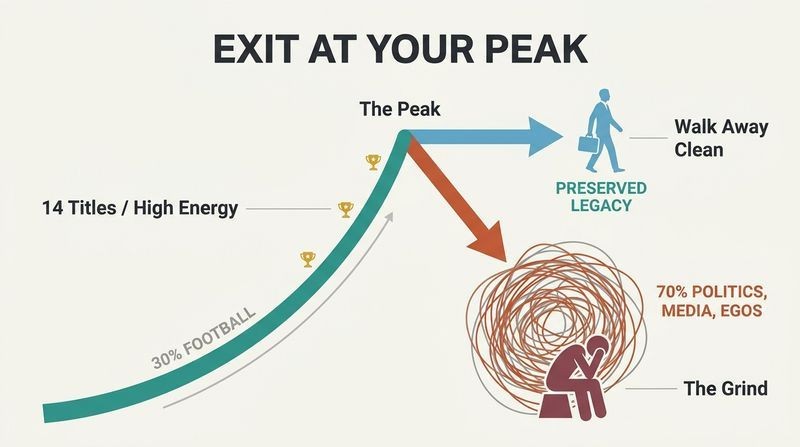
Guardiola resigned from Barcelona in April 2012 after four years and fourteen titles, at the height of the most dominant era in the club's history. His reason was not tactics or trophies but exhaustion. He told his players he was drained and had nothing left to give.
He had warned people this would happen. His mentor Johan Cruyff, who quit the Dream Team too late, advised him not to overstay. Charly Rexach's rule captured why the job devours you: a Barcelona coach spends only 30 percent of his energy on football and 70 percent managing everything else (media, president, politics, egos). Guardiola believed a team that always wins loses its hunger, and he could not summon the strength to rebuild that appetite a fifth time.
What's striking is how this inverts the usual sports narrative of clinging to power. Guardiola treated emotional capital as a depletable resource, much like the concept of decision fatigue in psychology, where the quality of choices degrades after prolonged exertion. Sir Alex Ferguson, who managed United for 26 years, could not comprehend the decision, suggesting temperament matters as much as circumstance. The tension is real: some leaders (Ferguson, Wenger) are energized by the prison of the job, while others are consumed by it. Guardiola's self-knowledge, recognizing his own limits rather than testing them to collapse, is arguably rarer and braver than endurance.
Beg for the failing reserve team when offered the prestigious job
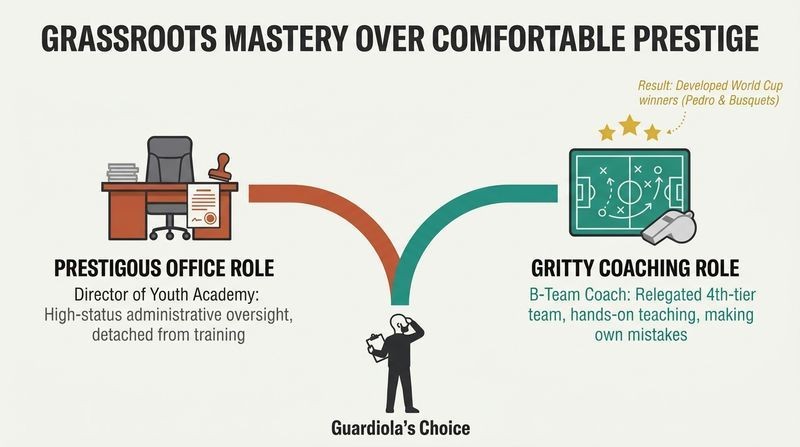
In 2007, sporting director Txiki Beguiristain offered Guardiola the role of director of Barcelona's entire youth academy, a prestigious, well-paid, logistical position. Guardiola turned it down. He wanted to coach the B team, which had just been relegated to the fourth tier of Spanish football, four divisions below La Liga.
Beguiristain thought he was crazy, warning it was easier to win La Liga than to win promotion from that division. But Guardiola insisted he wanted to be hands-on, to teach, to make his own mistakes rather than inherit others'. He disbanded the C team, cut fifty players to twenty-three, imposed strict discipline, scouted third-division opponents on video, and won promotion. The players he developed there, Pedro and Busquets, became World Cup winners within two years.
This is a masterclass in deliberately choosing a lower-status, higher-learning environment, echoing what psychologist Anders Ericsson called deliberate practice: growth demands a controlled arena where feedback is immediate and failure is survivable. The B team was Guardiola's laboratory, away from media glare. There is a counterintuitive career lesson here that applies well beyond football: proximity to the actual work often teaches more than an elevated overseer role. The risk, of course, is survivorship bias. Guardiola succeeded spectacularly, so the gamble looks wise. Countless others who take the humble path never rise. What made it work was that his experiment was reversible and his talent pool exceptional.
Sell your three biggest stars to protect one emerging genius
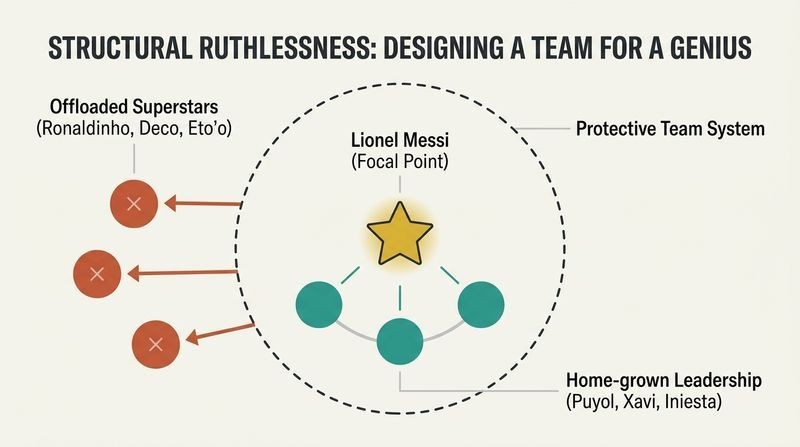
Upon taking charge in 2008, the 37-year-old rookie coach immediately offloaded Ronaldinho, Deco, and eventually Samuel Eto'o, three of the most decorated players at the club. Ronaldinho, once the world's best, had descended into nightclub indiscipline. Guardiola's ruthlessness announced his authority instantly.
The deeper logic was structural. Guardiola reorganized the entire team around Lionel Messi, moving him into a false nine role (a forward who drops into midfield, leaving centre backs with no one to mark). Every striker who competed for the spotlight, Eto'o, then Ibrahimovic, then Bojan, was eventually sold because their egos could not coexist with Messi's ascendance. Guardiola handed captaincy and leadership to home-grown players (Puyol, Xavi, Iniesta), while Messi led purely through football. Messi scored 73 goals in Guardiola's final season.
Guardiola's insight resembles a portfolio concentration strategy: identify your singular asset and subordinate everything to maximize it. This clashes with conventional team-building wisdom about depth and redundancy. The Ibrahimovic saga exposes the cost. A world-class 66-million-euro striker was rendered useless and hostile because the system had room for only one sun. Organizational theorists would note the danger of a single point of failure. Barcelona's over-dependence on Messi eventually became a vulnerability, as Chelsea demonstrated in 2012 by simply crowding him. The genius and the flaw are the same decision. Building around irreplaceable talent yields historic peaks and fragile ceilings.
Never lose the ball: possession is both attack and defense
Guardiola inherited and radicalized a philosophy planted by Laureano Ruiz in the 1970s and codified by Cruyff: dominate the ball, and the opponent cannot hurt you. The principle is deceptively simple. If you have the ball, the other team does not.
His innovations pushed this to extremes:
1. Build attacks from the goalkeeper and centre backs, treating the keeper as an outfield player.
2. Always position more players near the ball than the opponent, creating numerical superiority.
3. Press to win the ball back within five seconds of losing it, then drop into defense if unsuccessful.
4. Use possession to provoke opponents out of position, not merely to keep the ball.
He favored tiny, intelligent midfielders in an era obsessed with pace and power, turning apparent weakness into a system.
The five-second counterpress, later popularized as gegenpressing, reframes defense as the immediate aftermath of attack rather than a separate phase. This spatial-temporal thinking anticipates modern data-driven football. What makes Barcelona's model philosophically interesting is its rejection of the effectiveness-versus-beauty dichotomy. Guardiola argued beautiful football is beautiful because it is effective, not despite it. Andre Villas-Boas noted this style would struggle in England, where the risk of losing the ball near your own goal is culturally intolerable. That caveat matters: the system required players of extraordinary technical quality (Xavi, Iniesta, Messi) who could execute passes others could not attempt. The philosophy is not universally portable.
Explain why, not just what, and players self-correct on the pitch
Guardiola refused to simply issue orders. He explained the reasoning behind every instruction, believing that when players understand why they act a certain way, they believe in it more deeply and can improvise responsibly when the game changes.
Piqué described it as receiving a rich tactical manual rather than commands. This understanding allowed Barcelona to switch formations five or six times within a single match, reacting instantly to what the coach shouted from the touchline. Goalkeeper Victor Valdes, who admitted he had zero tactical knowledge before Guardiola arrived, described his four years as working through a degree in tactics. The approach mirrors Guardiola's own belief that his real vocation was teaching, coaching kids who still wanted to learn.
This aligns with self-determination theory in psychology, which holds that autonomy and competence drive intrinsic motivation. By giving players the reasoning, Guardiola converted compliance into ownership. Modern pedagogy calls this the difference between rote learning and conceptual understanding, and the latter transfers far better to novel situations, exactly what a chaotic football match demands. There is also a leadership parallel to the military concept of commander's intent: communicate the goal and logic so subordinates can adapt when plans meet reality. The limitation is that this method demands intelligent, receptive students. Guardiola himself noted it grows harder to inspire the same players after four years together.
Demand effort you can control, forgive mistakes you cannot
In his foundational team talk at St Andrews, Scotland, in 2008, Guardiola laid out his core bargain: he would forgive any misplaced pass or missed header, but he would never forgive a player who failed to give everything. Results he could not promise. Performance and effort he demanded absolutely.
This distinction runs through his whole method. He judged players on work rate, not private lives, refusing to police them in hotels the night before games and instead letting them sleep at home with their families. He redesigned the club around common sense: eating meals together, moving to a secluded training ground, banning individual media interviews to avoid favoritism. He abolished his own fine system after two years once the group self-disciplined.
Guardiola isolates the controllable (effort, preparation) from the uncontrollable (outcomes, luck), a principle borrowed almost directly from Stoic philosophy and now central to sports psychology's process-versus-outcome goal-setting. Focusing athletes on process reduces performance anxiety and paradoxically improves results. His refusal to treat players like children, trusting them to rest at home, reflects a bet that autonomy breeds responsibility, echoing management theorist Douglas McGregor's Theory Y. The approach worked because it was paired with relentless standards. Trust without demand is indulgence, as Rijkaard's undisciplined final season showed. Guardiola's genius was pairing warmth with non-negotiable intensity.
Emotional closeness with players is a gift with an expiry date
Guardiola invested unusually deep emotional capital in his players, hugging them, mothering them, blurring the line between coach and friend. He needed them to love him back, and when a player refused to look at him or speak to him, it wounded him personally.
But this intimacy carried a hidden cost. Because he could not bear to hurt the players he cared for, decision-making became agony. When the balance broke, he phoned a leading manager to ask: do you go, or do you change players? The answer, which Ferguson lives by, was change players. Guardiola could not. He felt too morally beholden to his footballers. That emotional entanglement, the very thing that built the group, ultimately made staying unbearable and drove him out.
This reveals the shadow side of transformational leadership, which relies on emotional bonds to inspire extraordinary commitment. Research on emotional labor shows that leaders who deeply invest personally face higher burnout, precisely Guardiola's fate. The contrast with Ferguson is instructive: Ferguson maintained professional distance, treating players as assets to be moved, which granted him longevity across decades. Guardiola's love made his teams transcendent and his tenure short. There is a genuine tradeoff here between depth and durability. The players who fell outside his affection (Eto'o, Ibrahimovic, Bojan, Yaya Toure) all described the same chilling withdrawal once the emotional connection died. Intimacy at scale is unsustainable.
Treat your best player differently, because equal treatment is a myth
As a teenage ballboy, Guardiola waited to get his idol Michel Platini's autograph, only to learn Platini did not come out to warm up with the other players. The lesson stuck: the greatest lie in football is that all players are treated as equals.
He applied it with Messi. To win the young Argentinian's trust, Guardiola defied the club and let him play in the 2008 Beijing Olympics, risking Champions League qualification. Later he handed Messi extraordinary freedoms: earlier holidays, a special diet, a best friend kept on contract, and license to skip defensive duties others could not. He loved all his players, he said, but he would not treat them all the same. Messi rewarded him by becoming arguably the greatest player ever.
Guardiola's principle contradicts a naive egalitarianism that pervades team management. Volleyball coach Julio Velasco taught him that your star is both your greatest asset and heaviest burden, because you are simultaneously above your players and dependent on them. This is the essence of star management: differentiated treatment calibrated to leverage. Modern organizations wrestle with the same tension, whether to build systems around irreplaceable talent or enforce uniform rules for cohesion. The danger, which Barcelona eventually hit, is that privileging one individual can breed resentment and imbalance. By his final season, Guardiola wondered whether he had created a monster, with Messi scoring 73 goals while teammates abdicated responsibility.
An enemy who provokes you can sharpen you or break you
Jose Mourinho, once Guardiola's friendly colleague under Bobby Robson at Barcelona, became his nemesis as Real Madrid coach. Mourinho waged psychological warfare through press conferences, accusations against referees, and conspiracy theories, believing games start and finish at the microphone.
Guardiola bit his lip for a year until, before a 2011 Champions League semi-final, he snapped, sarcastically calling Mourinho the boss of the press room. His team then won. The rivalry, four Clasicos in eighteen days at its most intense, pushed Guardiola to his psychological limit. He later confided that Mourinho had won the war, a conflict he never wanted, one that poisoned even his memories of the great matches. Estiarte called Mourinho's dark arts draining, tiring, and unfair.
The Guardiola-Mourinho duel illustrates asymmetric warfare between two personality types. Mourinho, thriving on conflict, energized his players through an us-against-the-world siege mentality, a documented cohesion-building tactic. Guardiola, who drew energy from harmony, found the same conflict corrosive. Crucially, Mourinho spent no energy managing his players' hunger, because watching Barcelona win made them hungrier, whereas Guardiola exhausted himself fueling a sated group. The episode shows that the same competitive pressure can be fuel or poison depending on temperament. Arrigo Sacchi called them two Picassos of the same era. The tragedy is that Guardiola's sensitivity, his greatest coaching strength, was precisely what Mourinho weaponized against him.
Motivate through story and emotion, but know when it backfires
Guardiola was a master of the emotional team talk. Before the 2009 Champions League final against Manchester United, he secretly commissioned a seven-minute video splicing his squad with footage from the film Gladiator, honoring every player. It moved men to tears in the dressing room.
But it may have worked too well. Iniesta admitted Barcelona's opening minutes were awful, and Guardiola conceded he might have stirred the players too much. By contrast, before the 2011 Wembley final, he delivered a purely tactical talk so precise that Mascherano felt he had already played the match. He also used outside speakers, like Andes plane-crash survivor Fernando Parrado, whose tale of eating the dead to survive taught the squad about rebellion against catastrophe.
This surfaces a nuance often lost in leadership literature that fetishizes inspiration. The Yerkes-Dodson law in psychology describes an inverted-U relationship between arousal and performance: too little energy and you are flat, too much and you choke. Guardiola's Gladiator video pushed his players past the optimal arousal point, degrading their early execution. His evolution toward cold tactical clarity at Wembley shows a leader learning that emotional manipulation is a dial, not a switch. The best motivators calibrate intensity to the moment and the individual. Fear and adrenaline are not free. What galvanizes one player can paralyze another, and pre-final nerves rarely need amplifying.
Talent is selected by intelligence and technique, never by height
Barcelona's dominance grew from a decision made in 1974, when Laureano Ruiz tore down a sign at the academy demanding that no player under 1.80 meters be offered. He prioritized reaction time, intelligence, and first-touch control over size and strength, building training around the ball rather than around running.
This produced La Masia, the youth academy whose graduates share a common DNA. In 2010, all three Ballon d'Or finalists (Messi, Xavi, Iniesta) came from it, a first in history. Guardiola himself was its product: too thin and too slow, he survived by learning to pass rather than dribble, substituting spatial awareness for physical power. He fielded seven academy graduates in the 2011 Wembley final. Ruiz's rondo drills, endless keep-away games, still define the club.
The Barcelona model is a powerful argument against selecting for visible physical traits, a bias that pervades talent identification everywhere from sports to hiring. By optimizing for cognition and technique, cheaper and more durable qualities, La Masia built a self-replenishing pipeline. This connects to research on the relative age effect and physical maturation bias, where early developers are wrongly favored over technically gifted late bloomers. Messi, whose growth required hormone treatment, would have been discarded by most systems. The deeper institutional lesson is patience: Ruiz planted seeds in the 1970s that flowered decades later. Few organizations tolerate that time horizon, which is precisely why few replicate the result.
Chase the perfect performance, and no trophy will satisfy you
Minutes after winning the 2011 Wembley Champions League final, one of the greatest performances of his era, Guardiola pulled his friend Estiarte aside and said he would never forgive himself, that he had failed. Even in triumph, his perfectionism denied him peace.
This torment defined him. When a player found a solution on the pitch he had not imagined, he felt a small defeat, sensing he should have found it first. He set impossibly high standards and was beset by never feeling good enough. He tried to make football, an infinitely unpredictable game, predictable through obsessive preparation, a battle he knew he was losing. He watched opponent videos when he should have attended his daughter's ballet. That relentless dissatisfaction fueled the success and drained the man.
Guardiola embodies what psychologists call maladaptive perfectionism, where achievement never quiets the inner critic. Research distinguishes this from adaptive perfectionism (high standards without punishing self-criticism) and links it to burnout, anxiety, and diminished life satisfaction, precisely the arc of his tenure. There is a poignant paradox: the trait that produced fourteen titles also ensured he could not enjoy them. The unattended ballet recital is the human cost made concrete. His story cautions high achievers that excellence and contentment are not the same pursuit, and optimizing ferociously for one can quietly bankrupt the other. Rest, he finally understood, was not weakness but the price of sustaining passion.
Analysis
This is a football biography, but its structure is unusual: Guillem Balague builds it backwards, opening with Guardiola's 2012 departure and using the question why did he leave as the organizing mystery. That framing signals the book's real subject, which is not tactics but the psychological cost of sustained excellence. The difficulty in summarizing it lies in separating the mythology (Guardiola as saint, philosopher, national icon) from the man Balague insists is pragmatic, fragile, and self-doubting.
The book's enduring value is its portrait of leadership as an exhaustible resource. Guardiola won everything in four years, then quit because he had spent his emotional capital. This is genuinely counterintuitive in a culture that valorizes endurance, and it reframes burnout not as failure but as an honest accounting of limits. The Ferguson contrast (26 years versus four) crystallizes a real typological divide between leaders energized by pressure and those consumed by intimacy.
The tactical material (possession as defense, the false nine, the five-second press, building from the goalkeeper) is well-covered elsewhere, but Balague usefully grounds it in the La Masia lineage from Laureano Ruiz through Cruyff, showing Guardiola as an evolver rather than an inventor. The most original contribution is the emotional anatomy: the need to be loved, the agony of dropping players, the Mourinho war that weaponized his sensitivity.
The book's limitations are its hagiographic tilt (Balague clearly reveres his subject) and its heavy reliance on insider access that occasionally reads as access-protecting. The Mourinho chapters flirt with a good-versus-evil framing the author himself acknowledges is media-manufactured. Still, for a reader interested in how elite performance is built and what it costs the builder, the book delivers a rare thing: a champion who understood his own machinery well enough to switch it off before it destroyed him. The lesson transcends football entirely.
Review Summary
Pep Guardiola: Another Way of Winning is highly praised for its in-depth look at Guardiola's coaching philosophy and tactics. Readers appreciate the insights into his leadership style, meticulous preparation, and ability to inspire players. The book covers Guardiola's time at Barcelona, Bayern Munich, and Manchester City, offering a comprehensive view of his career. While some found the writing repetitive or overly admiring, most reviewers considered it an engaging and informative read for football fans and those interested in management strategies.
People Also Read


Glossary
La Masia
Barcelona's youth academy and philosophyThe farmhouse residence and youth academy of FC Barcelona, and by extension the club's entire youth development system. It selects players for intelligence, technique, and first-touch ball control rather than size or strength, and instills a common playing philosophy of possession and passing. In 2010 it produced all three Ballon d'Or finalists: Messi, Xavi, and Iniesta.
False nine
Forward who drops into midfieldA tactical role in which the central striker, instead of staying high against defenders, drops deep into midfield. This drags centre backs out of position (they have no one to mark) and creates space and numerical superiority. Guardiola deployed Messi in this role from a 2009 match against Real Madrid onward, revolutionizing his and the team's output.
Rondo
Keep-away possession drillA training drill, also called toros or piggy-in-the-middle, where players in a circle keep the ball away from one or more defenders in the center. Introduced systematically by Laureano Ruiz in the 1970s and expanded by Cruyff, it encapsulates Barcelona's core principle of maintaining possession and creating numerical superiority, and remains central to the club's method.
The 30/70 rule
Coaching is mostly non-footballCharly Rexach's observation, confirmed by Guardiola's experience, that a Barcelona manager spends only about 30 percent of his effort on the actual team and football, while the remaining 70 percent goes to managing everything surrounding the institution: media, president, politics, egos, and expectation. It explains why the job is so draining.
Five-second press
Win ball back immediatelyGuardiola's defensive principle, rooted in Van Gaal's ideas, that after losing possession the team applies intense pressure for five seconds to win the ball back immediately. If unsuccessful, players quickly drop back into organized defensive positions. It reframes defense as the immediate continuation of attack rather than a separate phase.
FAQ
What's Pep Guardiola: Another Way of Winning about?
- Comprehensive Biography: The book is a detailed biography of Pep Guardiola, chronicling his journey from a young boy in Santpedor to a celebrated football manager.
- Coaching Philosophy: It delves into Guardiola's unique coaching philosophy, focusing on attacking football, discipline, and teamwork.
- Achievements and Innovations: The narrative highlights his achievements at FC Barcelona, including winning six titles in one year and his tactical innovations.
Why should I read Pep Guardiola: Another Way of Winning?
- Inspiration for Coaches and Fans: The book is an inspiration for aspiring coaches and football fans, showcasing Guardiola's dedication and innovative approach.
- Insight into Management: Readers gain insights into football management, including handling player egos and maintaining team discipline.
- Personal Stories: It includes personal stories and anecdotes that provide a deeper understanding of Guardiola as a player and coach.
What are the key takeaways of Pep Guardiola: Another Way of Winning?
- Teamwork is Crucial: Guardiola emphasizes that success is achieved through teamwork and collective effort.
- Adaptability and Innovation: The book illustrates how Guardiola adapts his tactics to suit players and the evolving nature of football.
- Emotional Intelligence: Guardiola's ability to connect with players and manage their emotions is a key theme, highlighting the importance of emotional intelligence in leadership.
What are the best quotes from Pep Guardiola: Another Way of Winning and what do they mean?
- Commitment to Hard Work: "I promise you that we’ll work hard. I don’t know if we’ll win, but we will try very hard." This reflects his dedication to effort over outcome.
- Fear and Winning: "When we lose our fear of losing, we’ll stop winning." This underscores the psychological aspect of competition.
- Simplicity in Football: "Football is the simplest game in the world – the feet just have to obey the head." This highlights the importance of strategic thinking.
What is Pep Guardiola's coaching philosophy as described in Pep Guardiola: Another Way of Winning?
- Possession-Based Play: Guardiola believes in dominating possession to control the game.
- High Pressing: He emphasizes regaining possession quickly, often using a five-second rule for pressing.
- Player Development: Guardiola focuses on developing players' understanding of the game, encouraging initiative and decision-making.
How did Pep Guardiola's early life influence his coaching style in Pep Guardiola: Another Way of Winning?
- Humble Beginnings: Growing up in Santpedor instilled a strong work ethic and values of integrity and humility.
- Street Football: His childhood experiences taught him creativity and adaptability, which he emphasizes in coaching.
- La Masía Influence: His time at La Masía shaped his understanding of football philosophy, focusing on technical skills and teamwork.
What challenges did Pep Guardiola face during his time at Barcelona as mentioned in Pep Guardiola: Another Way of Winning?
- Managing Egos: He navigated the complexities of managing high-profile players, making tough decisions for team discipline.
- Pressure to Succeed: The pressure to win titles and maintain performance led to moments of self-doubt and exhaustion.
- Health Issues: The health problems of key staff members affected him emotionally, contributing to his decision to leave.
How did Guardiola transform FC Barcelona during his tenure?
- Tactical Innovations: He introduced a possession-based style that improved performance and entertainment value.
- Youth Development: Emphasized promoting talent from La Masía, ensuring a sustainable success model.
- Winning Mentality: Instilled a winning mentality, focusing on hard work and discipline, leading to unprecedented success.
How did Guardiola's leadership style impact his players?
- Emotional Connection: His emotional investment fostered strong bonds and trust within the team.
- Encouraging Growth: Focused on developing players as individuals, helping them reach their full potential.
- Winning Culture: Instilled a culture of hard work, discipline, and respect, inspiring players to strive for greatness.
What role did emotional intelligence play in Guardiola's coaching?
- Understanding Needs: His ability to read emotions allowed him to tailor his approach to each player.
- Building Trust: Fostered open communication and genuine care, crucial for team cohesion.
- Handling Pressure: Emotional intelligence helped him manage high-stakes pressures, instilling confidence in players.
How did Guardiola's time at Barcelona influence his future coaching career?
- High Standard: His success established him as a top coach, opening doors at elite clubs.
- Philosophical Foundations: The principles developed at Barcelona continue to shape his coaching style.
- Legacy of Success: His achievements set a benchmark, influencing coaching methodologies worldwide.
What was the significance of the rivalry between Guardiola and Mourinho?
- Cultural Clash: Represented a clash of philosophies, with Guardiola's possession play versus Mourinho's pragmatic style.
- Media Attention: Intense media scrutiny created a narrative of good versus evil, focusing on their tactics.
- Impact on Football: Their rivalry pushed both to evolve strategies, raising competition levels in La Liga.
Download PDF
Download EPUB
.epub digital book format is ideal for reading ebooks on phones, tablets, and e-readers.








































