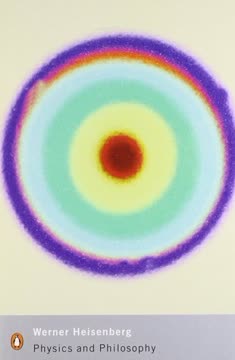
Key Takeaways
1. Modern Physics Shatters Classical Reality and Objectivity
When one speaks today of modern physics, the first thought is of atomic weapons.
Beyond weapons. While atomic weapons highlight physics' impact, the true revolution lies in its challenge to fundamental concepts like reality, space, and time. This impact transcends technology, forcing a re-evaluation of our world view across different cultures.
A break from the past. Classical physics, rooted in the 17th century, assumed an objective world describable independently of the observer. Quantum theory, however, represents a significant departure, revealing that this idealization is insufficient for the atomic realm.
New ways of thinking. The spirit of modern physics, born from rational analysis and empirical methods, is now confronting older philosophical and religious traditions globally. This international exchange, though potentially disruptive, promises entirely new developments in human thought.
2. The Atomic World Exists as Potentiality, Not Just Concrete Things
But the atoms or the elementary particles themselves are not as real; they form a world of potentialities or possibilities rather than one of things or facts.
Not little billiard balls. Unlike the classical view of atoms as tiny, solid objects, quantum theory suggests they exist in a state of potentiality. They are not always "somewhere" or "doing something" in the way macroscopic objects are.
Between possibility and reality. The probability function in quantum theory represents a tendency for events, a quantitative version of Aristotle's "potentia." It stands between the abstract idea of an event and the actual, concrete event that occurs upon observation.
Abstract yet fundamental. This abstract nature makes elementary particles more consistent as a basis for explaining matter's behavior. They lack the sensory qualities of classical atoms, and even geometric concepts like shape or motion cannot be consistently applied to them.
3. Quantum Theory Reveals Nature's Intrinsic Uncertainty
The particle simply does not possess simultaneously precise values of these two attributes.
Beyond measurement error. The uncertainty principle is not a statement about our inability to measure precisely due to clumsy tools. It asserts that certain pairs of properties, like position and momentum, fundamentally cannot have precise values simultaneously in nature itself.
Inherent unpredictability. This intrinsic uncertainty leads to indeterminism in quantum systems. Even with complete information, we can only predict the probability of outcomes, not the definite behavior of a single particle.
Statistical but fundamental. Quantum mechanics is a statistical theory, but unlike classical statistics (e.g., weather forecasting), the chance element is inherent to the system's nature, not just our limited knowledge of hidden variables.
4. Observation Plays a Decisive Role in Atomic Events
Therefore, the transition from thèpossible' to the àctual' takes place during the act of observation.
From potential to actual. The act of observation is crucial in quantum theory because it collapses the range of possibilities described by the probability function into a single, actual event. Before observation, the system exists in a superposition of states.
Not subjective mind. This doesn't mean the observer's consciousness creates reality. The "observation" refers to the irreversible interaction of the atomic system with a measuring device, which is part of the macroscopic world and registers a definite outcome.
Quantum jump. The discontinuous change in the probability function upon measurement is called a "quantum jump." It reflects the sudden change in our knowledge of the system as a definite result is registered, marking the transition from potentiality to actuality.
5. Classical Concepts Like Space, Time, and Causality Have Limited Applicability
The concepts of classical physics are just a refinement of the concepts of daily life and are an essential part of the language which forms the basis of all natural science.
Tools with limits. Concepts like position, velocity, space, time, and causality, refined from daily life and formalized in classical physics, are indispensable for describing experiments. However, quantum theory and relativity show these concepts have limited ranges of applicability.
A priori yet limited. Kant considered space, time, and causality as "a priori" conditions for science, independent of experience. Modern physics demonstrates they are conditions for classical science and describing experiments, but new experience reveals their limitations at extreme scales.
Paradoxical foundation. The Copenhagen interpretation starts from the paradox of using classical concepts to describe experiments on atomic phenomena, knowing these concepts don't accurately fit the atomic world itself. This tension is the source of quantum theory's statistical nature.
6. Matter is Mutable Energy, Not Indestructible Building Blocks
All the elementary particles are made of the same substance, which we may call energy or universal matter; they are just different forms in which matter can appear.
Beyond Democritus. Unlike the eternal, indestructible atoms of Democritus, modern elementary particles are mutable. Experiments show they can be created from energy and annihilated back into energy.
Energy as substance. This mutability suggests energy is the fundamental substance of the universe, akin to Heraclitus's "fire." Energy is conserved and can transform into various forms, including elementary particles.
Transmutation is key. High-energy collisions reveal this unity; particles transmute into others or are created from kinetic energy. This provides final proof that particles are not distinct, fundamental units but different manifestations of the same underlying reality.
7. Modern Physics Echoes Ancient Philosophical Debates
If we replace the word `fire' by the word ènergy' we can almost repeat his statements word for word from our modern point of view.
Heraclitus and energy. The ancient Greek philosopher Heraclitus saw fire as the basic element and emphasized constant change ("Becoming"). Replacing "fire" with "energy" aligns remarkably with the modern view of energy as the fundamental, ever-transforming substance.
Plato and mathematical forms. Plato and the Pythagoreans believed reality was based on mathematical forms (like geometric solids). Modern physics, seeking fundamental laws for elementary particles, also points towards abstract mathematical structures as the ultimate description of matter's forms.
Atomism revisited. The concept of smallest units goes back to Democritus's atoms. While modern elementary particles are far more abstract and mutable, the quest for fundamental building blocks or principles remains a continuous thread from ancient philosophy to modern physics.
8. Relativity Revolutionized Our Understanding of Space and Time
The decisive step, however, was taken in the paper by Einstein in 1905 in which he established the àpparent' time of the Lorentz transformation as thèreal' time and abolished what had been called `real' time by Lorentz.
No absolute framework. Special relativity abolished the idea of absolute space and time, showing that measurements of space and time intervals depend on the observer's relative motion. Simultaneity is not universal but relative to a frame of reference.
Space-time continuum. The theory revealed a deeper, interconnected structure of space and time, a four-dimensional manifold where events are ordered by causal connections limited by the speed of light. This structure replaces the simple, independent space and time of Newton.
Mass-energy equivalence. A profound consequence is E=mc², showing mass and energy are interchangeable forms of the same entity. This unified concept replaced the separate conservation laws of mass and energy from classical physics.
9. Science Develops as a Human Language to Describe Reality
Both science and art form in the course of the centuries a human language by which we can speak about the more remote parts of reality, and the coherent sets of concepts as well as the different styles of art are different words or groups of words in this language.
Concepts as tools. Language, including scientific language, is a tool for communication and thinking, developed through human interaction with the world. Concepts within this language are not perfectly defined and have limited ranges of applicability.
Mathematical precision. Natural science requires concepts defined with high precision, achieved through mathematical abstraction. Mathematical schemes represent phenomena by correlating symbols with measurements, allowing rigorous derivations and predictions.
Expanding language. As science explores new realms (like electromagnetism, relativity, quantum mechanics), the language expands, introducing new terms and applying old ones differently. Different scientific fields develop coherent sets of concepts, like different "styles" of art, each representing a specific group of connections in the complex tissue of reality.
10. The Unity of Matter May Lie in Abstract Mathematical Forms
The mathematical forms that represent the elementary particles will be solutions of some eternal law of motion for matter.
Beyond substance. Following Plato and the Pythagoreans, modern physics suggests elementary particles are ultimately not substance but mathematical forms. These forms are not static shapes but dynamic solutions to fundamental equations.
Eternal laws. The constant element in modern physics is not a fixed configuration but a dynamic law of motion. The elementary particles are expected to emerge as "Eigenvalues" and "Eigensolutions" from a fundamental, eternal law governing matter.
The final theory. The search for a unified theory of elementary particles aims to find a single mathematical framework, likely a quantized nonlinear wave equation, from which all particle properties and forces can be derived. This would represent the ultimate understanding of matter's unity through form.
11. Describing Atomic Reality Challenges Classical Logic
In quantum theory this law `tertium non datur' is to be modified.
The excluded middle. Classical logic assumes that for any statement, either the statement or its negation is true ("tertium non datur" - no third possibility). This principle is deeply embedded in ordinary language.
Quantum logic. Describing atomic phenomena, like an atom being in one half of a box or the other, requires modifying this principle. Quantum theory allows for "superpositions" or "coexistent states" that are not simply one alternative or the other.
Modified truth. Concepts like "degree of truth" or "complementarity" are introduced to describe these situations, where a statement might be "undecided" rather than simply true or false. This suggests quantum theory implies a more general logical pattern than classical logic.
Review Summary
Physics and Philosophy receives mixed reviews. Some praise its insightful exploration of quantum mechanics and its philosophical implications, appreciating Heisenberg's ability to connect physics with broader intellectual history. Others find it challenging, with dense physics content and dated information. The book is lauded for its examination of language, reality, and the nature of scientific knowledge. While some reviewers struggled with the technical aspects, many found value in Heisenberg's unique perspective on the intersection of science and philosophy.
People Also Read





FAQ
1. What is "Physics and Philosophy: The Revolution in Modern Science" by Werner Heisenberg about?
- Explores the philosophical impact: The book examines how the revolutionary developments in modern physics, especially quantum theory and relativity, have transformed our understanding of reality, knowledge, and scientific concepts.
- Focuses on quantum mechanics: Heisenberg, a key architect of quantum mechanics, discusses the origins, interpretation, and implications of quantum theory, particularly the Copenhagen interpretation.
- Bridges science and philosophy: The text connects the evolution of scientific ideas with philosophical traditions, comparing ancient Greek, Cartesian, and Kantian thought to modern physics.
- Addresses broader consequences: Heisenberg also considers the influence of modern physics on society, language, and human thinking, including the ethical and political ramifications of scientific advances.
2. Why should I read "Physics and Philosophy" by Werner Heisenberg?
- Firsthand insight from a pioneer: Heisenberg was a Nobel laureate and one of the principal creators of quantum mechanics, offering unique authority and perspective.
- Clarity on complex ideas: The book provides a lucid, non-mathematical explanation of the most challenging concepts in modern physics and their philosophical significance.
- Relevance to broader questions: It addresses fundamental questions about reality, knowledge, and the limits of scientific inquiry, which are relevant to anyone interested in science, philosophy, or the nature of truth.
- Historical and cultural context: Heisenberg situates scientific revolutions within the broader sweep of intellectual history, making the book valuable for understanding the interplay between science and culture.
3. What are the key takeaways from "Physics and Philosophy" by Werner Heisenberg?
- Limits of classical concepts: Classical physics concepts like space, time, and causality are not universally applicable; quantum theory reveals their limitations.
- Copenhagen interpretation: Reality at the atomic level is not objectively determined until observed; quantum mechanics describes probabilities, not certainties.
- Role of language and logic: Scientific language and logic are shaped by experience and may require revision as knowledge expands, especially in quantum physics.
- Science and subjectivity: The observer plays an unavoidable role in defining what can be known; objectivity in science is more nuanced than previously thought.
4. How does Heisenberg explain the Copenhagen interpretation of quantum theory in "Physics and Philosophy"?
- Measurement creates reality: According to the Copenhagen interpretation, properties like position or momentum do not have definite values until measured; observation brings potentialities into actuality.
- Probability, not determinism: Quantum mechanics provides only statistical predictions about ensembles of systems, not definite outcomes for individual events.
- Complementarity principle: Different experimental setups reveal complementary aspects (e.g., wave or particle) of quantum systems, but never both simultaneously.
- Limits of classical language: Classical terms are necessary for describing experiments, but their applicability is limited by quantum uncertainty.
5. What is Heisenberg’s uncertainty principle, and how is it presented in "Physics and Philosophy"?
- Fundamental limit to knowledge: The uncertainty principle states that certain pairs of physical properties (like position and momentum) cannot both be known to arbitrary precision simultaneously.
- Not just measurement error: This uncertainty is inherent in nature, not due to experimental imperfections or lack of information.
- Implications for reality: The principle implies that quantum particles do not have well-defined trajectories or states independent of observation.
- Philosophical consequences: It challenges the classical notion of an objective, observer-independent reality and introduces indeterminacy at the heart of physics.
6. How does "Physics and Philosophy" by Heisenberg compare quantum theory to earlier philosophical traditions?
- Greek philosophy parallels: Heisenberg draws connections between quantum concepts and ancient ideas, such as Aristotle’s "potentia" (potentiality) and Heraclitus’s focus on change.
- Critique of Cartesian dualism: The book critiques Descartes’ strict separation of mind and matter, showing that quantum theory blurs this distinction.
- Kantian a priori revisited: Heisenberg argues that Kant’s "synthetic a priori" concepts (like space, time, causality) are not absolute but have limited applicability in light of modern physics.
- Evolution of scientific concepts: The text demonstrates how scientific revolutions force a reevaluation of philosophical assumptions about reality and knowledge.
7. What is the role of language and logic in science according to "Physics and Philosophy" by Heisenberg?
- Language shaped by experience: Scientific and everyday language are formed through interaction with the world, and their concepts have only limited, context-dependent meaning.
- Limits of precision: Even the most precise scientific terms are idealizations and may lose their applicability as knowledge advances.
- Need for new logic: Quantum theory may require modifications to classical logic, such as relaxing the law of the excluded middle ("tertium non datur") at the quantum level.
- Communication and understanding: While mathematics provides unambiguous predictions, plain language is necessary for broader understanding, though it may be inherently vague in quantum contexts.
8. How does Heisenberg address criticisms and alternative interpretations of quantum mechanics in "Physics and Philosophy"?
- Hidden variables debate: Heisenberg discusses proposals like Bohm’s hidden variables, which attempt to restore determinism, but argues they add unnecessary and unobservable elements.
- Symmetry and consistency: Alternative interpretations often sacrifice key symmetries or features of quantum theory, making them less satisfactory.
- Role of the observer: Critics object to the centrality of the observer in the Copenhagen interpretation, but Heisenberg maintains this is an unavoidable consequence of quantum phenomena.
- No return to classical realism: Heisenberg concludes that attempts to restore a classical, objective reality are incompatible with experimental facts and the structure of quantum theory.
9. What does "Physics and Philosophy" by Heisenberg say about the structure and unity of matter?
- From atoms to energy: The book traces the historical development from Greek atomism to the modern view that all matter is composed of energy and elementary particles.
- Transmutation and unity: Experiments show that elementary particles can be transformed into one another, supporting the idea of a fundamental unity of matter.
- Matter and form: Heisenberg relates quantum particles to Aristotelian "potentia," suggesting that particles are forms or solutions of underlying laws, not static substances.
- Ongoing challenges: The search for a complete mathematical description of matter, uniting quantum theory and relativity, remains unfinished.
10. How does "Physics and Philosophy" by Heisenberg relate quantum theory to other sciences and human knowledge?
- Chemistry and physics unified: Quantum theory provides the foundation for understanding chemical behavior and the stability of atoms.
- Biology and limits of reductionism: While physics and chemistry explain much of biology, Heisenberg suggests that life may involve concepts beyond current physical theories.
- Psychology and subjectivity: The book argues that physics cannot fully explain consciousness or subjective experience, highlighting the limits of reductionist approaches.
- Science as interplay: Heisenberg emphasizes that science is not just about describing nature, but about the interplay between nature and human questioning.
11. What are the broader implications of "Physics and Philosophy" by Heisenberg for society, ethics, and culture?
- Impact on worldviews: The conceptual revolution in physics challenges materialism and calls for a more nuanced understanding of reality.
- Ethical responsibility: Heisenberg discusses the political and ethical consequences of scientific advances, especially regarding nuclear weapons.
- Science and tradition: The book explores how modern physics interacts with different cultural and philosophical traditions worldwide.
- Tolerance and openness: Heisenberg advocates for intellectual openness and tolerance, recognizing the limits of any single worldview or doctrine.
12. What are the best quotes from "Physics and Philosophy" by Werner Heisenberg, and what do they mean?
- "What we observe is not nature itself, but nature exposed to our method of questioning."
- This highlights the active role of the observer in shaping what can be known in quantum physics.
- "In the experiments about atomic events we have to do with things and facts, with phenomena that are just as real as any phenomena in daily life. But the atoms or the elementary particles themselves are not as real; they form a world of potentialities or possibilities rather than one of things or facts."
- Heisenberg distinguishes between observable phenomena and the underlying quantum reality, which is a realm of possibilities.
- "Every word or concept, clear as it may seem to be, has only a limited range of applicability."
- This quote underscores the limitations of language and concepts, especially when applied to new scientific domains.
- "Natural science does not simply describe and explain nature; it is part of the interplay between nature and ourselves."
- Heisenberg emphasizes that science is a human activity, shaped by our questions and perspectives, not a detached observation of an independent reality.
Download PDF
Download EPUB
.epub digital book format is ideal for reading ebooks on phones, tablets, and e-readers.








































