Key Takeaways
1. America's Inequality Crisis: A Widening Chasm
The United States is more plutocracy than democracy and is developing aristocratic features scorned by many of the Revolutionary and Constitution-framing generation of founders.
Unprecedented disparity. The United States is experiencing a startling increase in income and wealth inequality, reaching historic highs not seen since the 1920s or the First Gilded Age. This gap between the wealthiest 1% (and especially the 0.01%) and everyone else far exceeds disparities in other economically advanced countries. For instance, the top 1% garnered 95% of all income growth since the Great Recession, while median family income plummeted.
Misperceived reality. Most Americans dramatically underestimate the true extent of this wealth gap, often believing it to be far more equitable than it is. When presented with actual data, a vast majority (over 90%) would prefer to live in a country with a wealth distribution closer to that of Sweden, rather than the current U.S. reality. This disconnect highlights a fundamental misunderstanding of the economic landscape.
Global outlier. While inequality is a global phenomenon, its ascent has been more rapid and extreme in the U.S. over the last three to four decades. The U.S. now has a more skewed income distribution than many Latin American countries and lags behind most European nations in equitable wealth distribution, challenging its self-image as a land of opportunity.
2. The Fading American Dream: Opportunity Undermined
The land of opportunity now is rightly taunted as the “United States of Inequality for All.”
Mobility's decline. The cherished American Dream of upward mobility has largely become a myth, as the United States now exhibits less equality of opportunity than almost any other advanced industrial country. Studies show that an American child's life chances are more dependent on their parents' income and education than in most peer nations, a relationship that has intensified since 1980.
Education's role reversal. Education, traditionally seen as the great equalizer, increasingly contributes to rising inequality by stratifying Americans by income group.
- High-poverty schools perform poorly, and the gap with affluent districts is growing.
- Racial resegregation in schools has led to "apartheid schools" with fewer resources.
- Tuition at public universities has skyrocketed, shifting the financial burden to students.
Exploitative for-profits. For-profit colleges, often funded by federal taxpayer money, aggressively target low-income students and veterans with promises of secure employment. However, many graduates end up with significant debt, high unemployment, and lower earnings, deepening inequality rather than alleviating it. These institutions often prioritize marketing over instruction and have high student loan default rates.
3. The Middle Class Erodes: Economic Insecurity as the New Normal
The period from 2000 to 2010 has gone into history as the “lost decade of the middle class,” during which the middle class became “fewer, poorer, [and] gloomier.”
Shrinking and struggling. The American middle class, once the envy of the world and the bedrock of democracy, has significantly shrunk in size and wealth. From 1971 to 2011, the middle-income tier declined from 61% to 51% of adults, with many falling into the lower-income bracket. This decline has led to widespread anxiety, with 85% of middle-class adults reporting greater difficulty maintaining their standard of living.
Wealth evaporation. The Great Recession delivered a devastating blow, wiping out 39% of Americans' wealth, with middle-class families losing the most. Homeownership, a key middle-class asset, declined sharply, especially for young and minority families. This economic instability is compounded by "expenditure cascades," where the consumption patterns of the rich drive non-rich families into debt as they try to keep up.
Stagnant wages, disappearing benefits. Despite increased productivity, workers' real hourly compensation has lagged since the late 1970s, creating a significant "wage-productivity gap." Well-paying manufacturing jobs have disappeared, and traditional defined-benefit pension plans have become "rare" in private industry, shifting retirement risk onto individual employees. The decline of labor unions, once a "core equalizing institution," has further exacerbated this trend, contributing substantially to lower wages and increased inequality for all workers.
4. Rigged Systems: How the Rich Get Richer and the Poor Stay Poor
What is commonly referred to as the tax code might be better described as two codes: one that forces most Americans to account for every nickel of income they earn, and another that allows the wealthy to reveal or conceal [income] at their discretion.
Two-tiered taxation. The federal tax code is fundamentally unfair, shaped by elected officials beholden to wealthy donors and corporations.
- The rich benefit from low capital gains tax rates (often 15%), estate tax exemptions (up to $10.5 million per couple), and numerous loopholes.
- Many corporations pay little to no federal taxes, often using offshore havens, while their tax burden has plummeted from 6% of GDP in the 1950s to 1.6% in 2010.
- Middle and lower-income families bear a disproportionate tax burden, including payroll taxes that cap out for high earners.
Executive excess. CEO compensation has reached mind-boggling heights, with the CEO-to-worker pay ratio soaring to 273-to-1 in 2012, a major driver of income inequality. This "incentive pay" is often detached from company performance, with executives of firms that laid off workers or received taxpayer bailouts still pocketing millions. This "skimming" of wealth is a form of "rent seeking," where income is gained not by creating wealth but by manipulating rules.
Predation on the poor. A host of predatory industries actively exploit the lack of resources among the poor.
- Payday lenders trap individuals in cycles of debt with annual interest rates averaging 300%.
- Unlicensed tax preparers charge high fees for tax refunds.
- Subprime auto loans ensnare low-income borrowers.
- The "poverty industry" extracts billions annually through various schemes, effectively imposing a "poverty tax" on low-income individuals.
5. Inequality's Human Cost: Shorter Lives, Poorer Health
Income is merely a proxy. It is the pain of inferiority, frustration, [and] lack of autonomy and control which adversely affect the immune system and lead to greater illness, and to shorter lives: that status ‘complaints’ are sufficiently stressful in themselves to generate ill health and extra mortality, over and above the effects of income.
Health disparities. The United States lags behind other advanced nations in life expectancy and overall health outcomes, despite spending the most on healthcare. This "U.S. health disadvantage" is particularly stark for Americans under 50, who have the lowest chance of surviving to that age compared to peers in other developed countries.
- Life expectancy for the least-educated whites has declined.
- Infant mortality rates are the highest among peer countries.
- Racial and ethnic minorities face greater health problems due to less insurance and unhealthy living/working conditions.
Stress and mental health. Economic insecurity, job loss, and the constant struggle to make ends meet contribute to widespread stress, anxiety, and depression across income levels. The sense of helplessness in facing these challenges can adversely affect the immune system, leading to greater illness and shorter lives, a phenomenon where "inequality gets under the skin." The rise in antidepressant use reflects this societal burden.
Food insecurity and its drivers. Millions of households, including 15.9 million children, experience food insecurity, meaning disrupted eating patterns due to insufficient resources. While federal programs like SNAP provide a crucial safety net, they are often targeted for cuts by politicians who simultaneously support billions in federal farm subsidies for wealthy agribusinesses. This "crazy food policy" diverts funds from the needy to the "undeserving rich," exacerbating hunger.
6. Democracy Under Siege: Money's Overwhelming Influence
Its permanence is what gives the biggest spenders their power.
Unequal political voice. The United States ranks low in global democracy indices, partly due to low political participation and government dysfunction. Political voice is heavily influenced by income and education, with the affluent participating far more than others. Elected officials are consistently responsive to wealthy constituents and organized business groups, while the preferences of average citizens "appear to have essentially zero... impact upon policy change."
Judicial enablement. The Supreme Court, particularly under Chief Justice John Roberts, has amplified the influence of money in politics.
- Citizens United v. Federal Election Commission (2010) allowed unlimited corporate and organizational spending on advocacy campaigns.
- McCutcheon v. Federal Election Commission (2014) removed aggregate limits on individual contributions to political candidates and parties.
These decisions, based on the premise that "money is speech," have created a "dollarocracy" where a tiny slice of wealthy donors wield disproportionate power.
Systemic disenfranchisement. Beyond campaign finance, systematic efforts, often driven by partisan motives, aim to suppress votes from groups leaning Democratic.
- Voter ID laws, despite a lack of evidence for widespread voter fraud, disproportionately affect minorities, the poor, and the elderly.
- Curtailing early voting periods and purging voter rolls create obstacles.
- Felony disenfranchisement laws, rooted in post-Civil War racial containment, continue to deny millions of Americans, especially African Americans, the right to vote.
7. A Fractured Nation: The Decline of Shared Community
The fact that rich and poor can stroll together in Boston’s Common or New York’s Central Park is significant both literally and metaphorically.
Eroding social cohesion. Extreme inequality is dissolving the "social glue" that binds Americans as a common nation. The increasing residential segregation by income means fewer middle-class families live alongside low-income ones, leading to unequal access to quality schools, parks, and public services. This "civic secession" by the affluent, who increasingly withdraw into gated communities, reflects a diminishing sense of shared responsibility and community.
The "market society." The United States has transitioned from having a "market economy" to becoming a "market society," where almost everything can be bought and sold. This commodification of life, from concierge medicine to paying for faster lanes or parking spaces, deepens inequality and corrodes social values.
- Wealthy individuals can purchase privileges unavailable to the majority.
- The distribution of income and wealth becomes paramount, as money buys political influence, good healthcare, and access to elite education.
Distorted values. In a society where money buys almost everything, the public interest and a feeling of community diminish. The wealthy, often insulated from the struggles of ordinary citizens, may exhibit less compassion for the less fortunate. This creates a society where values become distorted, and the "we" disappears, replaced by a hierarchical structure defined by who can afford what.
8. The Undeserving Divide: Accountability for All
The undeserving rich are dependent on the government for handouts in the form of a rigged tax system, corporate welfare, and favorable laws and regulations that increase their profits at the expense of the U.S. Treasury and add to the tax burden and social costs for everyone else.
The "undeserving poor" myth. The narrative that some poor people are "undeserving" of help, often based on moral judgments of laziness or dependency, serves as a political weapon to justify cuts to social safety nets. This overlooks the reality that many poor individuals are working, often in low-wage jobs, and rely on "survival strategies" due to unsustainable incomes and a minimum wage that lags behind inflation.
Unpunished "undeserving rich." In stark contrast, a segment of the wealthy, the "undeserving rich," accumulate fortunes through "rent seeking," legal loopholes, and often unprosecuted financial misconduct.
- No high-level Wall Street executives faced jail time for systemic crimes that led to the 2008 financial crisis, illustrating a "too big to jail" phenomenon.
- Banks and financial firms engage in legal but ethically questionable practices, like manipulating commodity markets (e.g., Goldman Sachs' aluminum scheme), which extract wealth without creating economic value.
- Corporate welfare, tax exemptions, and deregulation allow these elites to profit at the expense of taxpayers and the public good.
A two-tiered justice system. The differential application of justice, where white-collar criminals often receive "slaps on the wrist" or avoid prosecution entirely, while low-income individuals face severe penalties for minor offenses, underscores a profound inequality. This "tyranny of money" in politics ensures that the financial industry "always wins," perpetuating a system where wealth is not balanced by strong, accountable government.
Review Summary
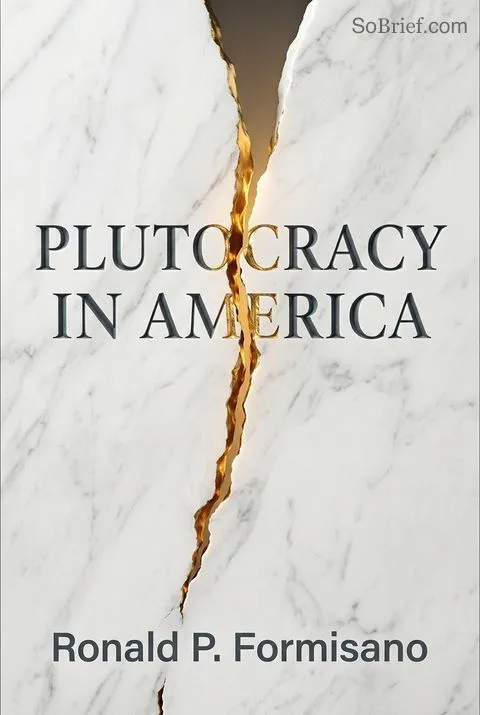
Reviews of Plutocracy in America are largely positive, averaging 4.05 out of 5. Most readers find it a compelling, well-documented examination of wealth inequality, its social consequences, and its corrosive effect on American democracy. Praised for its accessible writing and comprehensive coverage of issues like stagnant wages, declining social mobility, and political corruption by the wealthy, some critics note it lacks originality and could benefit from more data, graphs, and deeper theoretical analysis. Overall, readers consider it essential reading on inequality in modern America.
People Also Read


Download PDF
Download EPUB
.epub digital book format is ideal for reading ebooks on phones, tablets, and e-readers.








































