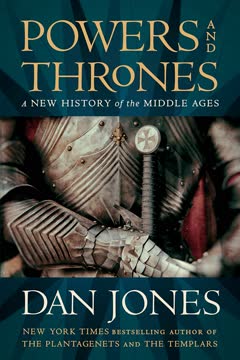
Key Takeaways
1. The Fall of Rome Ushered in a New Era of Barbarian Kingdoms
By the end of the fifth century the Roman Empire in the west no longer existed.
A world transformed. The Western Roman Empire, a superpower for over a millennium, collapsed between AD 409 and 476, marking the end of the classical era. This decline was driven by a confluence of factors including climate change, mass migration, and internal political instability. The burial of treasures like the Hoxne Hoard in Britain symbolized the chaotic retreat of Roman authority and the uncertainty of the times.
Barbarian incursions. The arrival of the Huns in AD 370, driven by a "megadrought" in Asia, displaced Germanic tribes like the Goths, pushing them into Roman territory. This led to:
- The Battle of Adrianople (378), where Goths decisively defeated and killed Emperor Valens.
- The Rhine crossing (406) by Vandals, Alans, and Suevi, destabilizing Gaul.
- The Sack of Rome (410) by Alaric's Visigoths, a symbolic blow to imperial prestige.
- The Vandal conquest of North Africa (429-439) under Geiseric, severing Rome's grain supply.
New political landscapes. In the wake of Rome's collapse, new barbarian kingdoms emerged, laying the foundations for future European states. Britain was abandoned, leading to Anglo-Saxon settlement. Attila the Hun's empire briefly terrorized Europe before its collapse. Odoacer deposed the last Western Roman Emperor, Romulus Augustulus, in 476, and Theodoric the Great established a sophisticated Ostrogothic kingdom in Italy, blending Roman traditions with barbarian rule.
2. Byzantium Preserved Roman Legacy Amidst Eastern Challenges
The Emperor… disregarding all questions of expense, eagerly pressed on to begin the work of construction, and began to gather all the artisans from the whole world.
Justinian's ambitious vision. In the East, the Roman Empire endured as Byzantium, reaching a zenith under Emperor Justinian I (527-565). He embarked on a monumental project to restore Roman glory, focusing on legal, religious, and architectural reforms. His most significant achievements included:
- The Justinianic Code, a comprehensive overhaul of Roman law that influenced legal systems for centuries.
- The rebuilding of Hagia Sophia, a marvel of engineering and a symbol of imperial power, after the devastating Nika riots of 532.
- The reconquest of North Africa from the Vandals (533-534) and parts of Italy from the Ostrogoths, led by his brilliant general Belisarius.
Challenges and transformations. Despite these successes, Justinian's reign was fraught with challenges. Religious schisms, particularly between Chalcedonians and Miaphysites, plagued the empire. A global climate shock (536-540) and the devastating Plague of Justinian (541-543), the first recorded global pandemic, killed millions and severely strained imperial resources.
A new identity. After Justinian, Byzantium gradually shed its Latin identity, becoming a Greek-speaking empire focused on the Eastern Mediterranean. Emperor Heraclius (610-641) achieved a decisive victory over the Sassanid Persians, ending centuries of intermittent warfare. However, this exhausting conflict left both empires vulnerable to a new, unforeseen power emerging from the Arabian Peninsula.
3. The Rise of Islam Forged a Vast, Enduring Empire
Damascus was conquered and its inhabitants paid the jizyah.
A new faith emerges. In the early 7th century, Muhammad's revelations in Mecca led to the birth of Islam, a monotheistic faith that rapidly united the Arabian tribes. The Hijrah (622) to Medina marked the founding of the first Islamic state, emphasizing community (umma) over tribal loyalties. After Muhammad's death in 632, the Ridda Wars solidified the caliphate's unity and launched a formidable military machine.
Rapid conquests. Muslim armies, led by generals like Khalid ibn al-Walid and Amr ibn al-As, swiftly expanded beyond Arabia, exploiting the exhaustion of the Byzantine and Sassanid Persian empires. Key conquests included:
- Syria (632-642), with the fall of Damascus and the decisive Battle of Yarmuk (636).
- Persia (636-642), culminating in the capture of Ctesiphon and the Battle of Nahavand.
- Egypt (639-642), including the strategic port of Alexandria.
An enduring legacy. The early caliphates, known as the "Rightly Guided" (Rashidun), established a unique faith empire that offered religious tolerance (jizyah) to conquered monotheists, fostering stability. The subsequent Umayyad Caliphate (661-750), with its capital in Damascus, further expanded the empire, conquering Visigothic Spain (al-Andalus) and challenging Byzantium with sieges of Constantinople. The Umayyads also initiated significant cultural reforms:
- Standardized Islamic coinage (dinars and dirhams).
- Imposed Arabic as the language of administration, leading to widespread Arabization.
- Commissioned monumental architecture like the Dome of the Rock in Jerusalem and the Great Mosque of Damascus.
The Abbasid Revolution (750) shifted the capital to Baghdad, ushering in a "Golden Age of Islam" and cementing the Sunni-Shia divide, but the foundations of a vast, enduring Islamic world were already firmly laid.
4. Charlemagne's Empire Reshaped Western European Identity
All who went before him, all who marched on his side, all who followed after him and the whole equipment of the army imitated him as closely as possible.
The rise of the Carolingians. After centuries of "do-nothing kings" (rois fainéants) under the Merovingian dynasty, power in the Frankish realms shifted to the Carolingian mayors of the palace, notably Charles Martel. His son, Pippin the Short, deposed the last Merovingian king in 751, securing papal backing through anointing, which established a powerful alliance between the Franks and the Roman Church.
Charlemagne's imperial vision. Pippin's son, Charlemagne (768-814), inherited a formidable war machine and expanded Frankish dominion across Western Europe, conquering Lombardy, Saxony, and parts of Spain. His relentless campaigns and administrative reforms culminated in his coronation as "Emperor and Augustus" by the Pope in Rome in 800, symbolically resurrecting the Western Roman Empire. Charlemagne's rule was characterized by:
- Centralized authority, replacing fragmented Merovingian rule.
- Extensive church-building and monastic reform.
- The establishment of a palace school at Aachen, fostering the Carolingian Renaissance.
- The development of Carolingian minuscule script for widespread literacy.
Fragmentation and new threats. Despite Charlemagne's grandeur, his empire proved too vast to sustain. His son, Louis the Pious, struggled with internal family rivalries, leading to the Treaty of Verdun (843) which partitioned the empire into West Francia, the Middle Kingdom, and East Francia. This fragmentation coincided with the rise of the Vikings, who launched devastating raids across Europe:
- Ragnar's raids on Paris (845).
- The Great Heathen Army's conquest of England, establishing the Danelaw.
- Rus' expansion into Eastern Europe, founding the Kievan Rus'.
The birth of Normandy. The Viking threat eventually led to the creation of Normandy in 911, when the Frankish king granted land to the Viking leader Rollo. This new duchy, blending Norse and Frankish cultures, would become a major power, profoundly influencing England and France for centuries to come.
5. Monks and Knights Defined Medieval Social and Spiritual Life
The world is full of monks.
The monastic ideal. Monasticism, originating with desert ascetics like St. Anthony, spread across the Christian world, offering a path to salvation through self-denial, prayer, and labor. St. Benedict of Nursia's Rule (6th century) became the blueprint for Western monasticism, emphasizing communal living (cenobitism) and discipline. The Carolingians actively promoted Benedictine rule, making it the norm across their empire.
Cluny's golden age. From the 10th century, monasteries experienced a "golden age," fueled by increased wealth and a desire for spiritual atonement among the warrior elite. Cluny Abbey, founded in 910, became the pre-eminent monastery in Europe, leading a vast network of daughter houses. Cluniac influence was immense:
- It spearheaded monastic reform, emphasizing strict adherence to the Benedictine Rule.
- It became a hub for pilgrimage, particularly along the routes to Santiago de Compostela.
- Its abbots, like Hugh the Great, wielded significant political power, advising kings and popes.
- Cluny III, its abbey church, was the largest building in Europe, a marvel of Romanesque architecture.
The rise of knighthood. Simultaneously, a new warrior class emerged: the knight. Driven by technological innovations like the stirrup, cantled saddle, and couched lance, heavy cavalry became dominant on battlefields from the 10th century. This military prowess translated into social status, with knights receiving land in exchange for service, forming the basis of a complex system of obligations.
Chivalry and its heroes. A code of conduct, chivalry, developed around knighthood, emphasizing courage, loyalty, piety, and honor. Literary works like "The Song of Roland" and Arthurian romances glorified knightly deeds. Figures like El Cid (Rodrigo Díaz de Vivar) in Spain and William Marshal in England became legendary, embodying the chivalric ideal through their military exploits and political influence.
6. The Crusades Transformed Holy War and Global Relations
God wills it!
The call to arms. In 1095, Pope Urban II launched the First Crusade, calling on Western knights to aid Byzantium against the Seljuk Turks and liberate Jerusalem. This unprecedented call for holy war, fueled by promises of spiritual reward, ignited a fervent response across Europe. The initial "People's Crusade" was marked by anti-Semitic violence, but the subsequent "Princes' Crusade" achieved remarkable military success.
Conquest and crusader states. Against all odds, crusader armies marched across Asia Minor and Syria, capturing Antioch (1098) and Jerusalem (1099) amidst brutal massacres. This led to the establishment of four Latin Christian states in the Levant, including the Kingdom of Jerusalem. These states were sustained by:
- Continuous waves of pilgrims and reinforcements from the West.
- The economic interests of Italian city-states like Venice, Genoa, and Pisa.
- The emergence of military orders like the Knights Templar and Hospitaller, who combined monastic vows with martial prowess.
Shifting tides and new fronts. The Second Crusade (1147-1149), led by French and German kings, was a disastrous failure, highlighting the challenges of maintaining Western presence in the East. The fall of Jerusalem to Saladin in 1187 prompted the Third Crusade, led by Richard the Lionheart, which recovered some territory but not the Holy City. Meanwhile, crusading expanded to other fronts:
- The Reconquista in Spain and Portugal against Muslim rulers.
- The Northern Crusades against pagan Slavs in the Baltic.
The weaponization of crusading. Pope Innocent III (1198-1216) redefined crusading, turning it against internal enemies of the Church. The Fourth Crusade (1202-1204) infamously sacked Christian Constantinople, establishing a Latin Empire there. The Albigensian Crusade (1209-1229) brutally suppressed the Cathar heresy in southern France. This expansion of crusading's scope, while initially strengthening papal power, ultimately diluted its original purpose and led to its decline in the East, culminating in the fall of Acre in 1291.
7. The Mongol Impact: Reshaping Eurasia and Global Connections
They came, they sapped, they burnt, they slew, they plundered and they departed…
Genghis Khan's rise. In the early 13th century, Temüjin, a nomadic boy from the Mongolian steppe, unified disparate tribes and became Genghis Khan (1206). He forged a ruthless and efficient military machine, characterized by:
- Decimalized military organization (Arban, Zuun, Mingghan, Tumen).
- A universal law code (Jasaq) emphasizing loyalty and discipline.
- Terror tactics: immediate submission brought tolerance; resistance brought genocidal destruction.
Unprecedented conquests. Genghis and his successors created the largest contiguous land empire in history, stretching from Korea to Mesopotamia. Their campaigns devastated established powers:
- The Jin dynasty in China and the Khwarazmian Empire in Persia were shattered.
- Cities like Merv and Baghdad were razed, with immense loss of life and cultural heritage.
- Mongol armies swept through the Caucasus and the Kievan Rus', sacking cities like Kiev (1240).
Global impact and fragmentation. The Mongol invasion of Europe in 1241, with victories at Legnica and Mohi, brought terror to the West before an abrupt retreat. The Pax Mongolica, however, facilitated unprecedented East-West trade and exploration, as documented by travelers like Marco Polo and Giovanni da Pian del Carpine. After Möngke Khan's death in 1259, the empire fractured into four khanates:
- The Yuan Dynasty in China (Kublai Khan).
- The Chagatai Khanate in Central Asia.
- The Ilkhanate in Persia, which eventually converted to Islam.
- The Golden Horde on the Russian steppe, which maintained a pragmatic relationship with Russian princes.
The Mongols' legacy was a profound reshaping of Eurasia's political, religious, and economic landscape, opening new trade routes and influencing the development of states from China to Russia.
8. Commerce, Scholarship, and Architecture Flourished in a New Age of Innovation
For God and profit.
The Commercial Revolution. From around AD 1000, Western Europe experienced a significant economic revival, driven by population growth, agricultural innovation, and improved shipbuilding. This "Commercial Revolution" saw the rise of:
- International trade fairs, like those in Champagne, facilitating exchange between Northern and Southern Europe.
- Powerful Italian city-republics (Venice, Genoa, Florence) that dominated Mediterranean trade and pioneered financial innovations.
- New financial tools: bills of exchange for cashless credit transfer, insurance contracts, and double-entry bookkeeping.
- The emergence of merchant bankers like the Florentine Bardi and Peruzzi, who financed kings and influenced national economies, as seen in the English wool trade.
The Twelfth-Century Renaissance. This economic boom coincided with an intellectual awakening, as scholars like Gerard of Cremona in Toledo translated vast amounts of classical and Islamic knowledge into Latin. This "Twelfth-Century Renaissance" revived disciplines like philosophy, mathematics, astronomy, and medicine, leading to:
- The spread of the astrolabe and other scientific instruments.
- The rise of scholasticism, integrating Aristotelian logic with Christian theology.
- A flourishing of historical chronicles, romances, and legal treatises.
The birth of universities. Communities of scholars organized into "universities" (Studium Generale) in cities like Bologna, Paris, and Oxford, becoming centers of learning and debate. Figures like Thomas Aquinas, a Dominican friar and professor at Paris, synthesized classical philosophy with Christian doctrine, producing seminal works like the Summa Theologiae. Universities also became training grounds for public servants, influencing politics and law.
Architectural grandeur. The High Middle Ages also witnessed an unparalleled era of monumental building. Military engineers like Master James of St. George constructed massive stone castles (e.g., Caernarfon, Beaumaris) for kings like Edward I, blending state-of-the-art fortification with imperial symbolism. Simultaneously, a new "Gothic" style revolutionized church architecture:
- Abbot Suger's St-Denis (1144) pioneered soaring heights, pointed arches, and vast stained-glass windows.
- Cathedrals like Notre-Dame in Paris, Lincoln, and Cologne became "heaven on earth," embodying piety and civic pride.
- In Italy, Arnolfo di Cambio began Florence's Duomo, a project culminating in Brunelleschi's iconic dome, blending Gothic and classical influences.
9. Catastrophe and Change: The Black Death and Popular Revolts
The past has devoured us, the present is gnawing our entrails, the future threatens yet greater dangers.
A calamitous century. The 14th century began with a dramatic shift in climate, the "Little Ice Age," leading to widespread crop failures and the Great Famine (1315-1321). This period of chronic overpopulation and food scarcity left Europe vulnerable to further shocks. The stage was set for the most devastating pandemic in recorded history.
The Black Death's devastation. From 1347 to 1351, the bubonic and pneumonic plague (Yersinia pestis) swept across Eurasia, killing an estimated 40-60% of Europe's population. Spread by trade routes, the disease caused unimaginable suffering and death, sparing no social class. The psychological trauma was profound, leading to:
- Widespread despair and questioning of divine will.
- Religious fervor, including the rise of flagellant movements.
- A drastic demographic shift, creating labor shortages and altering economic relationships.
Waves of rebellion. The Black Death's economic consequences, particularly soaring wages and plummeting rents, challenged established social hierarchies. Governments, like Edward III's in England, attempted to freeze wages and enforce old labor obligations, sparking widespread popular revolts:
- The Jacquerie (1358) in France, where peasants violently targeted the nobility.
- The Ciompi Revolt (1378) in Florence, where artisans and wool workers briefly seized control of the city.
- The English Peasants' Revolt (1381), led by Wat Tyler and John Ball, which demanded an end to serfdom and challenged royal authority, nearly toppling the government.
These rebellions, though often brutally suppressed, demonstrated the newfound power of ordinary people and forced elites to acknowledge their grievances. The "calamitous 14th century" fundamentally reshaped Western society, paving the way for new social and political dynamics.
10. The Renaissance Ignited a Rebirth of Art, Humanism, and Power
There was an age that was happier for poets...
A new intellectual dawn. Emerging from the turmoil of the 14th century, the Renaissance, meaning "rebirth," began in Italy and spread across Europe. It was characterized by a renewed interest in classical Greek and Roman culture, driving innovations in literature, art, and philosophy. Petrarch (1304-1374), often called the first humanist, pioneered this shift:
- He celebrated individual human experience and emotion in his Italian sonnets.
- He championed the study of classical texts and the pursuit of knowledge for its own sake.
- His coronation as poet laureate in Rome (1341) symbolized the revival of ancient glory.
Artistic genius and patronage. The Renaissance fostered an explosion of artistic talent, particularly in Italy and the Burgundian Low Countries. Powerful patrons, like the Medici family in Florence and the Dukes of Burgundy, funded magnificent projects to enhance their prestige and civic pride. Key figures included:
- Jan van Eyck (c. 1390-1441), who revolutionized painting with his mastery of oil techniques and lifelike portraiture (e.g., Ghent Altarpiece, Arnolfini Portrait).
- Leonardo da Vinci (1452-1519), a "universal genius" who excelled in painting (Mona Lisa, Last Supper), sculpture, anatomy, engineering, and scientific inquiry.
- Michelangelo, Raphael, Botticelli, and Brunelleschi, whose works transformed architecture, sculpture, and painting.
Power and politics. The Renaissance was deeply intertwined with political power. Artists and scholars served as diplomats, propagandists, and military engineers for ambitious rulers. Lorenzo de' Medici, "the Magnificent," used art to project Florence's glory and his family's influence. Leonardo da Vinci's career saw him serve various patrons, from Ludovico Sforza in Milan to the ruthless Cesare Borgia and King Francis I of France, demonstrating the pragmatic relationship between genius and power.
11. European Navigators Unveiled New Worlds and Global Empires
It has been a long time since there was a crusading expedition overseas...
The Ottoman challenge. The fall of Constantinople to Sultan Mehmed II in 1453, aided by massive cannons, marked the end of the Byzantine Empire and a new era of Ottoman expansion into Europe. This event, coupled with the Ottoman control of traditional East-West trade routes, spurred European powers to seek alternative passages to the Indies.
Pioneering Atlantic exploration. While earlier contacts with the Americas by Irish monks (St. Brendan) and Vikings (L'Anse aux Meadows, c. 1000 AD) were fleeting, the 15th century saw a concerted effort to explore the Atlantic. Prince Henry the Navigator of Portugal (1394-1460) spearheaded this drive:
- He sponsored expeditions down the African coast, leading to the colonization of Madeira and the Azores.
- Portuguese caravels, with their advanced lateen sails, enabled long-distance ocean voyages.
- The Portuguese established a lucrative, albeit morally abhorrent, slave trade from West Africa.
Columbus and the New World. In 1492, Christopher Columbus, backed by Spain's "Catholic Monarchs" Ferdinand and Isabella, sailed west in search of a route to Asia. Instead, he encountered the Caribbean islands, marking a pivotal moment in global history. His voyages led to:
- The "discovery" of the Americas, opening up a vast new continent to European exploitation.
- Initial, often brutal, colonization efforts in Hispaniola and Cuba, leading to the subjugation and enslavement of indigenous peoples like the Taíno.
- The reintroduction of horses and the introduction of African slaves to the Americas, fundamentally reshaping its demographics and societies.
Circumnavigating the globe. Vasco da Gama's voyage (1497-1499) around Africa to India established the Carreira da India, a direct sea route to the East, bypassing Ottoman control. Ferdinand Magellan's expedition (1519-1522) completed the first circumnavigation of the globe, definitively proving the Earth's spherical nature and opening up the Pacific. These voyages ushered in an age of European global empires, transforming world trade, power structures, and human understanding of geography.
12. The Reformation Shattered the Medieval Church and Redefined Faith
The Word so greatly weakened the papacy that never a Prince or Emperor inflicted such damage upon it...
The printing revolution. Johannes Gutenberg's invention of the printing press in Mainz (c. 1455) revolutionized communication, enabling the mass production of texts like the Gutenberg Bible. This technological leap transformed literacy, education, and the dissemination of ideas across Europe, setting the stage for profound social and religious change.
Papal decline and indulgence scandal. By the late 15th century, the papacy's authority had been eroded by centuries of political struggles, schisms, and perceived corruption. The widespread sale of papal indulgences, particularly for the remission of sins for the dead, became a major point of contention. Pope Leo X's aggressive indulgence campaign to fund St. Peter's Basilica, backed by powerful banking families like the Fuggers, sparked outrage among reformers.
Luther's challenge. In 1517, Martin Luther, a German professor, published his Ninety-Five Theses, a blistering critique of indulgence sales and papal authority. Printed and circulated widely, Luther's ideas rapidly went "viral," challenging core Catholic doctrines:
- He asserted that salvation came through faith alone, not through deeds or purchased indulgences.
- He questioned the scriptural basis for most sacraments and papal supremacy.
- His writings, including a German translation of the New Testament, empowered individuals to interpret scripture for themselves.
Political and religious upheaval. Luther's excommunication by Pope Leo X in 1521, and his condemnation by Emperor Charles V at the Diet of Worms, failed to silence him. Instead, his ideas ignited the Protestant Reformation, leading to:
- The German Peasants' War (1525), a violent uprising fueled by religious and social grievances.
- King Henry VIII's break with Rome (1534), establishing the Church of England and becoming "Defender of the Faith."
- The Sack of Rome (1527) by imperial troops, a brutal event that further weakened the papacy and reshaped Italian politics.
The Council of Trent (1545-1563) formalized the Catholic Church's response, but the schism in Western Christianity was permanent. The Reformation, driven by printing and profound theological shifts, marked the definitive end of the medieval world and ushered in a new era of religious and political conflict.
Review Summary
Powers and Thrones receives strong praise for Dan Jones's ability to make a millennium of medieval history engaging and accessible to general readers. Reviewers appreciate its thematic structure, vivid storytelling, and broad scope spanning 410–1527 AD. Common criticisms include an overly Eurocentric focus, insufficient coverage of women and marginalized groups, and occasionally overwhelming density of information. Most readers recommend it as an excellent introductory overview, though scholars may find it too superficial.