

Key Takeaways
Logic is only half your brain; the other half AI can never copy
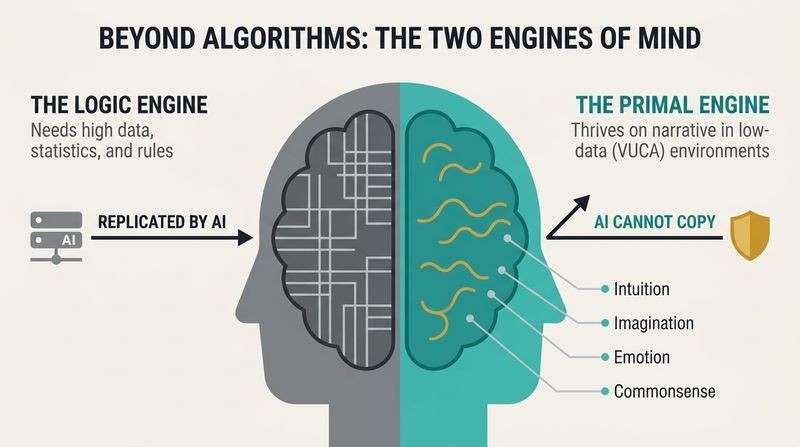
Fletcher's central claim is that the modern world wrongly equates intelligence with logic, the AND-OR-NOT operations Aristotle identified that now power arithmetic, statistics, and every algorithm. Logic needs abundant data, but real life is starved of it. So evolution built a second engine that acts smart with little or no information, split into four powers: intuition, imagination, emotion, and commonsense.
This is Primal Intelligence, and it runs on narrative cognition, meaning the brain literally thinks in story. Schools drill children to imitate computers, producing what Fletcher calls second-class algorithms. His theory was rejected everywhere except U.S. Army Special Operations, whose trainees had soaring IQs yet cracked under volatility, uncertainty, complexity, and ambiguity. When trained in Primal, senior officers improved creative problem-solving by nearly a full standard deviation.
The framing echoes Iain McGilchrist's work on hemispheric specialization and Gary Klein's naturalistic decision-making, both arguing that expertise lives in fast, tacit judgment rather than explicit calculation. Fletcher's sharper move is grounding this in neuroanatomy: he insists the synapse computes A leads to B (causation), while transistors only compute A equals B (correlation). That distinction is philosophically contestable, since large language models arguably approximate causal reasoning. But the practical warning lands: optimizing humans to do what laptops already do better is a losing bet, and the scarce, valuable skill is thinking where data runs out.
Hunt the exception, not the pattern, to see the future first
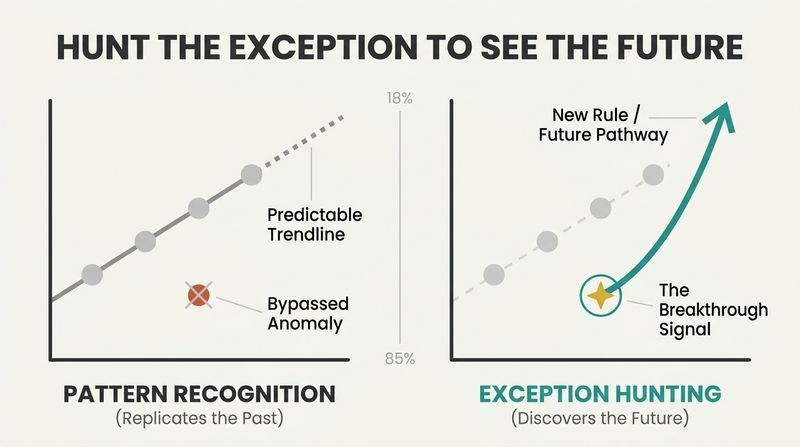
Intuition, Fletcher argues, is not pattern recognition (the definition behavioral economists borrowed from computing). It is the opposite: spotting exceptional information, an anomaly that violates a known rule and hints at a new one. Van Gogh noticed green-purple clashes outside the accepted color wheel and beat science to the RGB system every screen now uses. Marie Curie saw rays coming from inside a single atom, not from chemical bonds, and discovered radioactivity. Steve Wozniak saw promise in a microcomputer everyone dismissed as too small.
To reactivate this childlike eye, treat everything as unique. Fletcher's Shift to Narrative technique: when you catch yourself labeling something (crazy, beautiful, boring), convert the label into a specific story. And delay asking Why. Special Operations spy-hunters surface hidden truths with over 95% Who, What, When, Where, and How questions, because Why triggers judgment and ends curiosity.
The delay-Why discipline resembles the Toyota production system flipping it: Toyota asks Why five times to find root causes, while Fletcher warns Why prematurely collapses exploration into a verdict. Both can be right depending on goal (diagnosing a known defect versus discovering an unknown opportunity). The claim that children default to treating everything as novel aligns with developmental research on infants' heightened attention to surprising events. One tension: relentlessly treating everything as exceptional is metabolically expensive, which is precisely why adult brains prune to efficient pattern-matching. The art is knowing when novelty-hunting pays, a judgment Fletcher assigns to commonsense.
Imagination is planning: target one mountain, keep many routes up
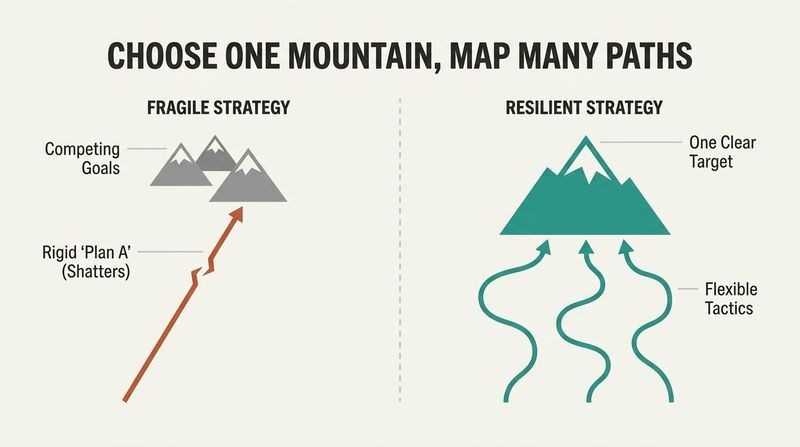
Fletcher reframes imagination as the brain's planning engine, powered by story (a plot is literally an invented sequence of actions). Effective imagination has a specific shape: an integrated past joined to a branching future, which he calls defined strategy, unlimited tactics. Most people invert this. They juggle multiple competing goals (one CEO claimed fifteen primary objectives) while clinging to a single Plan A that shatters on contact.
Special Operators do the reverse: rank objectives ruthlessly to one clear number one, then generate many flexible paths to reach it. Admiral Horatio Nelson's Trafalgar victory came from giving his fleet one unified goal while letting individual captains improvise tactics. Beethoven fused rigid classical structure with wild harmonic exploration. When a training bomb detonated mid-mission, operators kept the single goal (build rapport with the chieftain) but invented three completely different rescue tactics on the fly.
This maps neatly onto military doctrine's distinction between ends and ways, and onto Jim Collins's finding that focus beats diversification. The counterintuitive part is that an integrated past creates forward momentum, not backward drag. Psychologically this resembles narrative identity research (Dan McAdams): people with coherent life stories show greater resilience and goal persistence. A fair challenge: real organizations face genuine multi-objective tradeoffs where forcing a single number one can be reductive. Fletcher would answer that ranking, not eliminating, is the point, but the discipline of choosing under pressure remains the hard, underpracticed skill he keeps emphasizing.
Your fear, anger, grief, and shame are precise plan-failure alarms
Fletcher rejects the wise-men view that emotion is irrational noise. Each negative emotion is a diagnostic reading the shape of your mental life story:
1. Fear means you have no plan; your future has vanished.
2. Anger means you have exactly one plan and only one path forward.
3. Grief means something happened that splits your world into good and bad; you live in two worlds.
4. Shame means you acted against yourself; you live as two people.
The fix is not to suppress or wallow. For fear, push your gaze to your single strategic objective and make a first-step plan (any effective move; clarity snowballs from there). For anger, run an Emotion Reset: recall a time you improvised a new plan under pressure. For grief and shame, mine your past for dumb pride (a foolish-looking act you would repeat) and maverick gratitude (unexpected thanks that moved you) to rediscover your purpose.
This is a functionalist theory of emotion in the tradition of Lisa Feldman Barrett and Antonio Damasio, who showed patients with damaged emotional processing make catastrophic decisions. Fletcher's innovation is assigning each emotion a specific informational content about planning state, which is testable and unusually actionable. The framework risks over-tidiness: real emotions blend and misfire, and trauma can make fear signal danger that isn't there. Fletcher partly concedes this by noting ancient fear circuits are mistuned for modern life. Still, reframing shame as a signal of self-inconsistency rather than a verdict of worthlessness is therapeutically powerful and consistent with acceptance-based clinical approaches.
Commonsense is knowing when you don't know; tune anxiety to sense it
Commonsense, the trait children beat computers at, is simply the ability to detect when you have hit the edge of your knowledge, an unknown unknown. ChatGPT hallucinates because it cannot know that it doesn't know. Your brain measures environmental volatility through anxiety, which Fletcher insists is healthy, not a disorder. The trick is tuning it in three steps:
1. Past anxiety: NONE. Convert old fears into updated standard operating procedures, or dismiss them as bad luck.
2. Future anxiety: NEAR. Focus only on the next task, what operators call Now plus one, not the distant future which spawns infinite what-ifs.
Warren Buffett turned crippling public-speaking dread into a routine (a processed past anxiety) and profited by buying when fearful markets flashed back to old crashes. James Simons ran history's most lucrative hedge fund by fixing his gaze relentlessly on near-future volatility.
Fletcher rehabilitates anxiety in a way that dovetails with research showing moderate arousal optimizes performance (the Yerkes-Dodson curve) and with reappraisal studies where relabeling anxiety as excitement improves outcomes. His Buffett reading is elegant: markets crash because most investors carry unprocessed emotional memory, creating exploitable mispricing, an echo of behavioral finance's fear-and-greed cycles. The bolder claim, that human confidence comes from the absence of a falsifier rather than the presence of evidence, is essentially Popperian falsification applied to cognition. It usefully explains why over-collecting data breeds paralysis, though it underweights domains where more information genuinely does reduce uncertainty.
Innovate by holding rule and exception in tension until a new rule is born
True innovation is not brainstorming (random idea-generation, which Fletcher says is what AI and post-Jobs Pixar do). It is purposeful transformation, and he offers three methods to accelerate intuition into breakthroughs:
1. Turn an exception into a new rule. Einstein saw light's constant speed as an anomaly, then declared all time is local, birthing relativity.
2. Leverage conflict. Rather than choosing between a rule and its exception or splitting the difference, keep both in tension until a synthesis emerges. Darwin held nature's harmony against Malthus's over-reproduction and produced natural selection.
3. Eat your enemy. Absorb a rival's core strength into your own identity instead of becoming their opposite. Japanese industry fused American individualism with Bushido quality control.
A recurring thread: Einstein, Darwin, Jobs, and Clausewitz all read Shakespeare, whose characters break archetypes to reveal the power of the exceptional.
The leverage-conflict method is essentially dialectical thinking (thesis, antithesis, synthesis) and mirrors Roger Martin's integrative thinking, where superior leaders refuse the either-or and forge a better third option. The eat-your-enemy idea resonates with Sun Tzu and with competitive strategy's notion of absorbing rivals' capabilities. Fletcher's Shakespeare-obsession thread is charming but correlational, not causal; plenty of Shakespeare readers never innovate, and survivorship bias looms large. The durable insight is procedural: creativity comes from tolerating cognitive tension rather than rushing to resolve it, which aligns with research linking ambiguity tolerance to creative achievement.
Antifragility comes from 'I can succeed,' not 'I will succeed'
Fletcher distinguishes optimism from wishful thinking. Visualizing success (the New Thought lineage running through Napoleon Hill and The Secret) tells you you will win; when you lose, your faith cracks. Real optimism says you can win, which survives any number of losses as long as you win once. This durable optimism is the first secret of antifragility, growing stronger from setbacks.
It is built not through positive thinking (which fuels dissociation, the numb detachment behind burnout and depression) but through positive surprise. A clinic patient stuck in emotional numbness recovered purpose by recalling one fortunate plot twist in his own past, generating genuine wonder. The bigger the prior negative, the bigger the surprise, and the more purpose it creates. The second secret is Planner Not the Plan: rehearse planning itself, per Eisenhower, so that when every plan shatters you can build a new one.
Fletcher borrows Nassim Taleb's term antifragility but grounds it in narrative psychology rather than systems theory. His critique of positive thinking is supported by research on suppression and toxic positivity, which show that denying negative experience backfires. The can-versus-will distinction is subtle and valuable: it resembles the difference between fixed hope and what psychologist Charles Snyder called agency plus pathways thinking in hope theory. The claim that recalling personal positive surprises works while hearing others' does not is consistent with self-referential memory effects. A caveat: for severe trauma, self-directed recall is rarely sufficient without clinical support, something the everyday-burnout framing can obscure.
Match your plan's boldness to the situation's uncertainty, not your comfort
Good decision-making means matching the newness of your plan to the newness of your environment, drawn from three commonsense legends:
1. George Marshall junked his most decorated generals because expertise optimized for yesterday's war guarantees tomorrow's ruin. Trust expertise when it says I have never seen this before, not when it says this will work.
2. Thomas Paine showed new plans arrive half-formed as hints; double down on the odd part rather than trimming it, which takes boldness.
3. George Washington ran textbook sieges when stable but gambled on a night crossing of the Delaware when desperate.
Neil Armstrong survived a spinning Gemini capsule by firing reentry thrusters no astronaut had used for maneuvering. Fletcher's final tool: Go Where Experts Can't Say No. Ask an expert only whether they can prove your plan will fail; ignore their better ideas, which are optimized for the past.
The core error Fletcher names, that people take their biggest risks when secure and turn timid amid volatility, is empirically robust: it mirrors prospect theory's finding that people grow risk-seeking to avoid losses only after framing, and that comfort breeds complacency (the optimization trap he equates with hyperspecialized species going extinct). The expert-as-falsifier technique is genuinely clever and underused; it exploits the asymmetry that experts are reliable at spotting fatal flaws but unreliable at predicting novel success. The Marshall example is bracing but ethically loaded, since firing competent people for being calibrated to the past assumes the environment truly shifted, a judgment that itself requires the commonsense the whole book is trying to build.
Great communication makes people imagine a question, then answers it better than they can
Fletcher separates two modes. External communication (marketing, persuasion) works by sparking imagination, not fear. Fear-based messages produce fast but fragile compliance; imaginative ones merge your story into the audience's identity and endure. Nike's Just Do It ad, featuring an eighty-year-old jogger, outperformed even Apple's 1984 because it invited viewers to co-create a personal story. The techniques, lifted from Shakespeare: start in the middle, feature exceptions to rules, and pose riddles. Then end by answering Why and shut up, letting imagination run.
Internal communication (aligning a team) is the inverse: give one and only one goal plus the why, then let people invent the how. This is Commander's Intent, which turned Churchill's vague order for hunter-class troops into the British Commandos. Underneath both sits trust, built by authentically sharing your own life story, which Green Berets found reopened a frightened Vietnamese village.
The external formula (provoke a question, answer it) is a sophisticated version of the curiosity-gap theory George Loewenstein formalized: curiosity spikes when we sense a gap in what we know. Fletcher's insistence that you cannot control what an audience imagines, only seed it, is a useful corrective to manipulative persuasion models and aligns with reader-response theory in literary criticism. Commander's Intent is battle-tested doctrine now spreading into agile management. The trust-through-vulnerability claim echoes Brené Brown's research and self-disclosure studies showing reciprocal openness accelerates intimacy. The tadpole analogy (insecure environments force premature, stunted maturation) is a striking, evidence-backed metaphor for how fear narrows human development.
Coach by unleashing the rookie, then rescuing them; it grows you both
Fletcher's counterintuitive coaching rule: hand a rookie real control on a hard task, let them chain mistakes until they nearly crash, then take over, but push forward through their errors rather than undoing them. Because you cannot rewind, you are forced to invent a genuinely new solution in real time, expanding your own expertise. A Special Operations helicopter pilot, a Hollywood showrunner, and billion-dollar sales agents all independently described the same method and the same result: it makes the expert better, escaping the paradox that experts stop learning once they know.
Dr. William Osler revolutionized medicine this way, sending students into hospital wards to treat their own patients and listen to them, rather than memorizing textbooks. His trainees, including insulin's discoverer Frederick Banting, helped push life expectancy from forty-six to sixty-five. The deeper point for coaches: the barrier is not the rookie's risk but your reluctance to relinquish control.
This inverts the standard master-apprentice model and resonates with deliberate-practice research showing experts plateau once tasks become automatic; the rookie-induced crisis manufactures the desirable difficulty that Robert Bjork's learning science says drives growth. It also aligns with improv theater's yes-and discipline, which Fletcher explicitly cites. The neuroscience gloss (imagination branching forward from possibilities while reverse-branching backward from a goal until they intersect) is a vivid model of means-end planning. The obvious limit is stakes: letting a rookie nearly crash is fine in a simulator or a TV episode, riskier in surgery or live flight, which is why Fletcher restricts the deepest version to recoverable environments.
Leadership is vision plus self-reliance, and management is neither
Fletcher draws a hard line. Management (from a word meaning to steer a horse) is influencing others toward outcomes; leadership is taking the first step into a future others cannot see. No amount of managerial training produces leaders because leaders look forward, not at the followers behind them. The fatal flaw of would-be leaders is caution: at Special Operations' Pineland, recruits acted instantly on threats but hesitated on opportunities, rationalizing with critical thinking until the chance passed. Fletcher calls this mortgaging the future.
Leadership requires vision (grabbing one possible future and committing) plus self-reliance (Emerson's nonconformity). Nikola Tesla envisioned the alternating-current motor while reciting Goethe's Faust, a mind turning while the body stands still. To develop it, feed your imagination realistic fiction, seek a mentor who activates rather than programs you (as Wally coached Wayne Gretzky to anticipate rather than calculate), and test yourself with Covert Victory: succeeding without needing anyone to know.
The management-leadership distinction is not new (Kotter, Bennis drew it decades ago), but Fletcher's reframing of caution as the primary killer is fresh and provocative. His observation that people react faster to threats than opportunities is well-supported by negativity-bias research, and reframing critical thinking as sometimes a disguised excuse to avoid commitment is a bracing challenge to a sacred educational value. Covert Victory is a shrewd self-diagnostic for intrinsic versus extrinsic motivation, echoing Deci and Ryan's self-determination theory. The romantic Emersonian individualism runs a risk, though: history's self-reliant visionaries include both liberators and megalomaniacs, and the book's own commonsense-as-falsifier tool is what should keep vision honest.
Analysis
Primal Intelligence is a hybrid: part popular neuroscience, part self-help, part military ethnography, and part literary criticism, unified by a single contrarian thesis that intelligence is narrative, not logical. Angus Fletcher, a Project Narrative professor with a neuroscience background, structures the book as four core powers (intuition, imagination, emotion, commonsense) plus six applications, all illustrated through a classified U.S. Army Special Operations collaboration and a recurring cast of Shakespeare-reading geniuses. The framing device (a skeptical colonel investigating a rumored lost brain part) signals the book's storytelling ambition and its central irony: a book arguing the brain thinks in story is itself an extended narrative argument.
The intellectual spine is the claim that the synapse computes causation (A leads to B) while transistors compute correlation (A equals B), making commonsense and imagination permanently impossible for AI. This is the book's strongest and most vulnerable point. It offers a crisp, falsifiable mechanism and a genuine explanation for why large language models hallucinate. But the sharp binary underrates how far statistical systems can approximate causal inference, and the neuroscience is presented with more certainty than the contested literature supports. Fletcher's dismissal of divergent-thinking creativity research and behavioral economics (especially Kahneman's recognition-based intuition) is rhetorically bold but somewhat strawmanned.
Where the book excels is practical reframing. Treating each negative emotion as a specific plan-diagnostic, tuning anxiety via Now plus one, matching plan-novelty to situation-novelty, and the expert-as-falsifier tool are unusually actionable and cross-validate against naturalistic decision-making, hope theory, and desirable-difficulty learning science. The Shakespeare thread is delightful but leans on survivorship bias and correlation. The Special Operations material lends credibility and vividness, though its classified nature makes independent verification impossible. Overall, the book succeeds as a provocation and a toolkit more than as settled science: it will change how readers relate to uncertainty, emotion, and their own supposed irrationality, even where its harder neuro-claims invite skepticism.
People Also Read




Download PDF
Download EPUB
.epub digital book format is ideal for reading ebooks on phones, tablets, and e-readers.








































