

Key Takeaways
Redirect your sex drive instead of discharging it, and it becomes rocket fuel
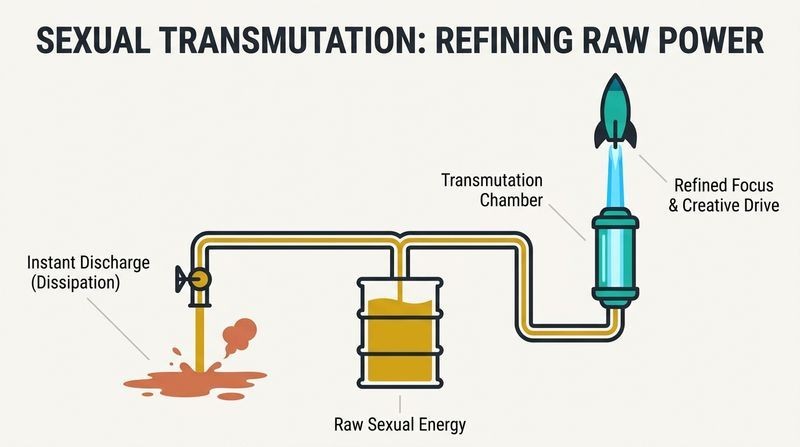
The book's central claim is transmutation. Joseph Peterson argues that the energy your body pours into producing and releasing semen can be consciously rechanneled into work, creativity, athletics, and spiritual growth. The idea predates him: Napoleon Hill devoted a chapter of Think and Grow Rich to "sexual transmutation," calling it a first step toward wealth, and observed that many men only succeed after 40 because they stop dissipating energy through over-indulgence.
The crude-oil analogy anchors it. Sexual energy is raw, powerful, and valuable, but you must refine it to make it useful. Released carelessly it produces a few seconds of pleasure; conserved and directed, Peterson claims it sharpens focus, drive, and confidence. You need not be celibate, just deliberate about not wasting your "essence," as he puts it.
What's striking is how this reframes an ancient ascetic intuition in modern productivity language. The transmutation idea echoes Freud's concept of sublimation, where libidinal energy gets redirected into civilization-building work. The weakness is the literal energy-accounting model: the body does not store a fixed reservoir of vitality that ejaculation drains. Still, the behavioral kernel is defensible. Compulsive porn use and constant arousal-seeking genuinely fragment attention. Whether the mechanism is mystical "Jing" or simply the discipline of refusing an easy dopamine hit, the practice of channeling restless energy into a project is sound advice that predates and outlives any biology.
Testosterone spikes roughly 145% by day seven of abstinence, then settles
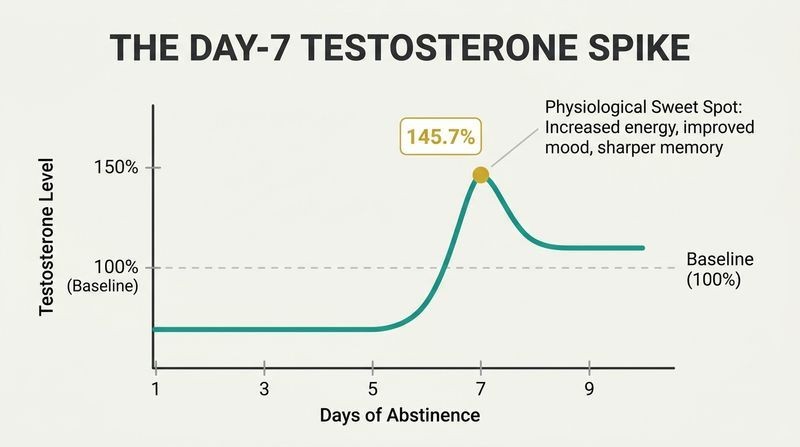
This is the book's strongest scientific card. Peterson cites Jiang et al. (2003), which tracked 28 men daily and found serum testosterone barely moved between days two and five, then peaked at about 145.7% of baseline on the seventh day of abstinence, after which no regular fluctuation continued. A separate study (Exton et al., 2001) found three weeks of abstinence raised testosterone, while orgasm itself did not alter testosterone levels.
Why testosterone matters cascades through the book. Peterson links higher testosterone to energy, mood, muscle mass, deeper voice, libido, better sleep, and reduced depression, drawing on Tyagi et al. (2017), which reviewed testosterone's benefits for bone density, lean mass, memory, and mood. He frames the day-seven peak as the practical sweet spot for the surge.
The day-seven spike is real but oversold. Jiang's sample was tiny (28 men), the peak was transient, and a single seven-day reading does not prove that chronic retention sustains elevated androgens. Notably, a separate finding the book itself cites shows abstinence beyond a week does not keep climbing. There's also a confound the book underplays: testosterone responds to exercise, sleep, and stress far more reliably than to ejaculation timing. The honest read is that abstinence produces a modest, short-lived hormonal blip, not a permanent testosterone transformation. Readers chasing a 45% "deeper voice" from one week of restraint will likely be disappointed.
Abstinence improves sperm volume and concentration, not depletes it
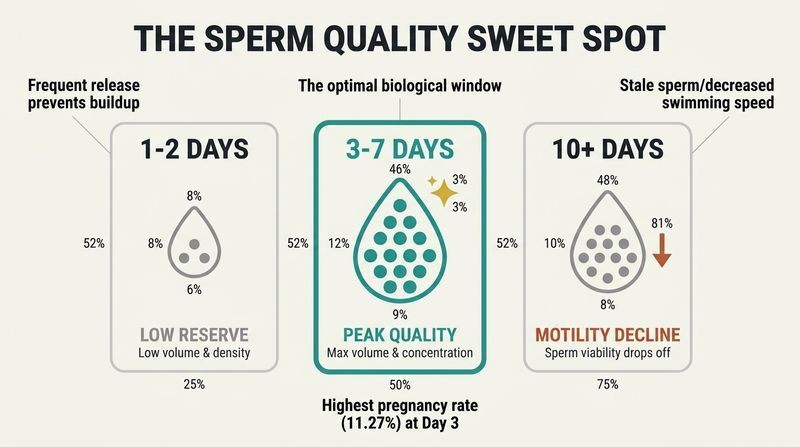
Peterson dismantles a common fear. Many assume holding back "stale" semen harms quality. He draws on Ayad et al. (2018), a review of dozens of studies, to argue the opposite: 23 of 24 studies found increased semen volume after abstinence, and 20 of 22 found higher sperm concentration, with the sharpest gains in the first two to five days.
The picture is nuanced, not uniform. Motility rose for several days then declined after about ten days. Viability peaked between days two and five. DNA fragmentation studies were mixed. The takeaway Peterson lands on: short to moderate abstinence (roughly three to ten days) leaves sperm quality unaffected or improved, and one fertility study found a three-day gap produced the highest pregnancy rate (11.27%), even though total motile sperm peaked at seven days.
This is the book at its most empirically careful, and it's worth crediting. The fertility literature genuinely supports shorter abstinence windows for conception, which overturns the old clinical advice to abstain for days before sperm collection. But notice the rhetorical sleight: a review showing sperm quality holds up over three to ten days does not validate indefinite lifelong retention, which is what the book ultimately promotes. The data support moderation, not abstinence as a permanent lifestyle. The gap between "abstaining a few days does no harm" and "never ejaculating transmutes into wealth and enlightenment" is enormous, and the citations only cover the first claim.
Sperm takes nearly three months to rebuild, so treat it as finite
Replenishment is slower than people think. Peterson walks through the biology: spermatogenesis takes 64 to 74 days, plus another 14 days maturing in the epididymis, for a full cycle approaching three months. Seminal fluid replenishes faster, roughly every two days, which is why men assume sperm is endless. In reality, you can ejaculate frequently and run down sperm count while fluid volume stays high.
The economic framing is the point. Peterson treats the body as an organism with finite nutrients (zinc, selenium, B12, phosphorus) distributed across competing priorities: metabolism, immunity, and new-cell growth. Zinc is 30 times more concentrated in semen than blood. By not constantly rebuilding semen, he argues, those resources get "recycled" toward sharper thinking, thicker hair, and brighter skin around the two-week reabsorption mark.
The reproductive biology here is accurate and well-explained, a genuine strength. Where it strains is the resource-reallocation leap. The body does reabsorb unejaculated sperm, but the nutrient quantities are trivial: the zinc in one ejaculate is a fraction of daily dietary intake, easily replaced by a handful of pumpkin seeds. The notion that retaining semen redirects enough zinc and phosphorus to visibly thicken hair or sharpen cognition has no controlled support. This is a recurring pattern in the book: solid physiology used as a launchpad for claims the physiology cannot bear. The finite-resource metaphor motivates discipline, but it is metaphor, not metabolism.
Train your pelvic floor to orgasm without ejaculating
The dry orgasm is the practical hack. For men who want pleasure and intimacy without losing the retained energy, Peterson teaches separating orgasm from ejaculation through Kegel muscle control. You locate the pelvic floor muscles by stopping urine midstream or halting gas, then strengthen them with contractions held three seconds, relaxed three seconds, several times daily, keeping buttocks and abdomen relaxed.
Timing is everything during sex. As orgasm approaches, you slow down, breathe deeply, hold still, and clamp the pelvic floor muscles at the "point of no return" to block ejaculation while still experiencing the orgasmic sensation. He notes a man can experience multiple dry orgasms (up to about five). A cruder fallback, pressing between scrotum and anus, causes retrograde ejaculation into the bladder, which he considers inferior for energy flow.
Pelvic floor training is legitimate and evidence-backed for continence and erectile function, and the multi-orgasm-without-ejaculation phenomenon is documented in sexology literature on "injaculation" and Taoist practice. The physiological reality is that orgasm (a neuromuscular event) and ejaculation (expulsion) are genuinely separable processes, so the technique is not mystical. One caution worth flagging that the book glosses: retrograde ejaculation routes semen into the bladder, which is harmless occasionally but should not be treated as a goal, and forceful suppression can in rare cases contribute to discomfort. The skill is real; the framing of "keeping the energy in" remains interpretive.
NoFap targets porn and masturbation; semen retention targets ejaculation itself
The two movements overlap but differ. NoFap, born from a 2011 online forum, asks men to quit masturbation and pornography but permits ejaculation with a partner. Semen retention goes further, avoiding ejaculation altogether through celibacy or dry orgasms. Peterson presents "hard mode": 90 days with no porn, no erotic imagery, no masturbation, no orgasm, no sex, no lusting, broken into three 30-day phases with environment changes, journaling, exercise, and accountability software.
The porn data is the alarming part. Citing NoFap's community survey, he reports that frequent porn users chase novelty (the Coolidge Effect), that 64% found their tastes escalating toward extreme content, that many developed the habit between ages 12 and 14, and that after quitting, 60% reported improved sexual function and 67% more energy.
The strongest practical content in the book lives here, because it shifts from mystical energy to behavioral conditioning. The Coolidge Effect, the tendency of males across species to renew sexual interest with novel partners, is well-documented, and supranormal stimulus theory (Deirdre Barrett) explains why infinite novel porn can recalibrate arousal expectations. The escalation findings align with addiction's tolerance mechanism. The caveat: these statistics come from a self-selected community of men who already believe porn harmed them, so they cannot establish prevalence or causation in the general population. The behavioral case against compulsive porn is credible; the survey numbers should be read as motivated testimony, not epidemiology.
Beat urges by cooling the body and crowding out idle time
Willpower alone fails; environment wins. Peterson offers a toolkit for redirecting arousal rather than white-knuckling it. Cold showers stimulate the vagus nerve, switching on the parasympathetic ("chill") nervous system and dampening the fight-or-flight arousal response. Fasting lowers FSH and sexual desire (a Ramadan study found drops in desire and intercourse frequency). Meditation grounds you in the present and rewires habit loops.
Design the day so urges have no room. He recommends naming the underlying feeling (boredom, loneliness, fear) to find the real need, redirecting into creative work (the heart of transmutation), exercise for endorphins, and blocking porn with accountability software while clearing stimulating triggers from your space. His sample schedule front-loads mornings with meditation, journaling, and exercise, and fills evenings with reading and a creative hobby.
This chapter quietly adopts modern behavioral science even as it's wrapped in chakra language. Naming an emotion to defuse it is "affect labeling," shown in UCLA neuroimaging (Lieberman) to reduce amygdala activity. Identifying the need beneath a craving mirrors urge-surfing in addiction therapy and the HALT check (Hungry, Angry, Lonely, Tired). Disrupting environmental cues is straight from habit research (Wood, Duhigg, Clear). The cold-shower vagal claim is plausible but the libido effect is more distraction than physiology. Stripped of the metaphysics, this is competent relapse-prevention advice. The real engine is not preserved semen but replaced behavior: idle, isolated, unstimulated time is what the urges colonize.
Famous geniuses cited as proof of retention deserve skeptical reading
The roll call is impressive and selective. Peterson lists Tesla (lifelong celibate who called women energy-thieves), Newton, Da Vinci, Michelangelo (whose biographer noted monk-like chastity), Beethoven, Freud (celibate after 40), Steve Jobs (practiced tantric retention), and Churchill ("I don't waste my essence in bed"). Athletes appear too: Muhammad Ali and Mike Tyson abstained before fights, and boxer David Haye held back for six weeks pre-fight, comparing himself to a starved, dangerous lion.
The logic is achievement-by-association. If titans of art, science, and sport conserved their sexual energy, the implication runs, conservation must have fueled their greatness. Peterson uses these figures as living evidence that transmutation produces world-changing output.
This is the book's most seductive and least rigorous move. It is textbook survivorship bias: cherry-picking celibate geniuses while ignoring the prolific womanizers (Picasso, Feynman, countless others) whose creativity hardly suffered. Correlation is asserted as causation with no comparison group. Many cited "facts" are also shaky historical inference; we cannot actually know Newton's or Da Vinci's private practices, and asexuality or repression is not the same as a deliberate energy technique. The pre-fight abstinence belief among boxers is itself contested by sports science, which finds little measurable effect of sex on next-day athletic performance. Inspiring rhetoric, but it proves nothing.
Karezza and tantric sex build intimacy by removing the finish line
Sex becomes connection, not conclusion. Peterson presents two partner practices. Tantric sex (Sanskrit for "to weave energy") emphasizes slow, fully present, multi-sensory lovemaking with synchronized breathing, eye-gazing, and orgasm control, where you repeatedly approach climax and pull back. Karezza (from the Italian for "caress," first described in 1931) goes further: prolonged touching, gazing, and even penetration with no orgasm or ejaculation at all.
The physiology flips the nervous system. Conventional goal-driven sex fires the sympathetic "fight or flight" system and ends in a powerful but fleeting orgasm. Karezza, being non-goal-oriented, activates the relaxation response and bonding circuitry, signaling safety. Practiced over at least three weeks, Peterson says, it recreates the honeymoon-phase intimacy and produces cumulative feelings of connection rather than the post-ejaculation slump.
This reframing has more support than the book's hormonal claims. The post-orgasm "slump" tracks with the prolactin surge and refractory period, and Peterson rightly notes prolactin's role in that listlessness. Karezza's bonding emphasis aligns with oxytocin-driven pair-bonding research; slow, sustained affectionate touch genuinely elevates oxytocin and lowers cortisol. Couples therapists like the Gottmans stress exactly this shift from performance to presence. The practice also sidesteps the orgasm-gap problem in heterosexual sex by decentering male climax. The honest caveat: for many couples, occasional orgasmic release deepens rather than depletes bonding, so Karezza is best framed as one valuable mode, not a mandatory replacement.
The scary warnings about retention are mostly unproven, but so are the miracles
Peterson defuses the fear campaign. He addresses three claims against retention. The prostate-cancer-prevention argument rests on a single unreplicated 2016 study that could not separate causation from correlation, while another found young frequent masturbators had slightly higher risk. The "semen retention is a sexual disorder" label he attributes to Western medicine's habit of separating mind, body, and spirit and dismissing millennia of Eastern practice. The "dangerous pent-up energy" worry he answers with transmutation: a healthy body reabsorbs retained semen rather than letting it stagnate.
His honest bottom line. Peterson concedes no rigorous studies exist on men who practice retention specifically, and suggests diet, exercise, and energy management likely matter more for prostate health than ejaculation frequency. His challenge to readers is modest: try 30 days and judge for yourself.
Crediting the book, the prostate-cancer debunking is fair; that literature genuinely is mixed and confounded, and the "sexual disorder" framing is a real diagnostic overreach. But intellectual consistency cuts both ways. The same standard that dismisses the cancer-prevention claim for lacking replication and controls should be applied to the book's own catalog of benefits, which rests on the same thin or absent evidence. Peterson's admission that no studies examine actual retention practitioners is the most honest line in the book, and it quietly undercuts the confident promises elsewhere. The closing 30-day experiment is the right spirit: treat it as a personal trial, not established science, and watch for placebo and self-selection in your own results.
Analysis
Semen Retention Miracle is a hybrid: part repackaged esoteric tradition (Taoist Jing, Hindu Veerya and Kundalini, Hellenistic alchemy), part men's self-improvement manifesto in the Napoleon Hill lineage, and part popular-science explainer. Its rhetorical engine is a recurring move: present accurate biology or a real study, then extrapolate to claims the evidence cannot support. The reproductive physiology is genuinely well-explained, and the Ayad and Jiang citations are real, but they establish only that short abstinence does not harm fertility and briefly nudges testosterone, not that lifelong retention produces wealth, thick hair, or enlightenment.
The book sits at the intersection of three modern phenomena worth naming. First, the online NoFap movement, which has genuine merit as a porn-addiction intervention but generates self-selected testimony that masquerades as data. Second, the broader wellness tendency to dress behavioral discipline in mystical or pseudo-scientific clothing, lending borrowed authority to advice that would stand on its own. Third, a contemporary masculinity discourse seeking frameworks for self-mastery, where the literal mechanism matters less than the felt experience of agency over impulse.
The most defensible reading separates practice from theory. The practices, reducing compulsive porn use, redirecting restless energy into creative and physical work, cultivating present-focused intimacy, designing environments that minimize idle temptation, are supported by mainstream psychology under different names: sublimation, urge-surfing, habit cue-disruption, oxytocin-driven bonding. The theory, a finite reservoir of vitality concentrated in semen that drains with ejaculation, is folk physiology with no controlled support.
The book's saving grace is its own concession that no studies examine retention practitioners directly and its modest closing ask: run a 30-day personal trial and judge honestly. That experimental humility is the right frame. Readers benefit most by adopting the behavioral discipline while holding the metaphysical accounting loosely, alert to placebo, expectancy, and the survivorship bias baked into its parade of celibate geniuses.
Review Summary
Semen Retention Miracle receives mixed reviews, with an average rating of 3.94/5. Positive reviews highlight increased energy, confidence, and motivation. Critics note a lack of originality and connection with readers. Some find the historical context and benefits compilation valuable, while others criticize the advocacy of NoFap "hard mode." Many readers report personal improvements from practicing semen retention. The book is praised for its concise introduction to the topic but criticized for simplistic writing and lack of scientific backing. Overall, readers recommend it as a starting point for those interested in semen retention.
People Also Read







Glossary
Semen retention
Avoiding ejaculation to conserve energyThe practice of deliberately avoiding ejaculation, either through total abstinence, periods of abstinence between sexual activity, or experiencing orgasm without ejaculating. The stated aim is to conserve and redirect the physical and spiritual energy associated with sexual release into other areas of life such as work, creativity, and health.
Sexual transmutation
Redirecting sex drive into achievementThe conversion of sexual energy into another motivation or drive, such as professional ambition, creativity, willpower, or spiritual growth. Popularized by Napoleon Hill in Think and Grow Rich, the concept treats the sex drive as a powerful creative force that, when not discharged, can fuel success in non-sexual pursuits.
Jing
Vital essence in Chinese medicineIn traditional Chinese Medicine, one of three vital life forces (alongside Qi/air and Shen/spirit). Jing is the essence that nourishes and fuels the body, believed to exist in finite supply and be most concentrated in semen. Its loss through ejaculation is said to cause aging, fatigue, and decline.
Dry orgasm
Orgasm without ejaculatingExperiencing the pleasure and sensation of orgasm while preventing the expulsion of semen, achieved by contracting the pelvic floor (Kegel) muscles at the point of climax. It allows sexual pleasure and partner intimacy without losing the retained energy, and reportedly permits multiple orgasms.
NoFap
Quitting masturbation and pornographyA movement and trademarked organization originating from a 2011 online forum, focused on abstaining from masturbation and pornography. Unlike full semen retention, NoFap permits ejaculation with a partner. Its "hard mode" variant prohibits porn, masturbation, orgasm, and sex, typically for a 90-day reset period.
Karezza
Prolonged sex without orgasmA lovemaking technique first described in 1931, named from the Italian for "caress." It involves touching, gazing, and optional penetration sustained slowly without orgasm or ejaculation. By avoiding a climactic goal, it activates the body's relaxation and bonding response, building deep intimacy rather than fleeting physical release.
Kundalini
Dormant spiritual energy at spineIn Hindu mysticism, a feminine creative energy believed to reside coiled at the base of the spine in the root chakra. When awakened, it rises through the body's chakras to unite with masculine energy at the crown, producing enlightenment. Semen retention is said to fuel this awakening.
Coolidge Effect
Renewed arousal from novel partnersA documented tendency, observed across many species, for males to regain sexual interest when presented with novel partners. Peterson cites it to argue that pornography trains compulsive novelty-seeking, eroding desire for a steady partner and escalating viewers toward more extreme content over time.
Veerya
Vital fluid in AyurvedaIn Ayurvedic texts, the term for semen conceived as a vital life essence, likened to the sap that gives a tree its color and vitality. Said to be derived from blood and pervade the whole body, its preservation is considered essential for physical, mental, moral, and spiritual development.
FAQ
What's "Semen Retention Miracle" about?
- Overview: "Semen Retention Miracle" by Joseph Peterson explores the practice of semen retention and its benefits for wealth, health, sex, and longevity.
- Core Concept: The book delves into the idea of sexual energy transmutation, where the energy typically used in ejaculation is redirected to enhance various aspects of life.
- Historical Context: It draws on ancient wisdom from traditional Chinese Medicine and Indian Ayurvedic practices, highlighting the historical significance of semen retention.
- Practical Guidance: The book provides techniques and methods for practicing semen retention, including muscle control and lifestyle changes.
Why should I read "Semen Retention Miracle"?
- Self-Improvement: The book offers a unique approach to self-improvement by harnessing sexual energy for personal and professional growth.
- Health Benefits: It discusses potential health benefits, such as increased energy, improved focus, and enhanced immune function.
- Spiritual Growth: Readers interested in spiritual practices may find value in the book's exploration of energy transmutation and spiritual awakening.
- Success Stories: The book includes examples of famous individuals who have practiced semen retention and achieved significant success.
What are the key takeaways of "Semen Retention Miracle"?
- Energy Transmutation: Sexual energy can be redirected to improve creativity, motivation, and overall life satisfaction.
- Health and Longevity: Semen retention is linked to various health benefits, including increased testosterone levels and improved mental clarity.
- Spiritual and Relationship Benefits: The practice can deepen spiritual connections and enhance relationship intimacy.
- Practical Techniques: The book provides actionable techniques for practicing semen retention, such as Kegel exercises and Tantric sex.
What is semen retention according to Joseph Peterson?
- Definition: Semen retention is the practice of avoiding ejaculation to conserve and redirect sexual energy.
- Methods: It can be achieved through abstinence or by separating orgasm from ejaculation, known as a "dry orgasm."
- Benefits: The practice is believed to increase productivity, motivation, and self-confidence while boosting physical and mental health.
- Historical Roots: It has roots in ancient Chinese and Indian traditions, where semen is considered a vital life force.
How does "Semen Retention Miracle" explain the benefits of semen retention?
- Physical Benefits: The book claims benefits like increased testosterone, improved immune function, and enhanced energy levels.
- Mental and Emotional Benefits: It suggests that semen retention can boost confidence, relieve depression, and improve focus and memory.
- Spiritual Benefits: The practice is said to awaken the root chakra and enhance spiritual growth and awareness.
- Relationship Benefits: Semen retention can improve sexual stamina, deepen emotional bonds, and enhance relationship satisfaction.
What are the best quotes from "Semen Retention Miracle" and what do they mean?
- Nietzsche Quote: "The reabsorption of semen by the blood is the strongest nourishment..." This suggests that retaining semen can nourish and empower the body.
- Napoleon Hill Quote: "The major reason why the majority of men who succeed do not begin to do so before the age of forty to fifty..." This implies that conserving sexual energy can lead to greater success.
- Yogaśāstra Quote: "Falling of semen brings death; preservation of semen gives life." This highlights the belief in semen as a vital life force.
- Winston Churchill Quote: "I don’t waste my essence in bed." This reflects the idea of conserving energy for greater achievements.
How does "Semen Retention Miracle" relate to ancient wisdom?
- Chinese Medicine: The book discusses the concept of Jing, Qi, and Shen, where semen is seen as a vital life force.
- Ayurvedic Texts: It references the idea that semen is derived from blood and is essential for vitality and longevity.
- Alchemy and Transmutation: The practice is linked to alchemical principles of transforming energy for creative and spiritual purposes.
- Historical Practices: The book highlights how ancient cultures viewed semen retention as a means to enhance life force and spiritual growth.
What techniques does "Semen Retention Miracle" suggest for practicing semen retention?
- Kegel Exercises: Strengthening pelvic floor muscles to control ejaculation and achieve dry orgasms.
- Tantric Sex: Engaging in slow, mindful sexual practices to enhance intimacy and avoid ejaculation.
- Karezza Technique: Focusing on non-orgasmic sexual intimacy to deepen emotional connections.
- Lifestyle Changes: Incorporating meditation, cold showers, and fasting to manage sexual urges and redirect energy.
How does "Semen Retention Miracle" address the science behind semen retention?
- Testosterone Levels: The book cites studies showing increased testosterone levels with semen retention.
- Semen Quality: Research is discussed regarding improved semen volume, concentration, and motility with abstinence.
- Mental Health: It references studies linking higher testosterone to improved mood and cognitive function.
- Physical Performance: The book suggests that semen retention can enhance athletic performance and overall vitality.
What is the relationship between NoFap and semen retention in "Semen Retention Miracle"?
- NoFap Definition: NoFap is a movement that encourages abstaining from masturbation and pornography.
- Similar Goals: Both practices aim to conserve sexual energy and redirect it for personal growth and success.
- Differences: NoFap focuses on avoiding pornography and masturbation, while semen retention emphasizes avoiding ejaculation.
- Complementary Practices: The book suggests that both practices can enhance self-control, motivation, and overall well-being.
What are the potential downsides of semen retention according to "Semen Retention Miracle"?
- Prostate Cancer Myth: The book addresses the claim that frequent ejaculation prevents prostate cancer, noting a lack of scientific consensus.
- Social Stigma: It discusses the misconception that semen retention is a sexual disorder and the potential for social judgment.
- Energy Management: The book emphasizes the importance of channeling retained energy into productive activities to avoid restlessness.
- Overall Conclusion: The book argues that the benefits of semen retention outweigh any potential drawbacks when practiced mindfully.
What is the 30-day challenge proposed in "Semen Retention Miracle"?
- Challenge Overview: The book encourages readers to try semen retention for 30 days to experience its benefits firsthand.
- Expected Outcomes: Participants are asked to assess changes in energy levels, motivation, and personal relationships.
- Techniques to Use: The challenge involves using the techniques outlined in the book, such as Kegel exercises and meditation.
- Goal of the Challenge: The aim is to help readers discover the transformative potential of semen retention and consider making it a lifestyle choice.
Download PDF
Download EPUB
.epub digital book format is ideal for reading ebooks on phones, tablets, and e-readers.








































