


Key Takeaways
Put her orgasm first, and everything downstream gets easier
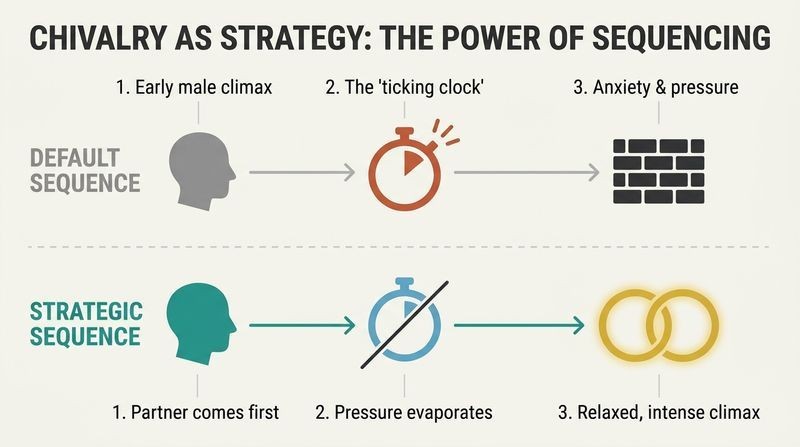
The book's title is its thesis. Kerner argues that a man should deliberately postpone his own climax until after his partner has reached hers. He cites the 1994 Sex in America Survey: about three quarters of men, but fewer than a third of women, reliably orgasm during intercourse. Reverse the order, and the pressure that fuels premature ejaculation and performance anxiety evaporates.
Crucially, Kerner distinguishes postponing gratification from postponing enjoyment. When she comes first, the man is freed from the ticking clock, and his own eventual climax is intensified by the wait. He frames this less as sacrifice than as strategy: chivalry that pays dividends. The book's ideal is mutual pleasure, not martyrdom.
What's striking is how Kerner reframes generosity as self-interest, which is persuasive psychology. Research on sexual satisfaction consistently shows that responsiveness to a partner's needs predicts relationship longevity better than technique alone. The framing also quietly dismantles a zero-sum view of sex. One caution: the rigid sequencing (her orgasm, then his) can itself become a new performance metric, breeding the very anxiety it aims to cure. The deeper principle, attentiveness over scorekeeping, matters more than the literal order. Emily Nagoski's work on responsive desire suggests presence and safety, not choreography, are what actually unlock arousal for many women.
The clitoris is an 18-part network, not a button
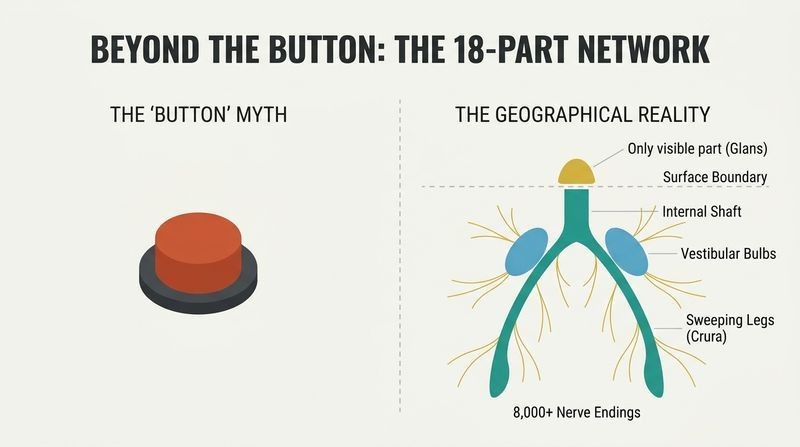
Kerner's central anatomical claim, drawn from the Federation of Feminist Women's Health Centers, is that the visible glans is just the tip. The clitoris is a sprawling system of roughly eighteen structures, many hidden, extending through the pelvic area, with about eight thousand nerve endings (twice the penis). It was formed from the same embryonic tissue as the penis and serves no purpose except pleasure.
He wants men to stop thinking of a tiny nub and start thinking geographically: shaft, legs (crura), bulbs, hood, frenulum, and more. Even the famed G-spot, he argues, is likely just the internal roots of the clitoris meeting the urethral sponge. His conclusion, borrowing Occam's razor: all orgasms are essentially clitoral.
The anatomical reframing has aged well. In 2005, urologist Helen O'Connell's MRI studies confirmed the clitoris is far larger than textbooks depicted, vindicating the feminist health researchers Kerner leans on. The point that female genitals are the male's turned inward is embryologically accurate and rhetorically powerful. Where nuance helps: collapsing all orgasms into clitoral orgasms is tidy but contested. Some researchers argue vaginal and cervical stimulation recruit distinct nerve pathways (the pelvic and vagus nerves) that produce qualitatively different experiences. The lesson survives regardless: ignoring the external structures wastes the majority of a woman's pleasure hardware.
Twenty-one minutes of foreplay changes the orgasm odds dramatically

Kerner marshals data to attack the idea that women simply take too long. Studies from Kinsey and Masters and Johnson found that when partners spent twenty-one minutes or more on foreplay, only about 7.7% of women failed to consistently reach orgasm. Compare that to the baseline where two out of three women are routinely left unsatisfied.
The shift, he notes, is tectonic: from roughly one in three women climaxing to nine in ten, purchased with a matter of minutes. The takeaway is not vaguely more foreplay but a structural rethink of time allocation. Men finish fast (Kinsey found 75% within two minutes); women need a longer runway. The math of the bedroom, Kerner insists, is solvable.
The framing of sexual dissatisfaction as an engineering problem with a known fix is refreshingly unromantic and empowering. The statistic anchors an otherwise touchy subject in something actionable. A fair critique: these mid-century figures come from small, non-representative samples, and averaging away individual variation risks turning twenty-one minutes into a stopwatch mandate, which contradicts the book's own warning against goal-fixation. Time is a proxy for attention, arousal, and safety, not a magic threshold. Still, the core insight, that the arousal gap is a timing mismatch rather than a female deficiency, reframes a common source of blame and shame.
Treat oral sex as the main course, not the appetizer
Kerner's signature move is linguistic: he rebrands cunnilingus from foreplay to coreplay. Foreplay, in his scheme, is everything preceding the first genital kiss; coreplay is the oral act itself, treated as a complete process with a beginning, middle, and end capable of leading a woman all the way to orgasm. Moreplay is the connected aftermath.
He backs this with survey data: in one study of ninety-eight wives, 82% rated oral sex very satisfying versus 68% for intercourse, and they reached orgasm 81% of the time orally versus 25% during intercourse. The tongue, he argues, is precise, tireless, and immune to premature ejaculation, making it a better instrument than the penis for the fine work of clitoral stimulation.
The play process (foreplay, coreplay, moreplay) is clever branding that smuggles a genuine reframe past cultural resistance. By demoting intercourse from the definition of real sex, Kerner challenges what sociologists call the coital imperative, the assumption that penetration is what counts. That imperative is culturally specific, not universal, and disproportionately serves male anatomy. The counterpoint worth naming: elevating one act to centerpiece can feel as prescriptive as the model it replaces. Not every woman prioritizes oral sex, and desire varies enormously. The durable insight is decoupling sex from penetration, opening a wider menu rather than swapping one mandatory dish for another.
Freud demonized the clitoris and set women back a century
Kerner delivers a pointed intellectual history. Up through the eighteenth century, Western medicine believed female orgasm was necessary for conception, and a one-sex model treated male and female genitals as equivalent. Then Victorian anatomists began erasing the clitoris from medical illustrations, and Freud delivered the coup de grace around 1910.
Freud declared clitoral orgasms infantile and insisted mature women should transfer sensation to the vagina through penetration. Kerner notes Freud had access to accurate anatomy and chose ideology anyway, calling it an abuse of the bully pulpit. The consequence, per Rebecca Chalker, was that the clitoris was culturally vaporized for most of the twentieth century, leaving generations of women worried something was wrong with them for not climaxing through intercourse alone.
The historical arc Kerner traces, from Galen through the Victorians to Freud, is well documented by historians like Thomas Laqueur, whose one-sex to two-sex model Kerner draws on. Framing sexual knowledge as socially constructed and reversible is genuinely illuminating: what feels like biological fact is often inherited ideology. The value here is diagnostic. Millions of women internalized a pseudoscientific standard and blamed themselves. Naming Freud's error as ideology, not observation, lifts that burden. A small caveat: Freud is an easy villain, and the story is cleaner than reality, since plenty of clitoral knowledge persisted in folk and medical traditions alongside his theories.
Female arousal follows a narrative arc, like a play
Borrowing from Aristotle's Poetics, Kerner insists arousal has a dramatic structure with a beginning, middle, and end, where each step depends on the completion of the one before. He maps it onto the physiology documented by Masters and Johnson: excitement, plateau, orgasm, resolution.
Along the way, specific things happen in sequence. Blood floods the pelvis, the clitoral head emerges then retracts under its hood about ninety seconds before climax, the inner labia darken with engorgement, and orgasm arrives as rhythmic contractions roughly every 0.8 seconds. Reading these signs lets a partner navigate rather than guess. Kerner's point: displace or skip a stage and the whole sequence collapses. Awareness of where she is in the arc is the difference between leading and stumbling.
The dramaturgical metaphor is more than a flourish. It reframes a partner from performer to attentive reader, shifting focus from what am I doing to where is she. This maps neatly onto the concept of interoceptive attunement in sex research: tracking a partner's physiological cues in real time. The observable signals (labial color change, clitoral retraction, breathing) are legitimate and underappreciated markers. One tension: the linear act-one-two-three model risks implying a single correct path, when arousal is often nonlinear, looping, and interruptible. Masters and Johnson's cycle itself has been critiqued for underweighting desire and emotional context, which Kerner's storytelling frame actually handles better than the clinical original.
A healthy vagina is cleaner than your mouth, so drop the squeamishness
Kerner tackles the hygiene anxiety that surveys show is men's number one reservation about oral sex. He explains that the vagina is a self-cleaning ecosystem, an acidic environment (roughly the pH of red wine) maintained by lactobacilli, the same beneficial bacteria found in yogurt. It hosts fewer harmful microbes than the human mouth.
He demystifies scent, or what he calls a woman's cassolette, her unique aromatic signature. Genuine off odors usually signal either simple hygiene needs or bacterial vaginosis, an imbalance that produces the fishy trimethylamine smell and is treatable. Diet, cycle, hydration, and even unprotected sex (semen is highly alkaline and disrupts pH) all shift taste and smell. His prescription: transform anxiety into enthusiasm, since fear is contagious to a partner.
Debunking the it's-a-swamp myth with microbiology is a genuine public service, given how much shame surrounds female genital scent. The yogurt comparison is memorable and scientifically grounded: vaginal and yogurt lactobacilli are indeed related, and the acidic, self-regulating ecosystem is real. The framing also has a feminist dimension, pushing back against a douche-and-deodorize industry built on manufactured insecurity. One point worth extending: Kerner's aside linking stronger scent to promiscuity via disrupted pH veers into shaky, moralizing territory that the rest of his evidence-based tone doesn't support. The solid takeaway is that normal is clean, and the anxiety is largely cultural, not biological.
Stillness beats frenzy: let her move against your resting tongue
Against the porn-fed instinct to lick faster and harder, Kerner argues that a flat, still tongue pressed against the vulva is one of the most powerful positions. Cunnilingus, he says, is something you do with a woman, not to her. You provide a consistent point of resistance and let her set the pace, grinding and shimmying to generate her own friction.
Women's top complaints, per the Hite Report, are that men are too rough, too fast, and change rhythm at the wrong moment (one woman said it felt like he was trying to erase her clitoris). Kerner's antidote is rhythm and restraint: establish a steady beat, break and remake contact to build tension, and resist speeding up as she nears climax, which derails the process.
The insight that fatigue signals effort misdirected rather than effort insufficient is quietly profound and generalizes well beyond sex. It echoes the motor-learning principle that skilled performance looks effortless because energy goes only where needed. Handing pace-setting to the receiver is also smart biomechanics: she has proprioceptive access to exactly where sensation lands that no partner can match by guessing. The do-with-not-to framing anticipates modern consent-and-collaboration models of intimacy. If anything, the book could push further: this same collaborative stance dissolves the giver-as-technician anxiety Kerner diagnoses, replacing a solo performance with a genuine duet where both nervous systems synchronize.
Repeat the Three Assurances until her anxiety dissolves
Kerner argues technique fails if a woman feels exposed, rushed, or self-conscious about her scent. Cunnilingus involves an unusual vulnerability: she is being seen, smelled, and tasted up close, often somewhere she herself finds unfamiliar. So he prescribes communicating, verbally and physically, three reassurances again and again:
1. Going down on her genuinely turns you on; you enjoy it as much as she does.
2. There is no rush; she has all the time in the world.
3. Her scent and taste are provocative, not something to apologize for.
The second assurance matters most because a common female anxiety is taking too long, which becomes a self-fulfilling prophecy. Kerner insists a partner never sigh, check a watch, or signal impatience, since sensed ambivalence sabotages everything.
This is the book's most psychologically sophisticated move, and it aligns tightly with contemporary sex therapy. Anxiety activates the sympathetic nervous system, which suppresses the parasympathetic arousal response, so reassurance is not sentimentality but physiology: it downshifts the body into a state where orgasm is possible. The self-fulfilling-prophecy point about taking too long mirrors research on spectatoring, Masters and Johnson's term for anxiously monitoring one's own performance, which reliably kills arousal. Reassurance interrupts that loop. The one risk is scripting: mechanically reciting three lines can read as insincere. The underlying instruction, make her feel safe and desired, is what actually does the work.
Her first orgasm unlocks the door to many more
Because women, unlike men, do not enter a refractory period after climax, Kerner argues multiple orgasms are the rule rather than the exception, and they depend almost entirely on the partner, not some special female gift. After orgasm a woman's genitals stay engorged and her bloodstream stays chemically primed, so the second summit is easier to reach than the first.
He cites a University of Wisconsin finding that multiorgasmic women were more likely to have partners who delayed their own climax. Masters and Johnson observed women reaching up to fifty consecutive orgasms with a vibrator. The practical method: after her first, return briefly to gentler foreplay (the head is hypersensitive), keep her warm, then resume genital stimulation once the acute sensitivity passes.
The reframe that multiple orgasms are a partner-dependent skill rather than an innate female trait is both flattering to men and empowering, and it is physiologically grounded: the absence of a refractory period is well established. Connecting masturbation ease to partnered difficulty makes the diagnosis concrete, most women already know they can, just not with a partner. The fifty-orgasm figure, while cited from Masters and Johnson, invites skepticism about measurement and definition, since counting discrete orgasms is notoriously slippery. The broader point stands and dovetails with the book's thesis: postponing male gratification is the master key that opens repeated, escalating pleasure.
Don't skip the epilogue: sex is not over at climax
Kerner ends where most couples stumble, in what he calls the snuggle gap, the mismatch in the resolution phase. Men crash fast, losing erection and drifting toward sleep in a refractory period; women descend slowly, taking five to ten minutes to return to baseline and craving continued connection.
Rather than pathologize either partner, he attributes the gap to biology and prescribes compromise: fall asleep holding her. He borrows sexologist Theodore Van de Velde's phrase, arguing the moments after orgasm are when a man proves whether he is an erotically civilized adult. Moreplay, his term for the connected aftermath, deserves the same fifteen minutes of intention as foreplay. Coming and then leaving, he warns, squanders an otherwise excellent performance.
Naming the snuggle gap as biology rather than character flaw is a small act of relationship diplomacy: it de-escalates a recurring fight by removing blame. The physiology is real, prolactin and oxytocin surges post-orgasm do drive male sedation. Attachment research adds weight to Kerner's prescription: post-sex affection (sometimes studied as afterglow) predicts relationship satisfaction days later, independent of the sex itself. The aftermath is where bonding consolidates. The framing that a man proves his maturity in these minutes is a shrewd motivational hook. It reframes cuddling from feminine obligation into a marker of competence, appealing to the same audience the book targets throughout.
Analysis
She Comes First is a hybrid: part clinical sexology, part cultural polemic, part instruction manual, all structured as an extended riff on Strunk and White's Elements of Style. Ian Kerner's conceit, that pleasuring a woman is a language with grammar and style, gives an otherwise explicit how-to book intellectual scaffolding and a disarming literary voice, threading in Aristotle, Nabokov, Kundera, and Taoist masters alongside anatomical diagrams. The book's genuine contribution is not technique (though Part Two and the appendices are exhaustively technical) but reframing. Kerner attacks the coital imperative, the cultural assumption that penetrative intercourse is the definitional core of sex, and shows it is poorly engineered for female orgasm. His rebranding of cunnilingus from foreplay to coreplay is rhetorical jujitsu: by renaming, he relocates an act from the margins to the center. Much of his anatomical argument, radical-sounding in 2004, was subsequently vindicated by Helen O'Connell's MRI imaging of the full clitoral structure.
The book's limitations are worth flagging. It is relentlessly heteronormative and orgasm-centric, and despite disclaimers about pleasure over goals, its entire architecture (six stages, timed routines, cheat sheets) is deeply goal-oriented, arguably reinstating the performance pressure it claims to relieve. Contemporary sex research, notably Emily Nagoski's dual-control model, would stress that desire, context, and emotional safety matter more than any choreography, and that responsive rather than spontaneous arousal is normal for many women. Kerner intuits this in his Three Assurances and his emphasis on stillness and letting her lead, which are his most durable insights.
Ultimately the book works because it fuses evidence (Kinsey, Masters and Johnson, Hite, the Sex in America survey) with a moral argument about equality and generosity in bed. Its thesis, that attentiveness and postponed gratification serve both partners, transcends its dated framing and remains its lasting value.
Review Summary
She Comes First receives mostly positive reviews for its comprehensive guide to female sexual pleasure, focusing on cunnilingus. Readers appreciate its detailed anatomical information, practical techniques, and sex-positive approach. Many recommend it for both men and women to improve their understanding of female sexuality. Some criticize its narrow focus, overly clinical tone, and occasional outdated concepts. Overall, reviewers find it informative and potentially relationship-enhancing, though some suggest complementing it with other resources for a more well-rounded sexual education.
People Also Read










FAQ
What's "She Comes First" about?
- Focus on Cunnilingus: "She Comes First" by Ian Kerner is a guide that emphasizes the importance of cunnilingus in pleasuring a woman. It argues that oral sex should be a man's primary focus in sexual encounters.
- Philosophy of Sexual Contentment: The book presents cunnilingus as more than just a sexual act; it is a philosophy that prioritizes female pleasure and satisfaction.
- Educational Approach: Kerner provides a detailed exploration of female anatomy and sexual response, aiming to educate men on how to effectively lead women to orgasm.
- Personal Experience: The author shares his personal journey with sexual dysfunction and how mastering cunnilingus transformed his sexual relationships.
Why should I read "She Comes First"?
- Improve Sexual Skills: The book offers practical advice and techniques to enhance your ability to pleasure a woman, making it a valuable resource for anyone looking to improve their sexual skills.
- Understanding Female Anatomy: It provides a comprehensive understanding of female sexual anatomy, which is crucial for effective sexual stimulation.
- Empowerment and Confidence: By learning and applying the techniques, readers can gain confidence in their sexual abilities and improve their intimate relationships.
- Unique Perspective: Kerner's personal experiences and professional insights offer a unique perspective on the importance of prioritizing female pleasure.
What are the key takeaways of "She Comes First"?
- Prioritize Female Pleasure: The book emphasizes the importance of focusing on female pleasure and satisfaction in sexual encounters.
- Cunnilingus as Coreplay: Kerner introduces the concept of "coreplay," where cunnilingus is the central act of lovemaking, rather than just foreplay.
- Anatomy and Technique: Understanding female anatomy and mastering specific oral techniques are crucial for effectively leading a woman to orgasm.
- Communication and Patience: Effective communication and patience are essential components of a satisfying sexual experience for both partners.
What are the best quotes from "She Comes First" and what do they mean?
- "The tongue is mightier than the sword": This quote highlights the power of oral sex in providing pleasure, suggesting that cunnilingus can be more effective than penetrative sex.
- "She Comes First offers men and women a surefire 'bird in the hand' approach to good sex": This emphasizes the reliability of cunnilingus in ensuring female satisfaction compared to the unpredictability of intercourse.
- "When a marriage goes on the rocks, the rocks are there, right there!": This quote underscores the importance of sexual satisfaction in maintaining a healthy relationship.
- "To her according to your abilities, from you according to her needs": A play on the Communist Manifesto, this quote stresses the importance of focusing on the woman's needs and abilities in sexual encounters.
How does Ian Kerner suggest men approach cunnilingus?
- Respect and Patience: Kerner advises men to approach cunnilingus with respect and patience, taking the time to understand and respond to a woman's needs.
- Focus on Technique: He emphasizes the importance of mastering specific oral techniques and understanding female anatomy to effectively stimulate a woman.
- Communication is Key: Open communication with a partner about what feels good and what doesn't is crucial for a successful experience.
- Pleasure-Oriented Approach: Men should focus on providing pleasure rather than rushing to achieve orgasm, allowing the woman to enjoy the experience fully.
What is the "Cunnilinguist Manifesto" in "She Comes First"?
- Respect Female Arousal: The manifesto calls for respecting the female process of arousal and prioritizing her pleasure in sexual encounters.
- Postpone Male Gratification: It advocates for postponing male gratification until after the woman has achieved orgasm, ensuring her satisfaction.
- Know the Clitoris: Understanding and appreciating the clitoris in all its aspects is essential for effective cunnilingus.
- Pleasure-Oriented, Not Goal-Oriented: The focus should be on mutual pleasure and enjoyment rather than solely on achieving orgasm.
What are the "Three Assurances" in "She Comes First"?
- Enjoyment of Giving: Assure her that going down on her turns you on and that you enjoy it as much as she does.
- No Rush: Let her know there's no rush and that you want to savor every moment, giving her all the time she needs.
- Appreciation of Her Essence: Communicate that her scent is provocative and her taste is powerful, all emanating from the same beautiful essence.
How does "She Comes First" redefine the concept of foreplay?
- Coreplay, Not Foreplay: Kerner redefines cunnilingus as "coreplay," making it the central act of lovemaking rather than just a precursor to intercourse.
- Extended Stimulation: The book suggests extending activities typically associated with foreplay into complete acts of lovemaking.
- Focus on Clitoral Stimulation: Emphasizes the importance of focusing on clitoral stimulation throughout the sexual encounter.
- Mutual Pleasure: Encourages a model of sex that goes beyond penetration and embraces mutual pleasure and satisfaction.
What techniques does Ian Kerner recommend for effective cunnilingus?
- Establish Rhythm: Start with gentle, rhythmic tongue strokes to acclimate the clitoral head to stimulation.
- Use of Fingers: Incorporate fingers to stimulate the clitoral cluster and enhance the experience.
- Gum-Press Technique: Apply pressure with the gums or upper lip to the front commissure for added stimulation.
- Vary Tongue Strokes: Use a variety of tongue strokes, including vertical, horizontal, and diagonal, to maintain interest and build tension.
How does "She Comes First" address common male anxieties about cunnilingus?
- Focus on Education: The book educates men on female anatomy and sexual response, reducing anxiety through knowledge.
- Emphasize Enjoyment: Encourages men to focus on the enjoyment of giving pleasure rather than performance anxiety.
- Communication with Partner: Stresses the importance of open communication to understand and meet a partner's needs.
- Patience and Practice: Reassures men that patience and practice will lead to improved skills and confidence over time.
What role does communication play in "She Comes First"?
- Essential for Success: Communication is highlighted as a crucial element for a successful sexual experience.
- Feedback Loop: Encourages maintaining a persistent feedback loop of stimulation and response with a partner.
- Express Preferences: Partners should openly express what feels good and what doesn't to enhance mutual satisfaction.
- Builds Trust and Intimacy: Effective communication fosters trust and intimacy, leading to a more fulfilling sexual relationship.
How does "She Comes First" suggest handling the transition to intercourse?
- Seamless Transition: Ensure the transition from cunnilingus to intercourse is seamless to maintain the rhythm and tension built.
- Female Superior Position: Recommends the woman-on-top position for better control and stimulation of the clitoris.
- Coital Alignment Technique: Suggests using the Coital Alignment Technique (CAT) to improve the chances of orgasm through intercourse.
- Post-Orgasm Intercourse: Advises engaging in intercourse after she has experienced her first orgasm for increased likelihood of multiple orgasms.
About the Author
Other books by Ian Kerner

Download PDF
Download EPUB
.epub digital book format is ideal for reading ebooks on phones, tablets, and e-readers.








































