

Key Takeaways
Some people don't tolerate single life, they thrive in it, forever
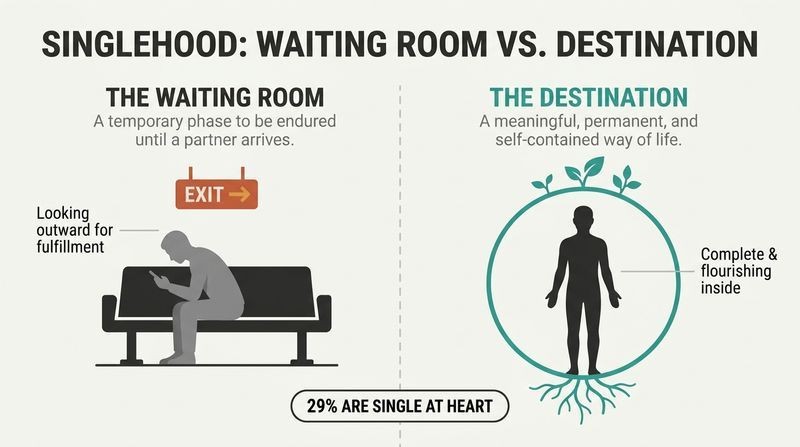
The core thesis reframes singlehood as a calling, not a waiting room. DePaulo coins "single at heart" for people who experience solo life as their most authentic, meaningful, and joyful existence, not a phase, not a Plan B, not a consolation for failed romance. These are people who feel relief, not devastation, when a relationship ends. Roughly 29% of the nearly 9,000 quiz-takers scored as clearly single at heart, and men (34%) qualified slightly more often than women (27%), overturning the assumption that single life mainly suits women.
The key distinction is desire, not circumstance. A single-at-heart person is not running from intimacy or nursing wounds. They freely choose single life because of what it offers, and even a flawless partner would not lure them away.
What's compelling is the inversion of the burden of proof. Psychology has long treated pair-bonding as the human default, echoing attachment theory and evolutionary mating frameworks. DePaulo's move parallels how researchers reframed introversion (Susan Cain) and asexuality: what looked like deficit is reframed as legitimate variation. The claim that men score higher is genuinely counterintuitive given cultural stereotypes of the lonely bachelor. One caveat: self-selected quiz respondents are not a representative sample, a limit DePaulo acknowledges. Still, the conceptual contribution stands independent of prevalence estimates. The category gives language to an experience many report feeling but lacked words for.
Stop comparing your single life to a partner who doesn't exist
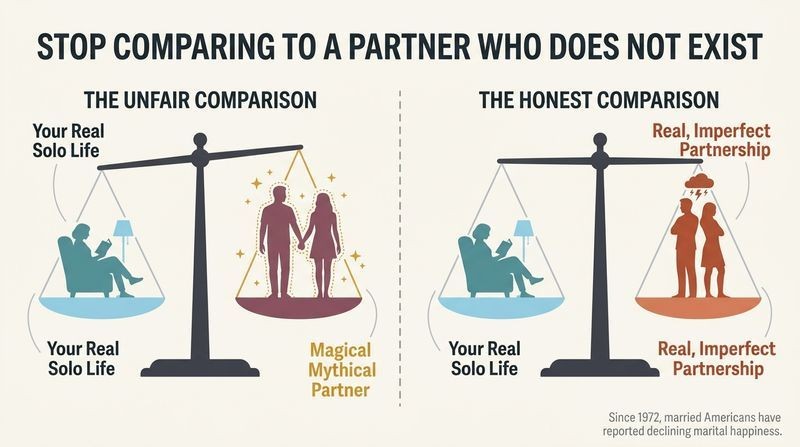
DePaulo names the trap the "Magical Mythical Romantic Partner." This is the fictional spouse who is always kind, always available, always wants the same sex at the same time, never strays, splits chores equally, and shows up whenever you fall ill. Skeptics who pity single people are unconsciously measuring solo life against this impossible standard rather than against real partners, who are human, imperfect, and sometimes absent.
Reality punctures the fantasy. Every year since 1972, married Americans have reported declining marital happiness. A study tracking coupled people found that, apart from the most consistently positive relationships, participants felt more frustration, worry, and sadness when their partner was present than absent. Meanwhile marriage rates fell in 34 of 37 OECD nations between 1970 and 2020.
This concept does real analytical work by exposing a hidden control group error. When people weigh singlehood against partnership, they compare actual solo life to idealized coupledom, not to the messy median marriage. Behavioral economists call this a framing bias; the reference point is rigged. The declining marital satisfaction data since 1972 aligns with Eli Finkel's "suffocation model," which argues modern marriages demand more psychological fulfillment from one person than any single relationship can sustainably provide. The nuance DePaulo could stress more: many people knowingly accept imperfect partnership because companionship still beats their alternative. The myth harms only those measuring against perfection.
Guard your solitude like the superpower it actually is
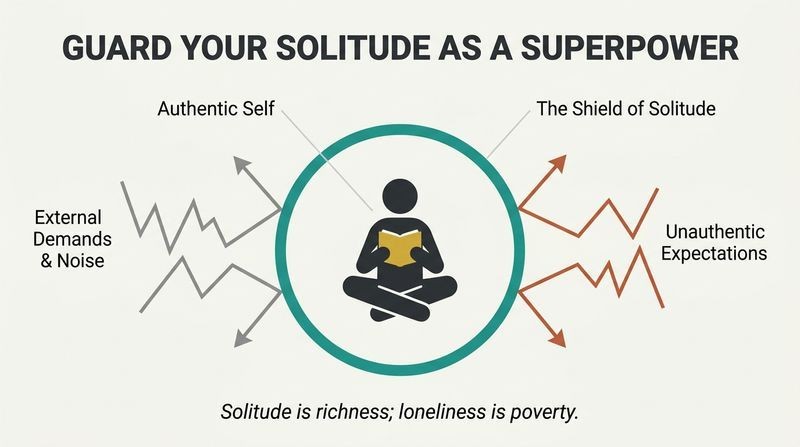
Solitude is the near-universal signature of the single at heart. Fully 98% who scored as clearly single at heart chose "Ah, sweet solitude" over "Oh no, I might be lonely," while 59% of those clearly not single at heart feared loneliness. Loneliness is the poverty of self; solitude is its richness. These people experience alone time as something found, not something missing.
Research reframes who loves solitude. Psychologist Thuy-vy Nguyen found introversion barely predicts enjoying solitude. What predicts it is authenticity: people whose actions align with who they really are seek out alone time and gain from it. Alone, you face only yourself, which is uncomfortable if you are living a life that isn't yours. The single at heart protect solitude fiercely, requesting solo days even on shared vacations.
The authenticity finding is the sleeper insight here, and it resonates beyond singlehood. Self-Determination Theory (Deci and Ryan) holds that autonomy and congruence with one's values are core psychological needs; solitude becomes restorative precisely when it serves those needs rather than isolating a person against their will. This dovetails with Coplan's research distinguishing chosen solitude from imposed isolation, the crucial variable the famous "loneliness kills like 15 cigarettes" statistic obscures. That statistic measures unwanted isolation, not voluntary aloneness. Conflating the two has muddied public health messaging for years. DePaulo's reframe is a useful corrective, though solitude's benefits likely still depend on having connection available when wanted.
Invest in The Ones, never bet everything on The One
Spreading love across many people is a survival strategy, not a consolation. The single at heart reject the "greedy marriage" pattern that sociologists Gerstel and Sarkisian documented, where couples pour time and attention into each other while neglecting friends, siblings, parents, and neighbors. Across two national surveys, lifelong single people did the most to maintain ties with everyone else; married people did the least. Evolutionary psychologist Robin Dunbar found falling in love costs you roughly two close friendships.
Diverse relationships outperform one all-purpose partner. DePaulo cites "emotionships," the practice of turning to different people for different emotional needs (one for celebration, another for grief, another for outrage). People with such varied portfolios report greater life satisfaction than those who funnel everything through a single confidant.
This is portfolio theory applied to intimacy. Concentrating emotional risk in one person is like holding a single stock: efficient when it works, catastrophic when it fails through death, divorce, or unavailability. The emotionships research (Cheung, Gardner, Anderson) suggests specialization beats generalization in emotional support, which challenges the romantic ideal of the spouse as best friend, lover, and confidant rolled into one. Queer communities and Black kinship networks pioneered chosen family and "othermothers" long before mainstream culture noticed, a lineage DePaulo rightly credits. The open question: sustaining many deep ties demands time and social skill that not everyone possesses or can afford.
Freedom is single life's crown jewel, and single people use it more
Every one of the 41 life-story participants named freedom as what they loved most. Not the freedom to be selfish, but the freedom to be the decider: to choose meaningful work over lucrative work, to move across the country without negotiating, to chart a life course that ignores the 1950s stage model of mate-select, marry, reproduce. When asked to make a big life decision, 96% of the clearly single at heart preferred deciding for themselves versus 70% of others who preferred deciding with a partner.
Freedom correlates with generosity, not narcissism. A study of 152 countries found more individualistic people volunteer more, give more to charity, and donate blood and organs more often. Single people out-volunteer married people across nearly every category of organization.
The freedom-breeds-generosity finding demolishes a common conservative critique that individualism erodes community. Abigail Marsh's cross-national data suggests autonomy may free people to pursue meaningful prosocial goals rather than defaulting to family-first obligation. This echoes Robert Putnam's paradox in reverse: the supposedly atomized turn out to be civically active. Carol's story, learning to drive, code, and eventually perform onstage as a musician after leaving a partnership at 36, illustrates how constraint sometimes masquerades as security. One tension worth noting: the freedom DePaulo celebrates presumes economic resources. She concedes this, acknowledging that Amazon Prime and outsourcing make solo life easier for those who can pay.
Lifelong single women in their seventies are the healthiest, least stressed group
Old age is when the single at heart cash in, not when they collapse. The scare story says solo agers die decrepit and alone. The data says otherwise. An Australian study of over 10,000 women in their seventies found lifelong single, childless women were the most optimistic, least stressed, most altruistic, and had the fewest major illness diagnoses, outperforming both currently and previously married women.
They never had to learn survival skills late. Unlike the newly widowed or divorced who must suddenly master tasks a spouse handled, lifelong single people have built their skills, social networks, and financial plans over decades. A US study found lifelong single seniors reported the least strain, and among Black Americans the effect was strongest. Satisfaction with single life keeps climbing after age 40.
This challenges the "marriage as insurance policy for old age" argument with striking force. The mechanism is preparation: solo agers front-load the self-sufficiency and network-building that coupled people often outsource, then scramble to acquire when a spouse dies first. It resembles the difference between someone who has exercised for decades and someone starting rehab post-injury. The Black American finding deserves emphasis given how relentlessly low marriage rates in that community get pathologized. A caveat: survivor and selection effects matter. People who chose lifelong singlehood and thrived may differ systematically from those pushed into it, so the data cannot promise outcomes to the reluctantly single.
Try coupling and feeling relief when it ends? You might be single at heart
The path to self-understanding often runs through failed relationships. Many single-at-heart people repeatedly attempted coupling, cold feet before weddings, marriages, even remarriages, before recognizing the pattern. Jennifer ended a ten-year relationship and a hard-won engagement, giving herself a decade to "get single out of her system," only to realize single life was her system. On the quiz, 84% of the single at heart felt relief when a romantic relationship ended, versus just 12% of others.
Some deliberately pursue relationships destined to fail. DePaulo describes people who chase unavailable partners not from commitment phobia but because, at some level, these "safe pursuits" guarantee a return to the solo life they actually want. The tell is emotional: they fear the relationship succeeding, not ending.
The relief-versus-grief metric is diagnostically elegant, a behavioral signal that cuts through what people think they should feel. It recalls the clinical distinction between ego-syntonic and ego-dystonic states: is your singleness at war with your values or aligned with them? DePaulo carefully separates single-at-heart people from the genuinely commitment-phobic who want partnership but sabotage it, a distinction that matters therapeutically since one group needs acceptance and the other needs help. The risk is that this framing could rationalize genuine avoidance. Not everyone who feels relief is single at heart; some are simply in wrong relationships. The evidence needed is a positive pull toward solo life, not just a push away from a bad partner.
Single parents do less housework and sleep more than married mothers
The frazzled single mom is largely a myth. Analyzing over 23,000 mothers in American Time Use Surveys, sociologist Joanna Pepin found it was married mothers, not single ones, who were "time poor." Married mothers spent more time cleaning, cooking, and doing laundry, got less sleep, and had less fun, all while spending no more time on actual childcare. The likely explanation: performing the role of the good wife for an audience.
Kids of single parents often do fine or better. A review of 122 studies across 29 nations found differences favoring married-parent children were typically small and often vanished once finances were equalized. Single-mother families in the Cambridge donor-insemination study had less mother-child conflict than two-parent families. What harms children is a home marked by conflict and coldness, not the number of parents.
Pepin's finding is one of the book's most counterintuitive and best-sourced. The "performing motherhood" interpretation connects to Erving Goffman's dramaturgical theory: married mothers may be doing visible domestic labor as impression management for a spouse, an audience the single mother lacks. It also aligns with research showing an extra adult helps only if that adult is not a husband generating his own care demands, grandmothers and aunts reduced workload, husbands did not. The Repetti finding that conflict, not structure, drives child harm reframes decades of "broken home" rhetoric. The nuance: economic precarity remains real for many single parents, and DePaulo's flourishing examples skew toward the financially secure.
Intimacy is not sex, and love is bigger than romance
The single at heart define intimacy expansively. They report abundant love from friends, family, pets, communities, even nature and spiritual figures, without a romantic partner at the center. They are disproportionately likely to be asexual (12% versus 3% of others) or aromantic, and they roll their eyes at compulsory sexuality, the assumption that wanting sex is more natural than not. Intimacy, to them, is a friend held while she cried over her dying father.
Sex without a partner offers more, not less, freedom. Some practice solo polyamory or friends-with-benefits arrangements; others are happily celibate. A German study found single people not seeking partners were about as sexually satisfied as married people. The single people who reported dissatisfaction were mostly those who wished they were coupled.
The unbundling of intimacy from romance and sex from partnership is philosophically significant. Philosopher Elizabeth Brake's concept of "amatonormativity," the assumption that a central exclusive romance is a universal goal, gives the critique intellectual teeth. The rise of visible asexuality (roughly 1% of populations in some estimates) supports the claim that sexual attraction is a spectrum, not a universal constant. What's refreshing is the refusal to rank: DePaulo does not argue celibacy is superior, only equally valid. The counterpoint worth holding: touch and physical intimacy have measurable health effects (oxytocin, stress reduction), so people who forgo them entirely may trade something real, even if they judge the trade worthwhile.
People refuse to believe single people are happy, and that reveals something
Declared happiness gets discounted when you're single. DePaulo's studies gave participants identical biographical sketches differing only in marital status. They consistently rated the married person happier, and worse, judged that single people claiming happiness were exaggerating. Add details about great friends, altruism, or career success, and the bias held. A married person's claim to happiness is accepted automatically; a single person's is second-guessed.
Happy singles threaten a cherished worldview. In two studies, single people who wanted to stay single, not those pining for partners, were judged less happy, less warm, more self-centered, and even provoked anger. The offense is challenging the promise that finding The One guarantees happiness and moral superiority. Insecurely coupled people are the likeliest to denigrate contented singles; the securely coupled don't feel threatened.
This is the book's sharpest social-psychological contribution. The discounting effect resembles system justification theory (John Jost): people defend prevailing arrangements, and evidence that one can flourish outside marriage threatens the just-world belief that the conventional path is rewarded. The anger response is telling; neutral disbelief would suggest ignorance, but hostility suggests threat. It parallels reactions to voluntarily childfree people and to those who leave high-status careers. The finding that insecurely coupled people are the main denigrators is both generous and empirically grounded, it locates the problem in the perceiver's anxiety, not the single person's choice. DePaulo names this bias "singlism," arguing it uniquely escapes the illegitimacy other prejudices now carry.
Flip the script: ask married people why they don't invest in themselves
DePaulo's rhetorical tool exposes double standards instantly. Whenever a question stings single people, she inverts it onto the married. When an advice-seeker asks a happily single woman whether she should date to secure her golden years, flip it: imagine asking a content married person whether she should divorce now to nurture friendships and build independent skills. The second question sounds absurd, which reveals the first was never neutral.
The technique unmasks buried assumptions. "Why are you still single?" becomes "Why did you marry?" "Aren't you afraid of dying alone?" becomes "Who will be there for you if you made a spouse your whole world and then lost them?" DePaulo notes everyone dies their own death; even in marriage, typically only one spouse has the other at the bedside.
Script-flipping is a portable critical-thinking device, essentially a symmetry test borrowed from moral philosophy's universalizability principle: if a question is only ever asked of one group, the asymmetry itself is the bias. The same move powers feminist and anti-racist analysis ("why do you dress that way?" asked only of women). Its power is diagnostic and disarming; its limit is that not all asymmetries are unjust, since some reflect real differences in circumstance. Still, applied to relationship status, it consistently reveals that coupling enjoys an unexamined default status. Readers can deploy it immediately in their own lives, which makes it perhaps the most transferable practical tool in the book.
Marriage became a status symbol that quietly subsidizes the coupled
Marriage flipped from ordinary to elite. In the 1950s nearly everyone married young; it was unremarkable. Now it is concentrated among the advantaged: as of 2015, 65% of US college graduates were married versus 50% of those with a high school education or less, and 54% of white versus 30% of Black Americans. Weddings ballooned into multi-day affluent extravaganzas.
The law hands married people hundreds of perks single people fund. Literature professor Jaclyn Geller catalogs the transfers: Social Security survivor benefits flow to spouses and even ex-spouses, while a lifelong single person's contributions return to the system. Married couples get tax-free spousal gifts, penalty-free IRA access, inheritance breaks, and family-farm loans. Marital status is absent from federal anti-discrimination protections that cover race, sex, age, and disability.
This shifts the argument from psychology to political economy, and it is the book's most structurally ambitious claim. The Social Security example is genuinely striking: it functions as a wealth transfer from the never-married to the married, invisible because it is baked into policy. Legal scholars Cahn and Carbone have argued benefits should be uncoupled from both marriage and employment, a proposal that resonates with universal basic income debates. The marriage-as-class-marker data connects to Andrew Cherlin's work on the retreat from marriage among the working class. One complication: some marital benefits exist to protect economically dependent spouses and children, so wholesale removal could harm the vulnerable the policies were designed to shield.
Analysis
Single at Heart is a thesis-driven work of social psychology that doubles as advocacy, built from three evidence streams: DePaulo's online quiz (roughly 9,000 to 19,000 respondents across 100-plus countries), 41 detailed first-person life stories, and a wide net of peer-reviewed studies. Its central move is taxonomic: coining a category ("single at heart") for people whose solo life is a positive vocation rather than a deficit or a phase. This is the same intellectual maneuver that legitimized introversion and asexuality, converting perceived pathology into recognized variation.
The book's strength is its relentless use of the natural experiment and the flipped comparison. DePaulo repeatedly asks: what happens when researchers actually distinguish single people who want to be single from those who don't? The answer reshuffles conventional findings, on happiness, sexual satisfaction, friendship investment, and aging, in the single at heart's favor. Her identical-biography experiments on "singlism" are methodologically clean demonstrations of bias.
The weaknesses are the familiar ones of self-selected samples and motivated reasoning. DePaulo is an advocate, and her flourishing exemplars skew educated and financially comfortable, though she candidly flags this and includes Dalit, disabled, and working-class voices. Correlational studies cannot fully separate selection (thriving people choose singlehood) from causation (singlehood enables thriving). Prevalence claims should be read cautiously.
What elevates the book is its structural turn from psychology to policy. By exposing how law, from Social Security to anti-discrimination statutes, materially privileges the married, DePaulo reframes personal choice as a civil-rights matter. Her demographic backdrop is decisive: with marriage declining across most wealthy nations and solo households now outnumbering nuclear families in dozens of countries, the single at heart are not a curiosity but a leading edge. The book's lasting value is giving language and legitimacy to an experience millions report but rarely dared name, while pushing readers to notice a bias so ambient it hides in plain sight.
Review Summary
Single at Heart receives mixed reviews, with many praising its validation of single life and challenge to societal norms. Readers appreciate the research-backed arguments and personal anecdotes. However, some criticize the book for being repetitive, lacking nuance, and overly focused on middle-class experiences. Critics also note an imbalance in gender representation and a potential bias against coupled life. Despite these criticisms, many readers find the book empowering and thought-provoking, especially those who identify as "single at heart."
People Also Read





Glossary
Single at heart
People who genuinely thrive singleDePaulo's coined term for people who experience single life as their most authentic, meaningful, joyful, and psychologically rich existence, not a phase, a fallback, or the result of trauma or pickiness. They do not want a romantic partner at the center of their lives, feel relief rather than only grief when relationships end, and intend to stay single permanently. It exists on a spectrum and can include some people in unconventional partnerships.
Magical Mythical Romantic Partner
Idealized fictional flawless partnerDePaulo's name for the imaginary ideal spouse against which people unconsciously measure single life: always kind, attentive, available, faithful, an equal sharer of chores, sexually perfectly matched, and present in every crisis. Skeptics pity single people by comparing solo life to this fantasy rather than to real, imperfect partners, distorting judgments about what single people supposedly miss.
Singlism
Discrimination against single peopleThe stereotyping, stigmatizing, marginalizing, and systematic disadvantaging of people because they are single. It operates in laws and policies (tax, Social Security, benefits reserved for the married), in workplaces, and in everyday interactions. DePaulo notes singlism is uniquely tolerated: marital status is absent from major anti-discrimination laws, and biased treatment of singles is often judged legitimate rather than prejudiced.
The Ones (versus The One)
Many important people, not oneDePaulo's contrast between building life around a single all-important romantic partner (The One) versus cultivating a diverse network of significant people (The Ones): friends, relatives, mentors, neighbors, pets, and chosen family. The single at heart favor The Ones, spreading emotional investment to reduce risk and gain richness, and research on this pattern links it to greater resilience and life satisfaction.
Psychologically rich life
Life of varied, perspective-changing experiencesA concept from psychologists Oishi and Westgate describing a life characterized by interesting, novel, and perspective-changing experiences, distinct from a happy life (comfort, joy) or a meaningful life (purpose). Its deathbed summary is "What a journey!" DePaulo argues the single at heart especially prize and attain this kind of life because their freedom enables curiosity, growth, and variety.
Greedy marriage
Couples neglecting outside relationshipsSociologists Gerstel and Sarkisian's term for how married couples concentrate time and attention on each other while withdrawing from friends, siblings, parents, and neighbors. Across national survey data, lifelong single people did the most to maintain wider social ties and married people the least, with the previously married in between.
Flipping the script
Inverting a question onto couplesDePaulo's rhetorical technique of taking any question or judgment aimed at single people and applying it to married people to expose double standards. For example, "Why are you still single?" becomes "Why did you marry?" The inverted version usually sounds absurd, revealing that the original was never a neutral inquiry but a product of the assumption that coupling is the default.
Emotionships
Different people for different emotionsA concept describing the practice of turning to different individuals for different emotional needs, one person for celebrating good news, another for comfort in distress, another for shared outrage, rather than relying on a single confidant for everything. Research found people with diverse emotionship portfolios report greater life satisfaction, supporting the single at heart preference for The Ones over The One.
About the Author
Other books by Bella DePaulo
Download PDF
Download EPUB
.epub digital book format is ideal for reading ebooks on phones, tablets, and e-readers.








































