
Plot Summary
Who Are You?
Sophie Amundsen, a fourteen-year-old girl living in Norway, finds her ordinary life upended when she receives a cryptic letter in her mailbox containing only the question: "Who are you?" This simple inquiry sparks a cascade of existential wonder, prompting Sophie to reflect on her identity, her place in the world, and the nature of existence itself. The question lingers, unsettling her sense of self and igniting a curiosity that will drive her through a journey of philosophical discovery. Sophie's initial confusion and introspection set the emotional tone for the story, as she begins to realize that life's greatest mysteries often start with the simplest, most personal questions.
Letters from the Unknown
Sophie soon receives more enigmatic letters, each containing profound philosophical questions and lessons. The sender, still anonymous, challenges her to consider the origins of the universe, the meaning of life, and the importance of wonder. These letters, delivered in secret and sometimes accompanied by strange occurrences, become Sophie's gateway into the history of philosophy. The lessons are both thrilling and unsettling, pulling her away from the trivialities of daily life and into a world of deep thought. Sophie's emotional landscape shifts from confusion to excitement, as she senses she is being drawn into a grand, hidden adventure that will change her forever.
Myths and Wonder
The letters guide Sophie through humanity's earliest attempts to explain the world: myths. She learns how ancient cultures used stories of gods and heroes to make sense of nature and existence, and how these myths provided comfort and order. Yet, the letters also reveal the limitations of myth, highlighting the transition to rational inquiry in ancient Greece. Sophie is captivated by the idea that philosophy begins with wonder—a childlike astonishment at the world's existence. This realization fills her with awe and a sense of connection to the long human tradition of questioning and seeking understanding beyond inherited stories.
The First Philosophers
Sophie is introduced to the natural philosophers—Thales, Anaximander, Anaximenes, Heraclitus, Parmenides, Empedocles, and Anaxagoras—who sought natural explanations for the world's workings. She learns about their debates over the basic substance of reality, the nature of change, and the reliability of the senses versus reason. The tension between the belief in a single underlying substance and the evidence of constant change fascinates Sophie. She feels the excitement and frustration of minds grappling with the unknown, and she begins to see philosophy as a living, evolving conversation rather than a set of fixed answers.
Atoms and Fate
The story of Democritus and his atomic theory introduces Sophie to the idea that everything is composed of tiny, indivisible particles—atoms—moving in the void. This materialist view challenges notions of fate and divine intervention, suggesting a universe governed by necessity and chance rather than gods. Sophie also explores the concept of fate in ancient cultures, from oracles to omens, and the gradual shift toward seeking natural causes for events. She feels the tension between the comfort of believing in destiny and the unsettling freedom of a world without predetermined outcomes.
Socrates' Questions
Sophie meets the figure of Socrates, whose relentless questioning and claim to know nothing become a model for philosophical inquiry. Through Socratic dialogue, she learns the value of admitting ignorance, the pursuit of ethical clarity, and the importance of self-knowledge. Socrates' courage in facing death for his beliefs inspires Sophie, while his method of exposing contradictions unsettles her certainties. She experiences both admiration and discomfort, recognizing that true wisdom often begins with doubt and the willingness to challenge accepted norms.
Plato's World of Ideas
Sophie is drawn into Plato's theory of forms, the distinction between the sensory world and the eternal world of ideas. She grapples with the allegory of the cave, the longing for truth, and the philosopher's journey from shadows to light. The notion that the soul yearns for the world of ideas resonates with her own sense of searching for meaning. Sophie feels both uplifted by the beauty of Plato's vision and troubled by the distance between ideals and everyday reality. The emotional arc here is one of yearning, hope, and the bittersweet realization of imperfection.
Aristotle's Order
Aristotle's philosophy offers Sophie a more grounded approach, emphasizing observation, categorization, and logic. She learns about Aristotle's views on substance, form, causality, ethics, and politics. The idea that happiness comes from fulfilling one's potential and living in balance appeals to Sophie's desire for harmony. Yet, she also confronts Aristotle's limitations, especially regarding women and social roles. Sophie feels a mix of admiration for Aristotle's systematic mind and frustration at the constraints of his worldview, deepening her appreciation for philosophy's ongoing evolution.
Hellenistic Mosaics
Sophie explores the diverse schools of Hellenistic philosophy—Cynicism, Stoicism, Epicureanism, and Neoplatonism—each offering different paths to happiness and tranquility. She learns about the fusion of Greek, Roman, and Eastern ideas, the rise of individualism, and the search for inner peace amid external chaos. The emotional tone is one of searching for stability in a changing world, as Sophie reflects on the relevance of ancient wisdom to her own life. She feels both the comfort of universal human concerns and the challenge of finding her own way.
Faith and Reason Collide
The story shifts to the rise of Christianity and its encounter with Greek philosophy. Sophie learns about Augustine and Aquinas, the tension between faith and reason, and the medieval quest to reconcile revelation with rational inquiry. She witnesses the birth of universities, the role of women like Hildegard, and the persistence of philosophical questioning within religious frameworks. Sophie feels the weight of tradition and the struggle for intellectual freedom, experiencing both the security of faith and the restlessness of doubt.
Renaissance Rebirth
The Renaissance brings a renewed focus on human potential, art, and scientific discovery. Sophie is inspired by the achievements of artists, explorers, and thinkers who challenge old authorities and embrace empirical methods. She learns about the scientific revolution, the heliocentric model, and the rise of individualism. The emotional arc is one of exhilaration and anxiety, as Sophie senses both the promise and the dangers of human ambition. She is caught between the excitement of new possibilities and the fear of losing touch with deeper values.
Science and Doubt
Sophie encounters the great debates of the early modern period: Descartes' rationalism, Spinoza's monism, Locke's empiricism, Hume's skepticism, and Berkeley's idealism. She wrestles with questions about the nature of reality, the limits of knowledge, and the role of perception. The story becomes increasingly self-referential, as Sophie begins to suspect she is part of someone else's story. The emotional tone is one of uncertainty, curiosity, and the dawning realization that reality may be more complex and mysterious than she imagined.
Enlightenment and Rights
The Enlightenment introduces Sophie to the ideals of liberty, equality, and fraternity, the rise of human rights, and the belief in progress through reason and education. She learns about the American and French revolutions, the struggle for women's rights, and the optimism—and limitations—of Enlightenment thought. Sophie feels both empowered by the vision of universal rights and sobered by the recognition of ongoing injustice. The emotional arc is one of hope, struggle, and the realization that ideals must be continually fought for.
Romantic Longings
Romanticism sweeps Sophie into a world of feeling, imagination, and the celebration of nature and individuality. She encounters poets, artists, and philosophers who seek meaning in the depths of the soul and the mysteries of existence. The tension between reason and emotion, the longing for the infinite, and the embrace of the unique self resonate deeply with Sophie. She experiences both the ecstasy of inspiration and the pain of isolation, recognizing the beauty and fragility of human experience.
Hegel's World Spirit
Sophie learns about Hegel's philosophy of history, the dialectic of thesis, antithesis, and synthesis, and the idea that reason unfolds through time. She grapples with the notion that truth is historical and that individuals are shaped by—and shape—society. The emotional tone is one of awe at the vastness of history and the complexity of human development, tempered by skepticism about grand systems and the dangers of losing the individual in the collective.
Existential Choices
The story moves into the modern era, with Kierkegaard's focus on individual choice, faith, and the leap into the unknown. Sophie encounters Marx's materialism, Darwin's evolution, Freud's unconscious, and the existentialism of Sartre and Simone de Beauvoir. She confronts the challenges of freedom, responsibility, and the search for meaning in a world without fixed certainties. The emotional arc is one of anxiety, courage, and the determination to live authentically despite uncertainty.
The Major's Game
Sophie discovers that her life is being orchestrated by Major Albert Knag, who is writing her story as a birthday present for his daughter, Hilde. The boundaries between fiction and reality blur, as Sophie and her philosophy teacher, Alberto, plot to escape the major's control. The emotional tone is one of rebellion, confusion, and the desire for autonomy. Sophie feels both trapped and empowered, as she realizes that questioning and resisting authority is itself a philosophical act.
Escaping the Story
In a daring act of counterpoint, Sophie and Alberto manage to slip out of the major's narrative, entering a new reality where they are invisible to ordinary people but free from the author's control. Meanwhile, Hilde confronts her father, asserting her own independence and agency. The story ends with a sense of liberation, ambiguity, and the ongoing quest for meaning. Sophie's journey through philosophy becomes a metaphor for the human struggle to understand, to question, and to create one's own story.
Analysis
Sophie's World is a unique blend of coming-of-age novel, philosophical primer, and metafictional experiment. At its heart, the book is an invitation to wonder—to question the world, oneself, and the stories we inhabit. By tracing the history of Western philosophy through Sophie's eyes, Gaarder makes abstract ideas accessible and emotionally resonant, showing how philosophy is not just an academic pursuit but a vital part of human life. The novel's structure—letters, lessons, and narrative twists—mirrors the process of awakening: from unexamined routine to critical self-awareness, from passive acceptance to active questioning. The metafictional turn, in which Sophie and Alberto rebel against their author, dramatizes the struggle for autonomy and the limits of control, both in fiction and in life. The interplay between Sophie, Hilde, and Major Knag explores the responsibilities of creators, the agency of characters (and people), and the porous boundaries between reality and imagination. In a modern context, Sophie's World encourages readers to resist complacency, to embrace uncertainty, and to recognize that meaning is not given but made—through dialogue, reflection, and the courage to ask, "Who are you?" The book's enduring lesson is that philosophy is not about finding final answers, but about sustaining the capacity for wonder and the willingness to live one's own questions.
Review Summary
Sophie's World graphic novel adaptation receives mostly positive reviews, praised for its accessible presentation of philosophy and engaging visuals. Readers appreciate the updated content and feminist perspective. Some note simplification of complex ideas but find it suitable for newcomers to philosophy. The book's humor, creativity, and ability to make philosophical concepts understandable are highlighted. A few reviewers mention eagerness for the second volume. Overall, it's seen as a successful adaptation that maintains the spirit of the original while appealing to modern audiences.
People Also Read
Characters
Sophie Amundsen
Sophie is a fourteen-year-old Norwegian girl whose ordinary life is disrupted by mysterious philosophical letters. Intelligent, introspective, and restless, she embodies the spirit of wonder that drives the story. Sophie's journey is both intellectual and emotional: she moves from confusion and insecurity to self-awareness and critical thinking. Her relationships—with her absent father, her busy mother, and her friend Joanna—highlight her longing for connection and understanding. As she delves deeper into philosophy, Sophie becomes increasingly aware of the constructed nature of her reality, ultimately rebelling against the authorial control of Major Knag. Her development mirrors the philosophical quest for autonomy, meaning, and authenticity.
Alberto Knox
Alberto is Sophie's enigmatic philosophy teacher, delivering lessons through letters, videos, and personal encounters. Wise, patient, and sometimes playful, he represents the voice of reason and the accumulated wisdom of Western philosophy. Alberto's role evolves from distant instructor to active co-conspirator, as he and Sophie plot to escape the confines of their fictional world. Psychologically, Alberto is both a father figure and a Socratic gadfly, challenging Sophie to think for herself and question authority. His own struggle for freedom reflects the philosophical tension between determinism and agency.
Major Albert Knag
Major Knag is the unseen hand orchestrating Sophie's world, writing her story as a birthday gift for his daughter, Hilde. He is both a benevolent creator and a controlling force, embodying the paradoxes of authority, creativity, and responsibility. His relationship with Hilde is affectionate but also intrusive, as he seeks to educate and amuse her through the lives of his fictional characters. Psychologically, Major Knag represents the limits of power and the ethical dilemmas of creation. His eventual confrontation with Hilde forces him to recognize the autonomy and desires of others.
Hilde Møller Knag
Hilde is Major Knag's daughter and the intended recipient of Sophie's story. Initially a passive observer, she becomes increasingly engaged, identifying with Sophie and Alberto and ultimately intervening in her father's plans. Hilde's journey is one of awakening, as she moves from curiosity to empathy to action. She represents the reader's perspective, questioning the boundaries between fiction and reality, and asserting her own independence. Psychologically, Hilde embodies the transition from childhood dependence to adolescent agency.
Joanna
Joanna is Sophie's best friend, providing a contrast to Sophie's philosophical preoccupations. Down-to-earth, practical, and sometimes skeptical, Joanna grounds Sophie in everyday concerns. Their friendship is tested by Sophie's growing obsession with philosophy, but Joanna's loyalty and humor offer emotional support. Joanna's presence highlights the tension between ordinary life and the life of the mind.
Sophie's Mother
Sophie's mother is loving but often preoccupied with work and daily routines. She represents the adult world's tendency to take existence for granted, contrasting with Sophie's sense of wonder. Her interactions with Sophie reveal generational gaps, misunderstandings, and the challenges of communication. Psychologically, she embodies the comfort and limitations of habit.
Hermes (the Dog)
Hermes is Alberto's dog and serves as a literal and metaphorical messenger, delivering letters and guiding Sophie to new discoveries. Named after the Greek god of communication, Hermes bridges the worlds of humans and gods, reality and fiction. His presence adds a touch of magic and playfulness, while also symbolizing the unpredictability of fate.
The Brass Mirror
The brass mirror, inherited from Hilde's family, appears throughout the story as a mysterious object linking Sophie and Hilde. It serves as a portal between worlds, a symbol of self-examination, and a reminder of the blurred boundaries between reality and imagination. Psychologically, the mirror represents the search for identity and the desire to see oneself clearly.
The Philosophers (Socrates, Plato, Aristotle, etc.)
The great philosophers appear as both historical figures and living presences in Sophie's lessons. Each embodies a different approach to knowledge, ethics, and reality, challenging Sophie to think critically and develop her own views. Their ideas shape the narrative structure and provide models for intellectual courage and humility.
The Fictional Characters (Little Red Riding Hood, Winnie-the-Pooh, etc.)
As Sophie's world becomes increasingly self-aware, characters from fairy tales and literature begin to appear, blurring the lines between genres and realities. These figures symbolize the power of imagination, the permeability of stories, and the ongoing interplay between reason and fantasy.
Plot Devices
Letters and Secret Messages
The story is driven by the arrival of mysterious letters and messages, which serve as both plot devices and metaphors for the transmission of knowledge. These communications disrupt Sophie's routine, provoke curiosity, and structure the unfolding of philosophical ideas. The secrecy and unpredictability of the messages heighten the sense of adventure and the emotional stakes of Sophie's journey.
Embedded Lessons and Dialogues
The novel's structure alternates between narrative episodes and philosophical lessons, often delivered through dialogues, stories, and thought experiments. This device allows the reader to learn alongside Sophie, experiencing both the excitement of discovery and the frustration of unresolved questions. The blending of story and lesson mirrors the integration of philosophy into everyday life.
Metafiction and Self-Reference
As the story progresses, it becomes increasingly self-referential, with characters questioning their own existence and the nature of their reality. The revelation that Sophie is a character in a book written by Major Knag for Hilde introduces a metafictional layer, challenging the boundaries between author, character, and reader. This device invites reflection on the power of stories, the construction of identity, and the limits of control.
Symbolic Objects and Motifs
Objects like the brass mirror, the rowboat, and the garden party recur throughout the story, serving as symbols of transition, reflection, and community. These motifs reinforce the themes of self-examination, the journey of life, and the search for meaning. Their repeated appearance creates a sense of coherence and resonance across different narrative layers.
Counterpoint and Parallel Realities
The novel employs counterpoint by juxtaposing Sophie's story with Hilde's reading and Major Knag's authorship. This device creates a dialogue between different realities, perspectives, and levels of agency. The interplay between characters who are both subjects and objects of stories highlights the complexity of existence and the interdependence of freedom and constraint.
Foreshadowing and Revelation
The narrative is rich in foreshadowing, with early hints about the nature of Sophie's world, the identity of the letter writer, and the connection to Hilde. Revelations are carefully timed to maximize emotional impact and philosophical insight, leading to moments of shock, recognition, and liberation. The structure mirrors the process of philosophical inquiry: questioning, doubting, and eventual understanding.
FAQ
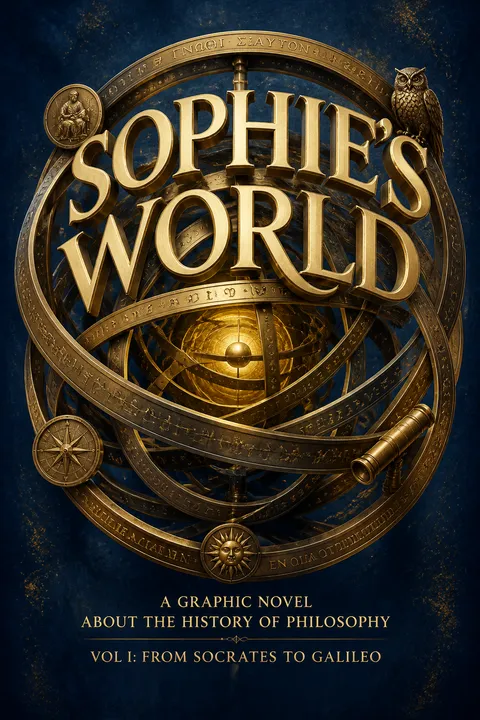
What is Sophie's World: A Graphic Novel About the History of Philosophy Vol I by Jostein Gaarder about?
- Philosophical journey through history: The book follows Sophie Amundsen, a young girl who embarks on a journey through the history of philosophy, guided by her mysterious mentor, Alberto Knox.
- Blending story and philosophy: It combines a coming-of-age narrative with accessible lessons on major philosophical ideas, thinkers, and epochs, from Socrates to Galileo and beyond.
- Meta-narrative intrigue: The story is layered with a mysterious subplot involving Hilde and her father, blurring the lines between fiction and reality.
- Imaginative teaching tools: Allegories like the white rabbit and the top hat are used to symbolize wonder and the unfolding of philosophical understanding.
Why should I read Sophie's World by Jostein Gaarder?
- Accessible introduction to philosophy: The graphic novel format and engaging storytelling make complex philosophical concepts understandable for readers of all ages, especially beginners.
- Comprehensive historical overview: The book covers Western philosophy from ancient Greece through the Enlightenment and into modern thought, providing foundational knowledge.
- Encourages critical thinking: Through Sophie’s questions and Alberto’s guidance, readers are prompted to question assumptions, analyze ideas, and reflect on their own beliefs.
- Engaging and memorable narrative: The intertwining of mystery, personal growth, and philosophical lessons makes the content both entertaining and thought-provoking.
What are the key takeaways from Sophie's World by Jostein Gaarder?
- Philosophy as self-discovery: The book emphasizes that philosophy is not just about learning facts, but about questioning existence, knowledge, and reality to better understand oneself.
- Historical and cultural context: Philosophical ideas are presented within their historical periods, showing how they evolved in response to cultural, religious, and scientific changes.
- Importance of wonder: Maintaining a sense of wonder and curiosity is portrayed as essential for philosophical inquiry and personal growth.
- Interconnectedness of ideas: The narrative demonstrates how philosophical concepts build upon and challenge each other, shaping the development of Western thought.
What is the "faculty of wonder" in Sophie's World and why does Jostein Gaarder emphasize it?
- Definition and importance: The "faculty of wonder" is the childlike ability to be astonished by the world and to question what is usually taken for granted.
- Philosophical foundation: Gaarder presents this as the starting point for all philosophical exploration, urging readers to never lose their curiosity.
- Contrast with indifference: The book warns against becoming "dim" or indifferent, suggesting that true philosophers keep their sense of wonder alive throughout life.
- Practical advice: Sophie is encouraged to choose a life of questioning and wonder, which is portrayed as the path to deeper understanding and fulfillment.
How does Jostein Gaarder explain the transition from mythological to philosophical thinking in Sophie's World?
- Mythological worldview origins: Early humans explained natural phenomena through myths involving gods and supernatural forces, using stories to make sense of the world.
- Philosophical critique emerges: Greek philosophers began to seek natural, rational explanations for the world, moving away from myth and superstition.
- Key figures and ideas: Thinkers like Xenophanes, Thales, and Anaximander questioned traditional myths and searched for fundamental substances or principles underlying reality.
- Significance of the shift: This transition marks the birth of philosophy and scientific reasoning, setting the stage for future intellectual developments.
What are the main ideas of the natural philosophers in Sophie's World by Jostein Gaarder?
- Basic substance theories: Early philosophers like Thales, Anaximander, and Anaximenes proposed that everything originates from a fundamental substance such as water, the boundless (apeiron), or air.
- Debate on change and permanence: Parmenides argued that change is an illusion, while Heraclitus believed in constant change and the unity of opposites.
- Empedocles and Democritus: Empedocles introduced four elements and forces of love and strife, while Democritus developed the atom theory, suggesting everything is made of indivisible atoms.
- Foundation for science: These ideas laid the groundwork for scientific inquiry and the search for natural laws.
How does Sophie's World by Jostein Gaarder portray Socrates and his philosophical method?
- Socratic questioning: Socrates is depicted as a gadfly who uses probing questions and irony to expose ignorance and stimulate critical thinking.
- Focus on ethics: He emphasized self-knowledge, virtue, and the idea that understanding what is right leads to right action.
- Legacy through Plato: Socrates wrote nothing himself, but his ideas and methods were preserved and expanded by his student, Plato.
- Martyr for philosophy: His trial and execution for "corrupting the youth" highlight his commitment to truth and the philosophical life.
What is Plato’s theory of ideas as explained in Sophie's World by Jostein Gaarder?
- World of forms: Plato distinguishes between the changing sensory world and the eternal, perfect world of ideas or forms, which are the true reality.
- Examples and metaphors: The book uses analogies like identical cookies from a mold and the Myth of the Cave to illustrate how forms are the patterns behind all things.
- Knowledge and the soul: True knowledge is knowledge of the forms, and the soul is believed to remember these forms from before birth.
- Philosophical implications: Plato’s theory supports the immortality of the soul and the idea of philosopher-kings ruling an ideal society.
How does Aristotle’s philosophy differ from Plato’s in Sophie's World by Jostein Gaarder?
- Rejection of separate forms: Aristotle argues that forms do not exist independently but are the characteristics of things themselves, inseparable from their substance.
- Empirical approach: He emphasizes observation, categorization, and logic, laying the foundation for biology and scientific method.
- Substance and change: Aristotle introduces the concepts of substance, form, potentiality, and actuality to explain how things change and develop.
- Ethics and the Golden Mean: His ethical philosophy centers on achieving balance and moderation for a good life.
How does Sophie's World by Jostein Gaarder explain the Middle Ages and its philosophy?
- Cultural bridge: The Middle Ages are presented as a period of growth and synthesis between antiquity and the Renaissance, not just a "Dark Age."
- Christianization of philosophy: Thinkers like St. Augustine and Aquinas blended Greek philosophy with Christian theology, debating the relationship between faith and reason.
- Role of the church: Monasteries and the church were centers of learning, preserving and transmitting philosophical ideas.
- Women and wisdom: The book highlights figures like Hildegard of Bingen and the concept of Sophia, the female aspect of divine wisdom.
What is the significance of the Renaissance and Enlightenment in Sophie's World by Jostein Gaarder?
- Rebirth of humanism: The Renaissance revived classical Greek and Roman ideas, emphasizing individual worth, creativity, and the rediscovery of ancient texts.
- Scientific revolution: Figures like Galileo and Newton introduced empirical methods and mathematical laws, transforming humanity’s understanding of nature.
- Challenging old worldviews: The heliocentric model and new technologies shifted perspectives on humanity’s place in the universe.
- Enlightenment ideals: The Enlightenment promoted reason, skepticism of authority, and the pursuit of knowledge, laying the groundwork for modern philosophy.
How does Sophie's World by Jostein Gaarder present modern philosophy, including Kant, Hegel, Marx, Darwin, Freud, and existentialism?
- Kant’s synthesis: Kant reconciles empiricism and rationalism, arguing that knowledge arises from sensory experience shaped by innate mental structures, and introduces the categorical imperative in ethics.
- Hegel’s dialectic: Hegel’s philosophy emphasizes the evolution of truth and reason through history via thesis, antithesis, and synthesis, focusing on the "world spirit."
- Marx’s materialism: Marx shifts focus to material conditions and class struggle as drivers of historical change, critiquing capitalism and advocating for a classless society.
- Darwin and Freud: Darwin’s theory of evolution and Freud’s psychoanalysis challenge traditional views of human nature, emphasizing natural selection and the unconscious mind.
- Existentialism: Twentieth-century existentialists like Sartre and Kierkegaard focus on individual freedom, responsibility, and the creation of personal meaning in a world without inherent purpose.
What are the best quotes from Sophie's World by Jostein Gaarder and what do they mean?
- “Cogito, ergo sum.” (Descartes): Asserts the certainty of self-awareness as the foundation of all knowledge.
- “Our heart is not quiet until it rests in Thee.” (St. Augustine): Expresses the soul’s longing for divine peace, central to medieval philosophy.
- “All the world’s a stage, And all the men and women merely players.” (Shakespeare): Reflects on the performative and transient nature of human life, echoing Baroque themes.
- “Two things fill my mind with ever-increasing wonder and awe... the starry heavens above me and the moral law within me.” (Kant): Highlights the dual sources of wonder—nature and morality—that inspire philosophical reflection.
- “Happy birthday, Hilde! As I’m sure you’ll understand, I want to give you a present that will help you grow.” (Hilde’s father): Symbolizes the gift of philosophical knowledge and the journey of personal growth

Download PDF
Download EPUB
.epub digital book format is ideal for reading ebooks on phones, tablets, and e-readers.








































