

Key Takeaways
Fix your core before stacking new capability on dysfunction
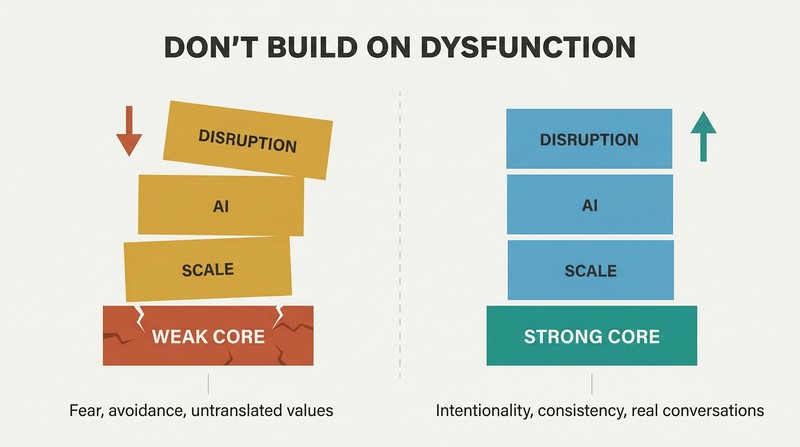
After a pickleball injury floored Brown, her trainer Tony delivered a hard truth: she scored 10 out of 22 on a basic fitness assessment. Her arms and back were compensating for weak core muscles — glutes, lats, stomach — doing work they weren't designed for. Tony's diagnosis: compensation injuries won't stop unless you strengthen the foundation first.
The same pattern plays out in organizations. Leaders want to add AI, disrupt industries, or scale fast — but they're building on cultures riddled with fear, avoidance of tough conversations, and untranslated values. Tony's prescription translates directly: assess the foundation, recruit the right muscles, and commit to intentionality and consistency over wild intensity. There is no app for transformation.
People and their connections are the strong ground — not tools or tech
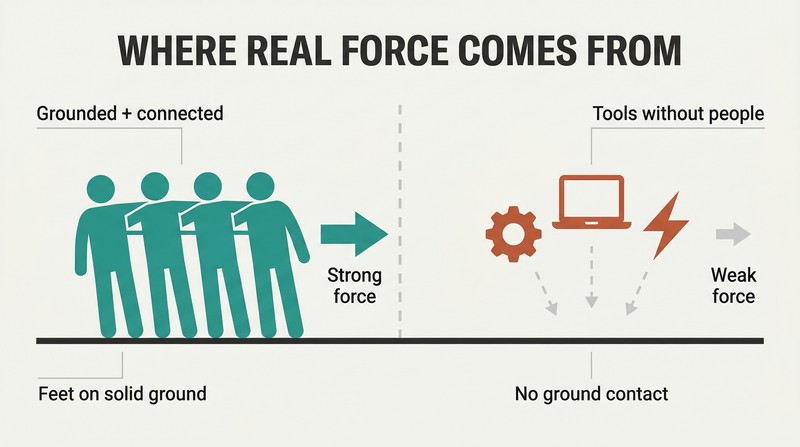
Strong ground has two elements: your own footing (values, self-awareness, humility) and your connection to others who are also grounded. Like the Philadelphia Eagles' "tush push" — where linemen drive their feet into the turf and push the quarterback forward together — power comes from grounded humans pushing in the same direction. Physicist Neil deGrasse Tyson explains that once a player loses ground contact, their force drops to nearly nothing.
Brown applies this physics to organizations. Companies that invest in people outperform those chasing technological shortcuts. Technology built on dysfunction is still dysfunction, regardless of the code's brilliance. When disconnection, distrust, and emotional dysregulation dominate a culture, no tool can compensate.
Your leadership has a ceiling — it's your capacity for vulnerability
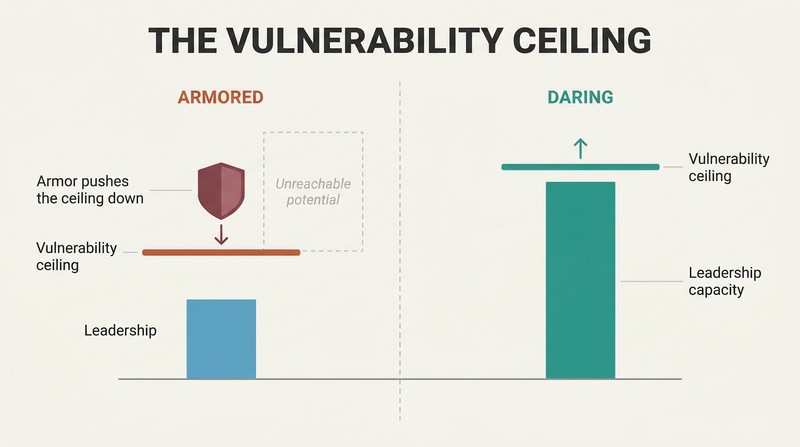
Vulnerability is the emotion we experience during uncertainty, risk, and emotional exposure. Brown has challenged thousands — from military special forces to NFL players — to name one act of courage that didn't require it. Not a single person has succeeded. A young soldier stood up and said simply, "No, ma'am. There is no courage without vulnerability."
The real barrier to daring leadership isn't fear itself — every daring leader Brown interviewed reported regular fear. The barrier is armor: the self-protective thoughts and behaviors we deploy when we refuse to sit with vulnerability. Brown identifies four courage skill sets that displace armor: Living into Our Values, Rumbling with Vulnerability, BRAVING Trust, and Learning to Rise.
Hold opposing truths at once — paradox outlasts whoever taps out
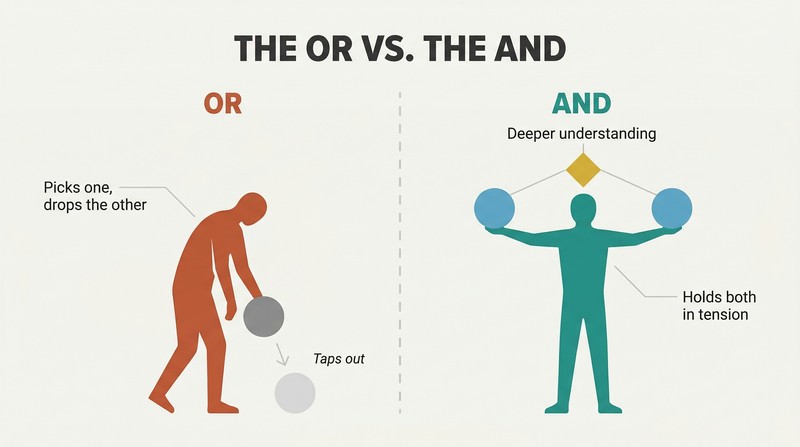
The Latin paradoxum means "seemingly absurd but really true." When two opposing ideas are both valid, our instinct is to pick the familiar one and discount the other. But Brown argues that holding the tension long enough births a deeper understanding. Jim Collins calls this the "Genius of the AND" versus the "Tyranny of the OR" — visionary companies embrace purpose AND profit, discipline AND creativity, long-term investment AND short-term performance.
The Stockdale Paradox crystallizes it: Admiral Jim Stockdale survived nearly eight years as a POW by maintaining faith he'd prevail while confronting the most brutal facts of his current reality. The optimists — those who couldn't hold both truths — "died of a broken heart." Brown's organization calls this practice "gritty faith and gritty facts."
Think like a scientist: search for reasons you might be wrong
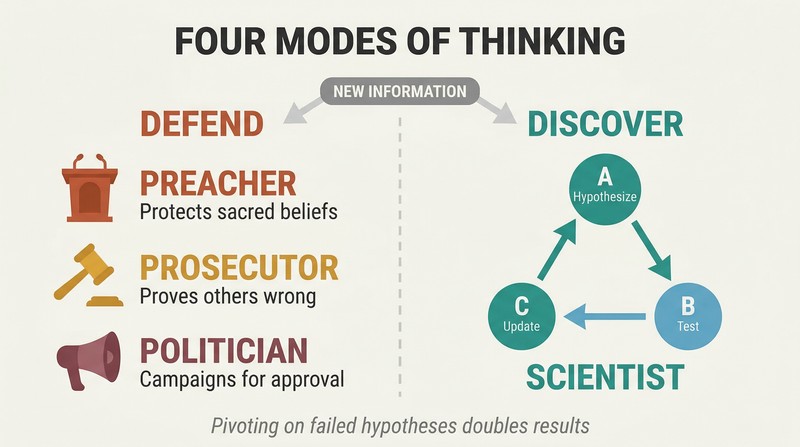
Brown draws on Adam Grant's research showing we slip into three defensive modes: preacher (protecting sacred beliefs), prosecutor (proving others wrong), and politician (campaigning for approval). In scientist mode, we form hypotheses and update views. A study of Italian startup founders found those trained to think scientifically generated over $12,000 in revenue versus under $300 for controls — because they pivoted twice as often when hypotheses failed.
Intelligence doesn't protect us. Research shows math whizzes analyze data brilliantly — unless it contradicts their ideology, at which point their skills become weapons against truth. Brown echoes Keats's concept of negative capability: the ability to remain in uncertainty without grasping for premature certainty, which she calls fundamental to courage.
Name whether fear is driving — or you are
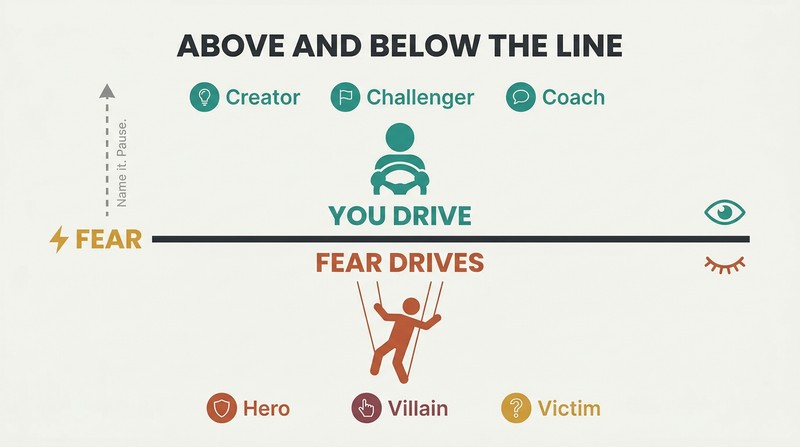
The Above/Below the Line Practice is Brown's most praised daily tool. The line is fear. Above it, you feel fear but stay aware — you're driving. Below it, fear drives your behavior mostly outside your awareness, pulling you into three roles: hero ("I'll do it myself"), villain ("someone takes the blame"), or victim ("nobody understands"). Above-the-line alternatives: creator, challenger, coach.
The big win is awareness, naming, and pause. Brown catches herself going below the line when she hears herself think phrases like "I'm on my own" or "I care more." The practice isn't about never going below — that's human. It's about recognizing it, naming it aloud, and calling a time-out. When a critical mass of people practice this simultaneously, it becomes a culture changer.
Transformation means willingly breaking what used to work
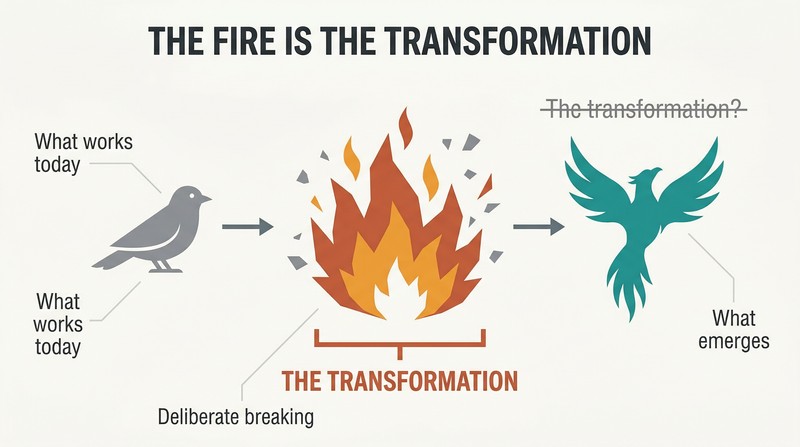
Real transformation requires strategic deconstruction. Brown is emphatic: "Incremental change times 5 is not transformative change." F1 racing boss James Vowles embodies this — sacrificing short-term results to rebuild Williams Racing before a 2026 regulatory overhaul: "Break everything. You have carte blanche. You'll never get this opportunity again."
But breaking must be disciplined, not reckless. Brown identifies six transformation sets that must work simultaneously: Assessment, Mindsets, Skill Sets, Tool Sets, Coaching Sets, and System Sets. The hardest paradox: strong performance makes breaking feel reckless, yet crisis makes people too fearful to break deeply. Halfhearted transformation is the worst scenario — people get destabilized but nothing actually changes.
Mission clarity turns a cafeteria worker into a cancer fighter
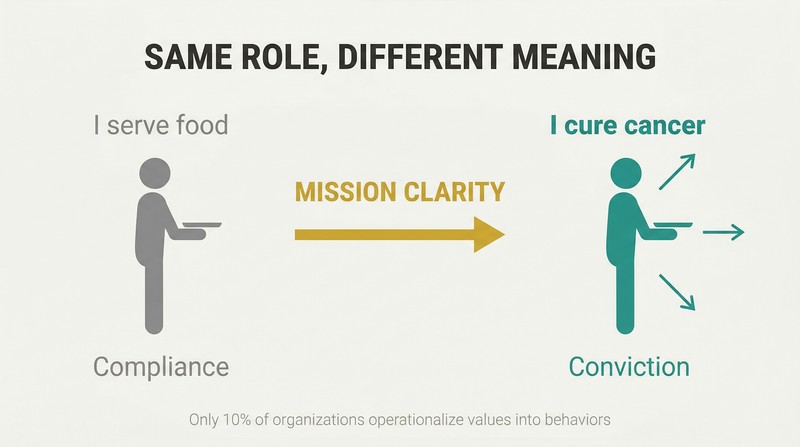
At St. Jude Children's Research Hospital, Brown asked a cafeteria worker what she does. Without hesitation: "I cure cancer." A volunteer gave the identical answer. When everyone understands how their daily work connects to organizational mission, compliance transforms into conviction. Only about 10% of organizations have actually operationalized their values into observable, measurable behaviors.
Brown's 5 C's tool makes clarity practical. Before executing any strategy or deliverable, demand:
1. Context — what else affects this?
2. Color — what does the vision look like specifically?
3. Connective Tissue — how does this connect to other plans?
4. Cost — money, time, bandwidth?
5. Consequence — what if we don't, or get it wrong?
About 30% of the time, Brown catches flaws in her own logic before finishing them.
Replace 'executive presence' with deep preparation
Brown proposes "pocket presence" over "executive presence" — a term she calls code for discrimination. Adam Grant agrees: it's "cover for discriminating against women and introverts." Pocket presence comes from football, where quarterbacks have roughly three seconds to read the entire field, trust teammates, and decide — before 1,200 pounds of defensive pressure arrives. Coach Sark names the enemies: "fear and arrogance. Both will get you hurt."
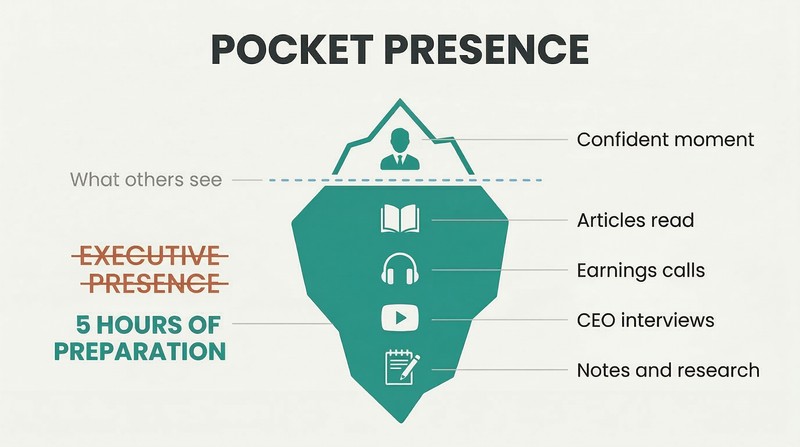
Preparation beats performance. When a colleague praised Brown's commanding presence at a strategy meeting, Brown revealed she'd spent five hours preparing — reading articles, listening to earnings calls, watching CEO interviews. She was wearing jeans and a Liverpool FC baseball hat. The most compelling leaders show respect through preparation and confidence through humility.
Rushing your work-to-home transition is how evenings capsize
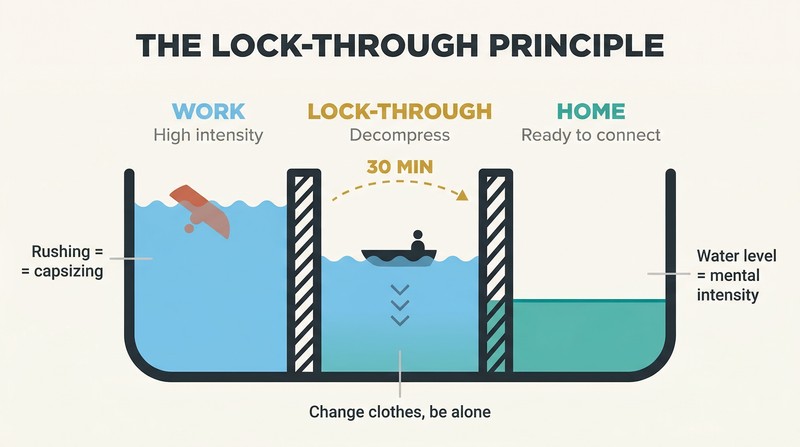
Brown borrows from canal locks on England's Thames to explain transitions. A lock creates a sealed chamber where water rises or falls to match the next waterway. The keeper's warning: force water in too fast and vessels capsize. Brown realized her difficult evenings had the same physics — hours of intense "lock-in" at work, then crashing into home without transition time.
She negotiated 30 minutes of lock-through with her husband: come in, change clothes, decompress alone. The two questions that capsize her fastest? "How was your day?" and "What do you feel like doing for dinner?" Seemingly innocent, but they demand cognitive resources she hasn't recovered. Lock-through isn't selfish — it's how you protect the focus that makes everything else possible.
A manager is not an undeveloped leader — honor both roles
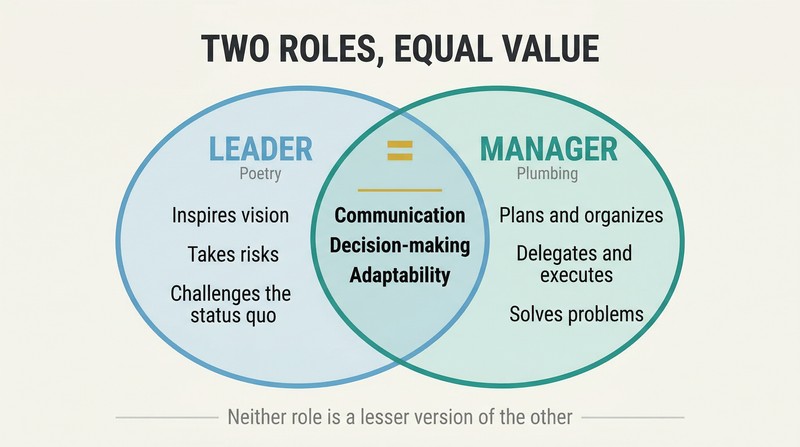
In a revealing conversation with executive recruiter Ginny Clarke, Brown confronts her own bias. Clarke draws a clear line: leaders inspire, set vision, and take risks; managers plan, organize, delegate, and solve problems. Both need communication, decision-making, and adaptability. A manager's gift is operational execution — not inadequate leadership. Brown's quote references James March's metaphor of leadership as "plumbing and poetry"; she admits she judged managers for lacking poetry.
The data is sobering. Gallup found 82% of companies choose the wrong people for management roles, and only 18% of managers are considered good at the job. Clarke attributes this to people never having been managed or led well themselves, plus chronic failure to give real-time, competency-based feedback. Brown's motto: "Clear is kind. Unclear is unkind."
Analysis
Brown's structural innovation in Strong Ground is extending a physical training metaphor — her trainer's insistence on 'finding the ground' before adding capability — across organizational psychology, paradox philosophy, systems theory, and cultural criticism. The result is less a sequel to Dare to Lead than a unifying field theory of her three-decade career.
What distinguishes this work is its integration density. Dare to Lead (2018) built a courage taxonomy. Atlas of the Heart (2021) mapped emotions. Strong Ground stitches both together, then layers on systems thinking from Donella Meadows, temporal awareness, symphonic cognition from Daniel Pink, and lock-in/lock-through dynamics — arguing that emotional intelligence alone was never sufficient. Leaders need the full cognitive-affective-somatic stack.
The grounded confidence taxonomy is ambitious — over twenty mindsets and skill sets across five categories. This comprehensiveness risks the very overwhelm Brown warns against. But her 'kettlebell' metaphor rescues it: specific tools like the Above/Below the Line Practice and the 5 C's build strength across multiple skills simultaneously, making the taxonomy feel like a training program rather than a checklist. Brown's most provocative reframe is replacing 'executive presence' — a sacred concept in leadership development — with 'pocket presence.' Borrowed from football quarterbacks, this shifts evaluation from how leaders look to how they read chaotic fields under pressure. Combined with her finding that only 10% of organizations have translated values into observable behaviors, the implication is damning: most leadership development optimizes the wrong variables entirely.
The book's weakness is scope — twenty-two chapters, six guest interviews, three poems, and dozens of frameworks create cognitive load ironic given Brown's canal lock metaphor about transitions needing time. Yet the core argument lands with force: in an era where AI can replicate analysis and algorithms can optimize operations, the irreducible competitive advantage is grounded humans who hold paradox, practice vulnerability, and push toward shared purpose. The physics of the tush push isn't just metaphorical — it's the math of what becomes possible when people stay connected to the ground and to each other.
Review Summary
Strong Ground receives a 4.26/5 rating with mixed reviews. Fans praise Brené Brown's authenticity, research, and leadership insights, particularly her concepts on fear-based thinking, paradox, and AI's workplace impact. Many appreciate her conversational audiobook style and sports metaphors. Critics find it repetitive, corporate-focused, and less original than her previous work, with some feeling it lacks practical applications and relies too heavily on other authors' quotes. Several reviewers note it feels like a business book rather than her typical style, though most still find valuable takeaways.
People Also Read









Glossary
Strong ground
Stability from grounding and connectionThe book's central concept for navigating uncertainty. Comprises two elements: (1) your own footing—values, self-awareness, curiosity, and humility—and (2) your connection to other grounded people. Brown developed the concept from physical training, where connecting mind and body through the ground produces stability and explosive power. In organizations, people and their connections are the strong ground.
Grounded confidence
Confidence built on practice, not posturingBrown's comprehensive taxonomy of leadership mindsets and skill sets. Defined as confidence built on self-awareness, courage, and practice rather than arrogance. Organized into five categories: Core (self-awareness, metacognition, emotional regulation, mindfulness, systems thinking), Strength (vulnerability, trust, compassion, humility, curiosity, mastery, discipline), Awareness, Thinking, and Communication. Driven by discipline and the joy of mastery.
Above/Below the Line Practice
Fear awareness and naming toolA self-regulation framework. 'The line' is fear. Above it, you feel fear but maintain awareness—you choose your response. Below it, fear drives behavior mostly outside your awareness. Below-the-line roles: hero (rescuer), villain (persecutor), victim. Above-the-line alternatives: creator, challenger, coach. Based on Karpman's Drama Triangle and Emerald's Empowerment Dynamic. The key practice is recognizing, naming, and pausing when below the line.
5 C's
Communication clarity frameworkA grounded communication tool used before executing strategies or deliverables. Five elements: Context (broader circumstances and history), Color (detailed vision and urgency level), Connective Tissue (links to other plans and strategies), Cost (money, time, bandwidth, priority shifts), and Consequence (stakes and unintended effects). Designed to sharpen situational, strategic, and anticipatory thinking simultaneously.
BRAVING Trust
Seven elements of trust-buildingBrown's acronym for trust components: Boundaries (respecting limits), Reliability (doing what you say), Accountability (owning mistakes), Vault (keeping confidences), Integrity (choosing courage over comfort), Nonjudgment (asking for help without judgment), and Generosity (assuming positive intent). Used to discuss, build, and repair trust in relationships and teams.
Rumble
Honest, vulnerable real conversationBrown's term for a discussion defined by commitment to lean into vulnerability, stay curious and generous, stick with messy problem identification, take breaks when necessary, own your parts, and listen with the same passion with which you want to be heard. Saying 'Let's rumble' serves as an intention-setter and behavioral cue to show up with open hearts and minds.
Negative capability
Staying with uncertainty without graspingTerm coined by poet John Keats in 1817 describing the ability to remain 'in uncertainties, Mysteries, doubts, without any irritable reaching after fact & reason.' Brown positions it as fundamental to courage, paradoxical thinking, and leadership. Building this capability requires reaching inward toward stillness rather than outward toward counterfeit certainty. A grounding tool for navigating unpredictable environments.
Lock-in and lock-through power
Deep focus plus deliberate transitionBrown's framework for engagement and recovery. Lock-in is the state of intense cognitive engagement—drawing on mental toughness, flow, deliberate practice, or deep concentration. Lock-through is the deliberate transition process between contexts (like a canal lock equalizing water levels), needed to shift from work to home or between demanding tasks without 'capsizing.' Both together form an essential capability set.
Pocket presence
Decisive awareness under pressureBrown's proposed replacement for 'executive presence,' borrowed from football. In the sport, it describes a quarterback's ability to read the entire field without seeing all of it, trust teammates, and make decisive calls within roughly three seconds. In leadership, it translates to preparation, situational awareness, trust, and decisive action under pressure—evaluated on skills and thinking, not appearance or gravitas.
Stockdale Paradox
Faith plus brutal facts simultaneouslyNamed by Jim Collins after Admiral Jim Stockdale, who survived nearly eight years as a Vietnam POW. The discipline of never confusing faith that you will prevail in the end with the need to confront the most brutal current facts. Stockdale noted that the optimists—who kept predicting imminent release—'died of a broken heart.' Brown's organization practices this as 'gritty faith and gritty facts.'
Genius of the AND
Embrace both extremes simultaneouslyJim Collins's concept from Built to Last describing how visionary companies reject the 'Tyranny of the OR' (false binary choices) and instead embrace seemingly contradictory dimensions at once: purpose AND profit, discipline AND creativity, long-term investment AND short-term performance. Brown extends this to paradoxical thinking more broadly, arguing the skill requires strong ground to hold the tension.
FAQ
What is Strong Ground: The Lessons of Daring Leadership, the Tenacity of Paradox, and the Wisdom of the Human Spirit by Brené Brown about?
- Core Focus: The book explores daring leadership, grounded confidence, and the wisdom of the human spirit, emphasizing the importance of vulnerability, courage, and connection.
- Leadership Redefined: Brown presents leadership as a practice rooted in self-awareness, discipline, and the ability to navigate paradox, rather than relying on titles or authority.
- Practical and Research-Based: Through personal stories, research insights, and actionable frameworks, Brown guides readers to build a strong foundation for leading in complex, rapidly changing environments.
Why should I read Strong Ground by Brené Brown?
- Timely Leadership Tools: The book offers practical frameworks and tools for leaders facing rapid change, digital transformation, and organizational complexity.
- Personal and Organizational Growth: Brown’s research-backed insights and relatable stories inspire both individual and team transformation, emphasizing authenticity and wholeheartedness.
- Actionable Practices: Readers gain access to methods like the BRAVING acronym for trust and the Above/Below the Line Practice, which can be immediately applied to foster courage, resilience, and effective communication.
What are the key takeaways from Strong Ground by Brené Brown?
- Courage and Vulnerability: Courage is teachable and rooted in vulnerability, which is essential for innovation, trust, and meaningful leadership.
- Grounded Confidence: Leadership requires a foundation of self-awareness, emotional regulation, and disciplined practice, not arrogance or posturing.
- Transformation and Paradox: Meaningful change demands embracing paradox, breaking outdated patterns, and investing deeply in people and culture.
How does Brené Brown define "grounded confidence" in Strong Ground?
- Definition: Grounded confidence is a form of confidence built on self-awareness, courage, discipline, and the joy of mastery, distinct from arrogance.
- Interconnected Skills: It encompasses vulnerability, trust, humility, curiosity, adaptability, and accountability, forming a system where each skill reinforces the others.
- Lifelong Practice: Brown emphasizes that grounded confidence is developed through continual learning, deliberate practice, and often with support from coaching or therapy.
What is the BRAVING acronym for trust in Strong Ground by Brené Brown?
- BRAVING Elements: BRAVING stands for Boundaries, Reliability, Accountability, Vault, Integrity, Nonjudgment, and Generosity—each representing a key behavior for building trust.
- Trust as a Choice: Trust involves making something valuable vulnerable to another’s actions, while distrust is the belief that what matters to you isn’t safe with someone.
- Practical Application: The BRAVING framework helps leaders diagnose trust issues, guide feedback, and rebuild trust in specific, actionable ways.
How does Strong Ground by Brené Brown explain the relationship between vulnerability and courage in leadership?
- Vulnerability as Strength: Vulnerability is presented as the birthplace of courage, innovation, and connection, not as a weakness.
- Courage-Building Skills: Brown identifies mindsets and practices—like embracing paradox and practicing curiosity—that help leaders develop and model courage.
- Daily Practice: Through stories and exercises, Brown shows how leaders can “rumble with vulnerability” in honest conversations, making courage a habit.
What does Brené Brown mean by "strong ground" in Strong Ground?
- Physical and Metaphorical Foundation: "Strong ground" refers to both literal physical stability (as learned through physical training) and a metaphorical foundation of values, courage, and connection.
- Core Stability: Just as a strong core prevents physical injury, a strong organizational or personal foundation helps navigate complexity and change.
- Mind-Body-Spirit Integration: Achieving strong ground requires intentional, consistent investment in physical health, emotional regulation, and spiritual connection.
How does Strong Ground by Brené Brown address the role of paradox in leadership and life?
- Paradox as Wisdom: Brown defines paradox as holding two opposing truths simultaneously, which is essential for deep understanding and wise leadership.
- Examples of Paradox: The book explores paradoxes like freedom vs. commitment and the Stockdale Paradox, showing how leaders can grow by embracing tension rather than resolving it prematurely.
- Spiritual and Intellectual Asset: Paradoxical thinking is framed as a strength that enables leaders to navigate complexity and uncertainty with greater insight.
What is the Above/Below the Line Practice in Strong Ground by Brené Brown?
- Dividing Line of Fear: This practice helps individuals recognize when they are acting from awareness and courage (“above the line”) versus fear and reactivity (“below the line”).
- Behavioral Roles: Below the line aligns with Drama Triangle roles (hero, villain, victim), while above the line aligns with creator, challenger, and coach roles.
- Emotional Regulation Tool: The practice involves pausing, naming emotions, and choosing to respond from above the line, fostering trust and productive communication.
What are the 5 C’s for mission clarity in Strong Ground by Brené Brown?
- Framework for Clarity: The 5 C’s—Context, Color, Connective Tissue, Cost, and Consequence—are questions to clarify intentions, connections, and impacts in decision-making.
- Enhancing Agency: Using the 5 C’s helps teams connect daily work to broader mission and strategy, improving problem-solving and creativity.
- Prevents Action Bias: Brown illustrates how the 5 C’s redirect teams from unproductive action to collaborative, strategic thinking.
How does Strong Ground by Brené Brown use metaphors like "pocket presence" and "lock-in/lock-through" to explain leadership concepts?
- Pocket Presence: Borrowed from football, this metaphor describes a leader’s ability to maintain situational awareness, trust, and decisiveness under pressure.
- Lock-In/Lock-Through: "Lock-in" refers to deep focus and commitment to a task, while "lock-through" is the transition between roles or environments, emphasizing the need for deliberate recovery.
- Practical Leadership Skills: These metaphors illustrate the importance of emotional regulation, adaptability, and structured support systems for effective leadership.
How does Strong Ground by Brené Brown address transformation and change in organizations?
- Transformation as Iterative: Brown describes transformation as breaking down outdated systems and building new mindsets, skills, and cultures on a strong foundation.
- Irreducible Requirements: Successful change requires readiness, willingness, and the ability to invest in people and protect core mission elements.
- Common Pitfalls: The book warns against halfhearted efforts, magical thinking, and leaders who disengage early, emphasizing that transformation is personal, relational, and requires courage to endure discomfort and uncertainty.
Download PDF
Download EPUB
.epub digital book format is ideal for reading ebooks on phones, tablets, and e-readers.








































