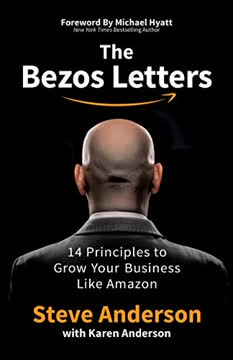
Key Takeaways
1. Amazon's Growth Principles: Embracing Risk and Innovation
"I've made billions of dollars of failures at Amazon.com. Literally billions of dollars of failures. You might remember Pets.com or Kosmo.com. It was like getting a root canal with no anesthesia. None of those things are fun. But they also don't matter."
Successful failure. Amazon's growth is built on a foundation of calculated risk-taking and learning from failures. Jeff Bezos encourages a culture where experimentation is valued, and failure is seen as a stepping stone to success. This approach has led to some of Amazon's biggest innovations, such as Amazon Web Services (AWS) and Amazon Prime.
Betting on big ideas. Amazon doesn't shy away from ambitious projects, even when they seem counterintuitive. Examples include:
- Amazon Marketplace: Allowing competitors to sell on Amazon's platform
- Kindle: Revolutionizing the book industry with e-readers
- AWS: Opening up Amazon's internal infrastructure to other businesses
By embracing risk and innovation, Amazon has consistently stayed ahead of the curve and created new markets for itself.
2. Customer Obsession: The Heart of Amazon's Success
"I constantly remind our employees to be afraid, to wake up every morning terrified. Not of our competition, but of our customers. Our customers have made our business what it is, they are the ones with whom we have a relationship, and they are the ones to whom we owe a great obligation."
Understanding customer needs. Amazon's success is rooted in its relentless focus on customer satisfaction. This obsession drives every decision, from product development to customer service. Amazon continuously seeks ways to improve the customer experience, often anticipating needs before customers themselves are aware of them.
Customer-centric innovations. Examples of Amazon's customer-focused approach include:
- Amazon Prime: Free shipping and additional benefits to enhance customer loyalty
- 1-Click ordering: Simplifying the purchase process
- Customer reviews: Providing transparency and helping customers make informed decisions
By prioritizing customer needs above all else, Amazon has built a loyal customer base and a reputation for exceptional service.
3. Long-Term Thinking: Amazon's Strategic Advantage
"We believe that a fundamental measure of our success will be the shareholder value we create over the long term."
Investing for the future. Amazon's approach to business is characterized by its willingness to sacrifice short-term profits for long-term growth. This strategy allows the company to invest heavily in new technologies, infrastructure, and market expansion without being constrained by quarterly earnings expectations.
Building for scale. Amazon's long-term focus is evident in its:
- Infrastructure investments: Building a vast network of fulfillment centers
- Technology development: Creating platforms like AWS that can support massive growth
- Market expansion: Entering new industries and geographic regions
This long-term orientation has enabled Amazon to build sustainable competitive advantages and consistently outpace its rivals.
4. High-Velocity Decision Making: Balancing Speed and Quality
"Most decisions should probably be made with somewhere around 70% of the information you wish you had. If you wait for 90%, in most cases you're probably being slow."
Two types of decisions. Bezos distinguishes between two types of decisions:
- Type 1: Irreversible, high-stakes decisions that require careful deliberation
- Type 2: Reversible decisions that can be made quickly with limited information
Empowering quick action. Amazon encourages employees to make Type 2 decisions rapidly, understanding that speed often trumps perfection in a fast-moving business environment. This approach allows the company to innovate quickly and respond to market changes more effectively than its competitors.
The company also uses unique methods like the "six-page narrative" for more complex decisions, ensuring thorough analysis while maintaining efficiency.
5. The Amazon Flywheel: Building Momentum for Growth
"Notice also what happens from a Prime member's point of view. Every time a seller joins FBA [Fulfilled by Amazon], Prime members get more Prime eligible selection. The value of membership goes up. This is powerful for our flywheel."
Self-reinforcing growth. The Amazon Flywheel is a concept that illustrates how various aspects of the business reinforce each other, creating a virtuous cycle of growth. Key components include:
- Lower prices → More customers
- More customers → More sellers
- More sellers → Expanded selection
- Expanded selection → Better customer experience
- Better customer experience → More traffic
Accelerating momentum. By focusing on improving each aspect of the flywheel, Amazon creates a self-sustaining engine for growth. Initiatives like Amazon Prime and Fulfillment by Amazon (FBA) have significantly accelerated this flywheel effect, driving rapid expansion across multiple business lines.
6. Frugality and High Standards: Core Values Driving Amazon
"Accomplish more with less. Constraints breed resourcefulness, self-sufficiency and invention. There are no extra points for growing headcount, budget size or fixed expense."
Frugal innovation. Amazon's culture of frugality encourages employees to find creative solutions and maximize efficiency. This mindset has led to innovations like the famous "door desk" and a focus on eliminating unnecessary costs throughout the organization.
Raising the bar. Simultaneously, Amazon maintains extremely high standards for its products, services, and employees. This is exemplified by:
- The "Bar Raiser" program in hiring
- Rigorous quality control for third-party sellers
- Continuous improvement in customer service
By combining frugality with high standards, Amazon ensures that resources are directed toward initiatives that truly matter to customers and drive long-term growth.
7. Continuous Innovation: Staying Ahead in a Changing World
"Invention is in our DNA and technology is the fundamental tool we wield to evolve and improve every aspect of the experience we provide our customers."
Culture of experimentation. Amazon fosters a culture where employees at all levels are encouraged to innovate and experiment. This approach has led to groundbreaking products and services like:
- Amazon Echo and Alexa
- Amazon Go stores
- AWS Lambda and serverless computing
Embracing emerging technologies. The company consistently invests in cutting-edge technologies such as artificial intelligence, machine learning, and robotics to improve its operations and create new customer experiences.
By maintaining a relentless focus on innovation, Amazon continues to disrupt industries and create new markets, staying ahead of competitors and evolving consumer expectations.
8. Leadership and Ownership: Empowering Amazon's Workforce
"We know our success will be largely affected by our ability to attract and retain a motivated employee base, each of whom must think like, and therefore must actually be, an owner."
Ownership mentality. Amazon cultivates a sense of ownership among its employees by:
- Offering stock options as a significant part of compensation
- Encouraging employees to think and act like owners of the company
- Empowering decision-making at all levels of the organization
Leadership principles. The company's leadership principles, such as "Learn and Be Curious" and "Bias for Action," guide employee behavior and decision-making, ensuring alignment with Amazon's core values and objectives.
This approach to leadership and ownership has created a highly motivated workforce that consistently drives innovation and growth across the company.
9. Data-Driven Culture: Measuring What Matters
"Many of the important decisions we make at Amazon.com can be made with data. There is a right answer or wrong answer, a better answer or worse answer, and math tells us which is which."
Metrics-focused decision making. Amazon relies heavily on data and metrics to guide its decision-making processes. Key areas of focus include:
- Customer behavior analysis
- Operational efficiency metrics
- Financial performance indicators like free cash flow
Balancing data with intuition. While data is crucial, Amazon also recognizes the importance of intuition and qualitative feedback. Bezos emphasizes the need to question metrics and trust gut feelings when anecdotal evidence contradicts data.
This data-driven approach, combined with a willingness to challenge assumptions, allows Amazon to make informed decisions and continuously improve its operations and customer experience.
10. Day 1 Mentality: Maintaining a Startup Mindset at Scale
"Day 2 is stasis. Followed by irrelevance. Followed by excruciating, painful decline. Followed by death. And that is why it is always Day 1."
Preserving agility. The Day 1 mentality is about maintaining the agility, customer focus, and innovative spirit of a startup, even as the company grows to massive scale. This mindset is reinforced through:
- Constant focus on customer needs
- Resisting bureaucracy and proxies
- Embracing external trends and new technologies
Avoiding complacency. By insisting that it's always Day 1, Amazon fights against the complacency and slow decision-making that often plague large organizations. This approach helps the company remain nimble and responsive to changing market conditions and customer preferences.
The Day 1 mentality is central to Amazon's ability to continue innovating and growing, even as it has become one of the world's largest and most influential companies.
Review Summary
The Bezos Letters receives mixed reviews, with an average rating of 3.95 out of 5. Positive reviews praise the book's insights into Amazon's success principles and Bezos' thinking, finding it valuable for business owners and entrepreneurs. Critics argue the author's analysis adds little value beyond the original letters, with some preferring to read Bezos' letters directly. Many readers appreciate the book's distillation of Amazon's growth strategies but note its uncritical stance towards the company. Some find the author's self-promotion and repetition distracting.
People Also Read






 Immersive



FAQ
1. What is "The Bezos Letters" by Steve Anderson about?
- Analysis of Bezos’ Shareholder Letters: The book analyzes 21 years of Jeff Bezos’ annual letters to Amazon shareholders, extracting the core principles that fueled Amazon’s growth.
- 14 Growth Principles: Steve Anderson identifies and explains 14 key growth principles that he believes are the foundation of Amazon’s success.
- Risk as a Growth Lever: The book frames Amazon’s story through the lens of risk-taking, showing how Bezos intentionally leveraged risk for business growth.
- Actionable Business Lessons: It translates Amazon’s strategies into practical advice that any business, regardless of size or industry, can apply.
2. Why should I read "The Bezos Letters" by Steve Anderson?
- Learn from Amazon’s Playbook: The book distills Amazon’s growth secrets, offering readers a rare look at the thinking behind one of the world’s most successful companies.
- Actionable Principles: Each principle is explained with real-world examples and ends with application questions, making it easy to implement in your own business.
- Risk Mindset Shift: It challenges conventional thinking about risk, showing how embracing calculated risks can drive innovation and growth.
- Broad Applicability: The principles are designed to be used by entrepreneurs, leaders, and organizations of any size or industry.
3. What are the 14 Growth Principles in "The Bezos Letters" and how are they organized?
- Four Growth Cycles: The principles are grouped into four cycles: Test, Build, Accelerate, and Scale.
- Test: 1) Encourage “Successful Failure”, 2) Bet on Big Ideas, 3) Practice Dynamic Invention and Innovation.
- Build: 4) Obsess Over Customers, 5) Apply Long-Term Thinking, 6) Understand Your Flywheel.
- Accelerate: 7) Generate High-Velocity Decisions, 8) Make Complexity Simple, 9) Accelerate Time with Technology, 10) Promote Ownership.
- Scale: 11) Maintain Your Culture, 12) Focus on High Standards, 13) Measure What Matters, Question What’s Measured, and Trust Your Gut, 14) Believe It’s Always “Day 1”.
4. How does Steve Anderson define and use "risk" in "The Bezos Letters"?
- Return on Risk (ROR): Anderson introduces the concept of “Return on Risk,” emphasizing that risk should be viewed as an investment, not just something to avoid.
- Intentional Risk-Taking: Bezos and Amazon take risks deliberately, using experimentation and calculated bets to drive growth and innovation.
- Successful Failure: The book highlights the importance of learning from failures and turning them into future successes.
- Risk as a Growth Engine: Anderson argues that strategic risk-taking is essential for business growth and that avoiding risk can be the biggest risk of all.
5. What is the significance of "Day 1" in "The Bezos Letters" and Amazon’s culture?
- Day 1 Mindset: “Day 1” represents a startup mentality—staying nimble, customer-obsessed, and innovative regardless of company size.
- Avoiding Day 2: Bezos warns that “Day 2” is stasis, irrelevance, decline, and death for a company, so maintaining a Day 1 mindset is crucial.
- Cultural Anchor: The concept is a recurring theme in Bezos’ letters and is used to reinforce Amazon’s core values and approach to business.
- Practical Application: Anderson encourages readers to regularly revisit their own “Day 1” values to avoid complacency and bureaucracy.
6. How does "The Bezos Letters" explain Amazon’s approach to failure and experimentation?
- Encourage “Successful Failure”: Amazon builds failure into its business model, viewing it as a necessary part of experimentation and innovation.
- Learning Organization: Failures are analyzed for lessons, and insights are used to improve future projects (e.g., Fire Phone’s failure led to Echo/Alexa’s success).
- No Punishment for Smart Risks: Employees are encouraged to try new things without fear of retribution if they fail in good faith.
- Big Bets, Small Starts: Amazon starts with small experiments and scales up only when there’s evidence of success.
7. What does "Obsess Over Customers" mean in "The Bezos Letters" and how does Amazon practice it?
- Customer Obsession Principle: Amazon’s primary focus is on delivering value, convenience, and satisfaction to customers, often anticipating needs before customers articulate them.
- Three Customer Experience Pillars: Low prices, best selection, and fast, convenient delivery are the foundation of Amazon’s customer strategy.
- Proactive Problem Solving: Amazon uses data and automated systems to identify and fix customer issues before they escalate.
- Empowered Employees: Customer service reps and third-party sellers are expected to go above and beyond to resolve issues and delight customers.
8. How does "The Bezos Letters" describe Amazon’s decision-making process and the "six-page memo"?
- Type 1 vs. Type 2 Decisions: Amazon distinguishes between irreversible (Type 1) and reversible (Type 2) decisions, treating each with appropriate speed and rigor.
- High-Velocity Decisions: Most decisions are Type 2 and should be made quickly to maintain agility and momentum.
- Six-Page Narrative: For major decisions, Amazon requires a detailed, narrative-style memo instead of PowerPoint, ensuring deep thinking and clarity.
- Disagree and Commit: Once a decision is made, all team members are expected to fully support it, even if they initially disagreed.
9. What is the "flywheel" concept in "The Bezos Letters" and why is it important to Amazon’s growth?
- Virtuous Cycle: The flywheel is a self-reinforcing loop where improvements in one area (e.g., selection, customer experience) drive growth in others.
- Focus and Alignment: Understanding the flywheel helps Amazon prioritize initiatives that accelerate growth and avoid distractions.
- Examples: Features like Prime, Marketplace, and Fulfillment by Amazon all add momentum to the flywheel, creating compounding benefits.
- Strategic Filter: The flywheel acts as a decision-making tool, ensuring all efforts contribute to long-term growth.
10. How does "The Bezos Letters" address maintaining company culture and high standards as Amazon scales?
- Leadership Principles: Amazon’s 14 Leadership Principles are ingrained in daily operations and hiring, ensuring cultural consistency.
- Bar Raisers: Specially trained interviewers help maintain high hiring standards, with veto power over candidates.
- Inward Innovations: Programs like Career Choice and Pay to Quit reinforce a culture of ownership, growth, and self-selection.
- Visible Cues: Symbols like the “door desk” and the “Day 1” building serve as constant reminders of Amazon’s frugality and startup roots.
11. What are some of the most impactful quotes from "The Bezos Letters" and what do they mean?
- “It remains Day 1.” – Emphasizes the importance of maintaining a startup mentality and avoiding complacency.
- “Encourage successful failure.” – Highlights the value of learning from mistakes and using them as stepping stones to innovation.
- “Obsess over customers.” – Reinforces that customer focus is the most protective and enduring business strategy.
- “Speed matters in business.” – Underlines the need for fast, decisive action to stay ahead in a rapidly changing environment.
- “If the size of your failures isn’t growing, you’re not going to be inventing at a size that can actually move the needle.” – Encourages taking bigger risks as the company grows to achieve meaningful innovation.
12. What are the key takeaways and actionable advice from "The Bezos Letters" by Steve Anderson?
- Adopt a Risk and Growth Mindset: View risk as an investment and embrace experimentation as a path to growth.
- Implement the 14 Growth Principles: Use the principles as a framework to test, build, accelerate, and scale your business.
- Focus on Long-Term Value: Prioritize decisions that build enduring value over short-term gains or Wall Street pressures.
- Measure What Matters: Use data to drive decisions, but always question your metrics and trust your intuition when necessary.
- Maintain Culture and Standards: As you grow, be intentional about preserving your core values, high standards, and customer obsession.
Download PDF
Download EPUB
.epub digital book format is ideal for reading ebooks on phones, tablets, and e-readers.








































