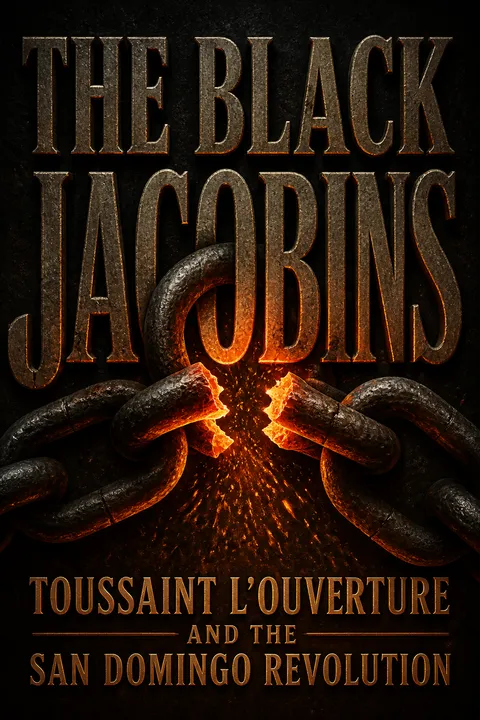
Key Takeaways
1. The Haitian Revolution was the only successful slave revolt in history, transforming brutalized property into self-governing citizens.
The transformation of slaves, trembling in hundreds before a single white man, into a people able to organize themselves and defeat the most powerful European nations of their day, is one of the great epics of revolutionary struggle and achievement.
Unprecedented historical triumph. The rebellion in San Domingo stands as a singular event in human history, where enslaved people successfully overthrew their oppressors to establish an independent state. Under a system of calculated brutality, torture, and overwork, the slaves were treated as mere beasts of burden. Yet, they retained their essential humanity and, when the historical moment arrived, organized a highly disciplined mass movement that defeated the armies of Spain, Great Britain, and France.
Systemic brutality defeated. The plantation system relied on extreme violence, including whippings, mutilations, and executions, to maintain order and cow the massive slave population. Despite these horrific conditions, the slaves utilized their shared labor experience in the sugar factories to build a cohesive, modern proletarian force. Their victory proved that even the most oppressed populations can organize and defeat highly advanced military empires.
Key elements of the struggle:
- The transition from disorganized maroon bands to a unified revolutionary army.
- The strategic use of Voodoo as a cultural and political medium for conspiracy.
- The total destruction of the plantation infrastructure to ensure that slavery could never be restored.
2. The wealth of the French bourgeoisie and the rise of Western capitalism were fundamentally built on the slave trade.
The slave-trade and slavery were the economic basis of the French Revolution.
Capitalism's dark foundation. The immense wealth of French maritime cities like Nantes, Bordeaux, and Marseilles was directly generated by the slave trade and the exploitation of San Domingo. This colonial commerce served as the economic engine of the eighteenth century, fertilizing domestic industries and providing the capital that built the French bourgeoisie. The very class that demanded liberty and fought against feudalism in France owed its social prominence to the profits of human bondage.
The economic engine. San Domingo was the greatest colony in the world, supplying two-thirds of France's overseas trade and acting as the primary market for the European slave trade. The entire French economic structure, from sugar refineries to textile mills, depended on the continuous importation of African labor. This economic reality created a powerful vested interest that fought desperately to maintain the colonial status quo.
Economic dependencies of the trade:
- The reliance of French domestic industries on raw materials imported from the colonies.
- The massive indebtedness of colonial planters to the maritime bourgeoisie of France.
- The strategic rivalry between Britain and France for control of the lucrative Caribbean sugar market.
3. The French Revolution's ideals of liberty and equality acted as a volatile solvent that destabilized the colonial class structure.
The ramifications of French ideals of liberty, equality and fraternity were dramatic enough in France.
Ideological shockwaves. The fall of the Bastille in 1789 sent immediate tremors through San Domingo, destabilizing a highly stratified society. When the French National Assembly proclaimed the Rights of Man, it unwittingly handed a powerful ideological weapon to the colonies' oppressed classes. The white colonists interpreted these ideals as autonomy from French trade restrictions, while the Mulattoes and slaves saw them as a promise of human equality.
A fractured society. The colonial structure was already torn by internal conflicts between the royalist bureaucracy, the wealthy planters, and the poor whites. The introduction of revolutionary ideals widened these cracks, causing the ruling classes to fight among themselves for political control. This political paralysis at the top loosened the reins of authority, creating the perfect opening for the slave population to strike.
Impact of revolutionary ideals:
- The demand for political representation by wealthy planters in the French States-General.
- The violent clashes between different white factions over the control of local assemblies.
- The inspiration of the slave masses, who interpreted "liberty and equality" in their own revolutionary image.
4. Toussaint L'Ouverture emerged as a military and political genius, shaped by the very revolutionary forces he came to lead.
Yet Toussaint did not make the revolution. It was the revolution that made Toussaint.
The rise of a leader. Toussaint L'Ouverture, a slave until the age of forty-five, rose to become the undisputed leader of the San Domingo revolution through his extraordinary intellect and military skill. His privileged position as a coachman and steward had allowed him to acquire the rudiments of an education, including the study of military history and political philosophy. When the rebellion broke out, he utilized this knowledge to organize a highly disciplined army out of raw, untrained laborers.
Unparalleled genius. Toussaint's military and political maneuvers baffled the most experienced European generals and diplomats of his time. He possessed an incredible capacity for work, often riding vast distances to inspect agriculture, drill troops, and administer justice. His ability to balance between local factions and international empires allowed him to consolidate his power and protect the freedom of his people.
Toussaint's leadership qualities:
- His profound self-discipline, physical bravery, and tireless work ethic.
- His strategic use of both military force and diplomatic intrigue to achieve his goals.
- His commitment to the restoration of agriculture as the ultimate guarantee of black freedom.
5. The British and Spanish empires sought to exploit the colonial chaos to expand their own slave-holding territories.
The British were intent on taking advantage of their adversary's misfortunes and keen to add that lucrative colony to their own string of Caribbean possessions.
Imperialist greed. The British and Spanish governments viewed the revolution in San Domingo not as a humanitarian crisis, but as a golden opportunity to capture the world's richest colony. Spain allied with the revolted slaves, offering them ranks and supplies to fight against the French Republic, while Britain launched a massive military expedition to seize the island. Both empires were determined to restore the old colonial system and protect their own slave-holding interests from the contagion of liberty.
A disastrous campaign. The British invasion turned into a military catastrophe, as their forces were decimated by yellow fever and the fierce resistance of the black and Mulatto armies. Despite pouring tens of thousands of troops and millions of pounds into the campaign, the British were eventually forced to evacuate the island. This defeat severely weakened Britain's military power in Europe and secured the freedom of the San Domingo blacks.
Consequences of the imperialist invasions:
- The temporary alliance of the black leaders with the Spanish monarchy against the French Republic.
- The massive loss of British lives and treasure in the pestilential West Indian climate.
- The strategic negotiations between Toussaint and British General Maitland for the peaceful evacuation of British forces.
6. The French bourgeoisie repeatedly compromised their revolutionary principles to protect their immense colonial investments.
The colonial question was no subordinate interest of the Constituent Assembly.
Bourgeois hypocrisy. The French revolutionary assemblies consistently hesitated, prevaricated, and compromised when faced with the question of colonial slavery. While they eloquently championed the Rights of Man in Europe, they feared that granting these rights to colonial blacks would ruin French commerce and ship-owners. This moral cowardice placed the assemblies at the mercy of the reactionary colonial lobby and weakened the integrity of the revolution at home.
The struggle for rights. The assemblies repeatedly refused to grant political rights to the wealthy Mulattoes, fearing it would be the first step toward the abolition of slavery itself. It was only under the intense pressure of the Paris masses and the reality of the slave revolt that the Convention finally decreed the abolition of slavery in 1794. This historic decree was born of revolutionary necessity, as a means to secure the loyalty of the blacks against the invading British and Spanish forces.
Key legislative milestones:
- The ambiguous decree of March 8, 1790, which left the fate of the colonies in the hands of the white planters.
- The short-lived compromise of May 15, 1791, granting rights only to Mulattoes born of free parents.
- The historic decree of February 4, 1794, which abolished slavery throughout all French colonies without a debate.
7. The deep-seated divisions between whites, Mulattoes, and blacks created a complex, multi-layered class and race conflict.
The rivalries of colour were not then the initial cause of the conflict which was beginning.
A fractured social hierarchy. The social structure of San Domingo was divided into rigid castes based on race, property, and legal status. The white population was split between the wealthy planters and the poor whites, who hated each other but were united in their contempt for the Mulattoes. The Mulattoes, many of whom were wealthy and educated, bitterly resented their social degradation but despised the black slaves who formed the bulk of the population.
Class over race. While the conflict often assumed the appearance of a race war, it was fundamentally a struggle over property and political power. The wealthy Mulattoes frequently allied with the white planters or the French bureaucracy to protect their slave property against the revolting masses. This instability of the intermediate classes allowed the imperialist powers to play one group against another, prolonging the civil war and increasing the bloodshed.
The complex social divisions:
- The conflict between the big whites and the small whites over local political control.
- The struggle of the Mulattoes for social and political equality with the white colonists.
- The deep-seated hostility between the free blacks, the Mulattoes, and the enslaved field laborers.
8. Toussaint's tragic flaw lay in his secretive diplomacy and his failure to maintain the trust of the black masses.
In allowing himself to be looked upon as taking the side of the whites against the blacks, Toussaint committed the unpardonable crime in the eyes of a community where the whites stood for so much evil.
The fatal miscalculation. Toussaint's greatest error was his failure to explain his complex political and economic policies to the black laborers who were his primary source of power. In his desire to restore the colony's economy, he protected the white planters and forced the blacks back to work under a system of rigid military discipline. This policy alienated the masses, who began to suspect that Toussaint was conspiring with their former masters to restore slavery.
A secretive dictatorship. Toussaint's close, self-contained temperament led him to govern by decree, keeping even his most trusted generals in the dark about his plans. When his nephew Moïse championed the cause of the dissatisfied laborers, Toussaint had him executed to appease the white planters and maintain order. This act of severity shattered the morale of the black population and left them confused and divided when the French expedition arrived.
Consequences of Toussaint's alienation:
- The growing distrust of the black laborers toward Toussaint's military dictatorship.
- The execution of Moïse, which destroyed the vanguard of the revolutionary movement in the North.
- The ease with which Leclerc was able to sow division among the black generals during the initial invasion.
9. The black laborers waged a scorched-earth, people's war of extermination to defend their freedom against Leclerc's invasion.
They advanced singing, for the Negro sings everywhere, makes songs on everything.
A war of extermination. When Napoleon sent a massive expedition under General Leclerc to restore slavery, the people of San Domingo responded with an unprecedented scorched-earth campaign. Led by Dessalines and other black generals, they burned their own cities, destroyed their crops, and poisoned the water supplies to deny sustenance to the invaders. This total war of resistance transformed the beautiful colony into a charred desert but made it impossible for the French to consolidate their conquest.
Unyielding revolutionary spirit. The black soldiers and laborers fought with a fanatical courage that astonished and terrified their seasoned French opponents. They faced the firing squads, the gallows, and the man-eating dogs of Rochambeau with a stoic defiance, singing revolutionary songs as they went to their deaths. This popular heroism, combined with the ravages of yellow fever, completely destroyed the French Army and forced their ultimate surrender.
Tactics of the people's war:
- The systematic burning of towns like Le Cap and St Marc to deny shelter to the French.
- The use of guerrilla warfare, ambushes, and natural obstacles in the mountainous interior.
- The active participation of women and children in the military defense of the island.
10. The Haitian Revolution shattered the myth of white supremacy and laid the historical foundation for global African emancipation.
The defeat of Bonaparte's expedition in 1803 resulted in the establishment of the Negro state of Haiti which has lasted to this day.
A world-historic achievement. The establishment of the independent republic of Haiti in 1804 was a stunning reversal of the racial and economic fundamentals of the Atlantic system. For the first time in history, enslaved Africans had defeated the most powerful European empires to secure their own freedom and statehood. This victory sent shockwaves of fear through slave-owning societies everywhere and served as a permanent beacon of hope for oppressed peoples across the globe.
The legacy of freedom. The Haitian Revolution was not merely a local event, but a pivotal moment in the unfolding of Atlantic history that accelerated the decline of the slave trade. By proving that black people could organize, fight, and govern themselves, the revolution shattered the pseudo-scientific myths of racial inferiority used to justify colonial exploitation. It laid the intellectual and political foundations for the modern Pan-African movement and the struggle for African emancipation.
The global impact of the revolution:
- The inspiration of slave revolts and abolitionist movements throughout the Americas.
- The strategic and financial assistance provided by Haiti to Simon Bolivar's campaigns for Latin American independence.
- The creation of a unique West Indian national identity rooted in the pride of self-emancipation.
Review Summary
The Black Jacobins receives widespread acclaim as a landmark historical account of the Haitian Revolution, praised for its passionate prose, rigorous research, and Marxist analysis of race and class. Readers celebrate James's vivid portrayal of Toussaint L'Ouverture and his framing of enslaved people as agents of their own liberation. Common criticisms include difficulty following the complex cast of characters, occasional heavy-handed Marxist rhetoric, and insufficient attention to women's roles. Most consider it essential reading despite its limitations.
People Also Read


Download PDF
Download EPUB
.epub digital book format is ideal for reading ebooks on phones, tablets, and e-readers.








































