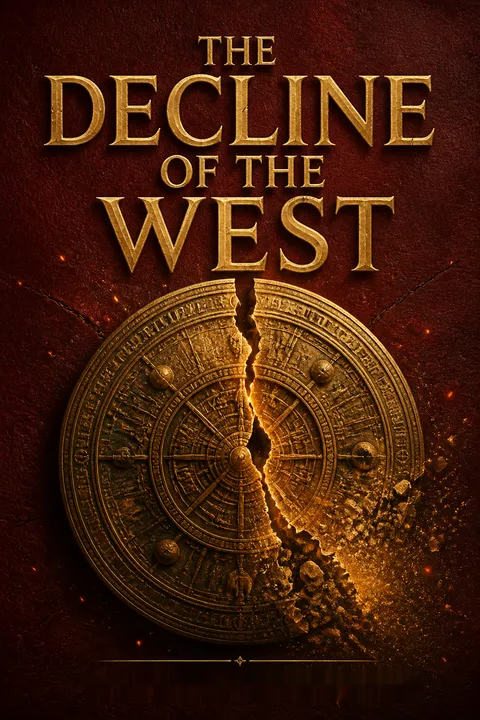

Key Takeaways
1. Cultures are Organisms with Predetermined Life Cycles
For everything organic the notions of birth, death, youth, age, lifetime are fundamentals — may not these notions, in this sphere also, possess a rigorous meaning which no one has as yet extracted?
Organic nature. Spengler posits that great Cultures are not mere aggregates of events but living organisms, each with a distinct soul and a predetermined life span. Like plants or animals, they undergo predictable stages of birth, growth, maturity, and decay, culminating in an inevitable death. This biological metaphor is central to understanding history.
Life stages. Each Culture experiences a "springtime" of primitive strength and mythic awakening, a "summer" of flourishing creative power, an "autumn" of intellectual refinement and urban dominance, and finally a "winter" of rigid civilization and spiritual exhaustion. These phases are not merely descriptive but represent an inner, organic necessity. For example:
- Spring: Romanesque and Gothic art, early feudalism.
- Summer: High Gothic, Renaissance, Baroque.
- Autumn: Enlightenment, Classicism.
- Winter: Modern industrial age, mass society.
Beyond "Mankind." The conventional idea of a linear "mankind" progressing towards a universal ideal is a Western illusion. Instead, Spengler sees a drama of multiple, distinct Cultures, each blooming and aging independently, stamping its unique image on its people, arts, and institutions, and never returning once its cycle is complete.
2. History is Cyclical, Not a Linear Progression
The scheme "ancient-medieval-modern" in its first form was a creation of the Magian world sense.
Western illusion. The familiar "ancient-medieval-modern" historical scheme is not a universal truth but a subjective construct, a "Ptolemaic system of history" centered on Western Europe. This linear progression, implying continuous upward development, is a profound optical illusion that distorts our understanding of other Cultures.
Distorted perspective. This egocentric view reduces millennia-long histories of non-Western Cultures—like Egypt, Babylon, India, or China—to mere episodes or footnotes, if acknowledged at all. It assumes a shared historical trajectory that simply does not exist, making our own recent centuries loom disproportionately large. For example:
- Egyptian and Chinese histories, spanning thousands of years, are treated as "preludes" to Classical history.
- American cultures are often ignored because they "do not fit in."
Copernican shift. Spengler proposes a "Copernican discovery in the historical sphere," recognizing that each Culture is a separate, dynamic world. This perspective allows us to see history as a morphology of distinct organisms, each with its own internal logic and destiny, rather than a single, universal narrative.
3. Each Culture Possesses a Unique Soul and Prime Symbol
The style of a Soul that comes out in the world of numbers, and the world of numbers includes something more than the science thereof.
Culture's essence. At the heart of every great Culture lies a unique, unconscious "soul," which expresses itself through a "prime symbol." This symbol is not invented but discovered within the collective being, shaping every aspect of its existence, from art and mathematics to religion and politics.
Pervasive influence. These prime symbols dictate the fundamental worldview and expression forms of a Culture. For instance:
- Apollinian (Classical): The sensuously present, individual body. Reflected in Euclidean geometry (magnitudes), nude sculpture, city-states (Polis as a body), and a focus on the "here and now."
- Faustian (Western): Pure, limitless space. Manifested in infinitesimal calculus (functions), Gothic cathedrals (soaring height), polyphonic music, and a drive towards infinite horizons.
- Magian (Arabian): The world as a Cavern. Expressed in algebra, mosaics (enclosing space), and dualistic religions (light vs. darkness).
- Egyptian: The Way or path. Seen in pyramid temples (processional routes), directional reliefs, and a profound sense of destiny.
Incommensurable worlds. These distinct symbolic worlds mean that concepts, art forms, and even scientific truths are not universally transferable. What is self-evident and profound in one Culture may be meaningless or absurd in another, highlighting the deep incommensurability of different historical realities.
4. Civilization Marks the Inevitable Decline of a Culture
The Civilization is the inevitable destiny of the Culture, and in this principle we obtain the viewpoint from which the deepest and gravest problems of historical morphology become capable of solution.
Inevitable conclusion. Civilization is not a higher stage of Culture but its terminal phase—the "thing-become" succeeding the "thing-becoming," death following life. It represents the hardening and petrification of a Culture's creative forms, marking the exhaustion of its inner possibilities.
Contrasting characteristics. The transition from Culture to Civilization involves a fundamental shift:
- Culture: Organic, spiritual, rooted in the land, characterized by growth and creative expression.
- Civilization: Inorganic, intellectual, urban, marked by rigidity, expansion, and practical utility.
This transition occurred for the Classical world in the 4th century BC and for the Western world in the 19th century.
Urban dominance. Civilization is defined by the rise of the "world city" (Megalopolis), which drains the countryside of its vitality and concentrates intellectual and economic power. This leads to a rootless, cosmopolitan populace, replacing organic folk with an undifferentiated mass, and tradition with cold, matter-of-fact rationalism.
5. Destiny Governs History, Causality Governs Nature
There is an organic logic, an instinctive, dream-sure logic of all existence as opposed to the logic of the inorganic, the logic of understanding and of things understood — a logic of direction as against a logic of extension — and no systematist, no Aristotle or Kant, has known how to deal with it.
Two logics. Spengler distinguishes between two fundamental modes of understanding the world: Destiny and Causality. Destiny is the "logic of time," an organic, irreversible necessity inherent in life and becoming, felt intuitively rather than rationally. Causality is the "logic of space," a mechanical, law-bound necessity governing static, measurable "things-become," accessible to the intellect.
History vs. Nature. History is the realm of Destiny, where unique, unrepeatable events unfold with a sense of direction and fate. Nature, conversely, is the realm of Causality, where timeless laws and repeatable cause-and-effect relationships prevail. Western thought, particularly since Kant, has erroneously attempted to apply causal logic to history, reducing living processes to dead mechanisms.
Incommensurable truths. Concepts like "luck," "doom," or "vocation" belong to the sphere of Destiny and can only be conveyed through art and religion, not scientific proofs. To seek causal explanations for historical events is to fundamentally misunderstand their nature, as it attempts to impose the rigid structure of the "known" onto the fluid reality of "becoming."
6. The West is Entering its Final Civilization Phase
The future of the West is not a limitless tending upwards and onwards for all time towards our present ideals, but a single phenomenon of history, strictly limited and defined as to form and duration, which covers a few centuries and can be viewed and, in essentials, calculated from available precedents.
Inevitable trajectory. The Western Culture, having reached its zenith, is now in its Civilization phase, analogous to the Roman Empire after Hellenism. This is not a judgment of value but a morphological observation of an organic process. The period from 1800 to 2000 marks a transition from the Hellenistic to the Roman age.
Exhaustion of possibilities. This phase is characterized by the exhaustion of creative artistic and philosophical possibilities. The grand styles of painting, music, and architecture have run their course, giving way to academicism, revivals, or mere craft. The focus shifts from intensive spiritual growth to extensive material expansion.
Embrace destiny. Spengler urges Westerners to recognize and embrace this destiny rather than clinging to outdated ideals of limitless progress. The task for the coming generations is to dedicate themselves to practical fields like technics and politics, accepting the hard, cold facts of a "late life" with Roman realism.
7. Money and Intellect Dominate Late Civilizations
Through money, democracy becomes its own destroyer, after money has destroyed intellect.
Abstract power. In the Civilization phase, money transcends its role as a mere medium of exchange to become an abstract, intellectual power, detached from land and traditional values. This "money thinking" dominates economic life, transforming goods into wares and human activity into calculable quantities.
Political infiltration. Money infiltrates and controls political processes, turning democracy into a tool for its own interests. Elections become battles of finance, and the press, ostensibly free, serves those who own it, shaping public opinion to their will. For example:
- Political parties become retinues of financial magnates.
- "Public opinion" is manufactured through media control.
- Constitutional rights become meaningless without financial backing.
Intellect's role. Intellect, too, becomes a tool of money, serving to rationalize and justify its dominance. The "educated man" of the world city, detached from organic life, becomes susceptible to abstract ideals that, in practice, pave the way for financial power.
8. The Rise of Caesarism Signals the End of Politics of Mind
The Imperial Age, in every Culture alike, signifies the end of the politics of mind and money. The powers of the blood, unbroken bodily forces, resume their ancient lordship.
Return to primitivism. Caesarism represents the final political constitution of Late Civilizations, a return to thorough formlessness and primitivism after the exhaustion of intellectual and monetary politics. Constitutional forms persist, but their spirit is dead, and real power resides in purely personal force.
Caesar men. This era is dominated by "Caesar men"—strong, race-driven individuals who rise to power through sheer will and brute force, often from outside traditional structures. They impose order on the chaotic masses, disregarding abstract ideals and intellectual debates. For example:
- Augustus in Rome.
- Shi-hwang-ti in China.
- Napoleon in the West.
Blood over money. The dictature of money collapses before these new, elemental forces. The "powers of the blood," representing ancient, unbroken bodily energies, reassert their lordship. This marks the end of politics driven by ideas and economic interests, ushering in an era of raw power struggles.
9. Art and Philosophy Reflect the Culture's Life Stages
Every philosophy is the expression of its own and only its own time, and — if by philosophy we mean effective philosophy and not academic triflings about judgment forms, sense categories and the like — no two ages possess the same philosophic intentions.
Cultural specificity. Art and philosophy are not universal or eternal but are deeply intertwined with the specific "soul" and life stage of each Culture. They are expressions of a particular worldview, and their forms, intentions, and meanings are incommensurable across different Cultures.
Evolution of forms. Each art form, like a living organism, has its own birth, growth, and death within a Culture. For example:
- Classical: Sculpture (nude body) and fresco painting dominated, reflecting the Apollinian focus on tangible, present forms.
- Western: Instrumental music (fugue, symphony) and oil painting (perspective, chiaroscuro) became supreme, embodying the Faustian drive into infinite space.
Decline in Civilization. In the Civilization phase, creative art and profound philosophy decline. Art becomes academic, imitative, or a mere craft, losing its symbolic depth. Philosophy devolves into social critique or abstract systems, detached from living experience, as seen in the "Alexandrian" periods of all Cultures.
10. Race and Language are Distinct Forces in Human History
Race is something cosmic and psychic (Seelenhaft), periodic in some obscure way, and in its inner nature partly conditioned by major astronomical relations. Languages, on the other hand, are causal forms, and operate through the polarity of their means.
Cosmic vs. Causal. Spengler distinguishes "race" as a deep, cosmic, blood-bound phenomenon, tied to the land and its rhythms, from "language" as an intellectual, causal construct for communication. Race is about being, language about waking being.
Race's essence. Race is not merely physical traits but an inner, felt harmony of destiny, a "single cadence of the march of historical Being." It is rooted in the soil and manifests in the "physiognomy of movement" in animals and the "physiognomy of position" in plants. Human races are shaped by their landscape and the collective will to a specific ideal.
Language's role. Language, particularly verbal language, is a tool of the waking consciousness, enabling abstract thought and communication. It creates a "Nature" of word meanings and logical systems. While race is inherited, language is learned and can be exchanged, though its deeper "spirit" remains tied to the culture that forged it.
Interplay and confusion. Historians often confuse race and language, leading to erroneous conclusions about "peoples." In reality, a people is a unit of the soul, forged by shared historical experience, which can transcend linguistic or physical origins, but is always deeply influenced by its underlying racial and linguistic forces.
11. Second Religiousness Emerges from Rationalism's Exhaustion
The Second Religiousness is the necessary counterpart of Caesarism, which is the final political constitution of Late Civilizations; it becomes visible, therefore, in the Augustan Age of the Classical and about the time of Shi-hwang-ti’s time in China.
Spiritual aftermath. The "Second Religiousness" is a spiritual phenomenon characteristic of late Civilizations, arising after the exhaustion of rationalism and intellectual critique. It marks a return to belief, but without the creative, myth-forming power of the original springtime religion.
Piety without depth. This piety is deep and pervasive, filling the waking consciousness of the masses, but it lacks the profound metaphysical insights and symbolic force of earlier faiths. It often manifests as popular syncretism, blending elements from various traditions, or as a sentimental attachment to old forms. For example:
- Hellenistic mystery cults.
- Mahayana Buddhism for the masses.
- Modern occultism and theosophy.
Counterpart to Caesarism. Just as Caesarism represents the final political form, the Second Religiousness is the ultimate spiritual state of a Civilization. It is a resigned piety, a comfort in the face of a historyless future, where men dispense with proof and seek solace in belief, even if it is a belief in "dead gods" or reinterpreted myths.
Review Summary
The Decline of the West is a monumental work of historical philosophy by Oswald Spengler. Readers praise its erudition, poetic language, and ambitious scope in analyzing world cultures. Spengler's cyclical view of civilizations and his concept of cultural relativism are seen as influential, though controversial. Critics note inaccuracies and question his deterministic approach. The book is viewed as both profound and flawed, with some hailing it as a masterpiece of 20th-century thought, while others dismiss it as pseudohistory. Its impact on conservative German thought is acknowledged.
People Also Read


Download PDF
Download EPUB
.epub digital book format is ideal for reading ebooks on phones, tablets, and e-readers.








































