

Key Takeaways
Stop trying to be all things to all people; pick one lane
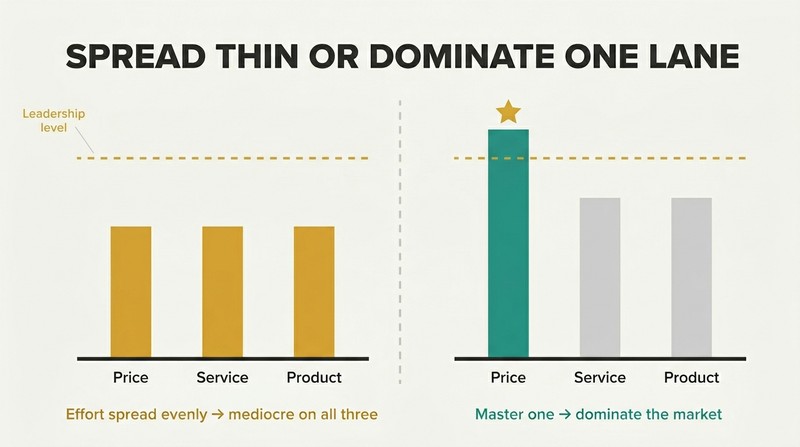
The book's core argument is brutal in its simplicity. No company wins by being good at everything. Treacy and Wiersema studied over 80 market leaders across three dozen industries and found that each dominated by mastering exactly one dimension of value, not by spreading effort evenly. A company spread across three priorities ends up mediocre on all three.
They saw it everywhere: Wal-Mart shines on price but sells no haute couture; L.L. Bean offers neighborly phone service but not the lowest cost; Starbucks pours great coffee but no faster than anyone. Customers, the authors argue, do not expect superior value on every axis from one supplier. They self-sort by what they care about most. Companies that refuse to choose, like the fictional toy retailer Kiddieville mimicking Toys R Us without its scale, get caught in the muddle and slowly bleed out.
What's striking is how this anticipated Michael Porter's warning against being "stuck in the middle" while making it more concrete and operational. The claim has aged unevenly, though. Amazon arguably delivers operational excellence, product breadth, and personalization simultaneously, suggesting digital platforms can break the trade-off through software economics the 1995 authors never imagined. Yet the underlying discipline still bites: most firms that chase every dimension at once dilute their identity. The honest reframe is that the trade-off is real until a technology shift temporarily suspends it.
Every winner masters one of three value disciplines
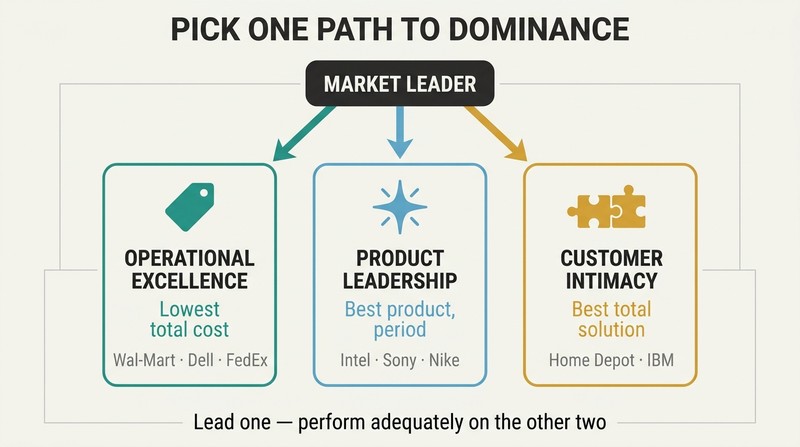
The authors name three distinct paths to dominance.
1. Operational excellence: deliver reliable products at the best price with the least hassle (Wal-Mart, Dell, FedEx). The promise is lowest total cost.
2. Product leadership: push performance boundaries with a relentless stream of breakthroughs (Intel, Sony, Nike). The promise is best product, period.
3. Customer intimacy: tailor a total solution to a specific client's needs and own the relationship (Airborne Express, Home Depot, old IBM). The promise is best total solution.
These map onto three customer types: those who want best total cost, best product, or best total solution. Choosing a discipline is not picking a marketing slogan. It defines what the company does and therefore what it is. A company picks where to stake its reputation, then performs adequately on the other two dimensions without trying to lead them.
The typology endures because it is memorable and decision-forcing, the hallmark of useful strategy frameworks. A subtle point worth surfacing: these are not personality types a firm is born with but deliberate bets that reshape hiring, metrics, and culture. The framework's weakness is treating the three as cleanly separable. Apple fuses product leadership with a near-intimate retail experience. The richer takeaway is that one discipline should be the organizing spine, even if the others receive serious investment, because someone must decide what gets sacrificed when priorities collide.
Your operating model should match your discipline, not your industry
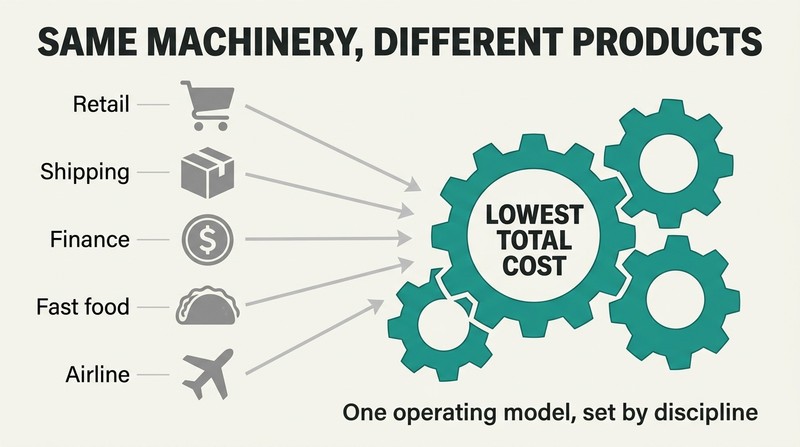
The authors made a counterintuitive discovery. When they examined how market leaders structured their operations, the patterns clustered by value discipline, not by industry. Wal-Mart, FedEx, Schwab, Taco Bell, and Southwest all run on remarkably similar machinery despite selling wildly different things, because all pursue lowest total cost. An executive could move between them easily. Send that same person from Arco to Sony, and they would feel like they landed on another planet.
The operating model is the combination of core processes, business structure, management systems, and culture that delivers the value promise. Operationally excellent firms centralize, standardize, and abhor waste. Product leaders stay loosely structured and reward experimentation. Customer-intimate firms push decisions out to people near the client. Core competencies alone are not enough: Honda and Briggs & Stratton both excel at small engines, but Honda channels that into best product while Briggs aims for lowest cost.
This is the book's most underrated insight and its most testable. The Honda versus Briggs & Stratton comparison elegantly dismantles the early-1990s obsession with core competencies by showing the same capability serves opposite strategies depending on the operating model wrapped around it. Modern organizational theory echoes this through the concept of complementarities, where practices reinforce each other only when aligned. The practical lesson for benchmarkers: copying a competitor's tactic without adopting the surrounding system usually fails, because the tactic was tuned to a different machine.
Lead on one dimension, but never let the others fall below the floor
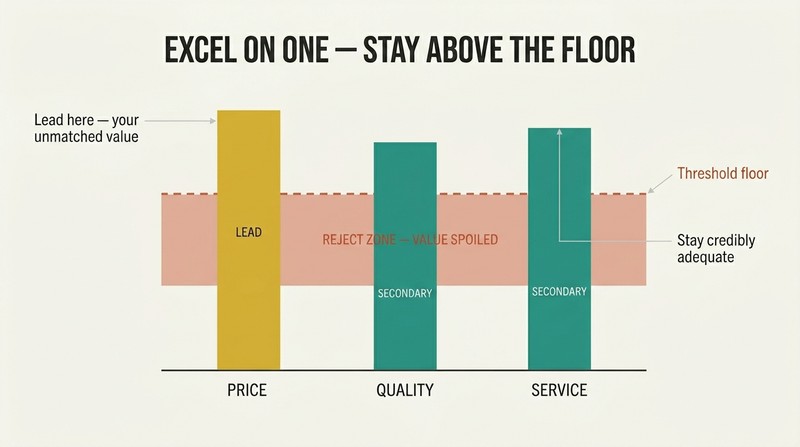
Specialization does not excuse mediocrity. The authors insist market leaders maintain threshold standards on the dimensions they do not lead. Yugo offered the cheapest car and still failed because its quality and service were unacceptable. Customers reject a price leader whose product is junk, or a product leader whose prices are outrageous. The rule: do not let secondary dimensions slip so far that they spoil the appeal of your unmatched value.
The danger cuts both ways. Polishing secondary disciplines too hard wastes energy and confuses customers. McDonald's, the operational-excellence icon, once bloated its menu with pizza, tacos, and fajitas to counter rivals, only to muddle what it stood for before retreating to what it does best. The art is calibration: excel on one axis, stay credibly adequate on the rest, and resist the urge to overinvest where you will never lead.
The threshold concept rescues the framework from caricature, since critics often hear "pick one" as "ignore the rest." It resembles the economics of hygiene factors in Herzberg's motivation theory: below a floor they destroy satisfaction, but above it they generate no advantage. The genuinely hard managerial question the book raises but cannot fully answer is where exactly the threshold sits, since it rises continuously as rivals improve. A floor that was adequate in 1995 becomes a liability by 2000, which is why threshold maintenance is a moving target requiring constant recalibration.
For operational excellence, treat variety as the enemy of efficiency
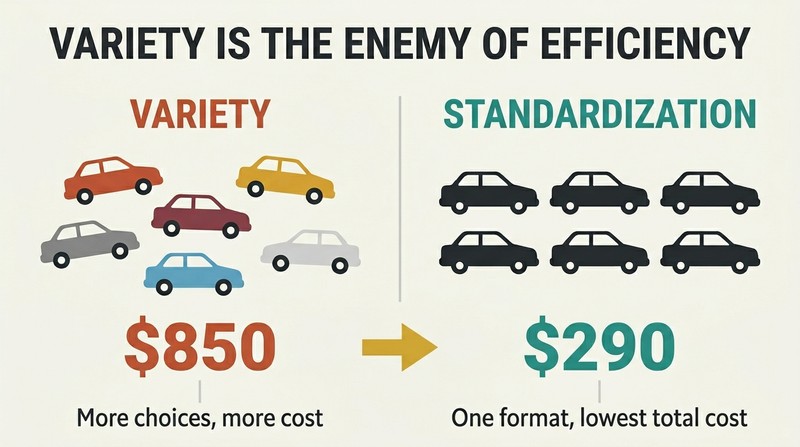
The lowest-total-cost discipline runs on relentless standardization. Henry Ford pioneered it, dropping the Model T from 850 to 290 dollars by refusing variety ("any color as long as it's black"). Today's operationally excellent firms inherit his playbook: identical Southwest 737s, look-alike Wal-Mart stores, cloned Taco Bell kitchens. Lowest total cost means more than price; it bundles reliability and convenience so the customer's full cost of ownership, including wasted time and errors, is unbeatable.
The authors detail clever mechanics: Wal-Mart's cross-docking moves goods truck-to-truck without warehousing; invoiceless payment at Ford pays suppliers at the loading dock. AT&T's Universal Card built a hassle-free credit card that issued in days, not a month, and won the Baldrige Award in its third year by tying everyone's pay to 120 daily quality measures. Growth comes from keeping assets busy, finding new markets for them, and replicating the formula.
The insight that variety silently destroys efficiency remains a frequent blind spot. Decades of SKU proliferation studies confirm that each added product variant carries hidden complexity costs in forecasting, inventory, and changeovers that rarely appear on a product-level P&L. AT&T's discovery that 15 to 30 percent of industry costs come from errors and rework prefigures lean and Six Sigma thinking. One tension the book underplays: extreme standardization can ossify into the very rigidity that disrupts incumbents, a vulnerability the authors themselves flag when assets become liabilities.
Product leaders kill their own hits before rivals can
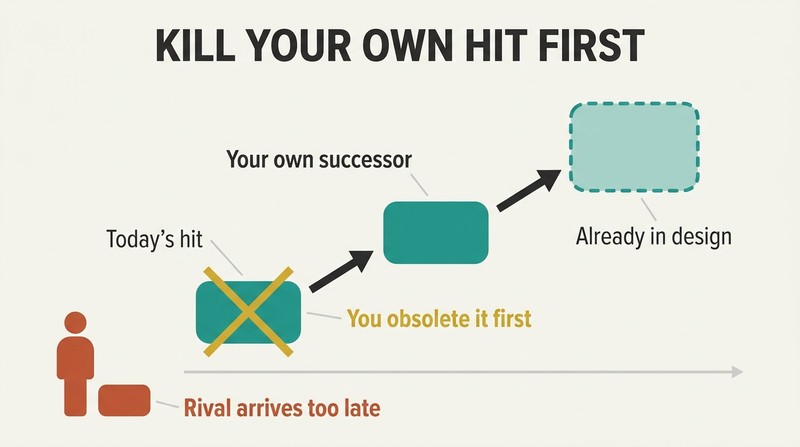
The defining move of product leadership is self-cannibalization. While marketers on one floor launch a hot new mini-camcorder, four teams on other floors race to make it obsolete. Sony did exactly this, rendering its own bestseller passe before wringing out the last dollar, because if anyone is going to obsolete the product, the leader prefers to do it. Intel lives this creed: as the 486 chip shipped, a team was already designing the Pentium, and another the chip after that, doubling performance at every price point each year.
The authors trace the discipline to Edison's Menlo Park lab. Product leaders think right to left, starting from an audacious target (light a whole town, not build a bulb) and working backward. They place big bets like Peter Lynch hunting ten-baggers, launch with a big bang (Disney's Lion King, J&J's Acuvue contact lenses), and protect talent above all. They make wrong decisions fast rather than right decisions late.
This is Clayton Christensen's disruption thesis from the incumbent's offensive side: deliberately obsolete yourself before an entrant does. The Intel example is the cleanest real-world proof that paranoid self-disruption can sustain leadership for decades. Yet the strategy demands deep pockets and tolerance for waste, which is why it concentrates among firms with fat margins. The book's romantic emphasis on heroic individuals (Edison, Lynch, the Zantac team) slightly undersells the systematic portfolio management that actually de-risks the bets, a nuance the authors do address through their concentration-of-resources point.
Customer-intimate firms win share of client, not share of market
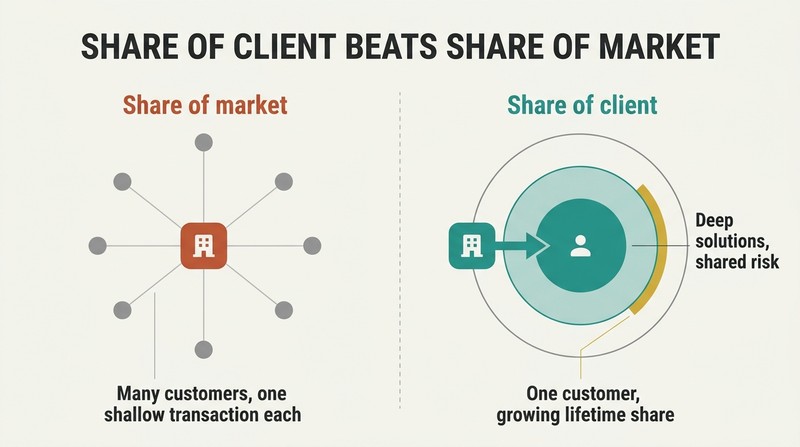
The intimacy discipline sells solutions, not transactions. These companies study a chosen customer so deeply they solve problems the customer has not yet noticed, then take responsibility for results, even sharing the customer's risk. Roadway Logistics runs the entire inbound logistics of Ford plants. Baxter manages hospital supplies down to the nursing station. Airborne Express stole accounts from FedEx not on price but by coding drivers' beepers for urgent Xerox parts and cutting one client's repair cycle from 30 days to five.
A surprising mechanic: many intimate firms are hollow, renting rather than owning capability. Cott Corporation became a giant in private-label soda without owning a single bottling plant, orchestrating concentrate makers, bottlers, and a design firm into a total solution. The worst failure here is not losing money on a deal but losing a client. Initial transactions can run at a loss because the lifetime relationship pays off, as Home Depot proved selling a $6.71 dimmer switch at a loss to win years of loyalty.
The hollow-business observation was prescient, anticipating the platform and orchestration models that now dominate. Cott prefigures contract-manufacturing empires and the asset-light strategies of countless modern brands. The discipline also carries a structural trap the authors name honestly: as clients absorb the firm's expertise, today's premium solution becomes tomorrow's commodity, forcing perpetual reinvention or graceful handoff. This treadmill explains why pure customer intimacy is hard to sustain and why consulting-style firms must constantly mine new veins of client potential or risk being repriced as vendors.
Raise customer expectations faster than rivals can match
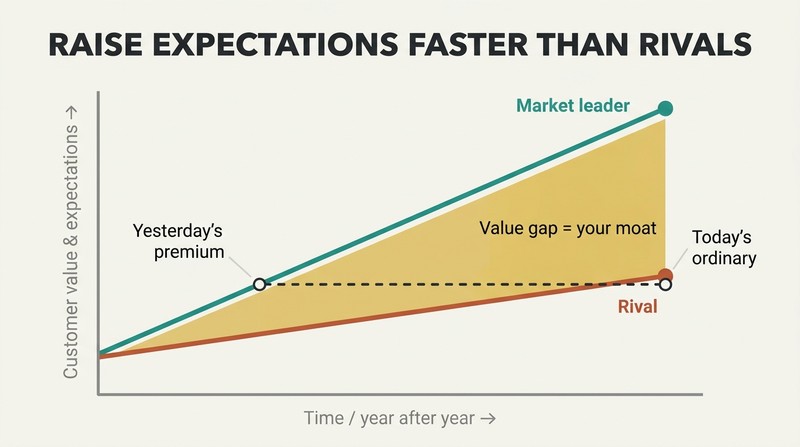
Market leaders do not just meet expectations; they reset them. By driving value forward, they spoil customers for everyone else. FedEx's overnight guarantee made flawless delivery the baseline customers demand from every supplier. The authors call this the new world of caveat vendor, where the buyer is king and yesterday's premium becomes today's ordinary. The third rule of competition: dominate by improving value year after year.
This creates a two-front siege. Nike faces not only Reebok on product performance but Wal-Mart redefining what running shoes should cost. The implication is that leadership is never banked. Arco froze gas prices during the 1991 Gulf War spike, shorting itself tens of millions in profit, and gained a 20 percent sales jump overnight while reinforcing its low-price identity. Wal-Mart refuses a tempting 1 percent price hike worth 800 million dollars because raising prices steals from future leadership and shrinks the value gap that protects it.
The escalation dynamic is essentially an arms race, and the book frames it as both opportunity and trap. Behavioral economics adds texture: customers anchor on the best experience they have had in any category, so a delightful one-click checkout in retail raises impatience with a clunky insurance claim. This cross-industry expectation transfer, which the authors spotted early, is now central to customer-experience strategy. The Arco and Wal-Mart restraint examples are powerful counters to short-term margin maximization, illustrating that deliberately leaving money on the table can be the disciplined long game.
Quick fixes drug management while the real machine rots
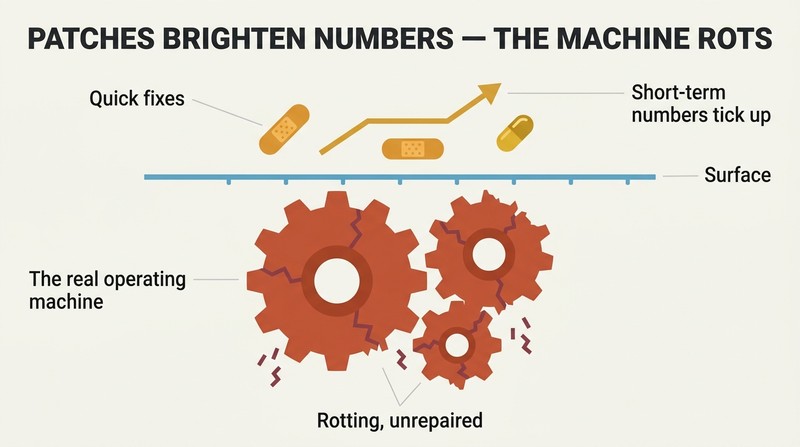
The authors diagnose how proud companies decline. When growth stalls, weak managers reach for bolt-ons, temporary patches that brighten near-term numbers: selective discounts, confusing promotions, throwing bodies at service problems, delaying capital investment, relabeling old products as new and improved. These treat symptoms, not the failing operating model, and actively make things worse by drugging the team into believing problems are solved while adding complexity that makes eventual repair harder.
A root cause is that many management groups are committees, not teams. In a team, everyone aims at the shared goal of dominating a market. In a committee, members defend their functional turf, the so-called stovepipe effect, and table the core issues whose resolution would shift the internal balance of power. Real recovery requires renovating the value-creating machinery itself, not fiddling with the fenders and chrome. The litany of fired CEOs at IBM, Kodak, GM, and American Express shows the cost of avoidance.
The bolt-on concept names a near-universal organizational pathology with unusual precision. It connects to the medical metaphor of treating symptoms while disease progresses, and to systems thinking's warning that quick fixes generate compounding feedback. The committee-versus-team distinction is sharp and still relevant: turf protection during stress is well documented in organizational behavior research on political behavior under threat. The framework's value is diagnostic, giving managers a checklist to catch themselves rationalizing. Its limitation is that recognizing the disease is far easier than mustering the political courage to perform the renovation it prescribes.
Your greatest strength curdles into the weakness that kills you
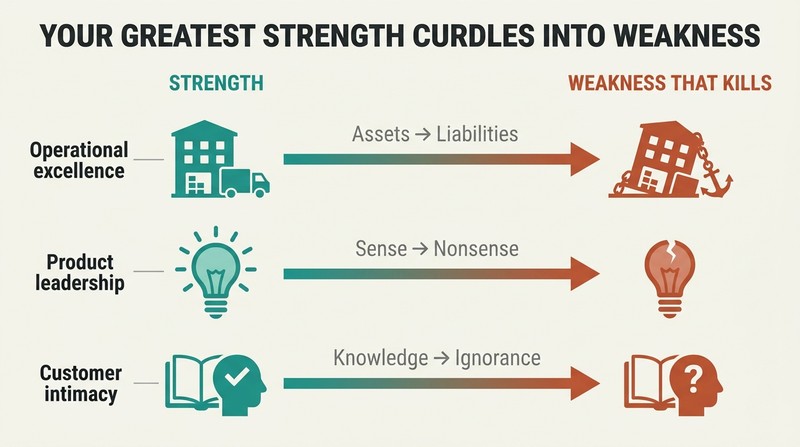
Sustaining leadership means fighting three specific decays. The authors identify how each discipline's core asset can turn toxic:
1. Assets into liabilities (operational excellence): American Airlines' costly hub infrastructure and mixed fleet became anchors against Southwest's lean model; a shift to home shopping could turn Wal-Mart's stores and trucks into dead weight.
2. Sense into nonsense (product leadership): GM kept believing Chevy buyers would upgrade to Cadillacs while tastes shifted to nimble European-style cars; experts famously declared flight, atomic power, and talking pictures impossible.
3. Knowledge into ignorance (customer intimacy): IBM mastered serving data-processing chiefs, then woke up ignorant of the financial executives who had taken over the buying.
The deeper warning is that copycats erode every advantage, so leaders must compete against their own success, tightening standards and obsoleting their own model before rivals do. Balance prevents the death spiral where shrinking profit forces more value exploitation, which accelerates the plunge.
The three-decay framework is the book's most sophisticated contribution, capturing why incumbents fail not from laziness but from the inertia of past excellence. It dovetails with the competency-trap literature, where the very routines that produced success blind firms to regime change. The phrase "sense into nonsense" elegantly describes belief perseverance under shifting conditions. What the framework adds beyond generic disruption theory is its discipline-specificity: it tells an operational-excellence firm to watch its asset base, a product leader to watch its sensing, and an intimate firm to watch its expertise gap, turning a vague fear into three targeted vigilance programs.
Build a culture where employees measure themselves by customer value
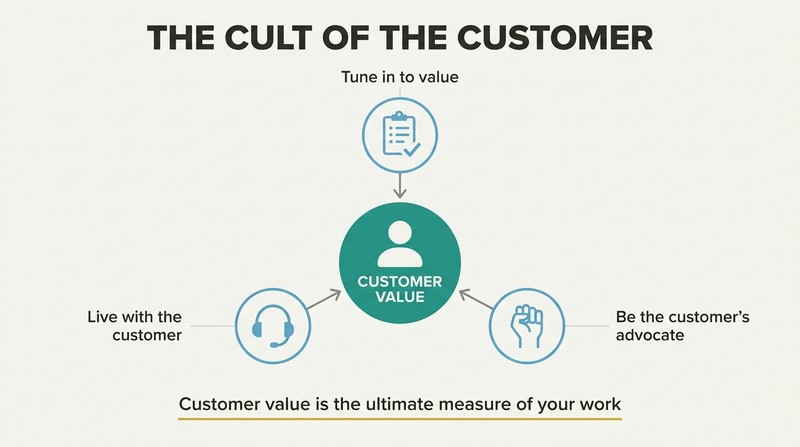
Strategy fails without what the authors call the cult of the customer. This is a palpable culture aligning everyone's behavior with the chosen value promise. Ask rank-and-file employees what success means, and in a market leader they answer in terms of value created for customers. The credo holds two beliefs: customer value is the ultimate measure of one's work, and the pace of improving it measures success.
The culture looks different per discipline. Operationally excellent firms celebrate the dependable team player (the FedEx driver who beats the snowstorm). Product leaders lionize individual feats. Intimate firms honor the employee whose client raves about them. The authors prescribe three habits: tune in to value (employees self-assess with a personal scorecard), live with the customer (AT&T requires every manager to listen to customer calls two hours monthly; McDonald's dissects hundreds of thousands of opinions), and act as the customer's advocate (Home Depot's Bernie Marcus praised an employee for accepting a competitor's wrench as a return).
The culture chapter rescues the framework from being a purely structural exercise, acknowledging that operating models run on human commitment. The distinction from generic total quality management is sharp and fair: TQM aims to satisfy expectations across the board, while the cult of the customer aims to deliver unmatched value to chosen customers on the chosen dimension. The "live with the customer" prescription anticipates today's customer-immersion and journey-mapping practices. The Bernie Marcus wrench anecdote illustrates how leaders encode values through visible storytelling, a mechanism organizational scholars call cultural sensemaking through narrative.
Analysis
Written in 1995 by two CSC Index consultants riding the wave of the reengineering boom, The Discipline of Market Leaders made a deliberately narrowing argument at a moment when management fashion preached doing everything well. Its enduring contribution is the value-disciplines trichotomy: operational excellence, product leadership, and customer intimacy. The framework's power lies in being decision-forcing rather than merely descriptive. It demands a sacrifice, which is what distinguishes genuine strategy from aspiration.
The book's sharpest intellectual move is decoupling operating models from industries. By showing that Wal-Mart and Southwest share organizational DNA while Wal-Mart and Nordstrom do not, the authors reframed competitive analysis around chosen value rather than sector. The Honda versus Briggs & Stratton example surgically deflates the then-dominant core-competence doctrine, demonstrating that capability is strategically neutral until an operating model directs it.
The framework shows its age in the platform era. Amazon, Apple, and others appear to violate the choose-one mandate, achieving low cost, deep product, and personalization at once, largely because software and data economics dissolve trade-offs that were ironclad in physical operations. Yet the deeper logic survives: even hybrid firms organize around a spine, and most companies attempting all three without that spine still drift into mediocrity. The threshold concept, often overlooked, is what keeps the thesis defensible.
The weakest section is the consulting-method chapter on tiger teams and three-phase agenda setting, which reads as billable-hours scaffolding rather than insight. The strongest is the sustaining-the-lead taxonomy of decay (assets to liabilities, sense to nonsense, knowledge to ignorance), which prefigures competency-trap and disruption literatures with unusual specificity. The case studies, especially AT&T Universal Card and Airborne, remain vivid teaching tools. Overall the book trades nuance for clarity, a defensible bargain that made it a durable strategic vocabulary.
People Also Read





Download PDF
Download EPUB
.epub digital book format is ideal for reading ebooks on phones, tablets, and e-readers.








































